Zomato's parent Eternal nearly doubles its profit as Blinkit plans 3,500 stores
Eternal's profit rose 92% to Rs 125 crore in July to September 2026. Blinkit added 308 dark stores and plans many more, including in small cities.
Picture this. In just three months, Blinkit opened 308 new stores. That is more than three new stores every single day. And most people will never walk into even one of them.
On 21 October 2026, Eternal, the company that owns Zomato and Blinkit, shared its results for July to September 2026. Its profit jumped 92% to Rs 125 crore, up from Rs 65 crore a year earlier. Its revenue grew 78%. And Blinkit says it expects to cross 3,500 stores by March 2027.
Here is what all of that means, in simple words.
First, who is Eternal?
You know Zomato, the app for ordering food. The company behind it has grown into a family of businesses. It re-branded itself from Zomato to Eternal. Today Eternal runs Zomato for food, Blinkit for quick grocery delivery, District for going out, and Hyperpure, which sells supplies to other businesses.
Companies share results every three months. Each three-month block is called a quarter. July to September 2026 is called Q2 FY27, the second quarter of the money year that ends in March 2027.
Revenue and profit are not the same thing
Think of a samosa stall. If you sell 100 samosas at Rs 20 each, you collect Rs 2,000. That is your revenue, all the money that comes in from sales. But you also paid for potatoes, oil, gas and the cart. What is left after paying every bill is your profit.
Eternal's revenue from its business was Rs 24,138 crore, up from Rs 13,590 crore a year ago. That is a huge pile of money. But its total expenses were Rs 24,166 crore. So the bills were Rs 28 crore bigger than the sales from its main business.
So how did it still make a profit? The company also earned Rs 351 crore of other income, money that does not come from selling food or groceries. With that added, total income was Rs 24,489 crore. After the bills and other costs, Rs 125 crore was left as profit.
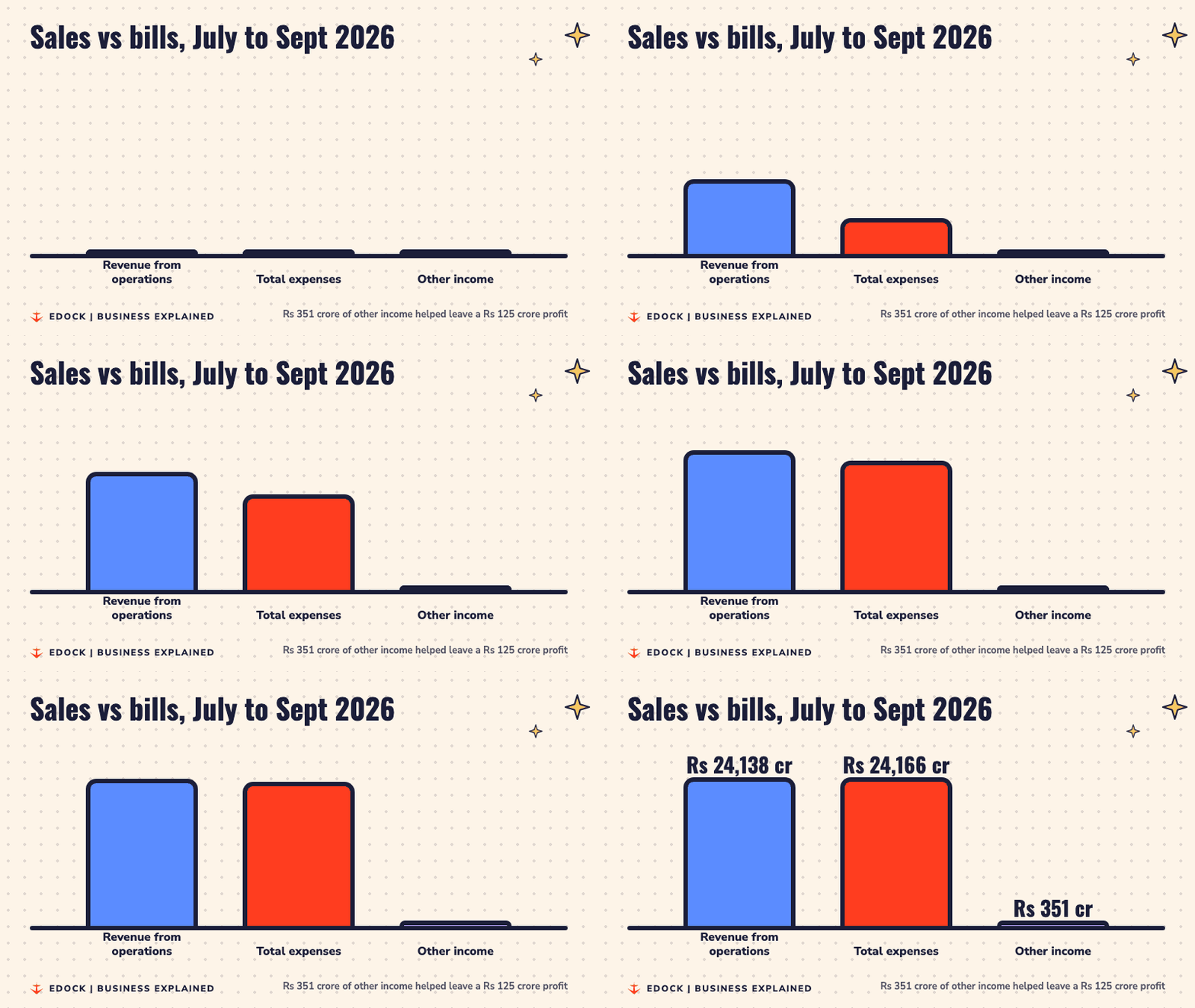
Rs 125 crore on sales of over Rs 24,000 crore is a thin slice, less than one rupee of profit for every Rs 100 of sales. But compared with the Rs 92 crore it made in April to June 2026, profit still grew 36% in just one quarter.
Why are the bills so big?
The biggest bill is the cost of the goods being sold, called material costs. They were Rs 14,602 crore, over 60% of all spending. Delivery costs were Rs 3,581 crore, and ads cost Rs 1,138 crore.
Blinkit is now the giant of the family
Blinkit is the biggest earner in the family. Its revenue grew 93% to Rs 19,152 crore. That is roughly 79 of every 100 rupees Eternal earned from its business.
Blinkit is a quick commerce app. Quick commerce means delivering daily things like groceries in minutes, not days. Another number companies watch is net order value, the total value of the orders placed. For Blinkit, it grew 79.3% to Rs 20,940 crore.
Even better for the company, Blinkit made money from its daily work. Its adjusted EBITDA, a way to measure what a business earns from its everyday operations before some costs like interest and tax, was a profit of Rs 184 crore, against a loss of Rs 156 crore a year ago.
So what is a dark store?
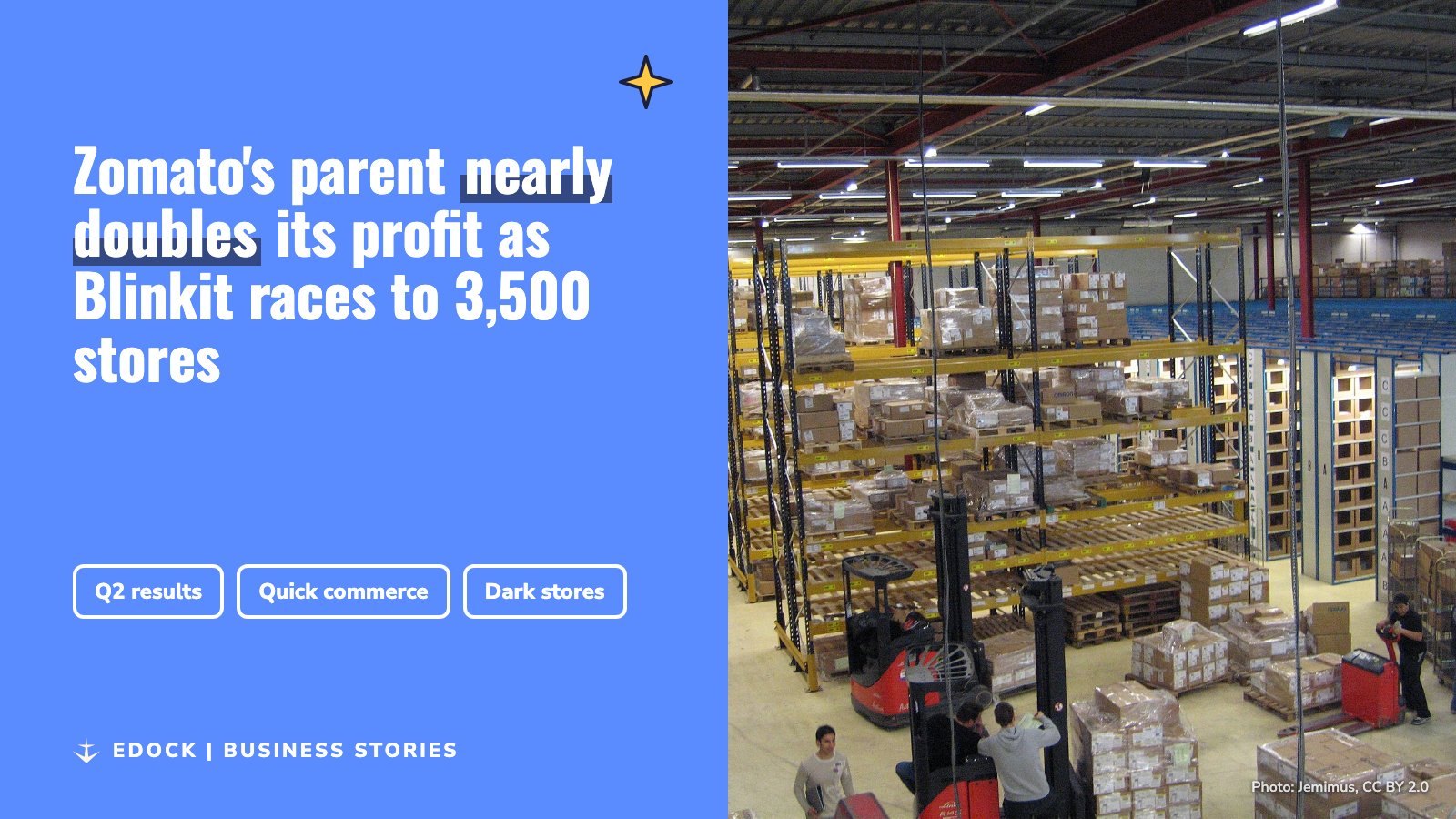
Blinkit's "stores" are not shops you can walk into. They are dark stores. A dark store is like a mini warehouse full of goods for online orders, and it is not open to the public. Inside, shelves are packed so workers can grab items fast. A rider then rushes the order to your door.
Think of it as a kitchen behind a restaurant. You never go into the kitchen, but every plate comes from there. The closer the kitchen is to you, the faster the food arrives.
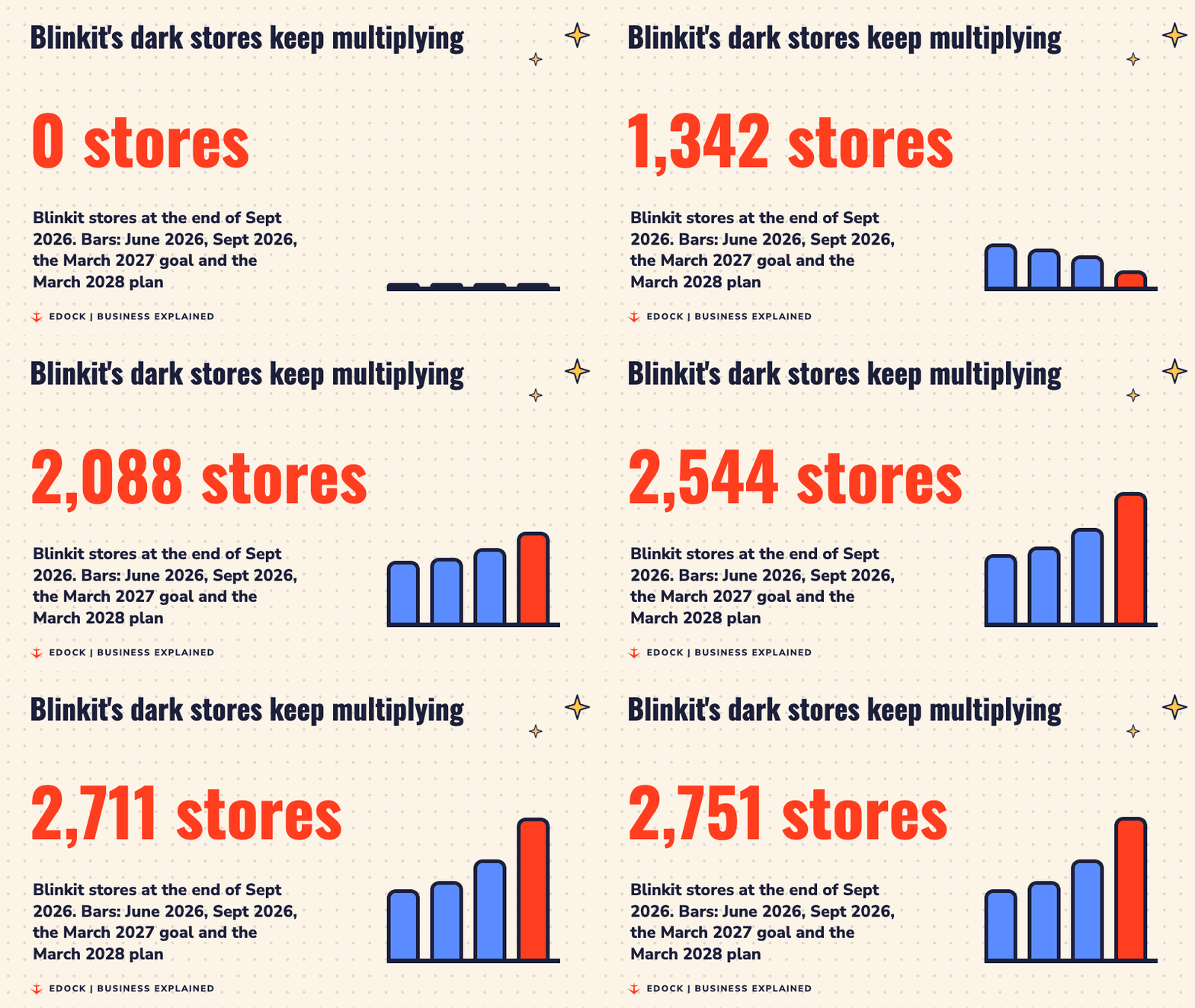
That is why store count matters so much. Blinkit added 308 net new stores in the quarter, taking its network to 2,751. So at the end of June 2026, it had 2,443.
The big plan: 3,500 stores, then 5,000
Eternal's finance chief, Akshant Goyal, said: "We now expect to cross 3,500 stores by March 2027, and our current plans point to about 5,000 stores by March 2028." Going from 2,751 to 3,500 means about 749 more stores in roughly six months.
He also said cash and profits from food delivery and quick commerce let the company fund this growth comfortably. Remember, these are plans and goals, not finished work.
Why small cities matter
In a letter to shareholders, Blinkit's chief, Albinder Dhindsa, said demand in small cities exists but has been poorly served. Many items are not sold locally, or take days to arrive. Blinkit says new stores in smaller cities reach 1,000 orders a day in a similar time as new stores in metros.
His view, in his own words: "In metros, we usually compete for a market that already exists. In smaller cities, we are building the market and the supply."
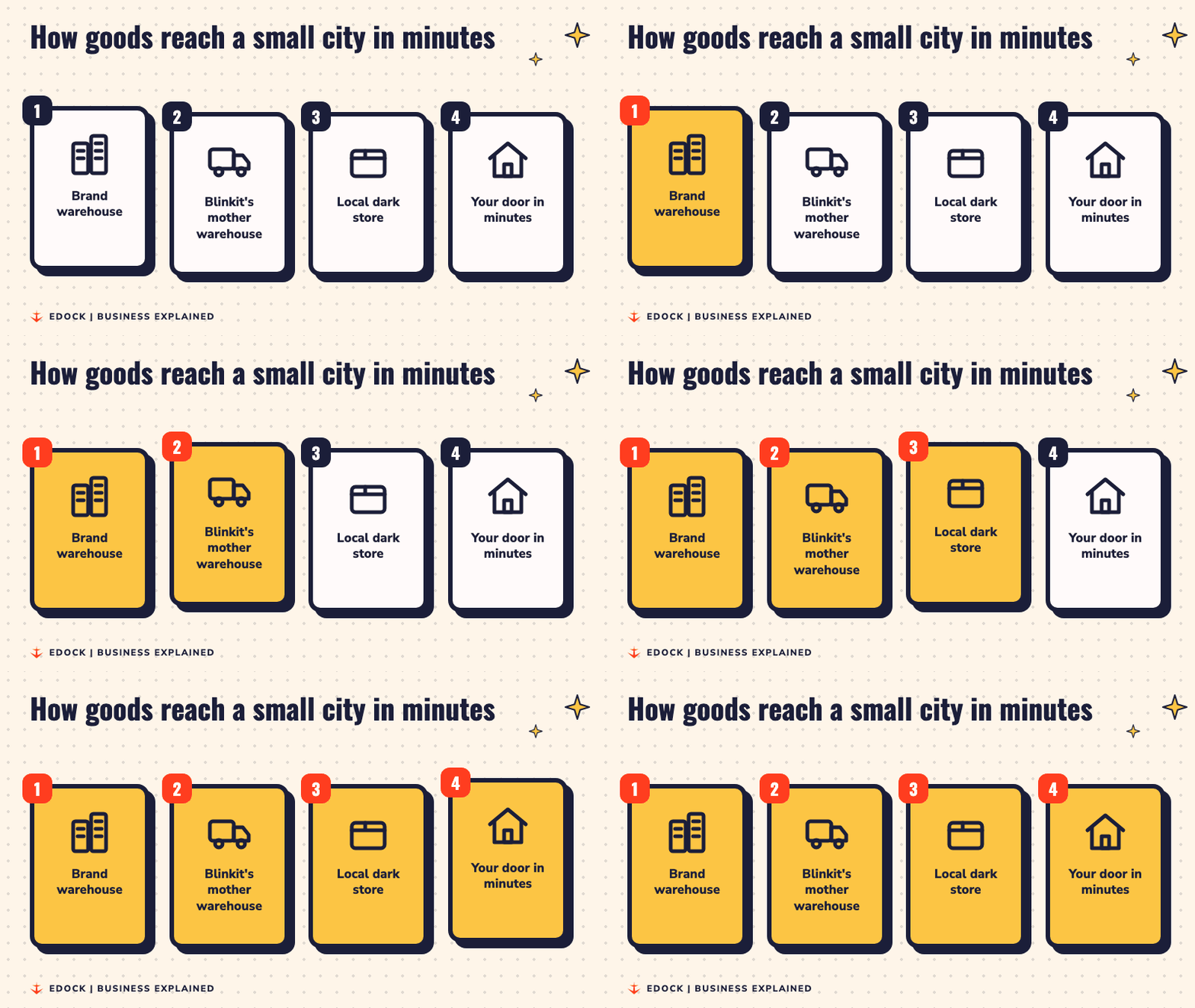
Building supply is the hard part. To serve these towns, Blinkit picks goods straight from brand warehouses into its own big "mother warehouses". Those then feed the local dark stores.
And Zomato, the food app?
Food delivery is growing too, just more slowly. Zomato's net order value grew 21.5% to Rs 11,445 crore. Its adjusted EBITDA was Rs 627 crore, up 25%.
Founder Deepinder Goyal sounded calm about it. He said the company tries "not to read too much into any single quarter" and expects food delivery to grow more than 20% a year over the long run.
What it means for you
If you live in a big city, you may already order milk or chargers in ten minutes. With hundreds of new dark stores planned, Blinkit wants that habit to reach many more towns, including smaller ones.
It also shows a simple business lesson. A company can sell a lot and still keep very little. Growing sales is one thing. Turning them into profit, rupee by rupee, is the harder game.
Sources
- The Economic Times: Eternal Q2 results, profit soars 92% to Rs 125 crore
- The Economic Times: Blinkit expects to cross 3,500 stores by FY27
- BusinessLine: Eternal profit nearly doubles to Rs 125 crore in Q2
- Entrackr: Eternal reports Rs 24,138 crore revenue and Rs 125 crore profit
- Inc42: Eternal's Q2 profit surges 92%
- Moneycontrol: Eternal Q2 results
- Business Today: How dark stores are powering quick commerce
- Video: NDTV Profit on YouTube, Eternal Q2 results
- Cover photo: DHL Netherlands warehouse working area (8), by Jemimus, CC BY 2.0

You may republish this story under CC BY 4.0: credit Manpreet Kaur and link to this page.