YES Bank's profit jumps 65%, but a Rs 8,415 crore bond ruling is not in the books yet
Version 1 of 1 saved 18 Oct 2026, 7:08 am IST · Chain line 86
As it was first published
YES Bank's profit jumps 65%, but a Rs 8,415 crore bond ruling is not in the books yet
YES Bank earned Rs 1,080 crore in July to September. Counting the Supreme Court's AT1 bond ruling would turn that into a loss. Here is what it all means.
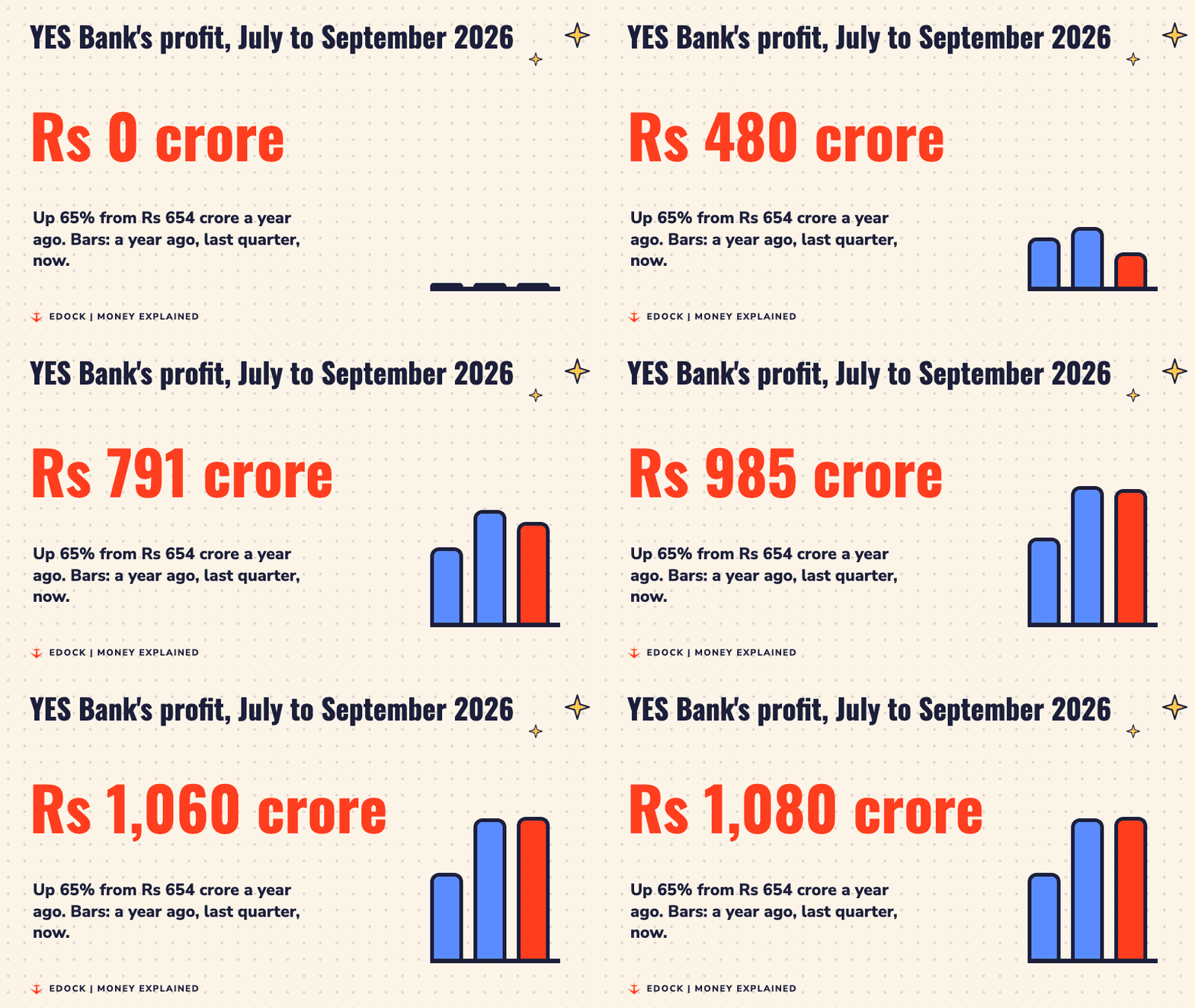
Picture this. A bank tells the world it earned Rs 1,080 crore in three months. Then, in the very same filing, it adds a small table. That table says: if one court ruling were counted, the profit would turn into a loss of Rs 5,217 crore.
That is what YES Bank did on Saturday, 17 October 2026. Business Standard reported that its profit for July to September rose 65 per cent to Rs 1,080 crore, from Rs 654 crore a year earlier. Two days before, the Supreme Court had ruled against the bank in an old case about special bonds worth Rs 8,415 crore. The bank has not put that ruling into its numbers yet.
So which number is the real one? Let us go step by step.
First, the good news
Banks report results every three months. July to September is the second quarter, or "Q2", of the financial year that ends in March 2027. People write it as Q2 FY27.
Experts who track the bank had guessed a profit of around Rs 955 crore, according to LSEG data quoted by The Economic Times. The bank earned more than that. In cricket terms, the team was expected to score about 95 and it scored 108.
Here is where the extra money came from, as reported by Business Standard:
- Loans given out (called advances) grew 23.7 per cent to Rs 3.10 trillion.
- Money kept by customers (deposits) grew 19.5 per cent to Rs 3.54 trillion.
- Money set aside for loans that may go bad (called provisions) fell 24.2 per cent to Rs 317 crore, from Rs 419 crore.
- Other income, like fees, rose 14.4 per cent to Rs 1,882 crore.
What is NII, in plain words?
NII stands for net interest income. It is the main way a bank makes money.
Think of a chai stall. The owner buys milk and tea leaves, and sells cups of chai. The gap between what the cup sells for and what the milk cost is what the owner keeps.
A bank works the same way, but with money. It pays interest to people who keep deposits with it. It charges a higher interest to people who take loans. The gap is NII.
YES Bank's NII rose 22.7 per cent to Rs 2,822 crore, from Rs 2,301 crore a year ago, ET reported. It earned Rs 8,640 crore in interest and paid out Rs 5,817 crore in interest, according to Business Standard.
Bad loans also went down. The share of loans that people stopped paying back, called the gross NPA ratio, fell to 1.2 per cent at the end of September, from 1.3 per cent at the end of June.
Now, what is an AT1 bond?
A bond is a loan that you give to a company. The company pays you interest and is meant to give your money back later.
An AT1 bond, short for Additional Tier 1 bond, is a special and risky kind of bank bond. Mint explains that these bonds have no fixed end date, are riskier than normal bonds and usually pay more interest. If a bank gets into serious trouble, the RBI can ask for them to be written down or cancelled.
"Written down" means the bond's value is cut, sometimes to zero. Imagine lending a friend Rs 100 of pocket money. You get a little extra for the risk. But a rule says: if the friend's shop nearly shuts down, your Rs 100 can be wiped out. That is the deal an AT1 bond holder signs up for.
What happened to YES Bank's AT1 bonds?
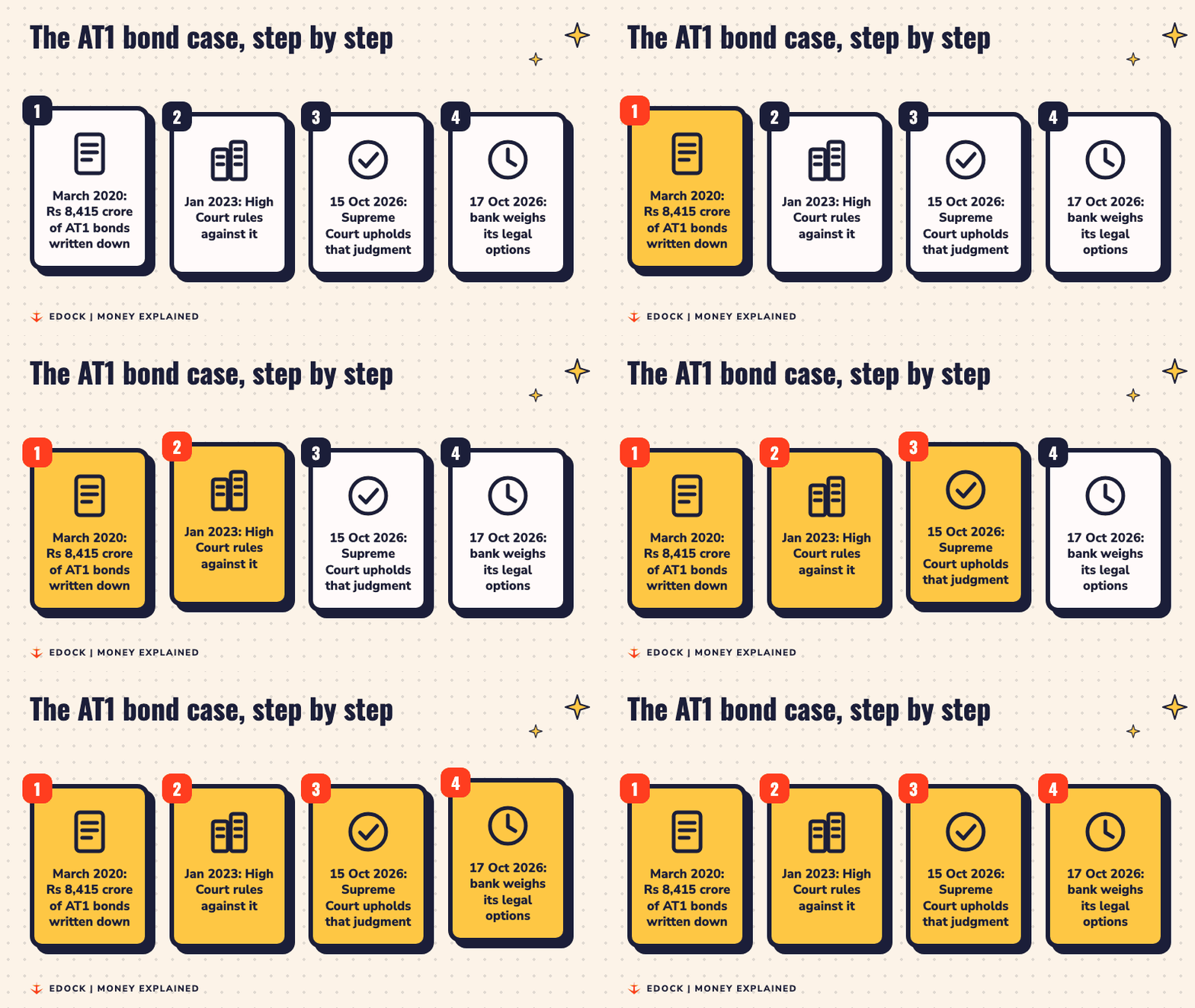
In 2020, YES Bank needed help. It was rescued under a restructuring plan that brought in new investors, ET reported. As part of that plan, in March 2020, AT1 bonds worth Rs 8,415 crore were written down.
The case went to court. On 20 January 2023, the Bombay High Court gave a judgment against the write-down. YES Bank, the RBI and the central government appealed.
On Thursday, 15 October 2026, the Supreme Court upheld the High Court's judgment and dismissed those appeals, Business Standard reported. In simple words, the old write-down does not stand.
Why does the ruling matter so much?
If the write-down does not stand, those bonds come back. The bank would once again owe that money. That changes its numbers in a big way.
The bank shared a "pro forma" table, which means "what it would look like if". According to ET, if the ruling were counted:
- The quarter would show a loss of Rs 5,217 crore instead of a profit.
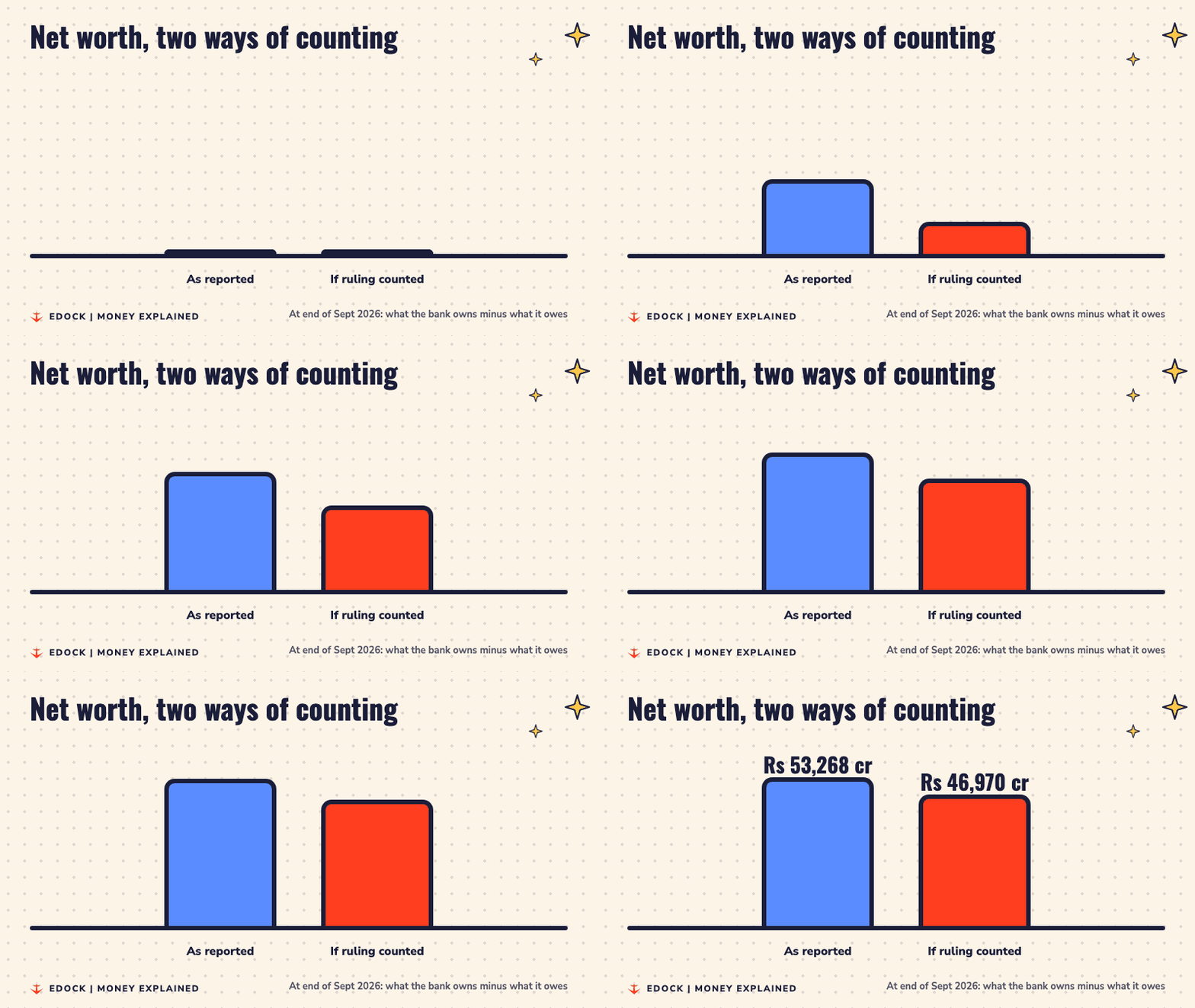
- Net worth, which is what the bank owns minus what it owes, would fall to Rs 46,970 crore from Rs 53,268 crore.
- Borrowings would rise to Rs 86,149 crore from Rs 77,734 crore. The jump is exactly Rs 8,415 crore, the size of the bonds.
The bank said its overall capital adequacy ratio, a check of how safe a bank is, would stay at 14.5 per cent. BusinessLine reported that its return on assets for the quarter would be minus 4.3 per cent instead of 0.9 per cent.
There is one more measure. In a filing on Friday, the bank said its core capital ratio, called CET1, could drop by around 250 basis points, Mint reported. A basis point is one hundredth of a per cent. So 250 basis points is 2.5 percentage points. Mint also reported that S&P Global Ratings does not expect the ruling to change its ratings for the bank.
Why is the loss not in the results yet?
The bank says it is still studying the judgment. It is looking at how and when to put it into effect, and how to show it in its accounts. It is also looking at "all legal remedies available", including further steps before the Supreme Court, BusinessLine reported.
Until that work is done, the bank has kept the impact out of its books. Its joint auditors, the outside checkers who review the accounts, gave what is called a "qualified" review conclusion on this point, Business Standard reported. A qualified view is like a teacher signing your report card with a note in the margin: "one subject still to be marked".
Managing Director and CEO Vinay M. Tonse said, as quoted by BusinessLine: "We respect the judgment of the Supreme Court relating to the Bank's Additional Tier 1 Bonds."
What can a young reader take from this?
A result has many layers. The headline number, here Rs 1,080 crore, is only the top layer. The notes and side tables can matter just as much.
It also shows why risky bonds pay more. The extra interest is a reward for a real chance of losing money. And sometimes, as in this case, courts decide later whether the rules for that loss were followed.
For now, YES Bank has a strong quarter on paper and a big open question beside it. The next few months will show how the bank handles the ruling.
Sources
- Business Standard: YES Bank Q2 profit up 65% at Rs 1,080 cr; AT1 ruling impact not yet reflected
- The Economic Times: Yes Bank Q2 profit beats estimates, but AT1 bond ruling impact not booked
- Mint: Yes Bank flags 250 basis point impact on core capital ratio
- BusinessLine: Yes Bank reports robust 65% jump in net profit at Rs 1,080 cr
- Business Today: Supreme Court strikes down Rs 8,415 crore AT-1 bond write-off for Yes Bank
- NDTV Profit: Yes Bank vs Supreme Court, full case explained
- Cover photo: Bandra Kurla Complex, Mumbai, by N. Vivekananthamoorthy, CC BY 4.0
