Why Dell's stock fell 11% and wiped over $20 billion off Michael Dell's paper wealth
A Barclays downgrade and hot US inflation data sank Dell shares on 14 October. Here is what market value and net worth on paper really mean.


Picture this. You wake up, check one number on your phone, and see that more than $20 billion of your wealth has gone. You did not spend it. You did not lose a bet. Nothing left your bank. That is roughly what happened to Dell Technologies founder Michael Dell on Wednesday, 14 October 2026, when Dell shares fell 11% in a single day.
According to Forbes estimates, his net worth dropped by more than $20 billion that day, to about $256.6 billion. He slipped from the world's fourth richest person to fifth. So what actually happened at the company, and how can money "vanish" like this? Here is the simple version.
First, what is a share?
Imagine a samosa stall split into 100 equal pieces. Each piece is a share. If you own 10 pieces, you own 10% of the stall. Big companies like Dell are split into millions of shares, and people buy and sell them every day on the stock market, a giant marketplace for these pieces.
The price of a share is not fixed. It moves up when more people want to buy, and down when more people want to sell. Think of it like the price of an IPL final ticket on a resale site. It depends on how excited people feel.
What went wrong for Dell on Wednesday?
The trigger was a report from the bank Barclays, which downgraded Dell before the market opened. Barclays moved Dell from "overweight" to "equal-weight".
Those words sound strange, so here is a school example. An analyst is like a teacher who studies a company and gives it a grade for investors. "Overweight" is like saying "this student will beat the class, buy more". "Equal-weight" is like saying "this student will do about as well as everyone else". It is not a fail mark. It is just less cheering than before.
Barclays analyst Tim Long also cut his price target for Dell shares to $574 from $603. A price target is the analyst's guess of where the share price could go.
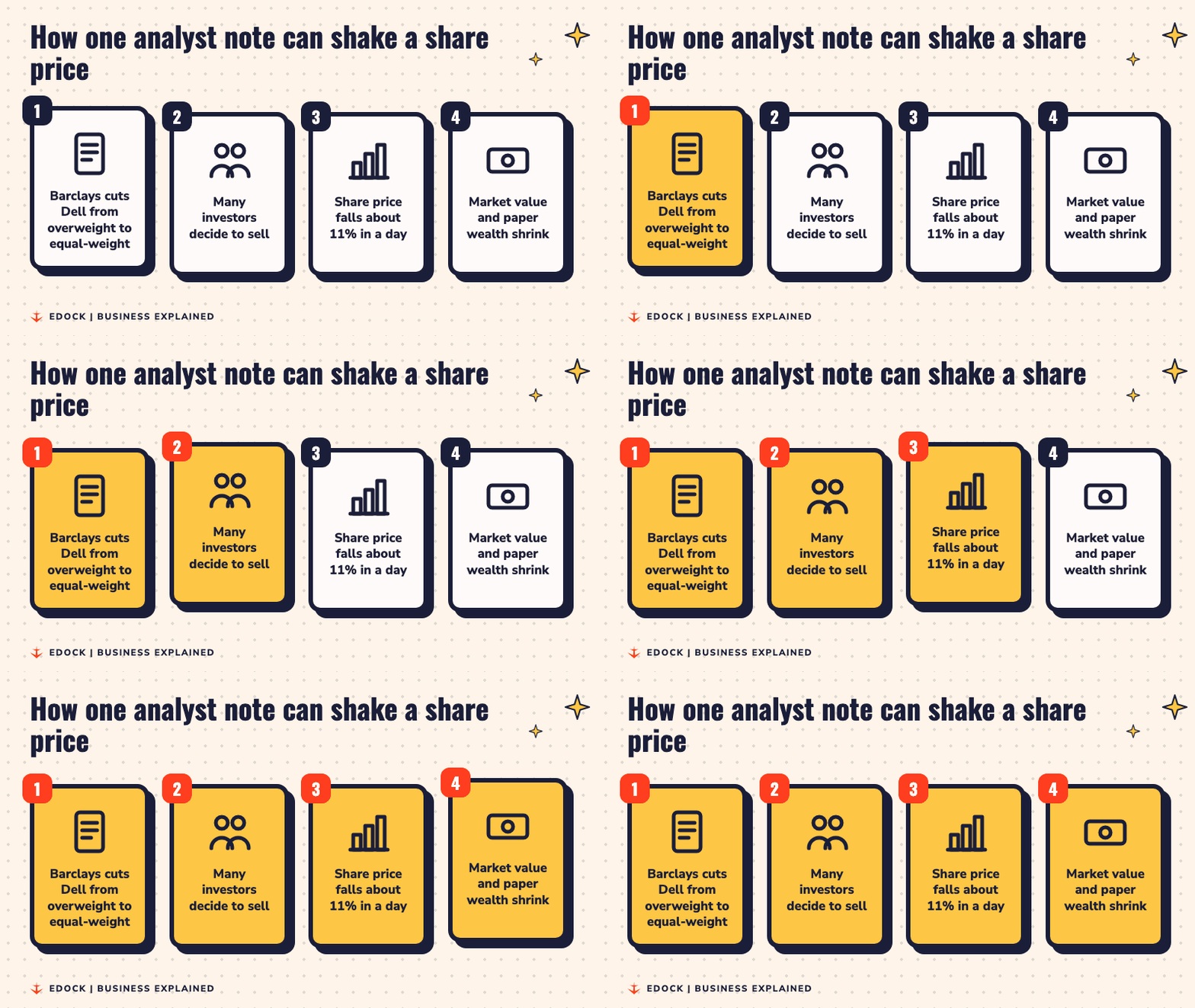
Why did Barclays turn less excited?
Dell sells servers. These are powerful computers that sit in big rooms called data centres and run things like AI tools. This year, Wall Street loved Dell because AI companies were buying huge amounts of this gear. Dell's stock was up more than 300% this year before the fall.
Barclays looked closer and raised a few worries, as reported by CNBC:
- Normal companies are not spending big on AI yet. Barclays said it had not seen a "meaningful AI inflection" in business spending. Businesses usually put just 5% of their IT money into AI, it said.
- Some growth came from pricier memory chips. There is a global shortage of memory chips, so they cost more. Server makers passed that higher cost on to buyers. That makes sales look bigger without many more machines being sold.
- Memory prices may cool down. If memory chips get cheaper again, those inflated sales could shrink too.
Think of a lemonade stall whose sales jump because lemons became costly and it charged more per glass. The money looks great, but not because more people are drinking lemonade. When lemons get cheap again, the sales number falls back.
There was also a "too far, too fast" feeling. Barclays made the downgrade "after a significant run", which means after the stock had already climbed a lot.
The whole market had a bad day too
Dell did not fall alone. On the same morning, the US government released hotter-than-expected inflation data. Inflation means prices of everyday things going up. If your chai went from Rs 10 to Rs 12, that is inflation.
Prices in the US rose 3.7% from a year earlier in September, above the 3.6% that economists expected. When prices rise faster than expected, people worry that interest rates will stay high. High rates make borrowing costly, and that tends to pull share prices down, especially for fast-growing tech companies.
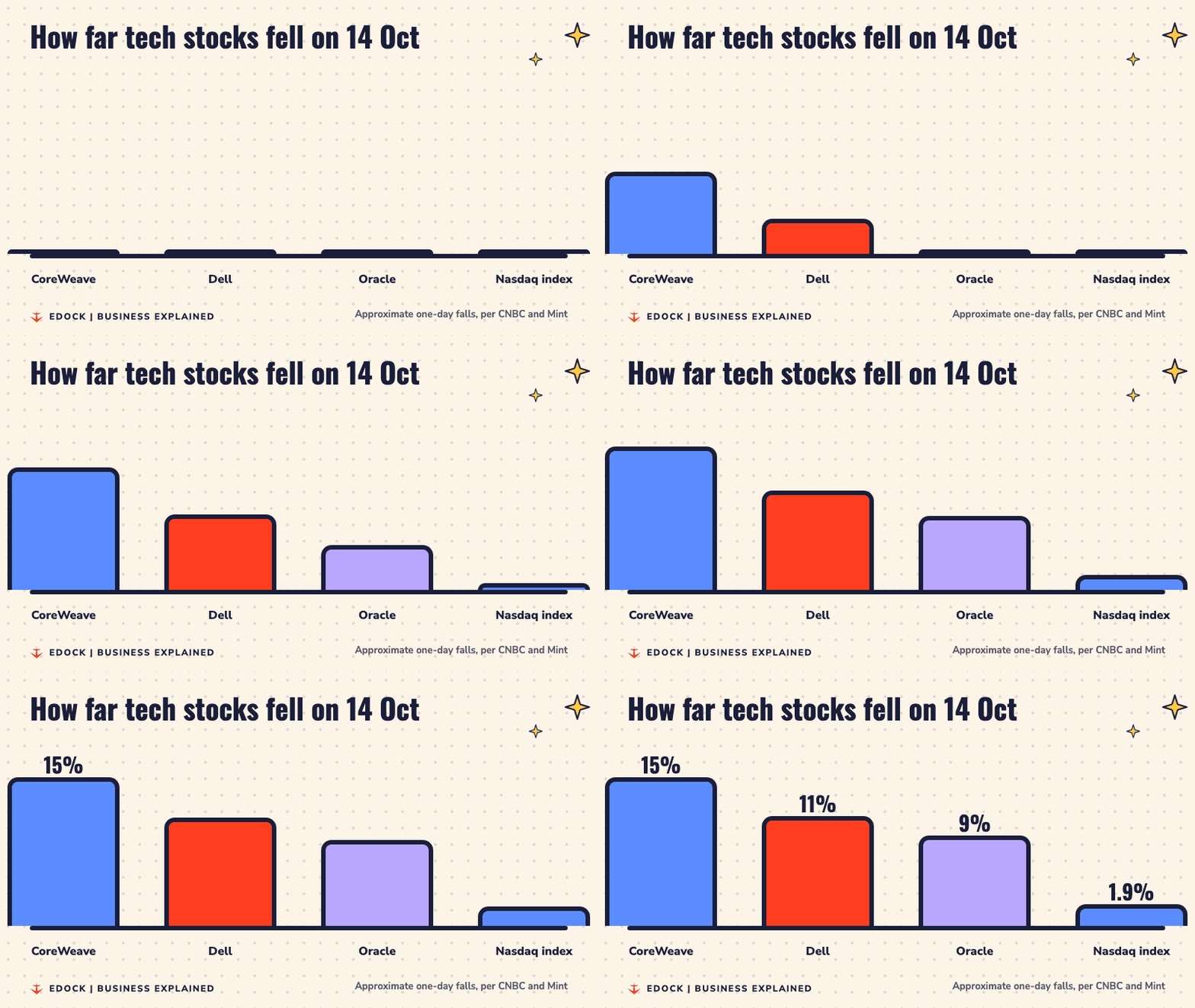
Other AI-linked stocks also dropped. Oracle fell 9% and CoreWeave plunged 15%, CNBC reported. Shortly before the close, the tech-heavy Nasdaq index was down 1.9%, and the S&P 500 had slipped 1.2%, as per Mint.
What is "market value"?
Market value is what the whole company is worth on the stock market. The sum is simple: share price multiplied by the total number of shares.
Back to the samosa stall. If each of its 100 pieces sells for Rs 50, the stall's market value is Rs 5,000. If the price of a piece drops to Rs 45, the market value falls to Rs 4,500. Nobody burned Rs 500. The stall, the oil and the samosas are all still there. People are just willing to pay less for a piece of it today.
That is what happened to Dell. Its factories, servers and customers did not disappear on Wednesday. The price people would pay for each share went down, so the value of the whole company went down.
And what does "net worth on paper" mean?
Net worth is everything a person owns minus everything they owe. For founders, most of it is usually shares in their own company. Michael Dell owns roughly 40% of Dell Technologies, as per Forbes.
Here is a rough sum to show the scale. If a 40% slice lost about $20 billion, the whole company lost something like $50 billion in market value that day, because 20 divided by 0.4 is 50. This is only a back-of-the-envelope estimate.
The word "paper" matters. Those shares are counted at today's price, but he did not sell them. So the $20 billion is not cash that left his bank. It is the drop in what his shares would fetch if sold at that moment. If the price goes up again, the paper wealth grows again too. If it keeps falling, the paper wealth keeps shrinking.
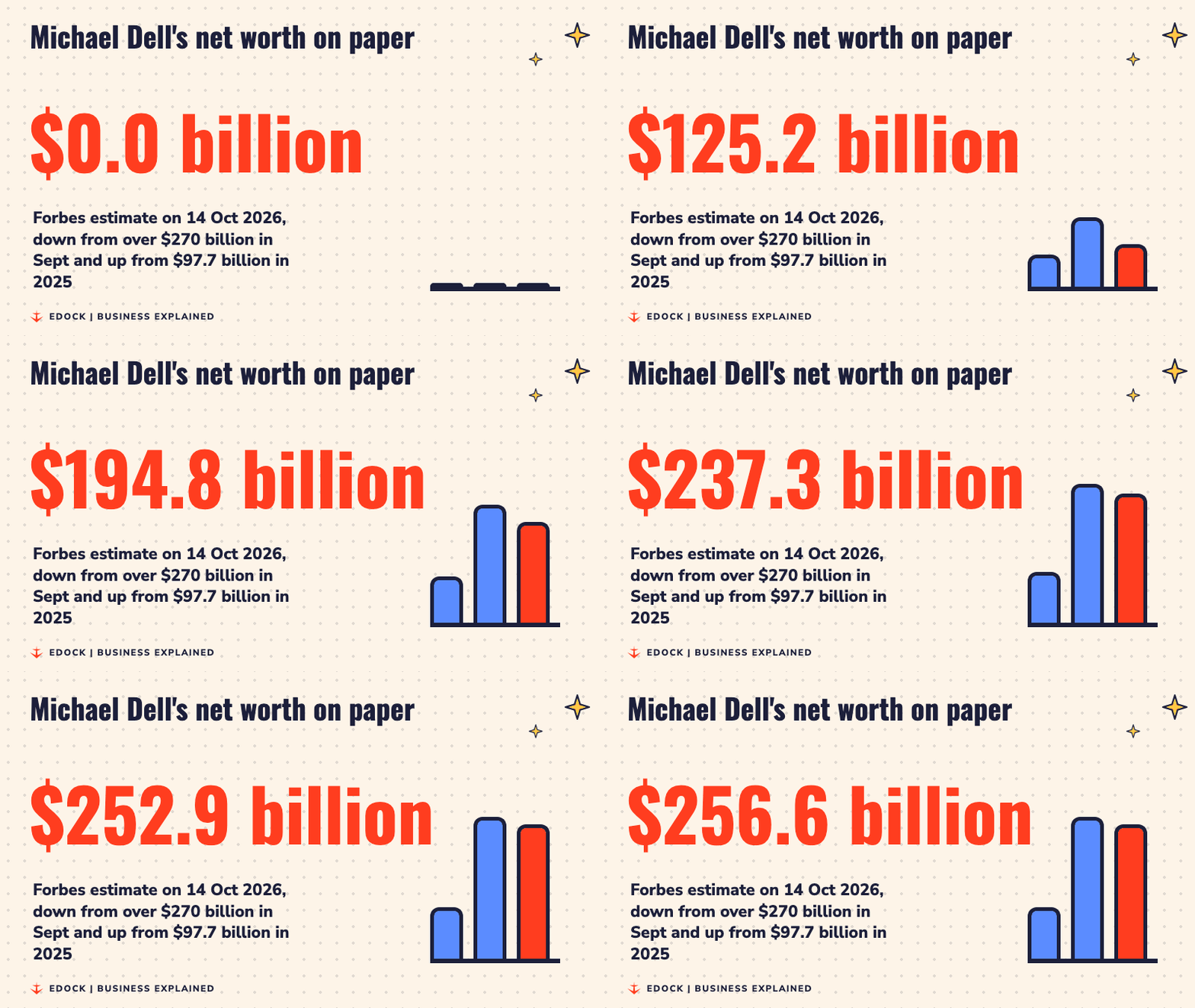
This swing works both ways. His net worth has grown by more than $157 billion in the past year, from $97.7 billion on the 2025 Forbes 400 list. Last month he briefly became the world's second richest person, with over $270 billion.
The slide did not stop on Wednesday
On Thursday, 15 October, the fall continued. Michael Dell was down another $15.2 billion that morning, based on Forbes figures, putting his net worth at about $241.2 billion and pushing him below Mark Zuckerberg.
The date of the first big drop is confirmed by other reports too, which say Dell shares had their largest intraday drop since July on October 14.
The big lesson
A share price is a mood meter as much as a scorecard. Dell is still a big company selling servers in the middle of an AI boom. But when a respected analyst says "the growth may be less real than it looks", and the whole market is nervous about prices and interest rates, that mood can flip in one day. Billions on paper can appear in a month and disappear in an afternoon.
Sources
- Mint: Michael Dell loses over $20 billion in a single day as Dell stock slumps 11%
- CNBC: Dell stock plunges 11%, leading data center sell-off
- Forbes via Yahoo Finance: Michael Dell's net worth falls over $20 billion
- Yahoo Finance: Why Dell (DELL) stock is falling today
- Yahoo Finance: Michael Dell loses title as world's fourth richest
- The Times of India: Michael Dell loses $20 billion in one day after Barclays downgrade
- Cover photo: Datacenter Server Racks, by Carl Lender, CC BY 2.0

You may republish this story under CC BY 4.0: credit Arshdeep Singh and link to this page.