WeWork India earned Rs 768 crore in three months by renting out office desks
Results for July to September 2026 show profit of Rs 20.44 crore, up from Rs 6.4 crore, as the shared office company added a record 11,700 desks.

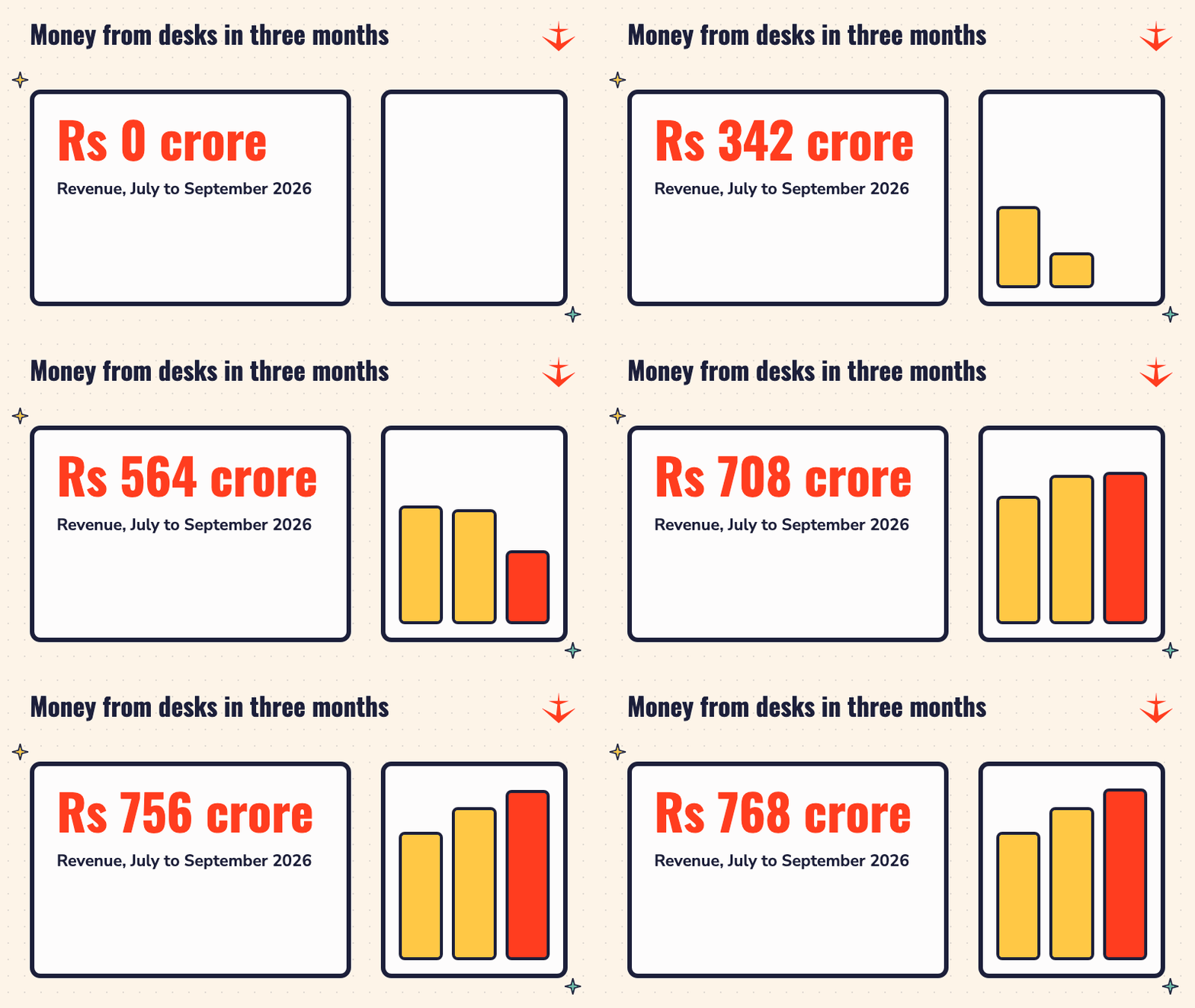
Picture a company that earned Rs 768 crore in just three months, mostly by renting out office desks. That is WeWork India. On Monday, 26 October 2026, its board met to approve the results for July to September 2026. The numbers show revenue up 33.8% and profit more than three times bigger than a year ago.
Here is what the numbers say, how a shared office business really makes money, and why so many young companies like this kind of office.
What did WeWork India earn?
Revenue is all the money a business collects from buyers before paying any bills. Think of a samosa stall: if it sells 100 samosas at Rs 20 each, its revenue is Rs 2,000, even before it pays for oil and potatoes.
For July to September 2026, WeWork India's revenue from operations was Rs 768 crore, up from Rs 574 crore in the same three months of 2025. Business people call these three months "Q2 FY27", which simply means the second quarter (three month block) of the money year that ends in March 2027.
The company also earned Rs 18 crore of other income, such as interest, so its total income for the quarter was Rs 786 crore. Renting workspace and the services around it was its only source of operating revenue.
And how much was left as profit?
Profit is what remains after every bill is paid. If the samosa stall pays Rs 1,800 for oil, potatoes and rent, the profit is Rs 200.
WeWork India's profit for the quarter was Rs 20.44 crore, up from Rs 6.4 crore a year earlier. That is a jump of about 219%. Just one quarter before, in April to June 2026, the company had a loss of Rs 4.1 crore. A loss means the bills were bigger than the money coming in.
For the full half year from April to September 2026, the company made a profit of Rs 16.37 crore. In the same six months of 2025, it had a loss of Rs 7.74 crore.

Wait, why are there two profit numbers?
Some news reports show a much bigger figure: profit of Rs 65.8 crore, up 67.4%. Both numbers are real. They just use different rule books for counting.
The Rs 20.44 crore follows the official Indian accounting rules, called Ind AS. The Rs 65.8 crore is an "IGAAP-equivalent" figure. According to Inc42, this version treats the long rent deals (called leases) and a few other items differently, and is not the company's official statutory result. A cricket comparison helps: a batter's score looks different if you count only runs off the bat or add the extras too. The match is the same.
So how does a shared office make money?
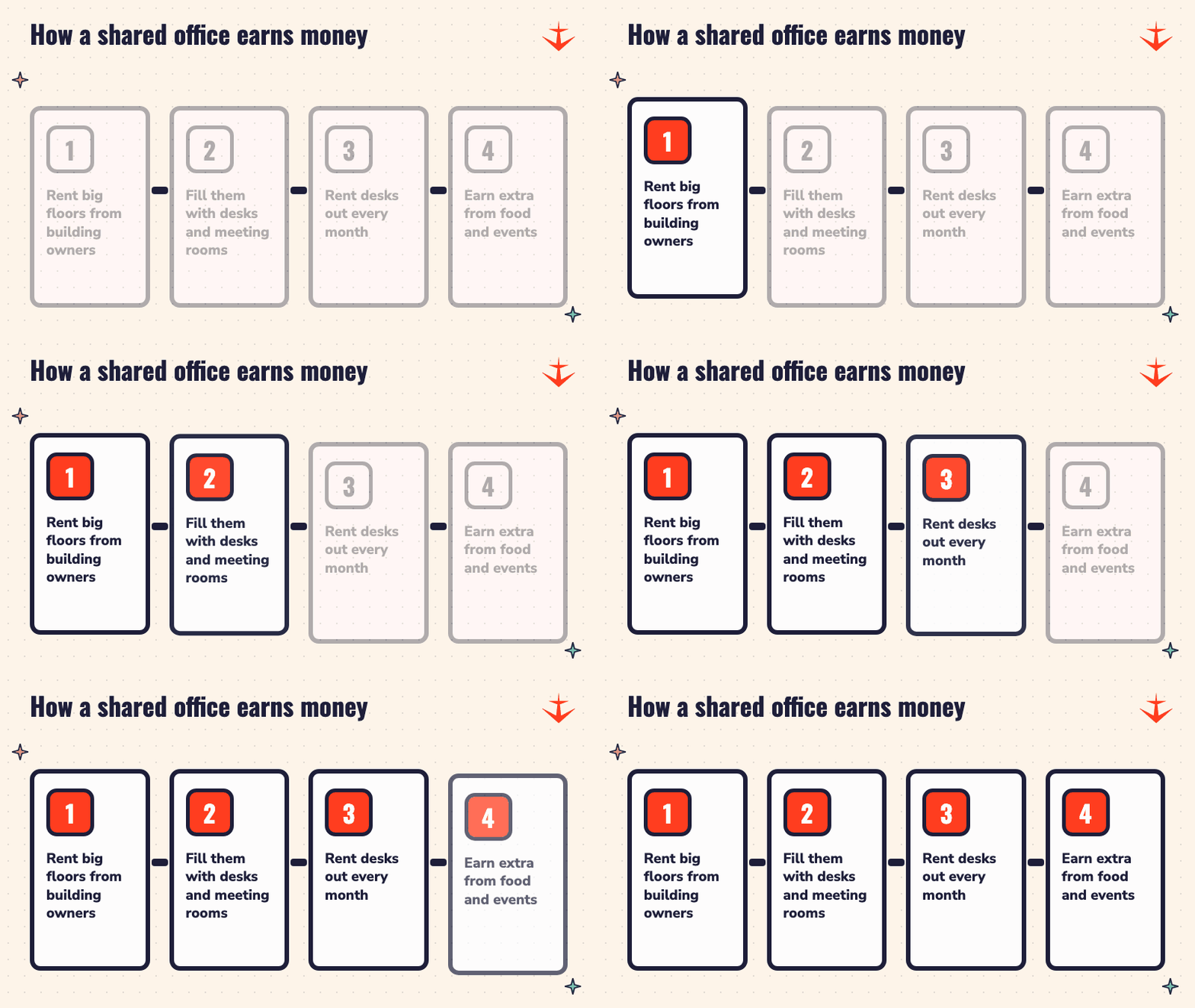
The idea is simple, a bit like a hostel owner who rents a whole building and then rents out rooms bed by bed.
First, the company signs long rent deals with building owners for big office floors. Then it fills those floors with desks, cabins, meeting rooms, Wi-Fi and coffee. Finally, it rents these desks to companies, usually every month. People who pay for a desk or a cabin are called "members".
The money comes from the gap between what WeWork India pays building owners and what members pay it. Inc42 reports that the company has contracted core revenue of Rs 3,843 crore (money members have already agreed to pay over their deals) against committed rent of Rs 1,421 crore, which it owes building owners.
There is extra money too. WeWork India earns from events, food and drinks, office customisation and tech services. It also sells "on demand" access, where someone books a desk only for the days needed, and virtual offices, which give a small firm an official address without a full office. On the IGAAP-equivalent basis, these extras brought in Rs 108.8 crore, up 38%.
Where does all that money go?
Running offices is costly. The biggest cost in the quarter was Rs 314 crore linked to leases. Under the official rules, rent on long deals shows up as "depreciation and amortisation", a way of spreading a big cost across many years. Finance costs, which include interest, were Rs 175 crore. Staff costs were Rs 56 crore. In total, expenses were Rs 767 crore.
Put simply, the company earned Rs 786 crore in total and spent Rs 767 crore. The gap between the two is thin, and just one quarter earlier it was a loss.
How many desks and members?
WeWork India added 11,700 desks in the quarter, its biggest addition so far. It now has 145,300 desks across eighty five centres in eight cities. Its members grew 32.5% to 1,21,700.
Occupancy, which means how many desks are actually filled, was 83.7%. Picture a cinema hall: if 84 of every 100 seats are taken, the hall is 84% full. Occupancy dipped a little from the previous quarter because new centres were still filling up.
The company also has more than 9,000 desks under signed leases and over 38,000 desks covered by letters of intent, which are early promises to sign a deal. It now has net cash of Rs 23.1 crore, meaning more cash than loans, compared with net debt of Rs 310.5 crore a year ago.
Who rents these desks, and why?
A big share comes from global capability centres, or GCCs. These are offices that large foreign companies set up in India to do their own tech, finance or research work. GCCs gave 40.8% of core revenue in the quarter. A year earlier, large company clients made up about 73% of revenue, and the average member stayed for 27 months.
For a startup, a shared office works like taking a monthly metro card instead of buying a car. There is no need to sign a long rent deal, buy furniture or set up Wi-Fi. A team of five can take five desks this month and twenty next month as it grows. Freelancers and small teams can use on-demand desks or a virtual office address. A fresher who joins a startup in such a space walks into a ready office, with meeting rooms and the events that WeWork India runs.
WeWork India started in 2017 and works in Chennai, New Delhi, Gurugram, Noida, Mumbai, Bengaluru, Pune and Hyderabad.
Watch: the results explained
This short video goes through the July to September 2026 numbers, using the IGAAP-equivalent figures.
This older Business Today video shows how the company spoke of the plans ahead around its IPO, its first sale of shares to the public.
What should young readers take away?
The shared office business is a game of filling seats. Rent is owed on whole floors, so filled desks matter. WeWork India has 145,300 desks and thousands more on the way. Keeping those new desks filled is the next test, the way a cinema needs full shows after adding a new screen.
Sources
- Entrackr: WeWork India's Q2 FY27 revenue and profit
- Inc42: WeWork India Q2 profit and desk numbers
- Free Press Journal: WeWork India Q2 FY27 results
- Multibagg: WeWork India board meeting on 26 October 2026
- WeWork India media release for July to September 2025
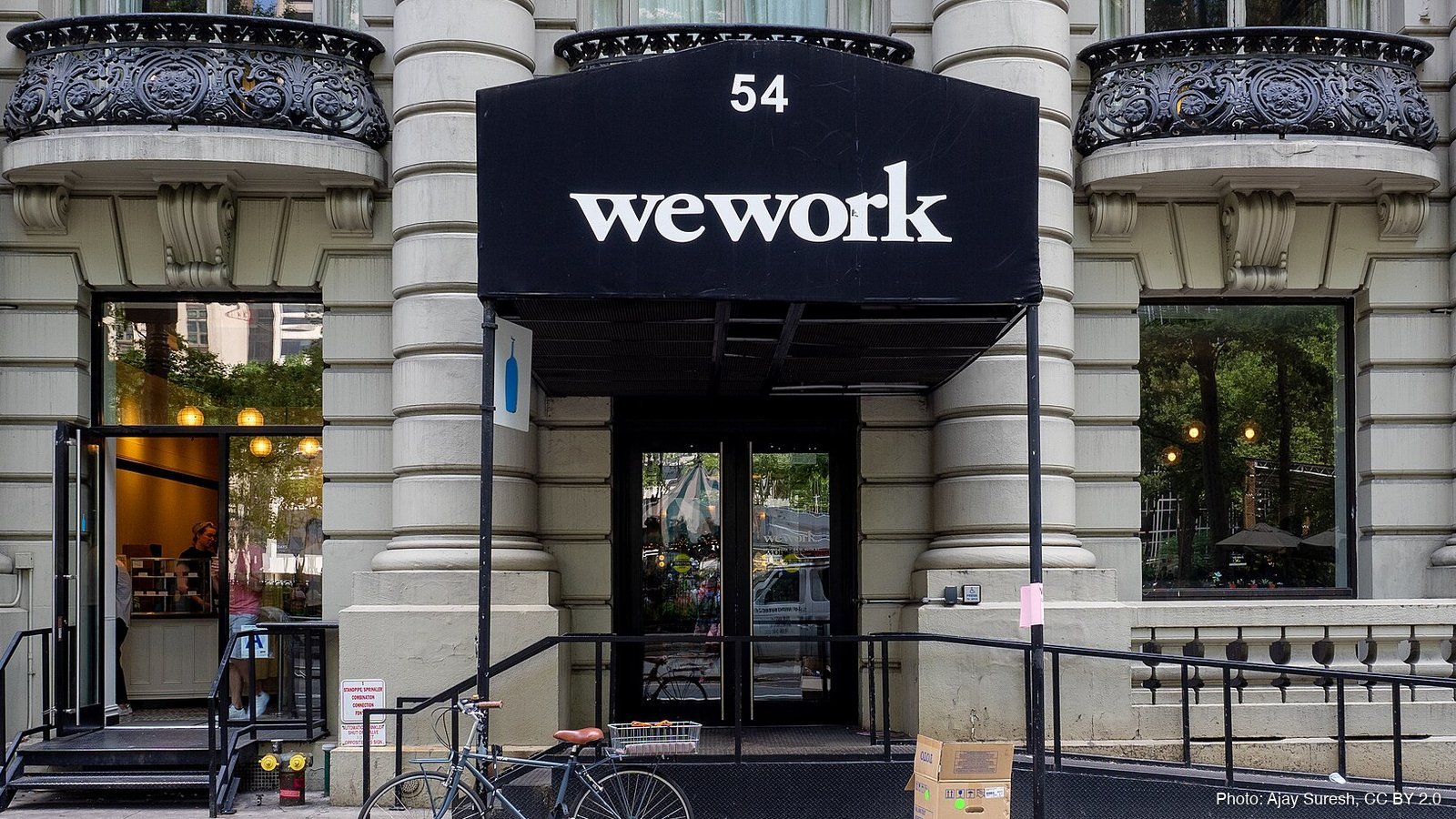
- Cover photo: WeWork entrance in Midtown Manhattan, New York, by Ajay Suresh, CC BY 2.0

You may republish this story under CC BY 4.0: credit Pranav Sharma and link to this page.