Waymo's driverless taxis are headed to Canada, with Toronto rides planned for 2028
Version 1 of 1 saved 17 Oct 2026, 10:32 am IST · Chain line 62
As it was first published
Waymo's driverless taxis are headed to Canada, with Toronto rides planned for 2028
Alphabet-owned Waymo will map Toronto's streets first and hopes to carry its first riders in 2028. Here is how a robotaxi company moves into a new city.
Picture this. You book a taxi on your phone, it pulls up, you open the door, and the driver's seat is empty. No driver, no small talk, just a car that steers itself. That kind of ride is now on its way to Canada. On Friday, 16 October 2026, Waymo announced that it is heading to Toronto, with the goal of carrying its first riders there in 2028.
Toronto is the company's first city in Canada. Here is what is happening, how it will work, and why it matters for the business of getting around.
First, who is Waymo?
Waymo is a self-driving car company owned by Alphabet, the parent company of Google. Its main product is a robotaxi.
A robotaxi is simple to explain. Think of booking an Uber or Ola, but the car drives itself. A computer system, which Waymo calls the Waymo Driver, uses cameras and sensors on the car to "see" the road.
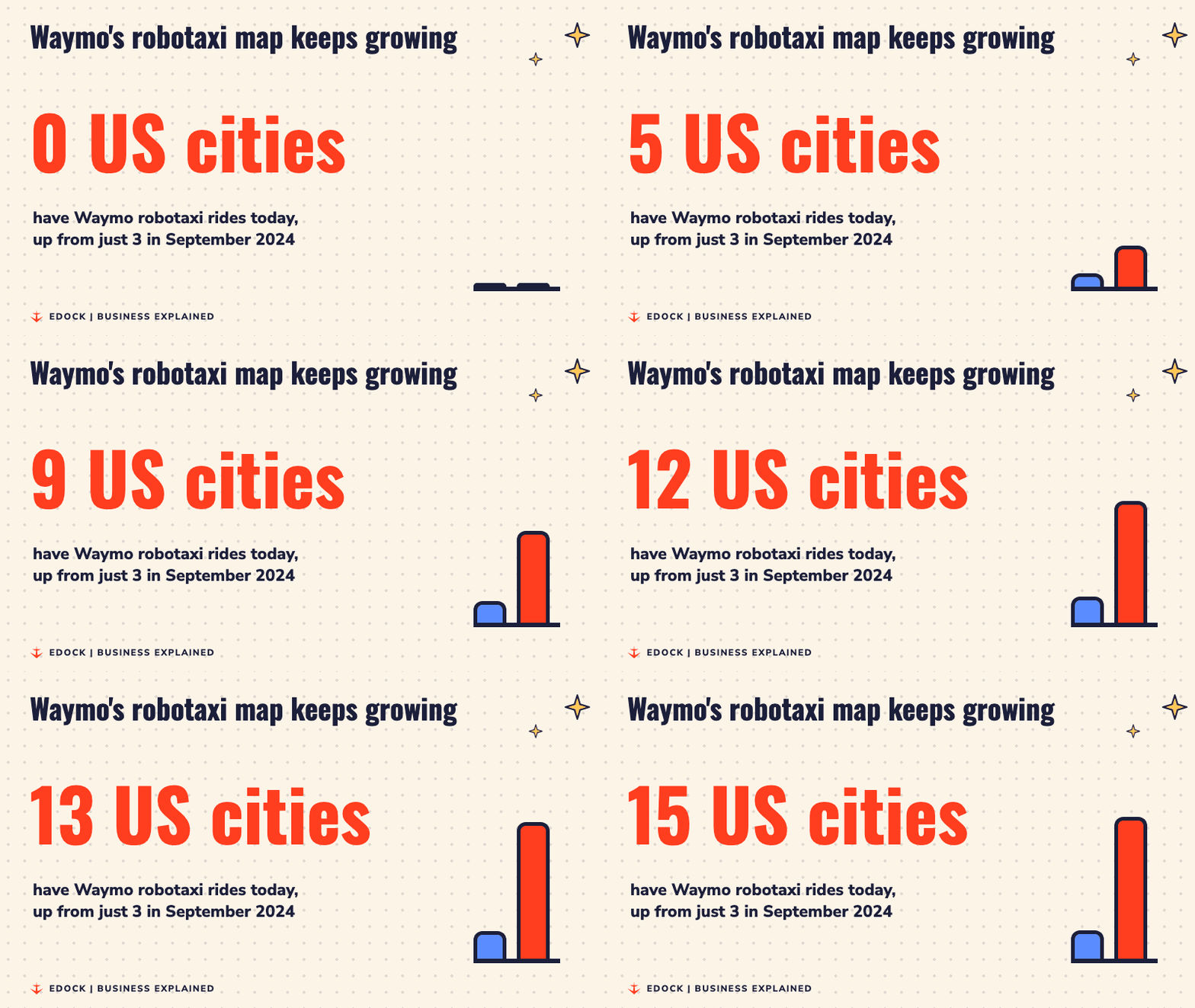
Waymo already runs robotaxi services in 15 US cities, and it is testing in London and Tokyo too.
How fast has Waymo grown?
Very fast. In September 2024, Waymo was running in just three cities: Phoenix, Los Angeles and San Francisco. Two years later, that number is 15. TechCrunch reported that Waymo now gives about 500,000 paid rides every week.
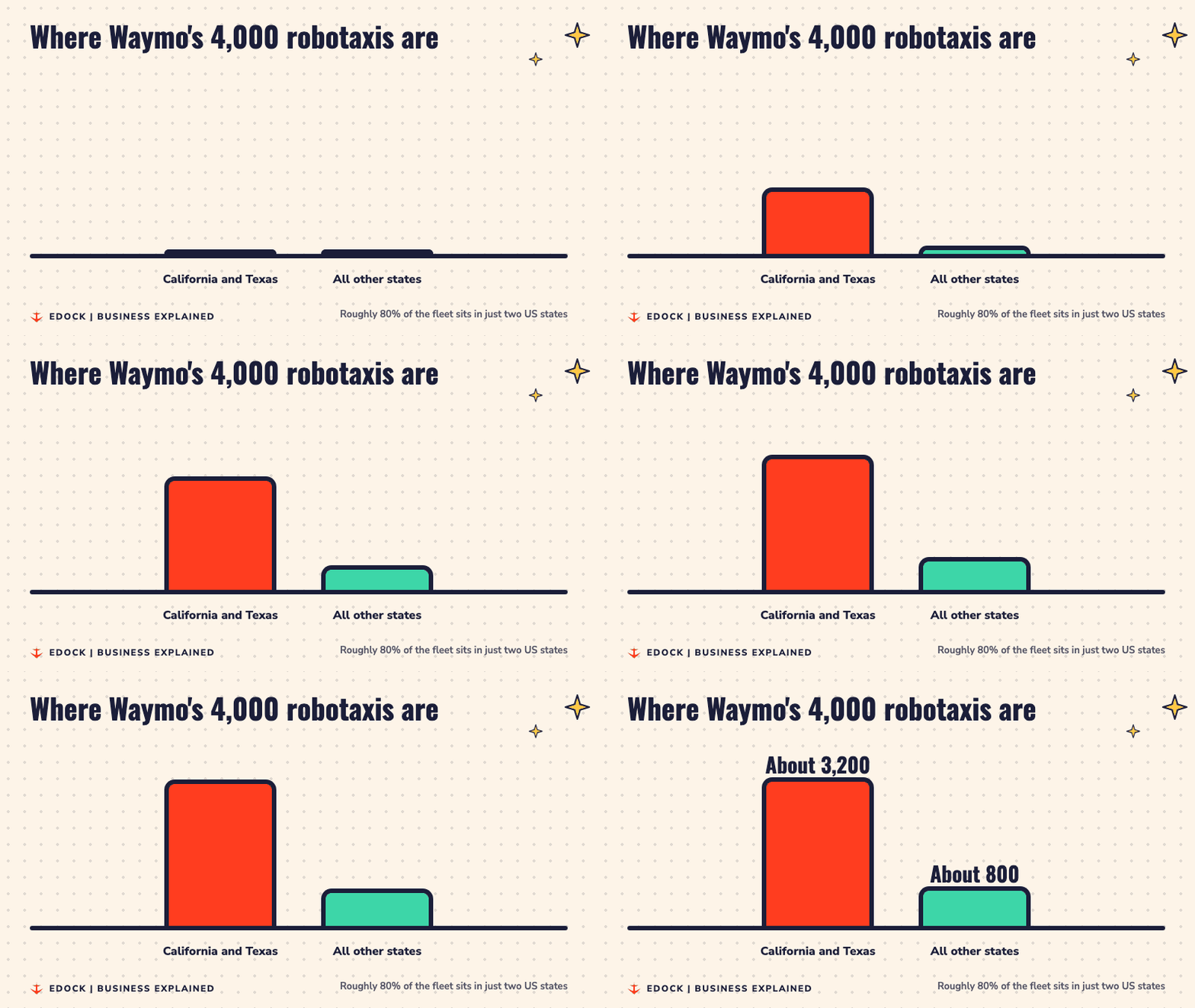
Its fleet, meaning the full group of cars it owns and runs, is about 4,000 robotaxis. But they are not spread evenly. About 80% of them are in just two US states, California and Texas. That leaves roughly 800 cars for every other place. (80% of 4,000 is 3,200, and 4,000 minus 3,200 is 800, so the sums match.)
So what exactly happens in Toronto?
Waymo is not switching on driverless rides tomorrow. It got approval to join Ontario's automated vehicle pilot program. A pilot program is a trial run, like a practice match before the real tournament. Ontario started this program 10 years ago.
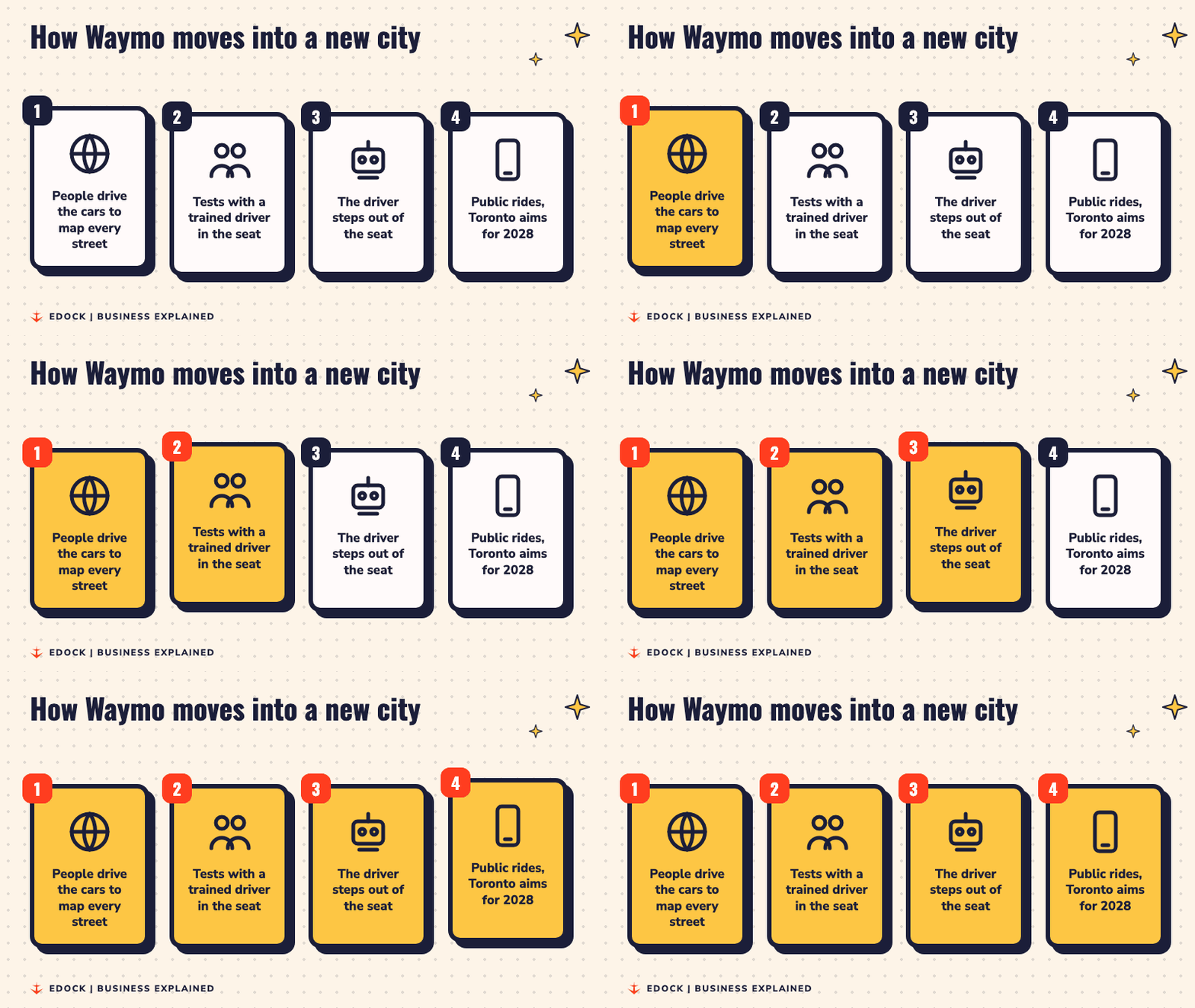
TechCrunch says Waymo follows the same playbook in every new city. In Toronto, it goes like this:
- Map the streets. People drive the cars by hand to build "high-definition maps". These are super detailed maps of every lane, sign and kerb, far more detailed than the map app on your phone.
- Test with a human ready to help. The car drives itself, but a trained safety operator sits behind the wheel, just in case.
- Remove the human. Once the system is ready, the operator steps out of the driver's seat.
- Open to the public. Then regular people can book rides.
Waymo says people will start to see its cars on Toronto's streets "in the coming days", driven by hand at first.
Why does Waymo need a partner?
Running thousands of cars is hard work. Someone must clean them, fix them, charge them and answer customer calls. So Waymo has teamed up with Element Fleet Management, a company based in Toronto that manages vehicle fleets.
Think of it like a cricket team. The players (the cars and the software) are in the spotlight, but the ground staff keep the pitch ready. Element will be the ground staff. Waymo says that together with Element and other partners it will invest in "hundreds of roles" over time, in areas like fleet maintenance, validation driving and customer service.
TechCrunch notes that using local partners to manage the fleet in each city is part of how Waymo is trying to grow faster.
Waymo also already has links to Canada. The company says the Canada Pension Plan Investment Board is a long-term investor, and Magna International is its manufacturing partner.
What is the big business idea here?
A normal taxi company has to pay a driver for every ride. A robotaxi company does not. That is the big promise: once the cars and software work well, each ride could need fewer people.
But it is not cheap to get there. The cars are costly (TechCrunch reports that Waymo is paying extra import tariffs on its new China-built minivans), every new city needs fresh maps and testing, and support teams are still needed. That is why Waymo takes years to move from "we are coming" to "book a ride". In Toronto, the gap between this week's news and the 2028 goal is a good example.
On safety, Waymo says that across more than 400 million fully driverless kilometres, its cars were involved in 95% fewer crashes causing serious injury or worse, compared with human drivers in the cities where it runs. This is the company's own claim, based on its own data.
Co-CEO Tekedra Mawakana said: "Expanding into Canada marks an important milestone in Waymo's global journey."
Will snow be a problem?
This is the big question. TechCrunch points out that Toronto is the most northern and possibly the most wintry city Waymo has tried so far. Snow, ice and slush are a real test for a car that depends on cameras and sensors.
Sidney Givigi, a robotics professor at Queen's University, told CBC: "All the sensors can get occluded by snow." Occluded simply means covered or blocked, like trying to read a phone screen covered in fog.
Is everyone happy about it?
Not everyone. Toronto Mayor Olivia Chow said her biggest worry is the safety of people in the city, and that the cars must be held to the highest standards, CBC reported.
A group called Technologists for Democracy has raised worries about privacy, data, effects on drivers' work and more traffic, according to BetaKit. On the day of the news, the group asked officials to pause the rollout and talk to residents first.
Uber, which has partnerships with more than 30 self-driving companies, sounded calmer. Laura Miller, Uber Canada's head of policy, said in a statement to CBC: "We believe the future of mobility will be hybrid, with human drivers and autonomous vehicles operating side by side."
Why should young people in India care?
Every time a company like Waymo enters a new country, it shows the world a playbook: get government approval, map the city, test carefully, find a local partner, then launch. That playbook could one day reach many more cities around the world.
It is also a reminder that new technology creates new kinds of work. Even "driverless" taxis need people for maintenance, testing, customer support and operations. For now, Toronto riders have to wait until 2028. The real test will be whether these cars can handle a snowy Canadian winter as well as a sunny California street.
Sources
- Waymo blog: Hello Toronto! Waymo is en route
- TechCrunch: Waymo's robotaxis are headed to Canada
- TechCrunch: Waymo is scaling fast, here is what the fleet data shows
- CBC News: Waymo to launch first phase of driverless taxi testing in Toronto
- BetaKit: Waymo to begin robotaxi pilot in Toronto, but with human drivers until 2028
- Cover photo: Waymo Jaguar I-Pace, Front Quarter View 03, by 9yz, CC BY 4.0
