UPI's new fee on big shop payments is on hold till after Diwali
Version 1 of 1 saved 13 Oct 2026, 5:05 pm IST · Chain line 11
As it was first published
UPI's new fee on big shop payments is on hold till after Diwali
A 0.4% fee on shop payments above ₹2,000 was due on 15 October. Here is what changed, who pays, and why UPI to friends stays free.
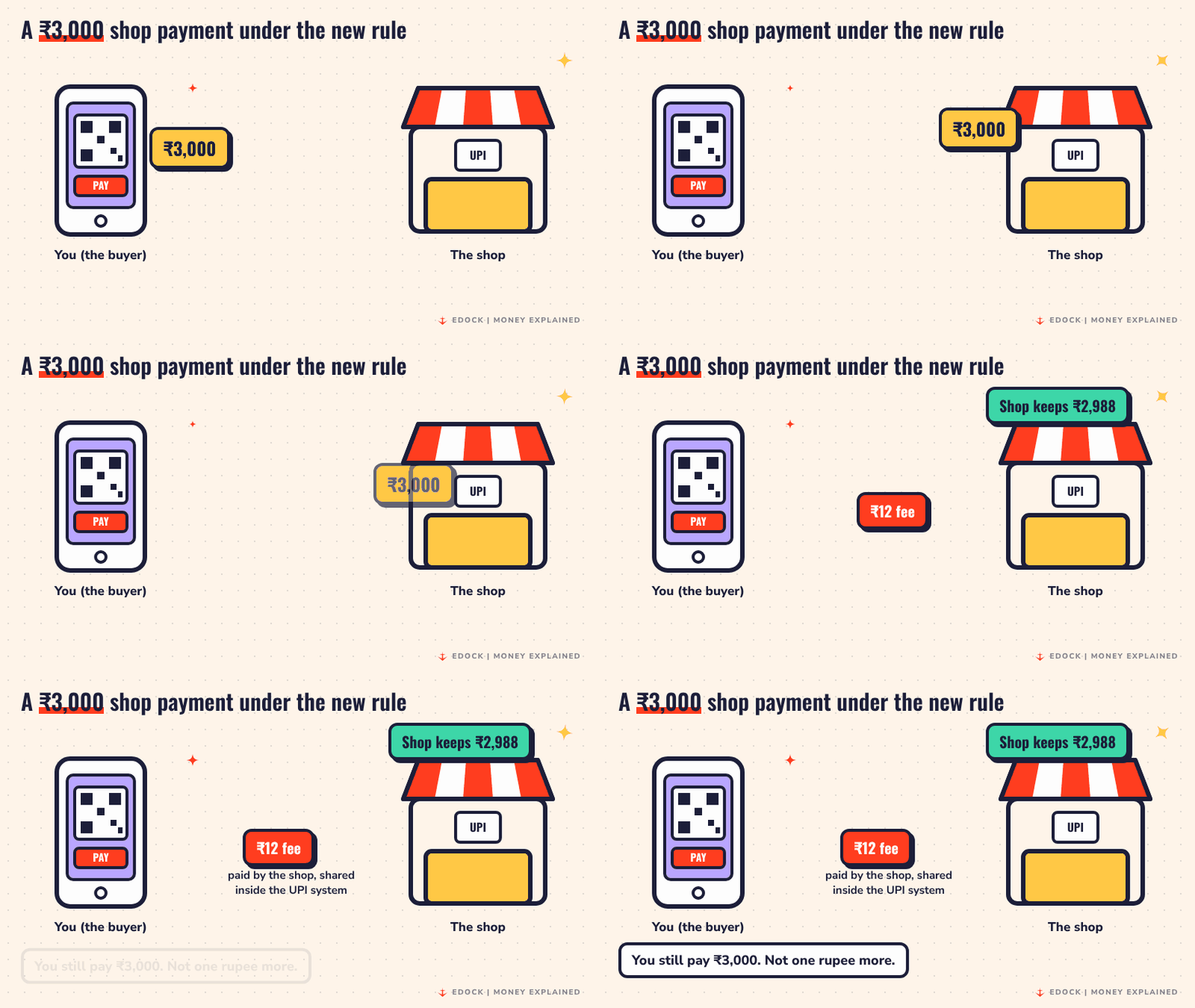
Picture this. You scan a QR code at a shop to buy new shoes for ₹3,000. You pay ₹3,000. Under a new rule, the shop would then pay ₹12 out of that money as a fee.
That rule was meant to start on 15 October 2026. Then, on Tuesday, 13 October 2026, the people who run UPI pressed pause. The fee will now start after Diwali, on a date that will be announced later. Here is the whole story in simple words.
First, what is UPI?
UPI is the system behind apps like the ones you use to scan and pay. It is run by the National Payments Corporation of India, or NPCI.
It is huge. In August 2026 alone, UPI handled 2,451 crore payments worth ₹29.9 lakh crore. August has 31 days, so that is about 79 crore payments every single day.
What is this new fee?
It has a long name: Merchant Discount Rate, or MDR. A merchant is just a shop or business. MDR is a small cut the shop pays each time a customer pays it digitally.
Think of a cricket ground that lets a samosa seller set up a stall. For every big order, the seller gives the ground a tiny share, because the ground keeps the lights on and the gates open. MDR works a bit like that. The shop gets a payment system that works, and it pays a small share to keep that system running.
Here is how the UPI fee was set up in the government's question and answer sheet, dated 15 September 2026:
- It applies only when you pay a business (called P2M, person to merchant) more than ₹2,000 in one go.
- The fee is 0.4% of the payment. That means 40 paise for every ₹100.
- For payments of ₹75,000 or more, the fee stops growing at ₹300. This limit is called a cap.
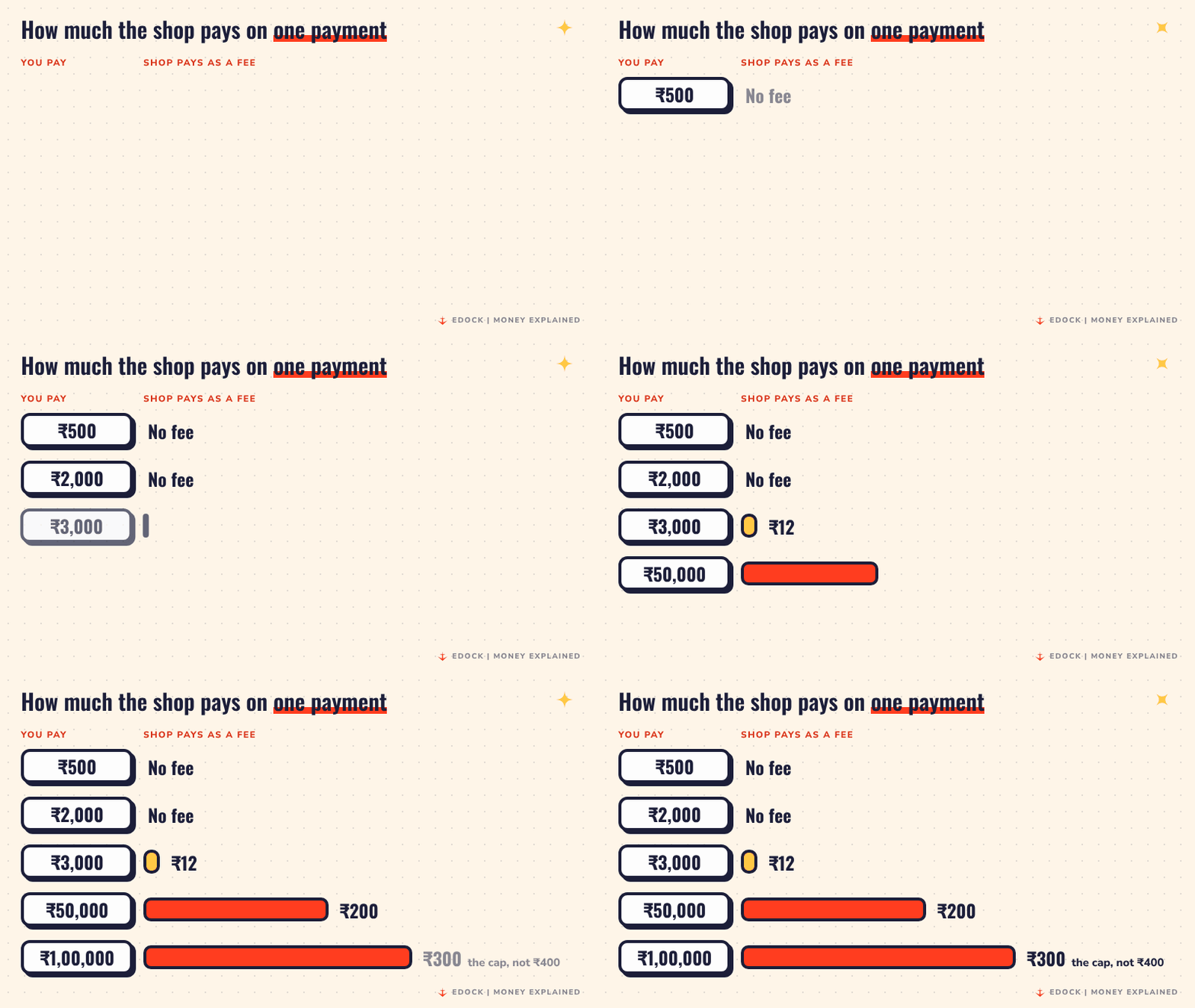
So a ₹3,000 payment means a ₹12 fee for the shop. A ₹50,000 payment means ₹200. A ₹1 lakh payment would be ₹400 at 0.4%, but the cap keeps it at ₹300.
Some payments get a different deal. Payments above ₹2,000 for things like railways, telecom, insurance and fuel carry a flat fee of just ₹5, according to Entrackr.
Business Today shared the rule on X:
Do you have to pay anything?
No. This is the most important part. The government's sheet says:
- Sending money to friends and family stays free, for any amount. Splitting a bill or moving money between your own bank accounts is free too.
- UPI apps cannot add a platform fee or any other charge on your payments.
- Shop payments up to ₹2,000 have no fee at all. These make up more than 95% of all UPI payments to shops.
- Auto payments, like a monthly OTT subscription set up on UPI AutoPay, do not carry this fee.
Shops are also not allowed to pass the fee on to you directly. You should pay the same price that is shown.
What about the chai stall?
Very small sellers are safe too. According to the government's sheet, vendors under a group called P2PM (person to person merchant) will keep paying zero fee. These are small sellers who receive up to ₹1 lakh a month through UPI QR codes straight into their own bank accounts.
So if you pay your local chai or momo stall ₹2,500 for a party order, that stall usually still pays nothing, as long as it stays in that small-seller group.
Why add a fee at all?
Running UPI costs money. Servers, internet lines, fraud checks and bank support all cost money. Industry estimates in the government's sheet put this at around ₹20,000 crore a year.
Until now, yearly government support has helped cover these costs. The sheet says that support was meant to be a short-term bridge, not a forever plan. The fee is meant to give UPI a steady way to pay for safety, new features and customer service. The money is shared within the UPI system, not collected as a tax.
The sheet also compares prices. Credit card fees for shops usually range from 1.5% to 2.5%, and debit card fees can go up to 0.9%. At 0.4%, UPI would still be cheaper for shops.
So why the pause?
The reason given is the festive season. In its statement, NPCI said:
"UPI and Services Steering Committee today decided that, keeping in mind the festive season, Merchant Discount Rate (MDR) on select Person-to-Merchant (P2M) UPI transactions shall be implemented immediately post Diwali on a date to be notified separately."
The UPI and Services Steering Committee is the group, headed by NPCI, that decides these rules. The Week notes that retailers, restaurants and online sellers see big jumps in digital payments during Diwali, which is why the timing matters to them.
Here is a short news video on the delay:
What to remember
- The fee has not started. It will come after Diwali, on a date still to be announced.
- When it starts, it is paid by shops, only on payments above ₹2,000.
- Your UPI to friends, your small shop payments and your AutoPay subscriptions stay free.
Next time you split a dinner bill with friends on UPI, you can tell them: still free.
Sources
- MDR on UPI transactions above Rs 2,000 deferred, new date to be announced after Diwali (Deccan Herald)
- FAQs: Merchant Discount Rate on select UPI (P2M) transactions (Department of Financial Services)
- UPI MDR new rules: 0.4% charge above ₹2,000, ₹300 cap (Business Today)
- NPCI defers UPI MDR rollout to post Diwali (Entrackr)
- NPCI defers 0.4% UPI merchant fee until after Diwali (The Week)
- Cover photo: QR code, by Topher, CC0 1.0