Tonbo Imaging opens at Rs 1,160 on its first trading day, 66% above its IPO price
Version 1 of 1 saved 23 Oct 2026, 12:34 pm IST · Chain line 171
As it was first published
Tonbo Imaging opens at Rs 1,160 on its first trading day, 66% above its IPO price
The Bengaluru maker of thermal cameras sold shares at Rs 700. Here is what an IPO, listing and premium mean, and why the company got no money from it.
Picture this. You buy a cricket match ticket for Rs 100. On match day, someone at the gate offers you Rs 166 for it. That is roughly what happened to people who got shares of Tonbo Imaging this week.
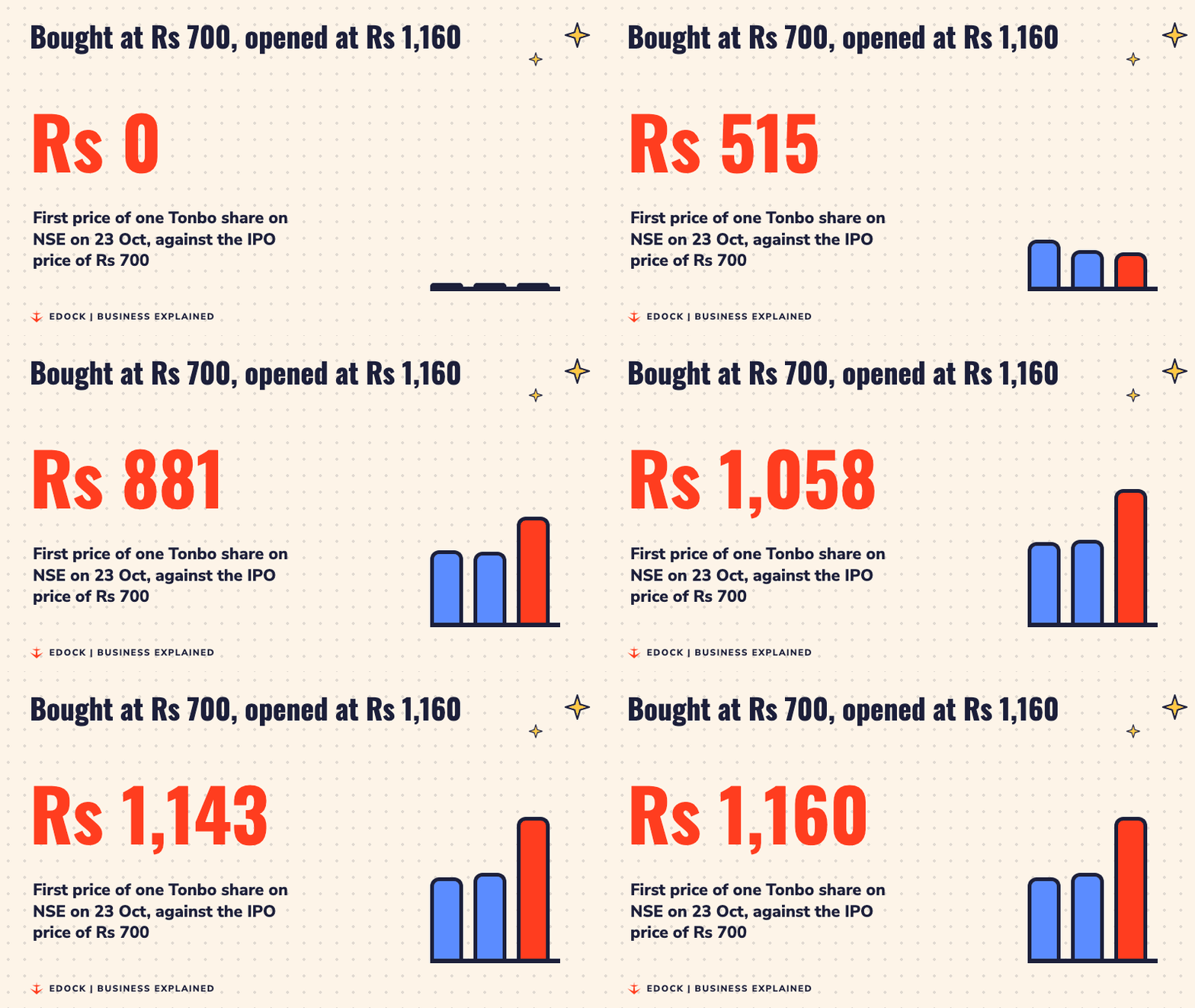
On 23 October 2026, Tonbo Imaging's shares started trading on the stock exchanges for the first time. Each share had been sold at Rs 700 in the company's IPO. On the NSE, the first price was Rs 1,160, which is 65.71% more. News reports rounded it to a 66% jump.
So who is Tonbo, what is an IPO, and why did so many people want these shares? Here is the story in simple words.
What does Tonbo Imaging make?
Tonbo is a Bengaluru company that makes cameras that can see in the dark. Its list includes thermal imaging systems, weapon sights, missile seekers and fire-control systems. A thermal camera does not need light. It sees heat. A warm person or engine glows on its screen even at midnight.
These products are mostly for the military. They help with watching borders, scouting an area and aiming at targets. Its systems are used across 24 countries. The Indian government is its biggest buyer. It made up 71% of Tonbo's revenue in FY26.
The company was set up in 2003. Its founders, Arvind Lakshmikumar, Ankit Kumar and Cecilia D'Souza, bought it out from Sarnoff Corporation in 2012. Tonbo designs and tests its products itself. But it hands the actual factory work to partner companies such as Kaynes Technology and Avalon Technology. Think of a chef who writes the recipe and checks the taste, while another kitchen cooks the food in big batches.
What is an IPO, in plain words?
A company's share is a tiny piece of the company. If a company were a pizza cut into a crore slices, one share would be one slice.
An IPO, or initial public offering, is the first time a company sells these slices to the general public. Before an IPO, only founders, early investors and staff own the company. After it, anyone with a trading account can buy and sell its shares.
Listing is the day the shares start trading on a stock exchange, like the NSE. A stock exchange works like a giant market, but for shares instead of vegetables. Buyers and sellers agree on a price every second.
Issue price vs listing price
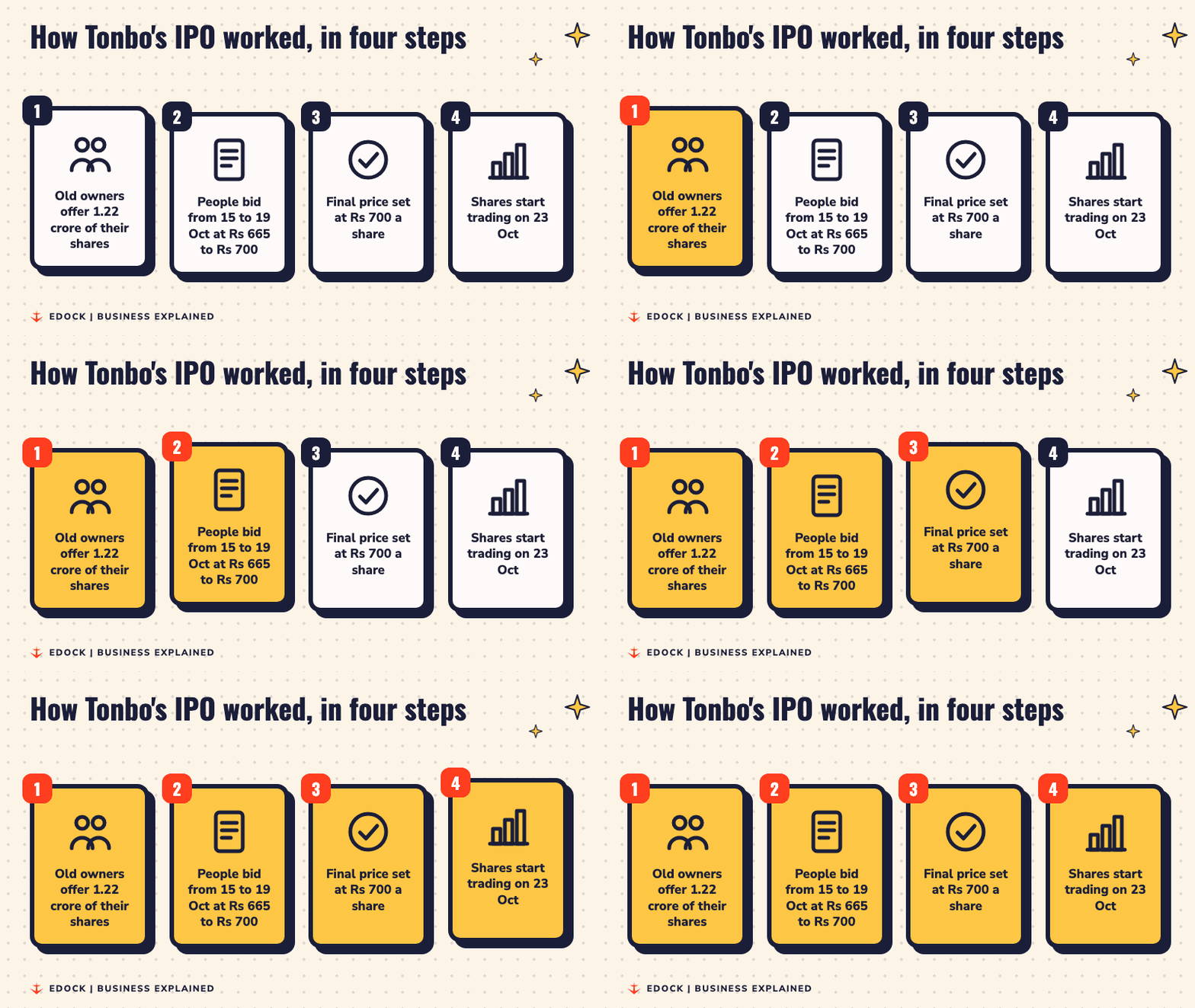
The issue price is the price at which the company sells shares in the IPO. Tonbo set a price range of Rs 665 to Rs 700 a share. Bids were open from 15 October to 19 October. The final price was fixed at Rs 700.
The listing price is the first price when trading begins. For Tonbo on the NSE, that was Rs 1,160. The extra amount over the issue price is called a premium. Here, the premium was Rs 460 a share (Rs 1,160 minus Rs 700).
Shares in an IPO come in fixed packs called lots. One Tonbo lot was 21 shares, costing Rs 14,700. At the NSE opening price, those same 21 shares were worth Rs 24,360. That is Rs 9,660 more than what was paid, on paper. "On paper" means the gain is real only if the shares are sold at that price.
How many people wanted these shares?
A lot. The IPO got bids for 135.90 times the shares on offer. Imagine a samosa stall with 1 samosa and 135 people asking for it. Most people go home empty handed.
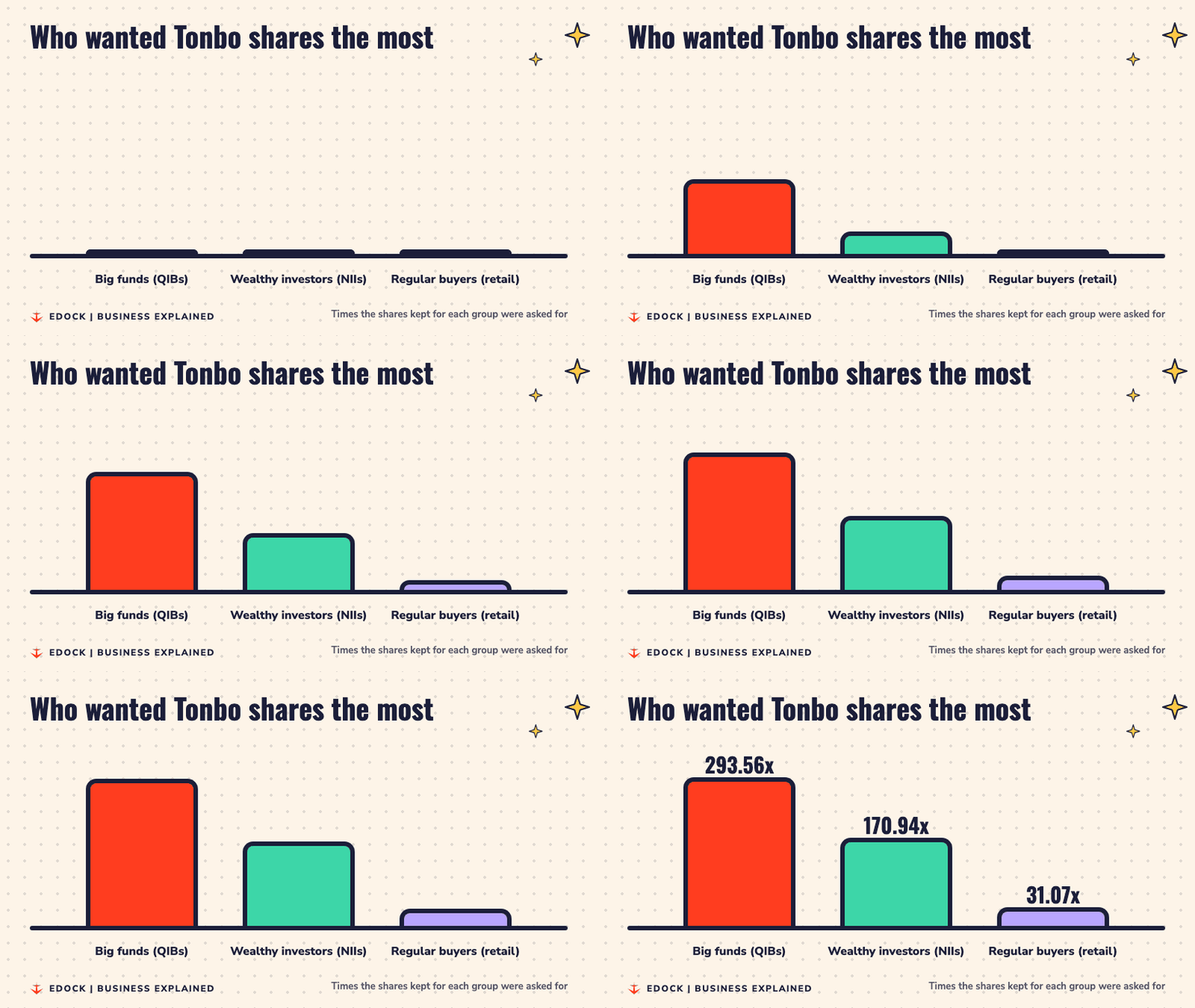
The IPO keeps a set portion for each kind of buyer. Big institutions like mutual funds and insurance firms, called QIB buyers, bid for 293.56 times their portion. Wealthy individual investors, called NII buyers, bid 170.94 times. Regular small buyers, called retail investors, bid 31.07 times. Employees bid 54.31 times. In all, there were 55,24,267 applications.
Even before the IPO opened to the public, Tonbo got Rs 255.4 crore from 43 anchor investors at Rs 700 a share. Anchor investors are large funds that commit early, a bit like the first guests who confirm for a party so others feel confident to come. Names included SBI Mutual Fund, Goldman Sachs and BlackRock.
Wait, Tonbo itself got no money?
Right. This is the twist. The whole IPO was an offer for sale, or OFS. That means only old owners sold their shares. No new shares were made. So the money went to the sellers, and Tonbo will receive no proceeds from it.
Think of it like this. If you sell your old cycle to a friend, the money comes to you, not to the cycle company.
The three cofounders together received Rs 137.2 crore by selling some of their shares. CEO Arvind Lakshmikumar got Rs 80.5 crore, Ankit Kumar got Rs 40.6 crore and Cecilia D'Souza got Rs 16.1 crore. Add them up and you get Rs 137.2 crore. Lakshmikumar still holds around 38.18 lakh shares.
The IPO's total size was eight hundred fifty two crore rupees, made up of 1.22 crore shares.
How is the business doing?
Here is the surprising part. The strong debut came even though Tonbo's recent numbers went down. Revenue is all the money a company earns from selling its products. Profit is what is left after paying all its bills.
In FY26, the money year that ended in March 2026, Tonbo's revenue from operations fell 22.7% to Rs 362.6 crore, from Rs 469.1 crore. Its net profit fell to Rs 50.8 crore, from Rs 72.8 crore. In the April to June 2026 quarter, it made a net loss of Rs 17.7 crore on revenue of Rs 36 crore.
The CEO told Inc42 that the fall in FY26 came from delays in carrying out overseas programmes. Those delays pushed deliveries into FY27.
At its listing price, Tonbo's total market value, the price of all its shares put together, was about Rs 6,656 crore, per Inc42. At the IPO price, it had been valued at Rs 4,009.8 crore.
Why this matters to young readers
Words like IPO, listing and premium show up in the news almost every week. Tonbo's debut is a clean example of all three in one story. It also shows two things that are easy to miss. First, a company can sell shares in an IPO and still get no money from it, if only old owners sell. Second, a share price on listing day is set by demand from buyers, and that demand can be high even when recent profits have dropped.
The listing-day price is only the first price. It keeps changing every second the market is open. This post explains what happened. It is not advice on buying or selling any share.
Sources
- Inc42: Tonbo Imaging makes strong market debut, lists at 66% premium to IPO price
- Inc42: Tonbo Imaging cofounders and the IPO payout
- Business Standard: Tonbo Imaging shares make strong debut, list at 66% premium over IPO price
- Kotak Neo: Tonbo Imaging IPO listing
- Cover photo: Infrared camera at LAAS, by Guillaume Paumier, CC BY 3.0
