Three rocket engineers raised $1.5 million to build Moon delivery robots
Indian startup Cosmochute wants to carry and place equipment on the Moon with a reusable rover and trailer. Here is how its plan works.
Picture a delivery van, but on the Moon. It drives across grey dust, pulling a trailer full of science kits, and drops each one exactly where it is needed. That is the idea behind Cosmochute, a new Indian space robotics startup. On 15 October 2026, it announced it had raised $1.5 million to build it.
The company was only founded this year. So how does a brand-new startup get money for something as wild as Moon robots? Let us break it down.
Who is behind Cosmochute?
Cosmochute was founded in 2026 by Janhavi Gore, Amit Chowdhary and Dhruv Alok Sangal. Business Standard describes them as three UK-returned rocket engineers who chose to build in India.
They also have an experienced guide. The startup is advised by Mylswamy Annadurai, the former programme director of Chandrayaan-1, India's first mission to the Moon.
What exactly are they building?
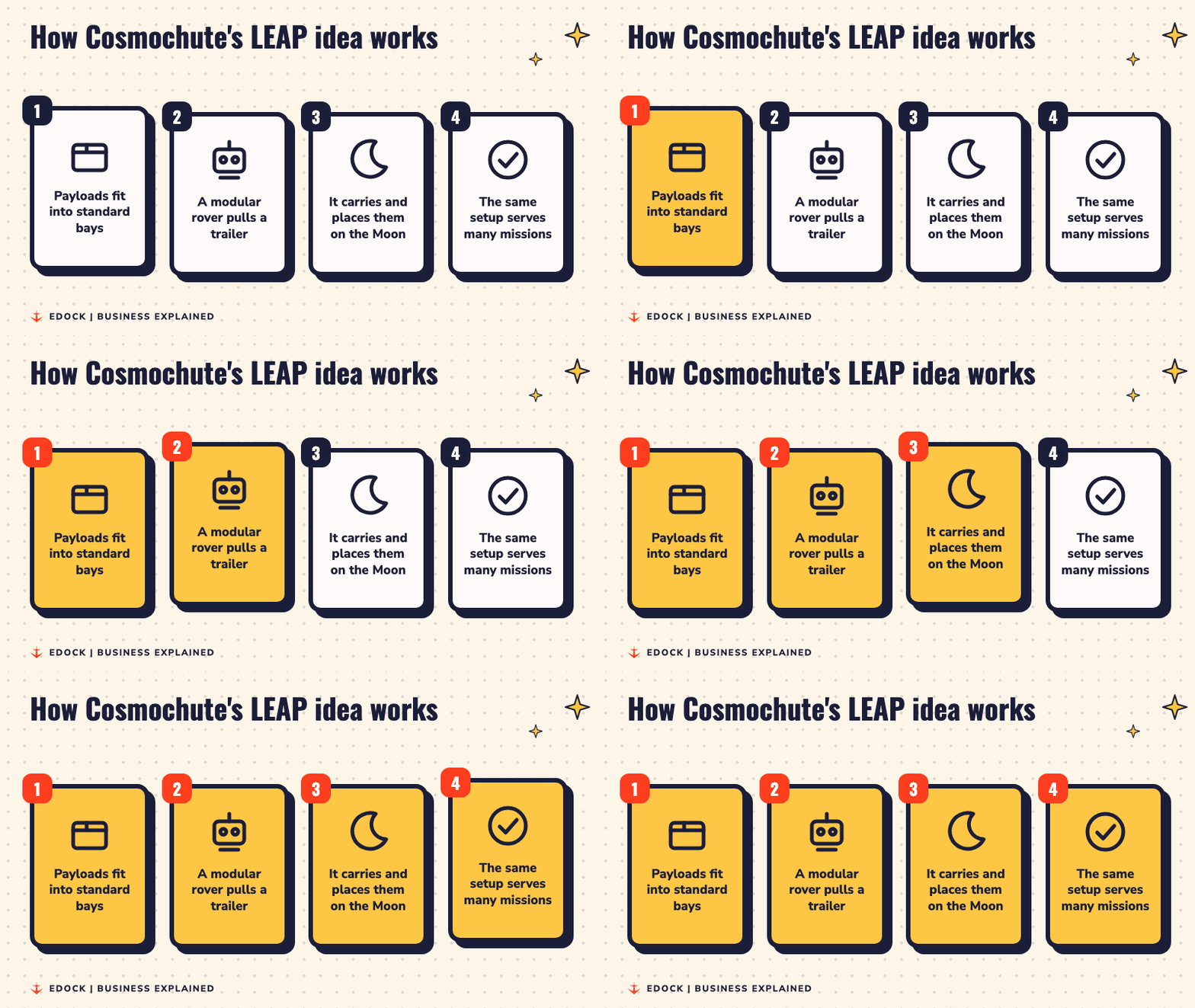
Their first product is called LEAP. It is a modular rover and trailer with standard payload bays, meant to carry equipment and place it on the Moon's surface.
Two words to know here:
- Payload means the useful thing a spacecraft carries. On a Moon mission, that could be a camera, a sensor or a small science experiment. Think of it as the parcel, while the rover is the delivery van.
- Modular means built from standard blocks that can be swapped around, like Lego. You do not build a brand-new van for every parcel. You just slot the parcel into a ready space.
Why is that a business, not just a science project?
Because getting things onto the Moon is expensive and slow today. Accel Atoms, one of its backers, put it simply on X: each mission is "engineered largely for itself".
Imagine if every Swiggy order needed a new bike built just for it. Food delivery would cost a fortune. Cosmochute wants to be the standard bike that many orders can share. If many missions can use the same platform, Entrackr reports, the company hopes to cut down the need for mission-specific engineering and make Moon deliveries more repeatable.

Who put in the money?
This was a pre-seed round, the very first money a startup raises, usually before it has a finished product. It is like the pocket money a cricket academy gives a promising young player before they have played a single big match.
Business Standard reports that Prosus Ventures led the round, while Entrackr says it was led by Accel and Prosus Ventures together. Both describe it as part of their joint programme, Atoms X. IIMA Ventures' Deep-tech and Aerospace Acceleration Fund, Operators Studio and Chinmayi Muthyala also joined, according to Entrackr.
What is Atoms X?
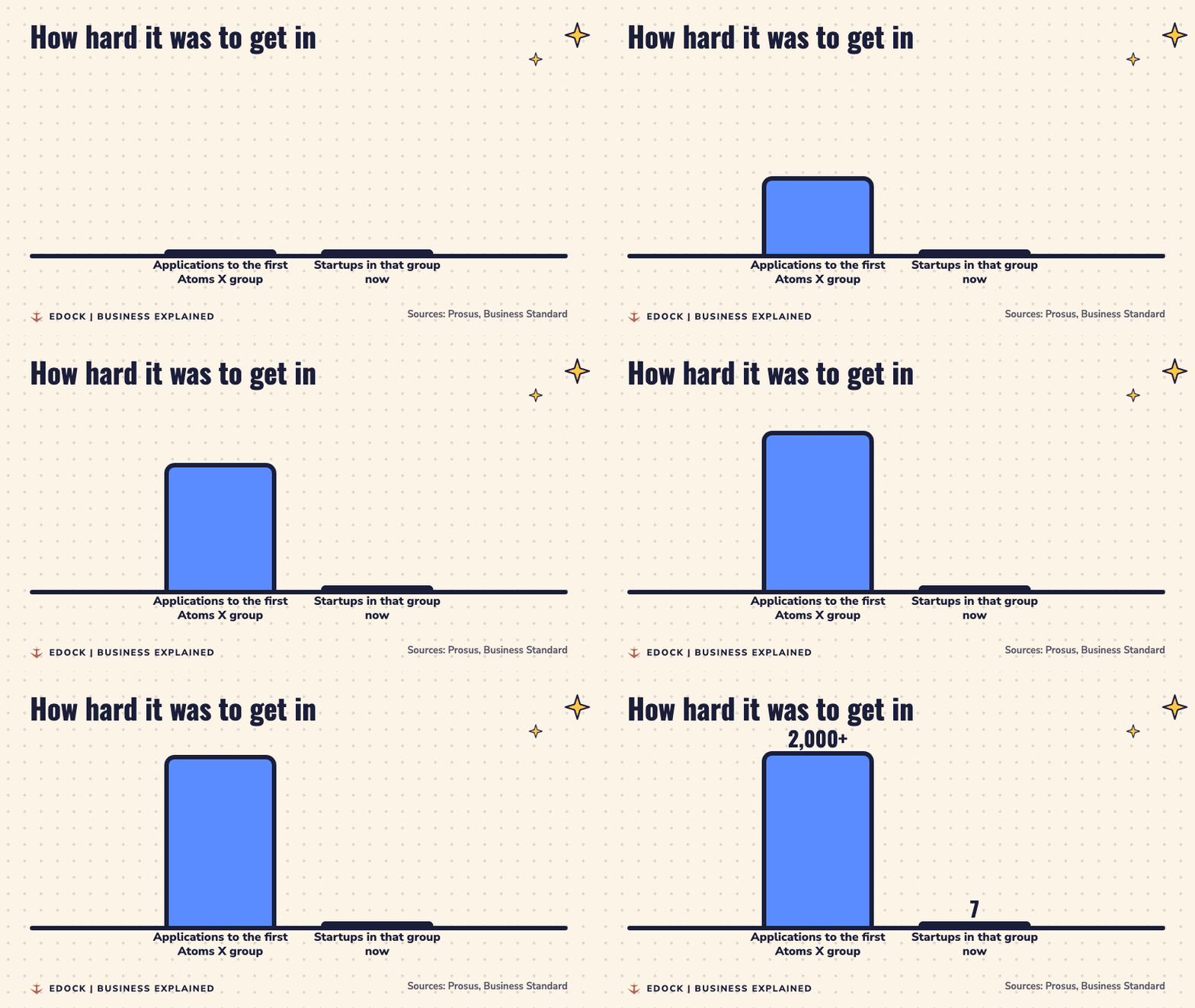
Atoms X is a programme by venture capital firm Accel and global tech company Prosus that backs founders building frontier tech companies from day one. When it announced its first group in March 2026, Prosus said those startups were picked from over 2,000 applications. Under the deal, Prosus matches Accel's investment in each company.
A cohort is just a batch, like a class in school that starts together. Cosmochute now joins the six startups of that first batch, making it seven.
What will they do with the money?
Cosmochute says it will spend it on building LEAP, hiring more engineers and planning how to sell its service, as per its press release. It is also setting up its lunar laboratories at IIMA Ventures' incubation facility. An incubator is a place that gives young startups desks, equipment and advice, a bit like a hostel for new companies.
Space 1.0, 2.0 and 3.0
Co-founder Janhavi Gore explained the bigger picture in three steps, in comments to Business Standard. In her words, Space 1.0 was ISRO proving India could reach orbit. Space 2.0 made orbit commercial and open to private money. Space 3.0, she said, is about what happens next, including taking the in-space economy all the way to the surface of the Moon.
India already knows how to get to the Moon. ISRO's Chandrayaan-3 mission was built to show safe landing and roving on the lunar surface, using its own lander and rover. Here is how that landing looked live:
Business Standard describes this moment as India's private space sector moving beyond launches and satellites, towards the infrastructure needed to make lunar exploration commercially viable. Cosmochute wants to be part of that infrastructure.
The short version
Cosmochute, a startup founded in 2026 by three rocket engineers, has raised $1.5 million to build LEAP, a reusable rover and trailer for carrying equipment on the Moon. Its backers include Prosus Ventures and Accel through Atoms X, a programme that picked its first batch from over 2,000 applications. It is a very early bet on a very big idea: making Moon missions as routine as a delivery run.
Sources
- Prosus Ventures leads $1.5 million funding in space startup Cosmochute, Business Standard
- Space robotics startup Cosmochute raises $1.5 Mn in pre-seed round, Entrackr
- Accel and Prosus announce inaugural Atoms X cohort, Prosus
- Chandrayaan-3 details, ISRO
- Accel Atoms post introducing Cosmochute, X
- Chandrayaan-3 Moon landing live, CNN-News18 on YouTube
- Cover photo: Amundsen crater 4006 h1, by James Stuby based on NASA image, CC0 1.0
You may republish this story under CC BY 4.0: credit Manpreet Kaur and link to this page.