This AI does not chat, it just decides. Now it is worth $7.5 billion
TypeSafe AI raised $870 million for Jev, an AI model that answers with a choice and a score instead of long text.

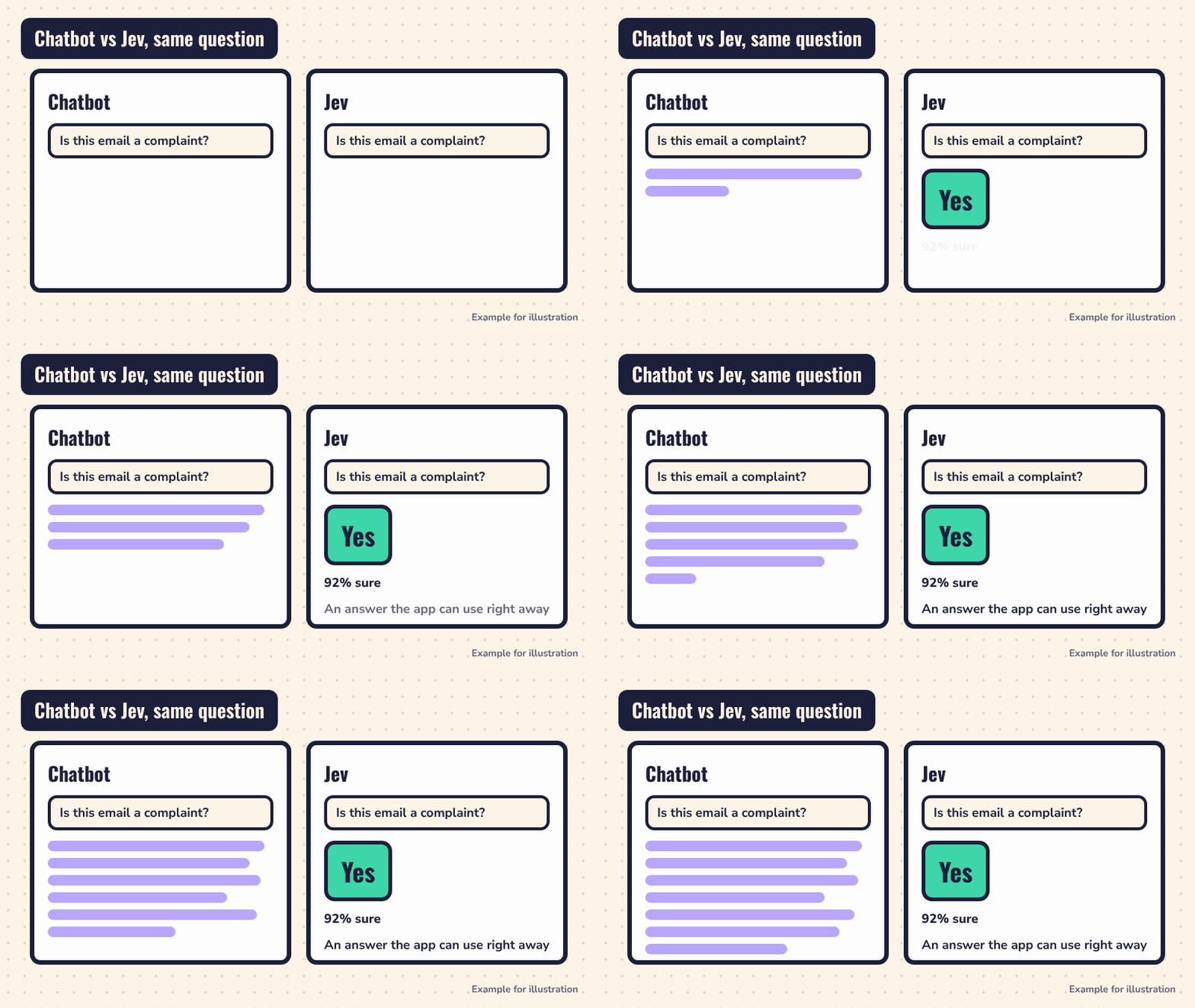
Picture this. You ask two friends, "Is this email a complaint?" The first friend writes you a long paragraph. The second friend just says, "Yes. I am 92% sure." If you are a computer app in a hurry, the second friend is the one you want.
A young AI company has built that second friend, and investors love it. On October 9, 2026, TechCrunch reported that TypeSafe AI raised $870 million at a $7.5 billion valuation. Its first AI model, called Jev, had come out on September 15. That is just 24 days between launch and the big deal.
So what is Jev, and why is it worth so much? Let us break it down.
First, what do chatbots do?
Chatbots like ChatGPT are great at talking. You ask a question, and they write an answer one small piece at a time, like a person typing.
That is perfect for people. But many apps do not need an essay. They need one clear choice, like a switch: yes or no, spam or not spam, send it to team A or team B.
When an app gets a long reply, it has to dig out the answer. And sometimes a chatbot makes things up and sounds very sure. Grown ups call this hallucination.
So what does Jev do differently?
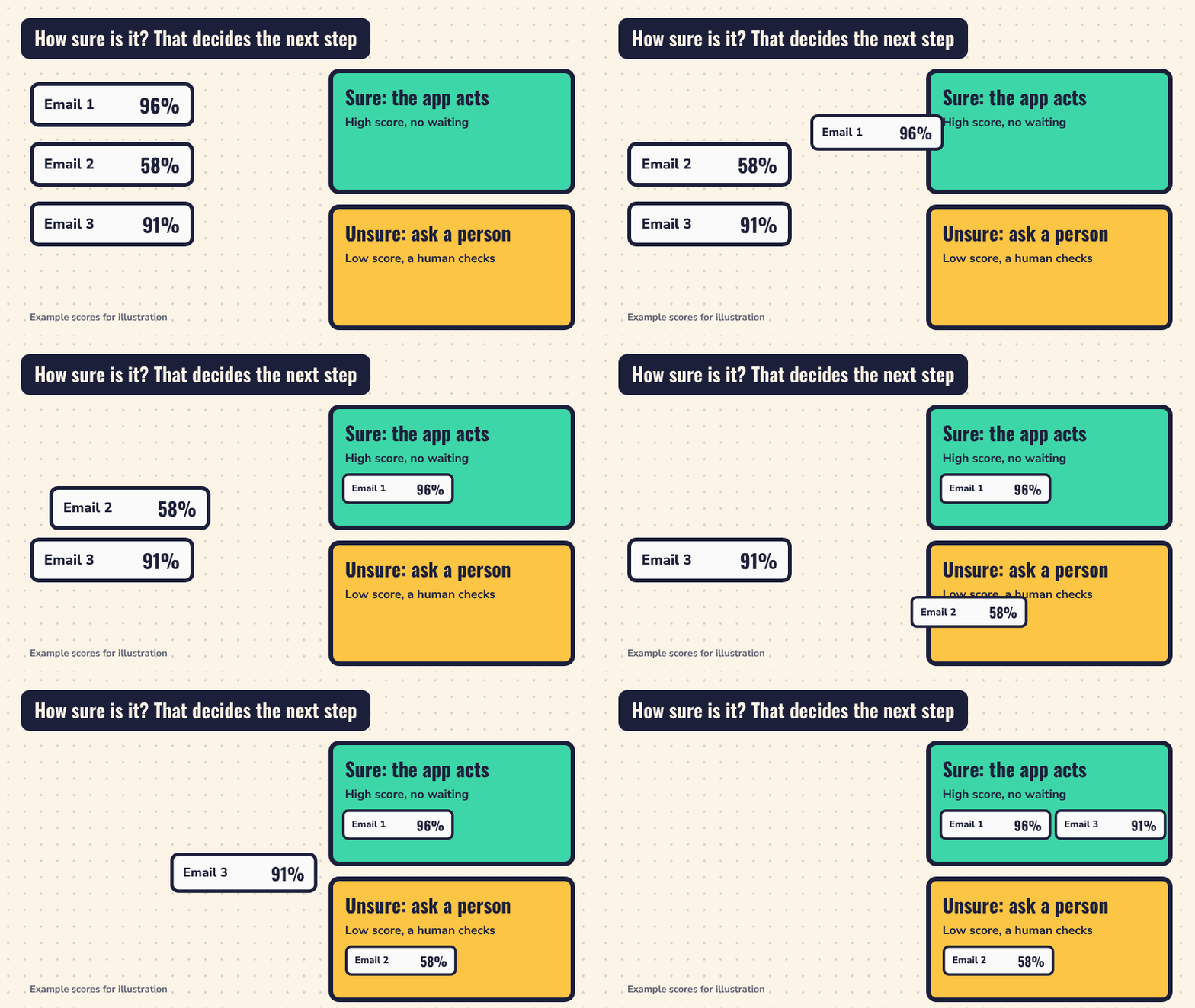
Jev does not write sentences at all. You tell it the possible answers in advance. Then it picks one and tells you how sure it is. That "how sure" number is called a probability, from 0% to 100%.
Think of a cricket umpire. The umpire does not give a speech. The answer is out or not out. Now imagine the umpire also said, "I am 95% sure." That is roughly how Jev works.
Because the answers are fixed in advance, TypeSafe says in its launch post that Jev "can't hallucinate." It cannot give an answer that is not on the list. The company calls Jev a "System One" model, built for quick, gut-feeling decisions instead of long thinking.
Who made it?
TypeSafe's chief executive is Diogo Almeida. At OpenAI, he helped build the methods behind ChatGPT, he writes in the launch post. He started TypeSafe in 2024 with Sasha Sheng, a former Meta research engineer, and Erik Gafni, TechCrunch reports.
Fast and cheap, says the company
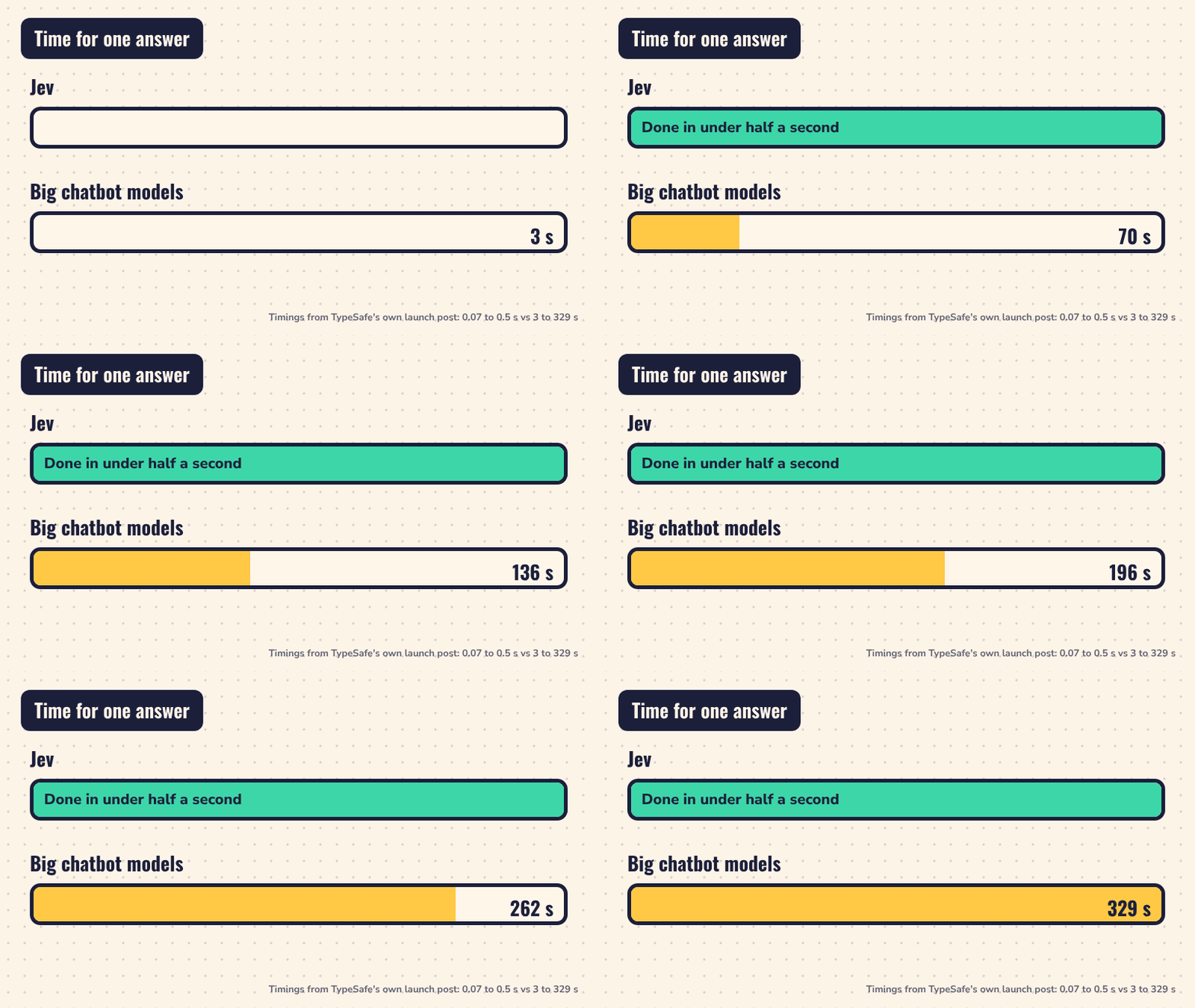
TypeSafe says one Jev answer takes 70 to 500 milliseconds. A millisecond is one thousandth of a second, so that is under half a second. Big frontier models (the most powerful chatbot models) take 3 to 329 seconds for the same kind of job, it says.
Its lead investor, Andreessen Horowitz, wrote that Jev costs roughly 1/100 to 1/500 of what frontier models cost. It also said Jev reached 1 trillion tokens in just three days after launch. A token is a small piece of text, a bit like a syllable.
Outside testers have tried it too. At the web company Vercel, swapping in Jev for a safety check gave results 5 to 18 times faster, and more accurate, TechCrunch reported in September.
It does not win every test. Another team, Bryo AI, sorted business emails. Google's Gemini was slightly more accurate than Jev. But Gemini cost 10 to 20 times more.
TypeSafe has also shown fun demos. In one, Jev plays the old video game Doom. In another, it races through Wikipedia, clicking from one page to another to reach a target page.
Why would anyone pay $870 million?
First, a quick word on valuation. Imagine a lemonade stall. If a friend pays ₹10 for a small share and that share makes your whole stall worth ₹100, then ₹100 is the stall's valuation. It is a price tag on the whole company, not money in the bank.
For TypeSafe, investors put in $870 million, and the whole company was valued at $7.5 billion. Andreessen Horowitz led the round. Sequoia and DCVC, an earlier investor, joined in. Andreessen Horowitz partner Martin Casado is joining TypeSafe's board, the company says.
What about big companies? TypeSafe says a third of Fortune 500 companies are using Jev. The Fortune 500 is a list of the 500 biggest companies in the US. Andreessen Horowitz gave a slightly different number: 25% of them, it wrote, have added Jev to their systems.
What is the catch?
A score only helps if someone decides what to do with it. Armin Ronacher, the chief technology officer of the software company Earendil, said Jev "delegates the hallucination problem a little bit to the user," TechCrunch reported. In simple words, people still have to pick which scores to trust.
TypeSafe itself admits some limits. Its test tasks were made by its own team, and it says "some bias could exist." It also says it "can't prove" its low prices are not subsidised. That means a company might sell below cost for now to win customers, like a new chai stall selling cups at ₹5 in its first week.
It has also been hard to keep up. Demand was so high after launch that TypeSafe briefly could not serve users from its API, TechCrunch reported. An API is the door that other apps use to talk to a service.
Why this matters to you
Many apps make tiny decisions all day. Is this message spam? Which team should handle this request? Does this answer need a human check? If tools like Jev keep proving fast and cheap, those small choices could get much quicker. For now, Jev is less than a month old, with a very big price tag and a lot still to prove.
Sources
- TechCrunch: The maker of non-text AI model Jev valued at $7.5B just weeks after launch
- TechCrunch: A new kind of AI model from a ChatGPT inventor is thrilling developers
- TypeSafe AI: Introducing System One models and Jev
- TypeSafe AI: Series A announcement
- Andreessen Horowitz: Investing in TypeSafe AI
- Cover photo: Server Room, by Carl Lender, CC BY 2.0

You may republish this story under CC BY 4.0: credit Pranav Sharma and link to this page.