Tesla starts making Optimus robots in California as its quarterly profit falls 43%
Sales held steady at about $28 billion, but heavy spending on AI and robots cut profit to $787 million. Here is what that means.
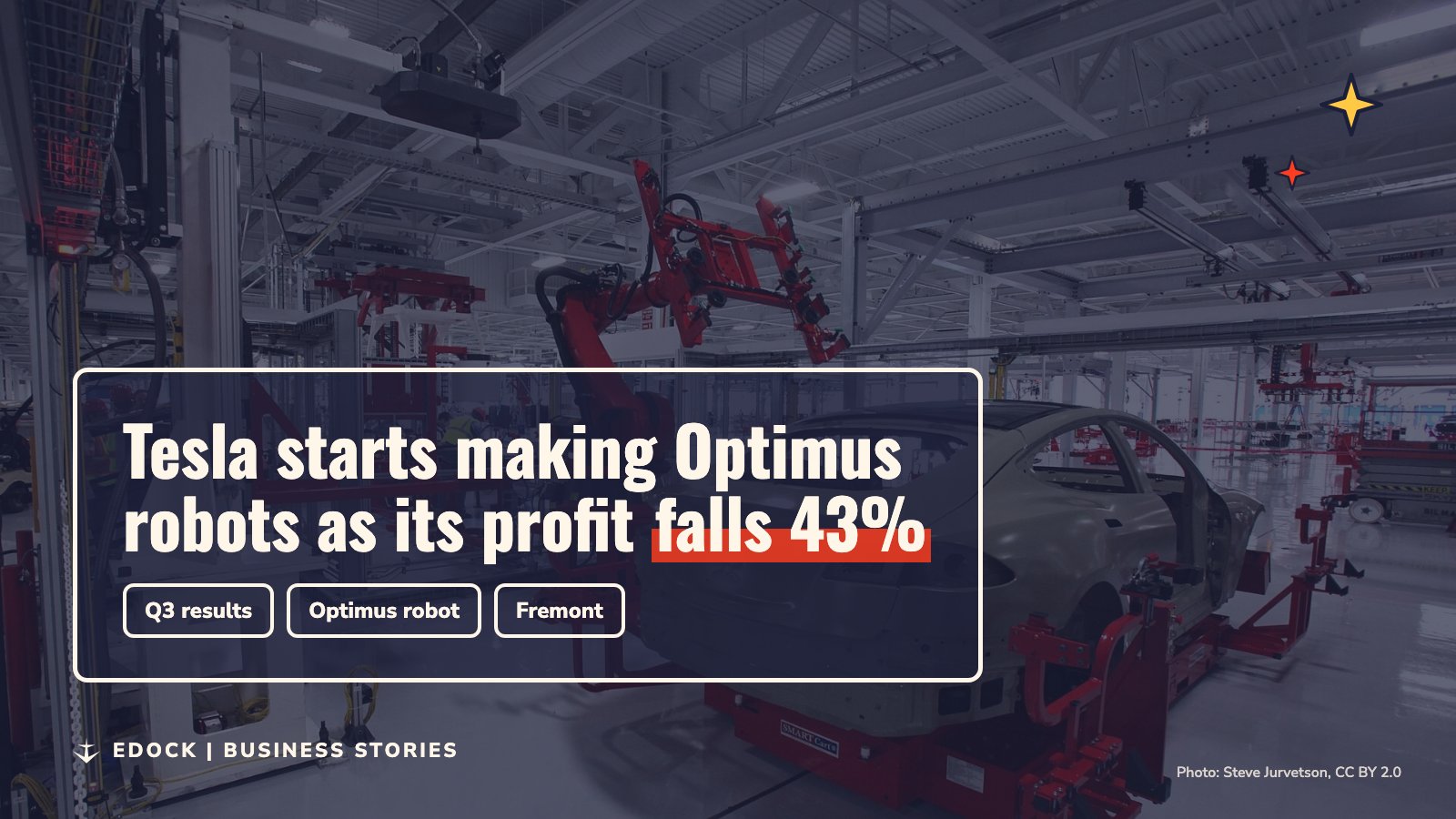
Picture a factory hall where electric cars used to roll down the line. Now, in that same space, the things coming off the line have two arms, two legs and a head. They are robots, built to look a bit like people.
On Wednesday, 21 October 2026, Tesla said it has started making its Optimus humanoid robot at its factory in Fremont, California, in a part of the plant once used for electric cars. On the very same day, it shared its results for July to September. Its profit for those three months fell 43%.
So one company had a big "first" and a weak report card on the same day. Here is what both mean, in plain words.
First, what is a quarterly profit?
Big companies share their numbers every three months. Each three month block is called a quarter. July, August and September make up the third quarter, or Q3.
Now think of a samosa stall. Say you sell samosas worth Rs 10,000 in three months. That is your revenue, all the money that came in. But you also paid for potatoes, oil, gas and the stall's rent. Whatever is left after all those bills is your profit. If the bills grow faster than your sales, your profit shrinks, even if you sell just as many samosas.
That is exactly what happened at Tesla.
Sales stayed flat, profit fell
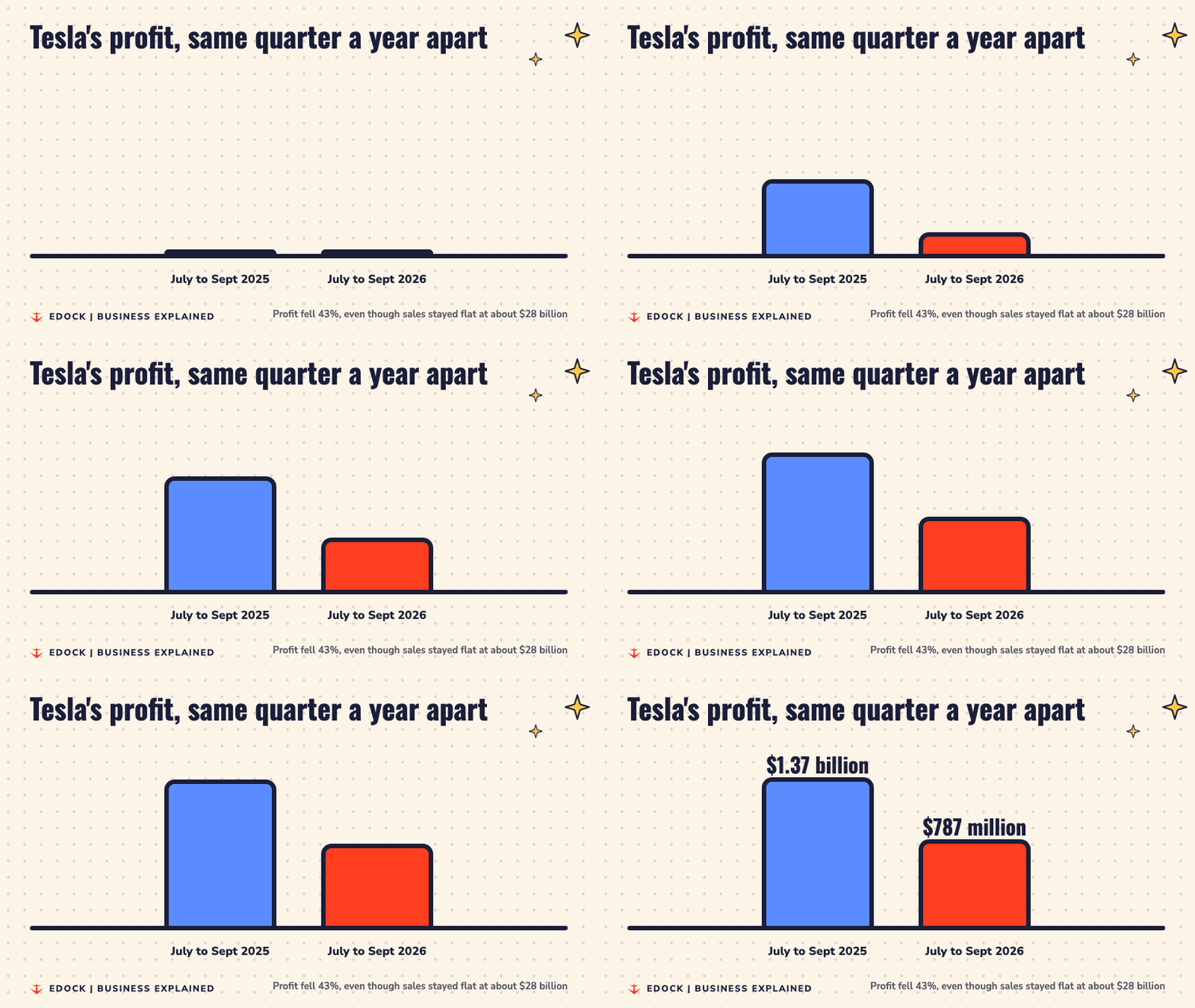
Tesla's revenue for the quarter was about $28 billion, almost the same as the same quarter a year ago, says its letter to shareholders. Shareholders are the people who own small pieces of the company.
But its profit, which the letter calls net income, dropped to $787 million, down 43% from $1.37 billion a year earlier. Quick check: $787 million is about 57% of $1.37 billion, so a little over two fifths of the profit is gone.
Car sales did not save the day either. Tesla delivered 486,532 vehicles in the quarter, down 2.1% from a year ago. In its letter, Tesla said battery supply was the main thing holding back how many cars it could sell.
So where did the money go?
The biggest reason is spending on the future. Tesla's operating expenses, the money it spends to run the company beyond building the cars themselves, went up 39% to $4.78 billion.
Inside that, research and development (R and D) jumped 69% to $2.76 billion. R and D is money spent on inventing and testing new things before they earn anything. It is like a cricket team paying for a new academy: the young players may win matches one day, but today they only cost money. Electrek says this spending is going into what Tesla calls "Super Intelligence" (its AI work), Optimus, and its Cybercab robotaxi.
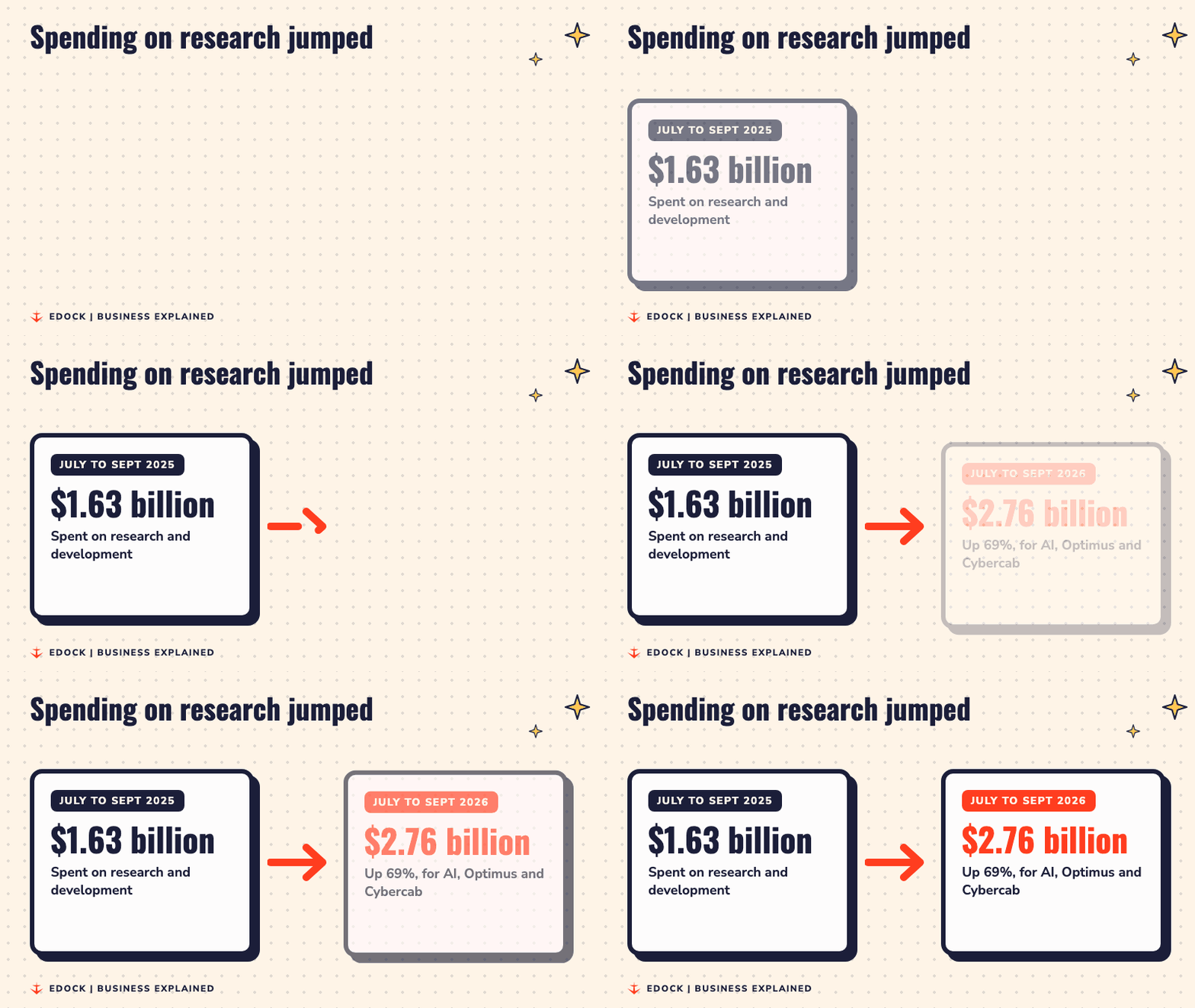
Quick check: $2.76 billion minus $1.63 billion is $1.13 billion of extra research spending in a single quarter.
Two more things hurt:
- Fewer credit sales. In the US, carmakers that miss pollution rules used to buy "credits" from cleaner carmakers like Tesla, a bit like buying extra marks from a classmate. Tesla earned only $113 million from these credits, down from $417 million. Electrek says this market has mostly dried up.
- A weaker energy business. Tesla also sells big batteries for homes and power grids. That revenue fell 16%, which Tesla blamed on refunds to customers linked to tariffs (taxes on imported goods).
There was one bright spot. Tesla's services business, which includes paid self-driving software for its cars, grew 33% to $4.6 billion and earned a record $734 million in gross profit (profit before the big company-wide costs).
Tesla is not short of cash, though. It ended the quarter with $45.4 billion in cash and investments.
What exactly is Optimus?
Optimus is a humanoid robot: a machine shaped roughly like a human, with arms, legs and hands. Most factory robots are just one big arm bolted to the floor. A humanoid is meant to walk around and work in spaces built for people.
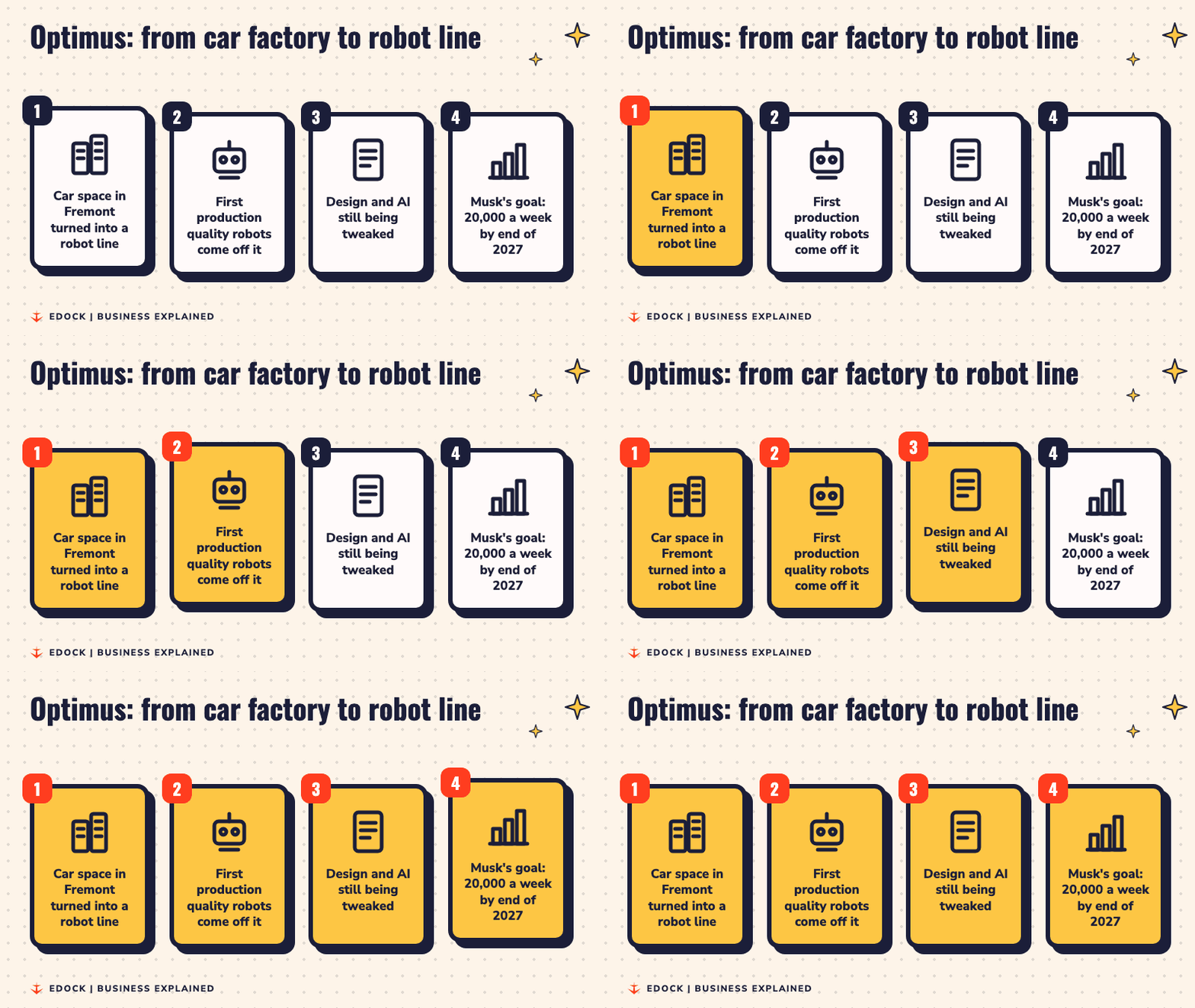
In its letter, Tesla wrote that the robots now coming off the Fremont line are "the first production-quality bots that we have manufactured." It added that it has proven its way of making Optimus is suitable for a product it can sell, while it keeps improving the hardware and the process. The same letter lists an Optimus factory in Texas as under construction.
How fast will the robots come?
Not very fast at first, by Tesla's own account. On a call with analysts, CEO Elon Musk called this "early production" and said the climb would be slow and "somewhat bumpy" because the product is so new.
He also said some design work is still left. The robot has to be safe, reliable and long lasting, so it does not wear out after a month. And there is still a lot of AI work before the robot is truly useful for open-ended tasks, meaning tasks nobody planned for in advance.
Even so, Musk claimed Tesla will be able to make 20,000 robots a week by the end of 2027. That is a target, not a promise. Tesla's own timelines have slipped before: TechCrunch notes that the date for its "unsupervised" self-driving software, where the driver does not need to watch the road, was pushed back again.
Why should a student in India care?
Because this is a live example of a lesson every business learns. A company can choose to earn less today to build something big for tomorrow. Tesla is making that choice in public: its sales are steady, but it is pouring billions into AI and robots, and its profit is paying the price.
Whether the bet works is still an open question. The robots are only in early production, and the 20,000 a week goal is more than a year away. What is clear is the trade off: today's profit for tomorrow's possible product.
Here is Bloomberg's video report from Tesla's earnings call.
Sources

You may republish this story under CC BY 4.0: credit Manpreet Kaur and link to this page.