Tata Capital's profit jumps 51%, and its loans get costlier from 1 November
Version 1 of 1 saved 28 Oct 2026, 9:34 am IST · Chain line 293
As it was first published
Tata Capital's profit jumps 51%, and its loans get costlier from 1 November
The Tata group's lender earned Rs 1,660 crore in three months, lends faster with AI, and will raise floating loan rates after the RBI's hike.
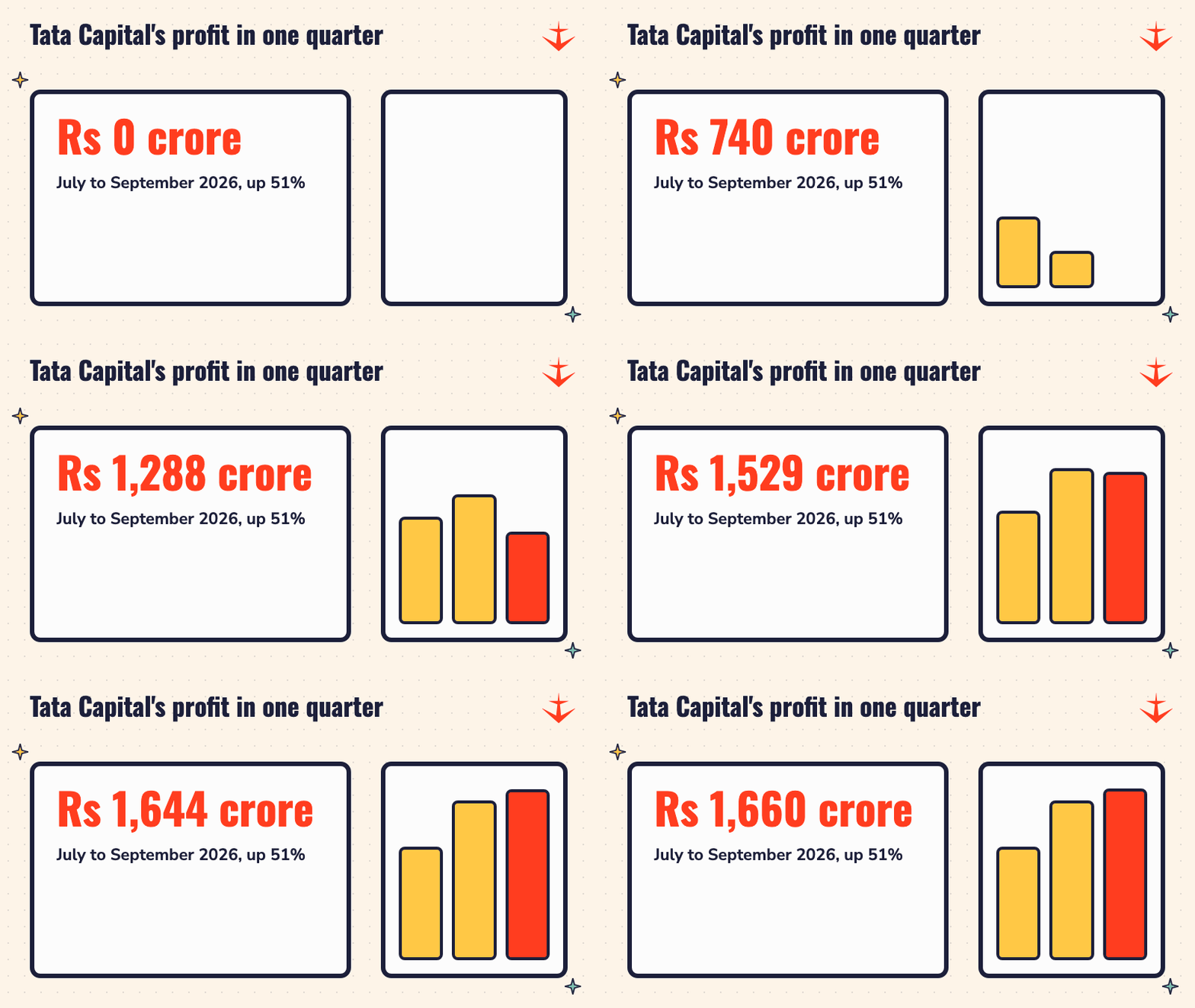
Picture this: between July and September 2026, Tata Capital made about Rs 18 crore of profit every single day. On Tuesday, 27 October 2026, the Tata group's money-lending company said its profit for those three months jumped 51% to Rs 1,660 crore, up from Rs 1,097 crore a year earlier. That is the consolidated number, which means the main company and its home loan arm added together.
And there is a second piece of news hidden inside, one that touches ordinary borrowers. From 1 November, Tata Capital will raise the interest rate on its floating-rate loans by 20 to 25 basis points. Here is what all of this means, in plain words.
First, what kind of company is Tata Capital?
Tata Capital is the main financial services company of the Tata group. The Reserve Bank of India (RBI) lists it as an NBFC, short for non-banking financial company.
An NBFC is a lender that is not a bank. Think of it like this: a bank is the big school canteen, while an NBFC is a busy snack stall outside the gate. Both feed hungry students, but they run under different rules. Tata Capital gives home loans, personal loans, two-wheeler loans, business loans and more. In all, it offers over 25 kinds of loans through 1,515 branches in 26 states and union territories.
This short video explains what NBFCs are and how they differ from banks.
How does a lender actually make money?
Imagine a friend borrows Rs 100 from an elder cousin and promises to pay back Rs 107 next year. Then the friend lends that same Rs 100 to a schoolmate, asking for Rs 112 back. The Rs 5 in the middle is the friend's earning. A lender works the same way, just with crores instead of hundreds.
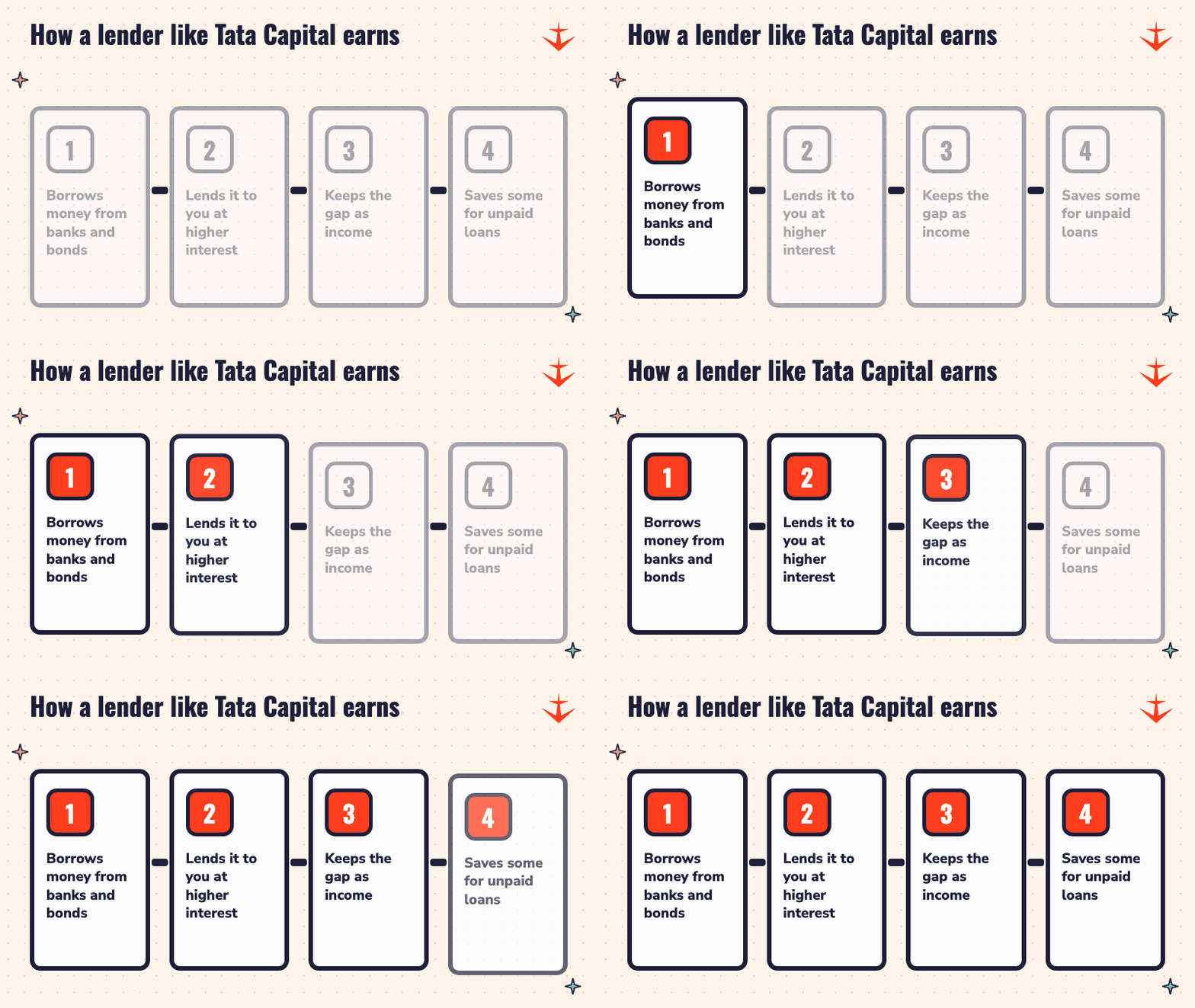
That gap has a name: net interest income. For Tata Capital, it rose 23% to Rs 3,696 crore in the July to September quarter, from Rs 3,006 crore a year earlier. The company also earned Rs 725 crore in fees, up 9%. Adding a few more items, its net total income came to Rs 4,676 crore, up 24%.
Where did the big jump in profit come from?
Three simple things helped.
1. It lent a lot more money. Tata Capital's gross loan book, meaning all the money it has lent out and not yet got back, crossed Rs 3 lakh crore for the first time. It stood at Rs 3,03,739 crore at the end of September, up 27% from Rs 2,39,960 crore a year before. In short, about Rs 2.4 lakh crore grew to about Rs 3.04 lakh crore.
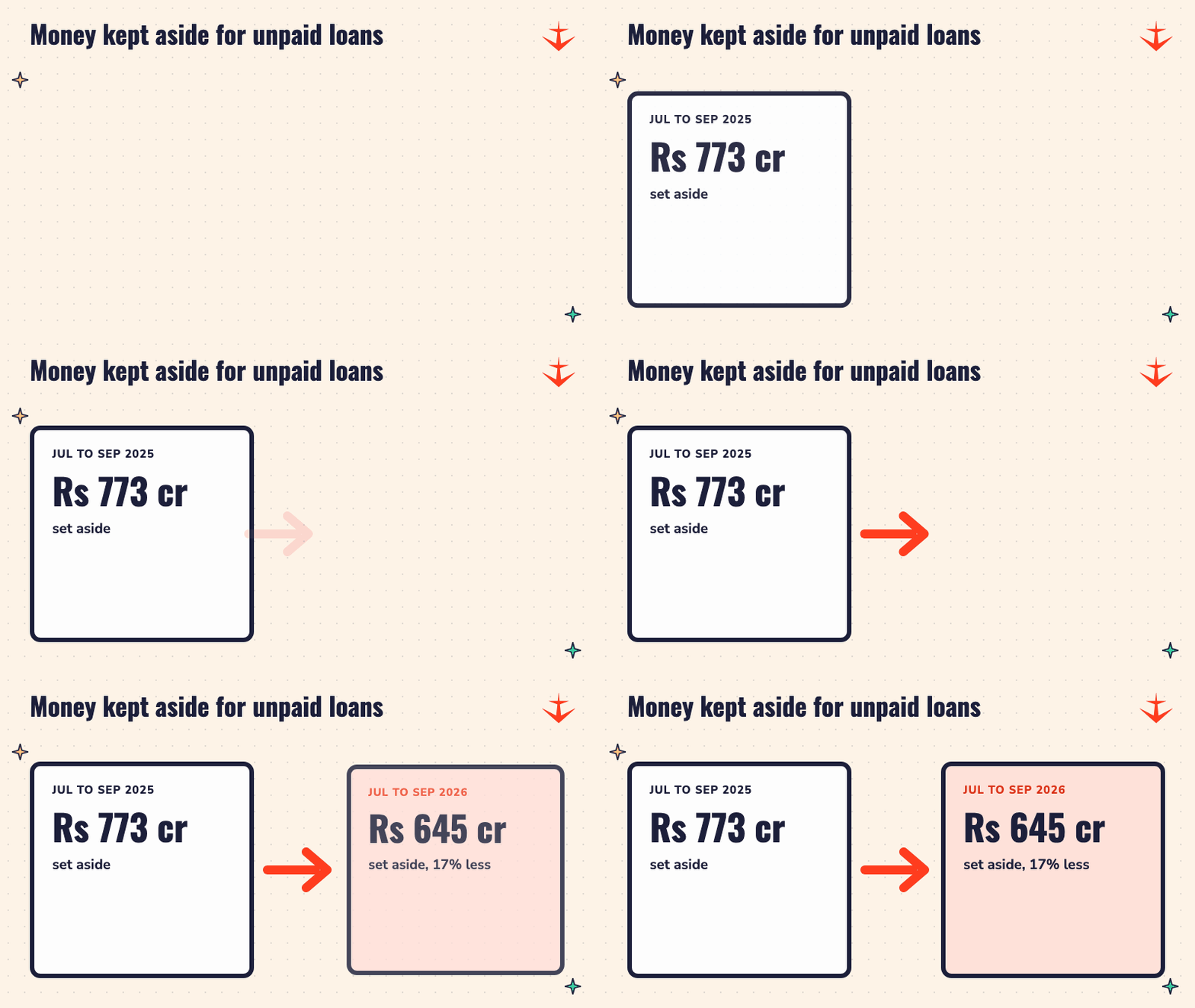
2. It needed to keep less money aside for unpaid loans. Every lender knows a few borrowers will not pay back. So it keeps some money aside, a bit like a shopkeeper keeping a small box of cash for torn notes. This is called provisions. Tata Capital set aside Rs 645 crore this quarter, 17% less than Rs 773 crore a year ago.
3. Running costs grew slower than income. Operating costs, things like salaries and offices, rose 10% to Rs 1,651 crore, while income rose 24%. So out of every Rs 100 it earned, it spent about Rs 35.30 on running the business, down from about Rs 39.70 a year earlier. The company calls this its cost to income ratio, which improved to 35.3% from 39.7%.
Who borrows from Tata Capital?
Mostly regular people and small businesses. The Economic Times reports that the company's retail loans, which include home loans, loans against property, two-wheeler loans, personal loans and business loans, stood at Rs 1.51 lakh crore. Loans to big companies were Rs 44,862 crore, and motor finance loans were Rs 23,591 crore.
Unsecured loans, meaning loans given without anything like a house or a bike kept as a guarantee, made up 10% of the money it manages. These are riskier for a lender, because there is nothing to take back if the borrower stops paying.
Are people paying their loans back?
Mostly, yes. Tata Capital's gross stage 3 ratio, a fancy name for loans that are badly overdue, was 1.9% at the end of September. Put simply, for every Rs 100 lent, about Rs 1.90 sits in loans that are seriously late. After counting the money already kept aside, that falls to 0.8%. Managing director and CEO Rajiv Sabharwal said the quality of its loans stayed stable, thanks to careful lending and good collections.
Robots now read most loan forms
Here is a change young borrowers may notice. Tata Capital says more than 70% of its retail loan applications are now processed using AI. For personal loans and business loans, AI helps check the borrower in over 95% of cases. The company says this has cut the time to process a loan by over 39%.
In simple words, a loan form that once waited on a desk for a person to read it is now checked first by software. That can mean a faster yes or no. AI agents also handle a big share of customer calls and early reminders to pay.
In this July 2026 interview, from the previous quarter, Sabharwal spoke about AI, the push into retail loans and home loans.
What changes for borrowers from 1 November?
This is the part that touches wallets. On 7 October 2026, the RBI raised its repo rate by 25 basis points, from 5.25% to 5.50%, its first hike since February 2023. The repo rate is the rate at which banks borrow from the RBI. When that goes up, borrowing gets costlier for everyone down the line.
So Tata Capital will lift rates on its floating-rate loans by 20 to 25 basis points from 1 November, Sabharwal said. A floating-rate loan is one whose interest rate moves up or down over time, like a bus fare that changes with diesel prices. A basis point is one hundredth of 1%. So 25 basis points means 0.25 percentage points.
How much is that? On a loan of Rs 1 lakh, an extra 0.25 percentage points of interest works out to roughly Rs 250 more a year.
There is one more rule change to watch. The RBI has proposed that NBFCs stop giving revolving credit, which works like a flexi loan you can dip into and refill again and again. Sabharwal said such loans make up about 3 to 4% of Tata Capital's book, and that the company is "evaluating alternative products".
What comes next?
To keep lending more, a lender must keep borrowing more. Tata Capital's board approved raising the limit of its foreign borrowing programme from 2 billion dollars to 3 billion dollars. Sabharwal also said the company expects to raise fresh capital in the second half of FY28, depending on how quickly the loan book grows.
For a student eyeing a first two-wheeler loan, or a small shop owner who needs money for stock before a festival, the message is simple. Lenders like Tata Capital are lending more and checking forms faster with AI, but the price of borrowing is now creeping up.
Sources
- Tata Capital: Press release, financial results for Q2FY27 (27 October 2026)
- The Economic Times: Tata Capital Q2 net profit rises 51% on higher income
- The Economic Times: Tata Capital Q2 results, profit jumps 51% to Rs 1,660 crore
- Business Today: Tata Capital Q2 PAT jumps 51%, loan book crosses Rs 3 lakh crore
- Business Standard: Tata Capital Q2FY27 results, net profit surges 51%
- Motilal Oswal: RBI raises rate by 0.25%, and the effect on the economy
- Cover photo: Bombay House, Tata Group Headquarters in Mumbai, by AroundTheGlobe, CC BY-SA 3.0
