Swiggy's loss shrinks to Rs 922 crore as revenue jumps 36%
Version 1 of 1 saved 22 Oct 2026, 7:28 pm IST · Chain line 147
As it was first published
Swiggy's loss shrinks to Rs 922 crore as revenue jumps 36%
Food delivery made record profits in July to September 2026, but Instamart's quick commerce push kept Swiggy spending more than it earned.
Picture a samosa stall that sells many more samosas every month, yet still ends each month with less money than it started with. That is roughly where Swiggy, the food delivery app, stands today. On Thursday, 22 October 2026, Swiggy said it lost Rs 922 crore in the July to September quarter, down from a loss of Rs 1,092 crore a year earlier.
In the same three months, its revenue from operations jumped 36% to Rs 7,571 crore. So sales are rising fast, and the loss is getting smaller. But the company is still spending more than it earns. Here is what that means, and what each part of Swiggy did.
First, what is a quarter and what is Q2 FY27?
A quarter is simply three months. Indian companies count their money year from April to March. So July to September is the second quarter of the year that ends in March 2027. People write this as Q2 FY27. Think of it like the second term of a school year.
Revenue up, loss down: how can both be true?
Go back to the samosa stall. Revenue is all the money that comes in when people buy samosas. Expenses are what you pay for potatoes, oil, the gas cylinder, your helper and the rent for the cart. If expenses are bigger than revenue, you have a loss. If they are smaller, you have a profit.
Swiggy's total expenses rose to Rs 8,703 crore in the quarter. That is more than its revenue of Rs 7,571 crore. Swiggy also had other income of Rs 212 crore, which took its total income to Rs 7,783 crore. Even then, money going out was bigger than money coming in, by about Rs 920 crore. That gap is close to the final loss of Rs 922 crore.
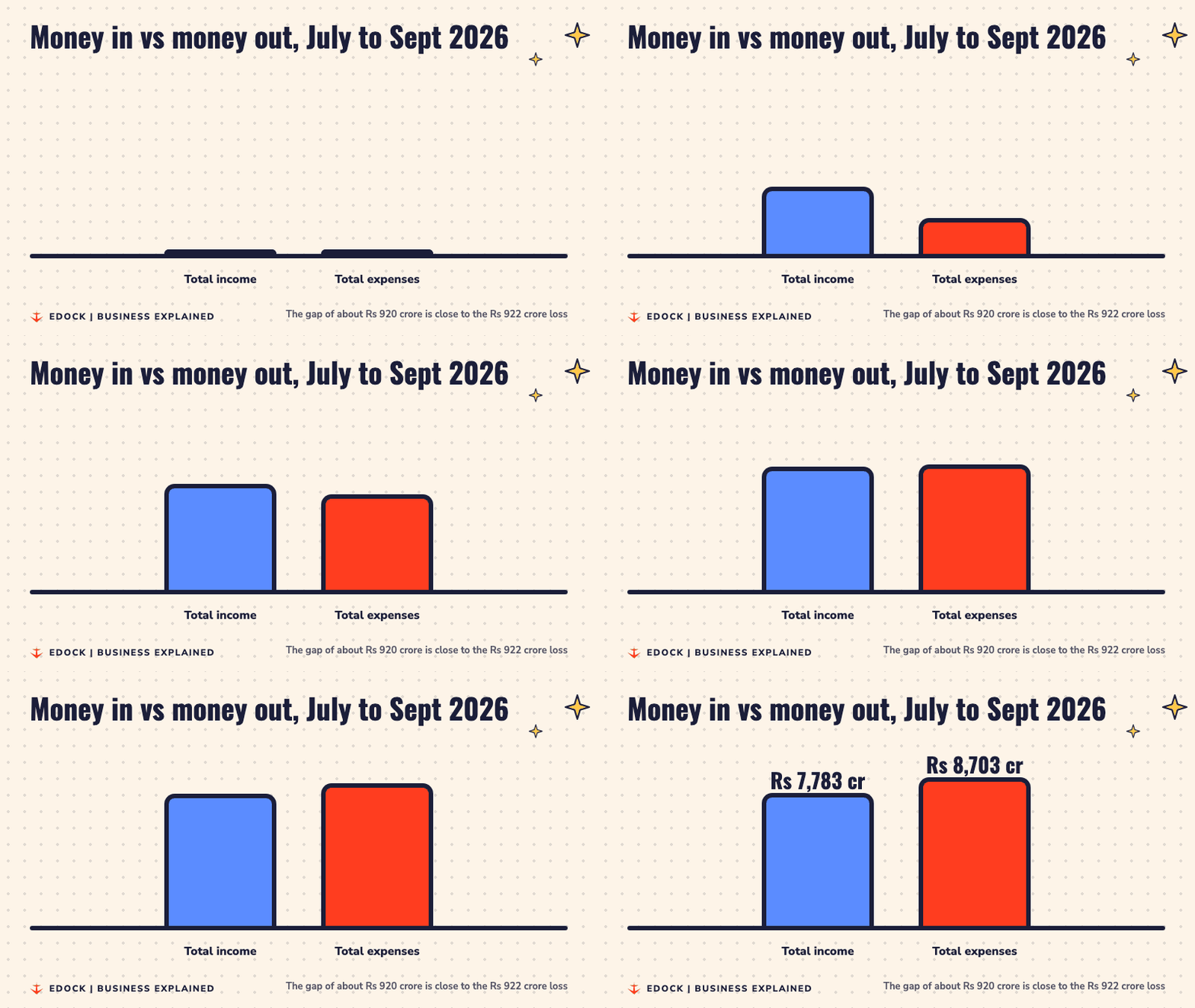
Still, the loss is smaller than last year. According to Inc42, it narrowed by 16% compared with the same quarter a year ago. Check the sum: Rs 1,092 crore minus Rs 922 crore is Rs 170 crore, and that is about 16% of Rs 1,092 crore.
There is a catch. The loss was bigger than in the April to June quarter just before it. It was also bigger than what experts who study the company had guessed. Mint reported that analysts had expected a loss of 7.92 billion rupees, which is Rs 792 crore. Revenue, on the other hand, came in higher than they expected.

Food delivery: the part that makes money
Swiggy is really a few businesses under one roof. The oldest one, food delivery, is doing well. The money value of all food orders, called gross order value or GOV, grew 17.7% to Rs 10,054 crore. GOV is like adding up the full bill of every order placed on the app.
Food delivery's adjusted EBITDA went up by Rs 101 crore to Rs 341 crore. EBITDA is a way of measuring the money a business makes from its daily work, before some costs like interest, tax and the slow wearing out of machines are taken away. Think of it as what the samosa stall earns from selling samosas, before paying back the loan for the cart.
Mint said this record profit came from higher advertising revenue and delivery efficiencies. Advertising revenue is money restaurants pay to show up higher in the app, a bit like a shop paying for the best spot at a mela.
Swiggy's chief, Sriharsha Majety, said food delivery "delivered its highest-ever profits and margins". He also named Toing, Swiggy's separate offering for affordable meals. Swiggy is testing Toing as a new app for people who want cheaper food.
Instamart: growing fast, still losing money
Instamart is Swiggy's quick commerce arm. Quick commerce means groceries and other items reach your door in minutes. To do this, Instamart uses dark stores. These are small warehouses close to homes, packed with goods but not open to walk-in shoppers. Think of a kirana shop with its shutter down that only packs orders for delivery riders.
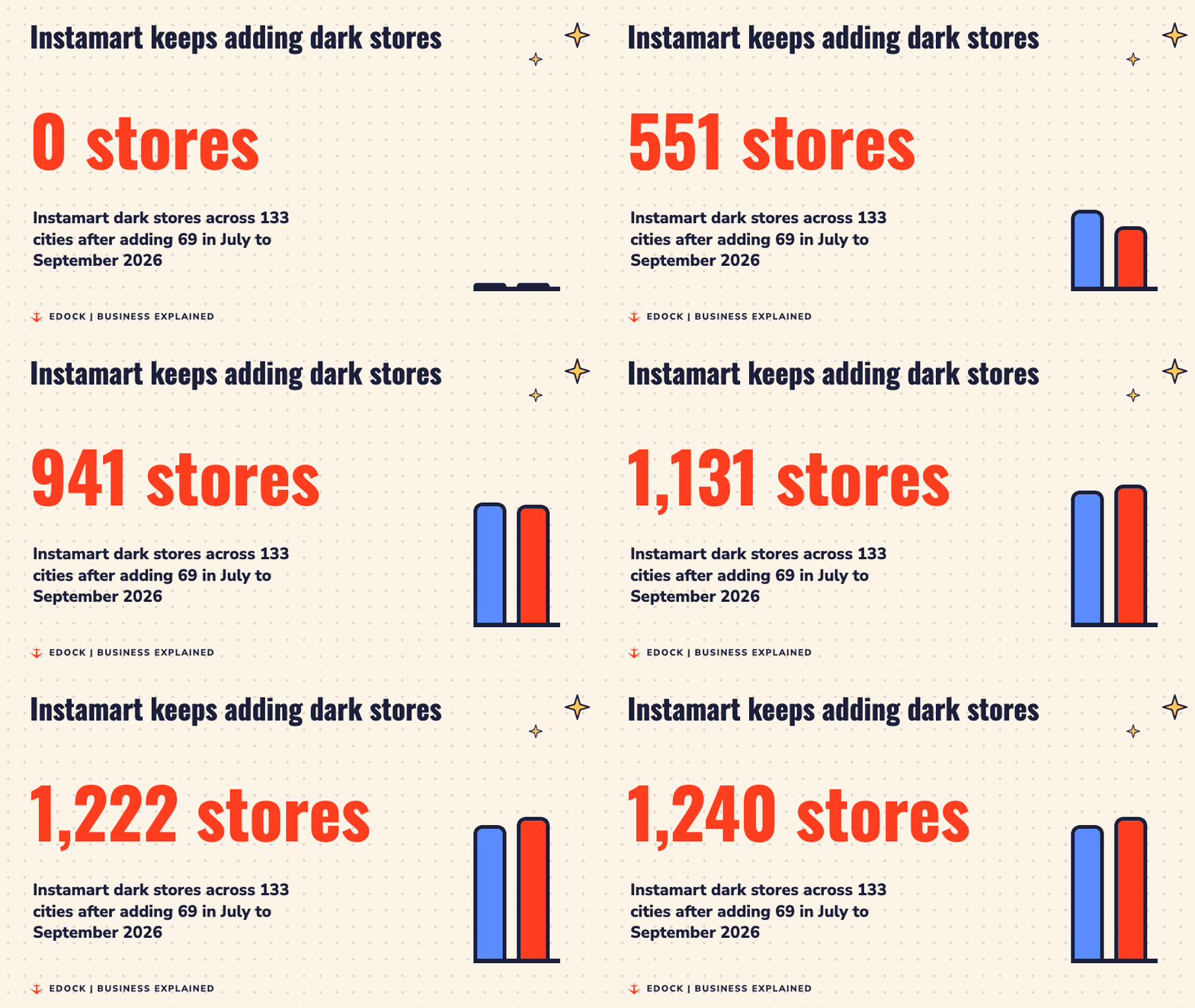
Instamart's GOV grew 31% to Rs 9,230 crore, from Rs 7,022 crore a year earlier. It added 69 dark stores in the quarter, taking its total to 1,240 stores across 133 cities. About 14.8 million people used it every month.
But growth is costing money. Instamart's adjusted EBITDA loss widened to Rs 895 crore, from Rs 849 crore a year earlier and Rs 778 crore in the June quarter. Mint said Swiggy spent more on pricing, winning new customers and warehouse expansion. Inc42 added that Swiggy put money into targeted pricing to bring back users who had stopped ordering, and paid the starting costs of new dark stores.
Orders on Instamart rose 29% to 130.3 million, and the average order was worth Rs 506. Swiggy said it believes Instamart's losses peaked in this quarter. That is the company's own view, and only the coming quarters will show if it holds.
A big change coming to Instamart
Swiggy also announced a new plan. It will start moving Instamart to an inventory-led model by the middle of the October to December quarter, according to Inc42. In simple words, this means owning more of the goods it sells, like a shopkeeper who buys stock and keeps it on his own shelves.
Swiggy said this could give it more control over assortment, pricing and availability. It could make the move because it now qualifies as an Indian-owned and controlled company, which Majety called an important milestone. Inc42 reported that this new status is what lets Swiggy move Instamart to the inventory model.
The race around Swiggy
Swiggy is not alone. Its rival Blinkit, owned by Eternal, added 308 net stores in the same quarter, Mint reported. And Flipkart is testing its own food delivery service, "Eat-in by Minutes", in Bengaluru, with more than 8,000 employees trying it so far.
For young people who order biryani at midnight or chips during a cricket match, this race matters. More players often means more offers, faster delivery and new apps to try. For Swiggy, the job ahead is simple to say and hard to do: keep the sales growing while making sure money in becomes bigger than money out.
Watch the results news
Sources
- Business Standard: Swiggy Q2FY27 results, net loss narrows to Rs 922 crore
- ET Retail: Swiggy Q2 results, loss narrows YoY to Rs 922 crore
- Inc42: Swiggy Q2 loss narrows 16% YoY to Rs 922 crore
- Mint: Swiggy's Q2 loss narrows on food delivery gains, misses estimates
- Mint: Flipkart tests Eat-in by Minutes in Bengaluru
- Video: ET Now on Swiggy's Q2 results
- Cover photo: A man carrying takeaway delivery packages, by Meanwell Packaging, CC BY 2.0
