Starting a small business from home? GST registration just got easier
New tax office rules say no Udyam proof, no objection to a home address, and a decision within seven working days.


Picture this. You want to sell homemade samosas to offices near your flat, and your kitchen is your factory. To do it properly, you need a GST number. Until now, a tax officer could hold up that number just because your address was a house, or ask for papers the law never asked for. On Tuesday, 27 October 2026, India's indirect tax department told its officers to stop doing that.
The new rules make GST registration simpler, put a clock on officers, and make tax notices fairer. A separate change, from 1 November, makes discounts given after a sale easier to handle. Here is what each one means, in plain words.
First, what is GST?
GST stands for Goods and Services Tax. It is a tax added to the price of almost everything you buy, from a phone to a plate of chaat. India started GST on 1 July 2017, and the new tax replaced many older ones, like VAT and service tax.
A shop collects this tax from buyers and pays the money to the government. To do that, the shop needs a GST number, which comes through GST registration. Think of it like a school roll number. Until you get one, you are not on the list.
Who changed the rules?
The Central Board of Indirect Taxes and Customs, or CBIC, runs GST for the central government. The board issued eight circulars dated 26 October 2026. A circular is an official letter telling officers how to apply the law. They were made public on Tuesday.
These circulars follow the 57th meeting of the GST Council on 8 October 2026, chaired by Union Finance Minister Nirmala Sitharaman. The GST Council is the group that decides GST rules for the whole country.
This video walks through the eight circulars, numbered 257 to 264.
What changes for someone starting small
The biggest circular, number 257, is about registration. According to the circular, these things alone can no longer be a reason for an officer to object:
- No Udyam certificate. Udyam is the government's sign-up for small firms. Officers should not ask for it before giving a GST number.
- A home address. Officers should not assume a house is unfit for business.
- The electricity bill. A domestic connection instead of a commercial one, or the size of the bill, is not a valid reason to object. Bills are checked mainly for the name and the address.
- Living in another city. If the owner's own home is in a different city or state, that alone is not a problem.
The Economic Times reported that the move is expected to help a large number of MSMEs and businesses working from co-working spaces. MSMEs are micro, small and medium enterprises, like a tailoring unit or a small bakery.
The circular also gives a clear paper list. If you run your samosa kitchen from your parents' flat, you pick "Consent" as the type of premises and attach a consent letter with ownership or address proof. A co-working desk needs the membership agreement plus the owner's or lease papers. A bank account is not needed on the day you apply. Its details are due within thirty days of registration, or sooner if you file your first sales details before that.
Seven days, or the answer counts as yes
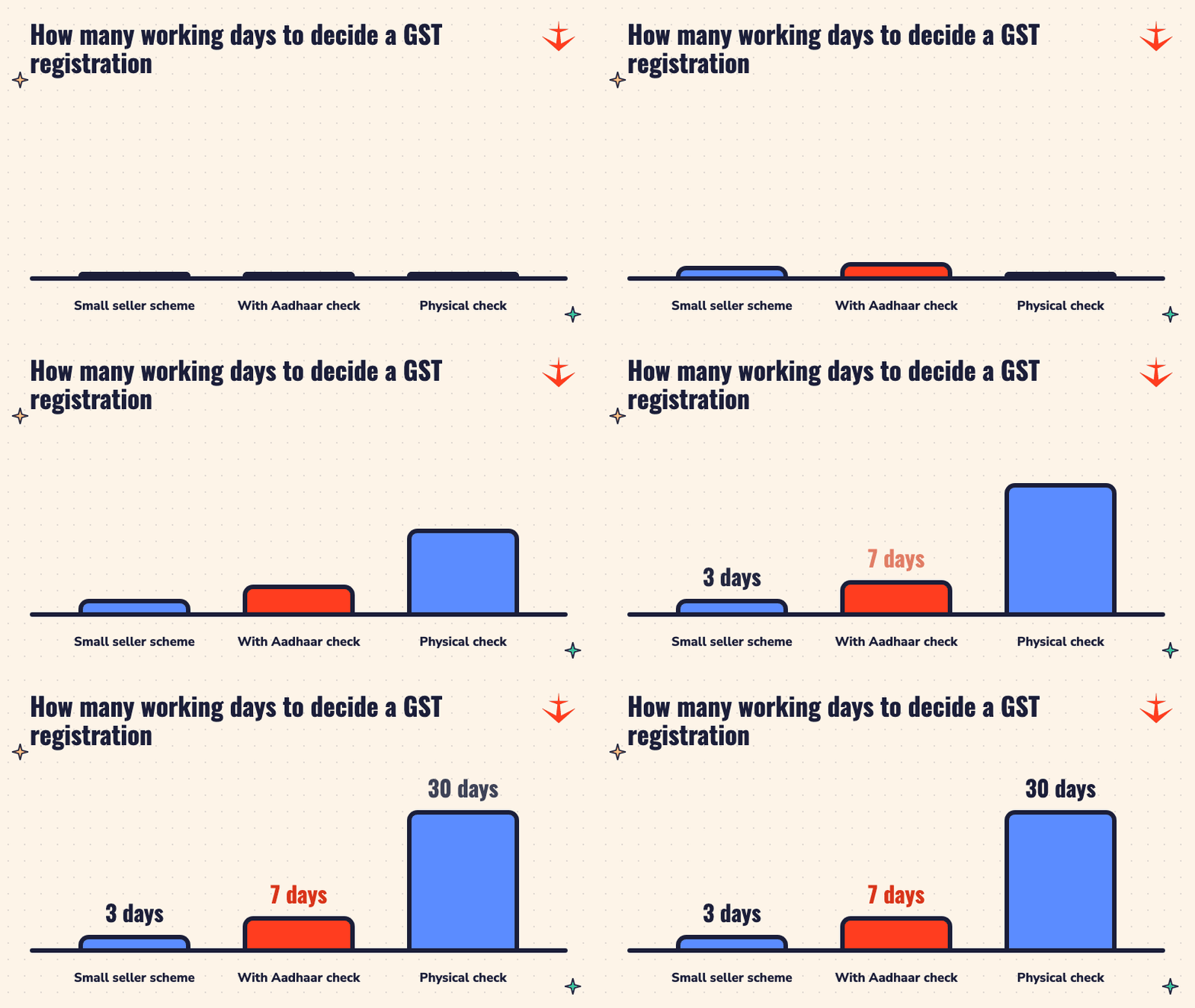
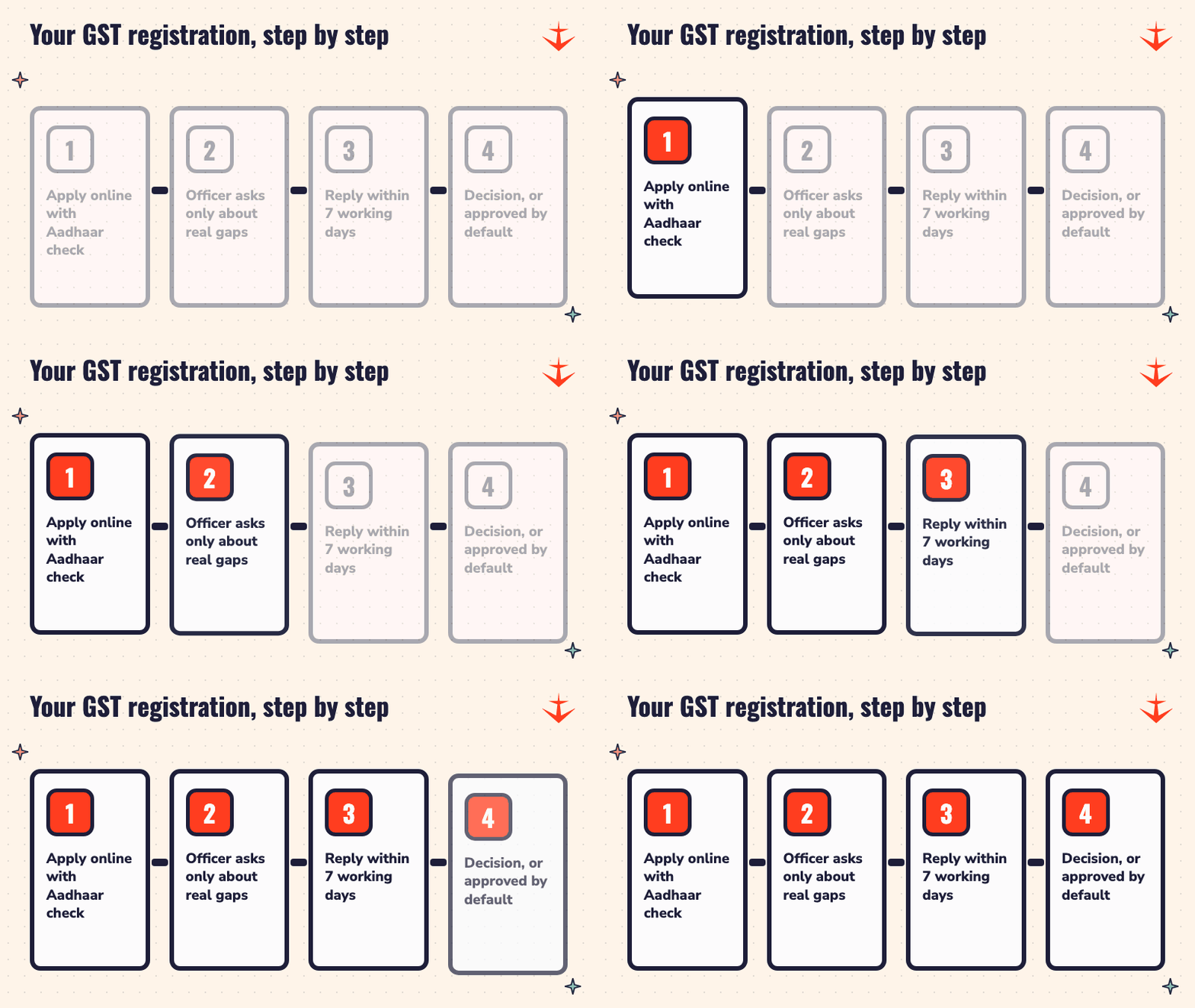
Now the clock. If you verify yourself online with Aadhaar and the check succeeds, the officer should process the application within seven working days. If there is no Aadhaar check, or the officer needs to visit the premises, the limit is generally thirty days.
If the officer finds a real gap, like a blurry document or a wrong address, a query goes out on a form called REG-03. The applicant replies within seven working days. The officer then has seven working days to decide. If the officer does nothing within the time limit, the registration is treated as approved. Think of a teacher who says: if there is no objection by Friday, your project is accepted.
Very small sellers who choose a simpler scheme, under a rule called Rule 14A, can get registration within three working days, if they meet the conditions.
And if an officer delays the application or keeps asking for needless papers, the applicant can complain to the senior tax commissioner through a special email address for each zone or state.
Fewer scary tax notices
A show-cause notice is a letter from the tax office asking a business to explain why it should not pay extra tax or a fine.
Circular 258 says officers cannot call something fraud just because tax remains unpaid or a check found a mismatch. They must show evidence and an intent to evade tax. It is like a referee who must check the replay before showing a red card.
Every notice must now name the alleged mistake, the period, the evidence, and how the tax, interest or penalty was worked out, preferably year by year. Central and state officers also cannot run two cases on the same matter.
Discounts after the sale, from 1 November
Here is the second big change. Say a biscuit company sells cartons to a shop at full price. A month later, the shop has sold plenty, so the company gives a discount.
Under the old rule, GST could be cut on that discount only if it was known and agreed before or at the time of the sale and linked to the bill. In real life, most such discounts are given later, without any written deal.
From 1 November 2026, no prior agreement is needed. The seller issues a credit note, a slip that says "you owe me this much less". The buyer then gives back the matching input tax credit. Input tax credit is the tax a shop already paid on the things the shop bought, which can be subtracted from the tax it owes. The Economic Times said the change should help FMCG companies, which make everyday goods like soap and biscuits, along with medicine makers and retailers.

Also from 1 November, businesses where the tax on inputs is higher than the tax on what they sell can claim 90% of their refund upfront, subject to risk checks. And the old Rs 1,000 minimum for export refunds goes away, which helps small courier and postal exporters.
What is still to come
Some decisions need changes to the GST laws themselves. Those are targeted for 1 April 2027. They include changes to arrest rules and a minimum of Rs 10,000 before a show-cause notice can be sent. The Council also decided to raise the limit for prosecution to Rs 5 crore from Rs 1 crore.
Saurabh Agarwal, a tax partner at EY India, said, as quoted by The Economic Times, "the latest clarification will bring greater certainty, consistency and standardisation in tax administration." He added that following the rules the same way across all tax offices will be key.
This video explains the main reforms from the 57th GST Council meeting.
For a young person with a small idea, a home kitchen, a laptop or a rented desk, the message is simple. The paperwork to start is now clearer, and officers have a deadline.
Sources
- The Economic Times: GST registration gets easier as CBIC drops Udyam proof
- The Economic Times: Centre eases GST rules for post-sales discounts
- TaxO: CBIC issued various circulars after the 57th GST Council meeting
- TaxGuru: Decoding CBIC Circular No. 257/03/2026-GST
- TaxGuru: Circular No. 258/04/2026-GST on demand, adjudication and appeal
- The Hawk: Eight circulars to clarify GST reforms rollout
- The Hawk: Notification for first set of GST changes from 1 November
- Mondaq: GST discount schemes and credit notes changes by Budget 2026
- Wikipedia: Goods and Services Tax (India)
- Cover photo: General provision store, Simsa, Manali, by Timothy A. Gonsalves, CC BY-SA 4.0

You may republish this story under CC BY 4.0: credit Arshdeep Singh and link to this page.