SpaceX wants to be your phone company
Satellites that work like cell towers in space, and why the big phone companies are worried. Explained in super easy words.


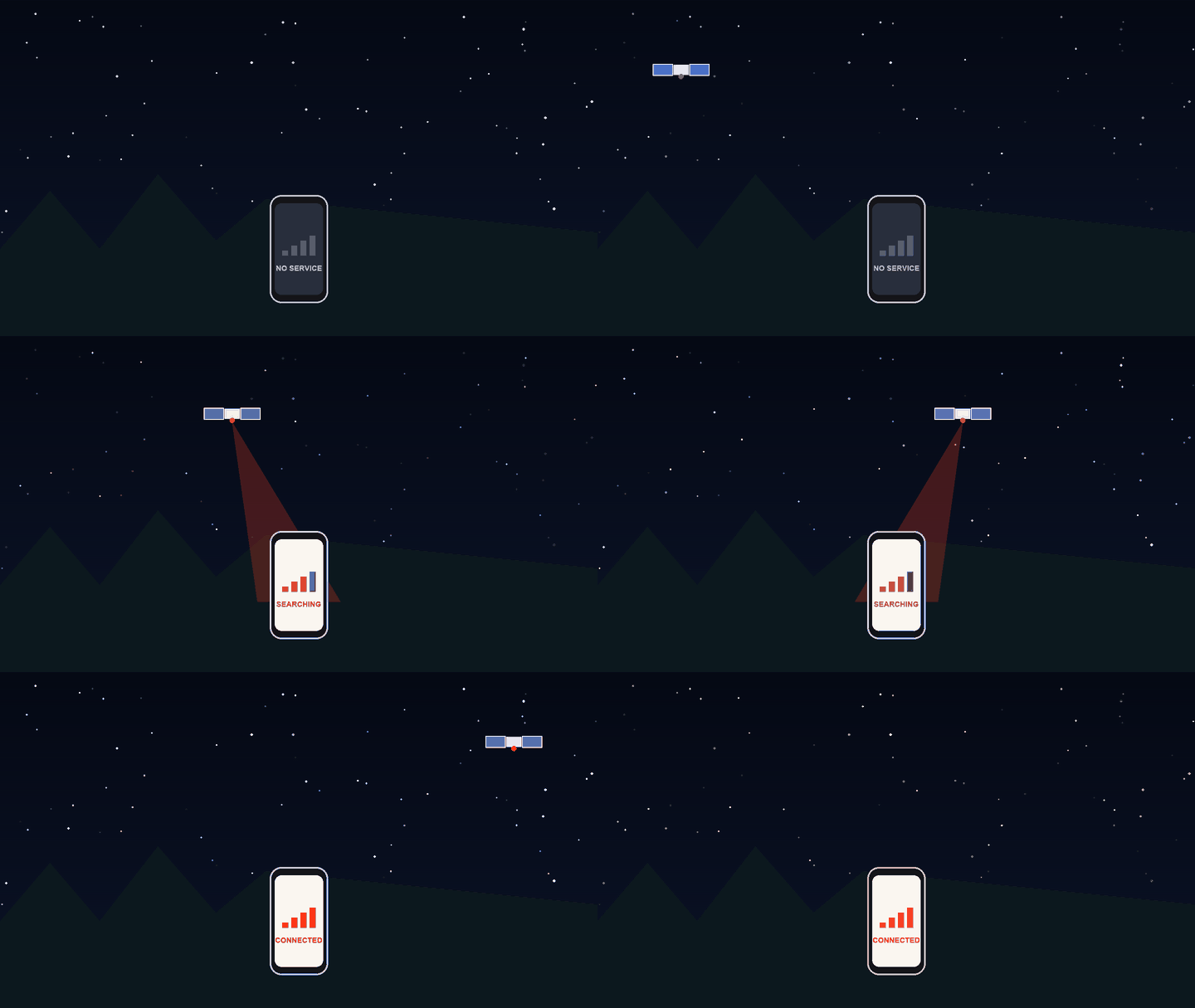
Imagine you are camping deep in a forest with your family. You pull out your phone to send a photo to your best friend. But the top of the screen says No Service. Nothing goes through.
Now imagine a satellite flying high above you fixes that. Your normal phone, the one in your pocket, talks straight to space. Ping! Your message is sent.
That is real. And on October 8, 2026, the rocket company SpaceX said something big: it wants to become a major phone company in America.[12][13] Let us break it down, step by step.
First, what is a phone company?
A phone company gives your phone its signal. Grown ups call it a carrier. In America, the three biggest carriers are AT&T, Verizon and T-Mobile.
Carriers build tall towers on hills, roofs and roads. Your phone talks to the tower closest to you. But what if there is no tower nearby? Then you get no signal. That spot is called a dead zone.
The US has a lot of dead zones. T-Mobile says more than 500,000 square miles of the country get no signal from any carrier.[2] That is about one out of every seven pieces of land in the whole country. Think of mountains, deserts, forests and long empty roads.
Who is SpaceX?
SpaceX is a company started by Elon Musk. It is famous for rockets that fly to space and then land back on Earth by themselves, like a movie trick, but real.
SpaceX also runs Starlink. Starlink is a giant group of small satellites that circle the Earth and send internet down to people. Right now there are more than 11,000 Starlink satellites working up there.[16] If you look up on a clear night, you can sometimes see a line of them moving across the sky like a train of tiny stars.
A cell tower, but in space
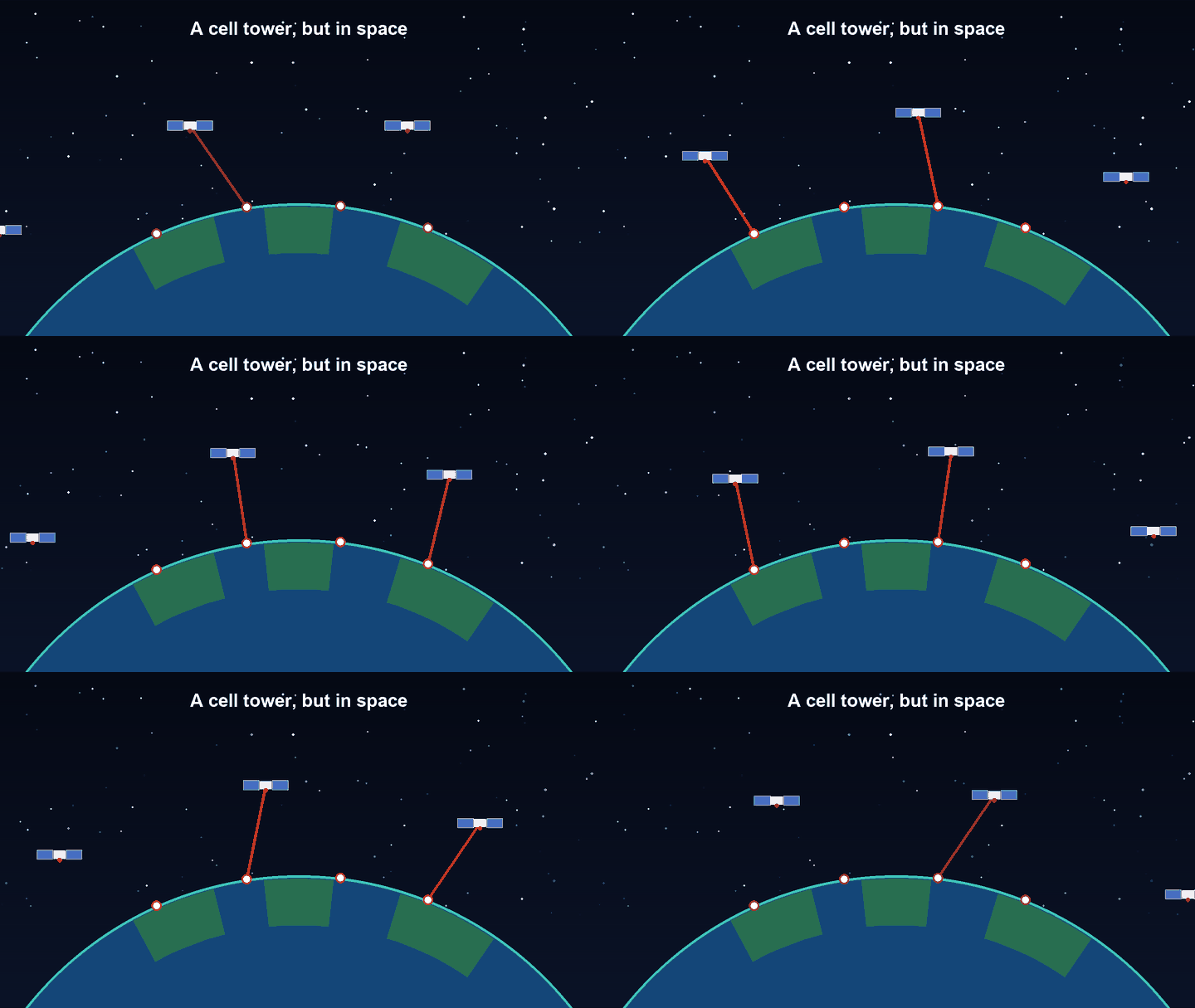
Back in 2022, SpaceX and T-Mobile teamed up with a wild idea. What if some Starlink satellites carried a cell tower inside them?[1][2]
Here is how it works:
- Special satellites fly about 360 kilometers (about 224 miles) above the Earth.[8]
- Each one works like a cell tower floating in space.
- Your normal phone can talk to it. You do not need a special phone or a big dish.
- The satellites are super fast. Things at that height zoom at around 17,000 miles per hour and go around the whole Earth in about an hour and a half.[17]
Watch this short video from T-Mobile that shows the idea:
The first texts from space
In January 2024, SpaceX launched its first six phone satellites. Just six days later, it sent the first text messages through them.[3] Here is the post SpaceX shared:
A few weeks later, Elon Musk posted on X straight from a normal phone, through a satellite:
In November 2024, the FCC said yes. The FCC is the part of the US government that makes the rules for radio signals and phones. It allowed SpaceX and T-Mobile to start the service for real.[4]
It is already helping people
In January 2025, big wildfires burned near Los Angeles. Many phone towers stopped working. SpaceX and T-Mobile switched on the satellite service early, so people could get emergency alerts and send texts, even to 911.[5]
In July 2025, T-Mobile launched the service for everyone and called it T-Satellite. It started with texting. It cost $10 a month for most people, and it even worked for people on AT&T and Verizon.[6] Later, some apps started working over satellite too, like WhatsApp, Google Maps and AccuWeather.[7]
By March 2026, about 10 million people around the world were using SpaceX phone satellites every month.[10]
The big news: SpaceX wants to BE the phone company
Until now, SpaceX was a helper. T-Mobile was the phone company, and SpaceX gave it extra signal from space. Now SpaceX wants its own customers.
To do that, it needs spectrum. Spectrum is like invisible lanes on a highway in the air. Phone signals travel in these lanes. A company cannot just use any lane it likes. It has to own the right to use it, and these lanes cost a LOT of money.
So SpaceX went shopping:
- September 2025: it agreed to buy lanes from a company called EchoStar for about $17 billion.[8]
- November 2025: it bought more EchoStar lanes for about $2.6 billion.[9]
- October 8, 2026: it agreed to buy special low band lanes from a company called Grain. News reports say the price is about $8 billion.[12]
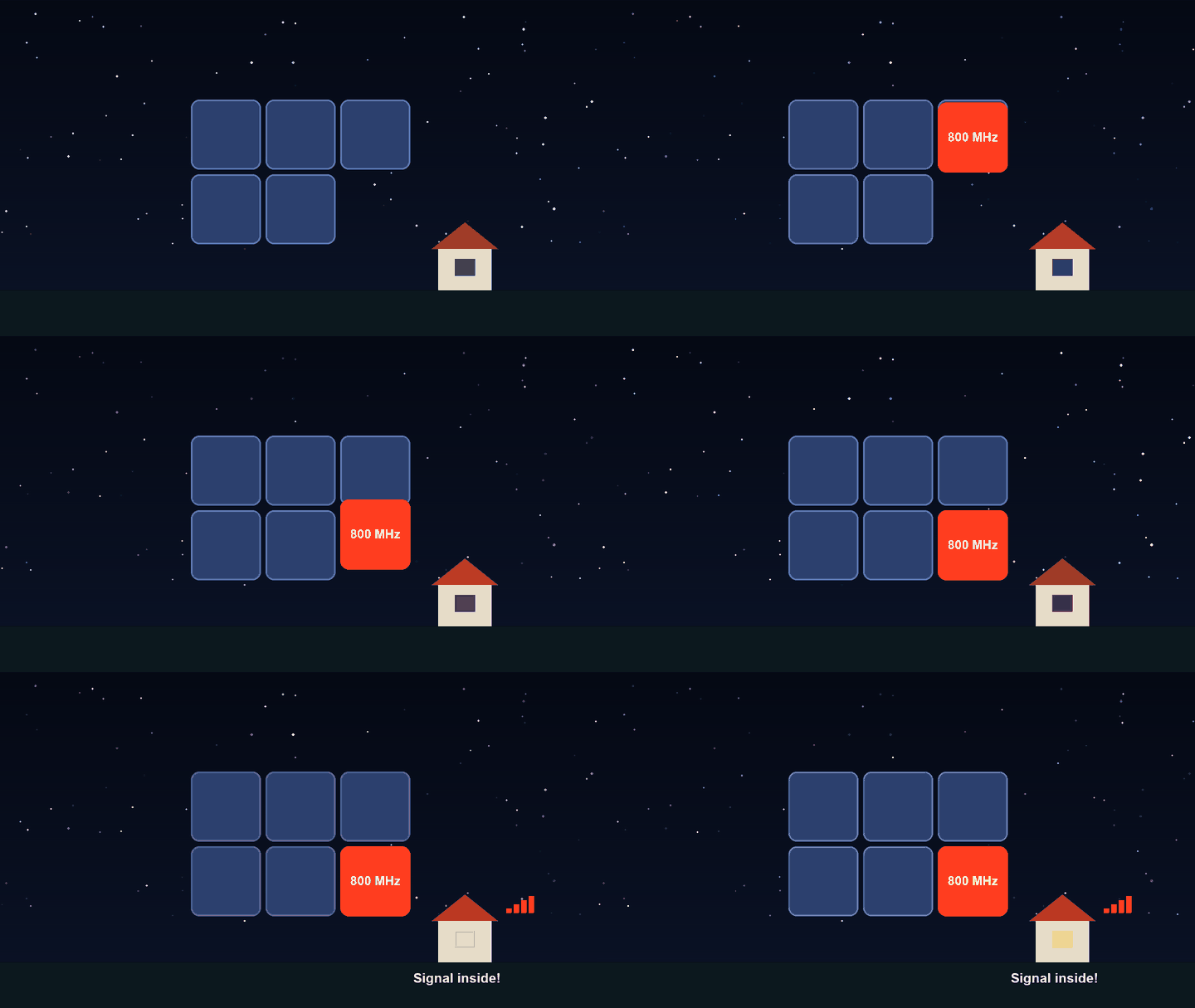
Why do low band lanes matter? Low band signals are great at going through walls. So you could get signal inside your house, your school or a big mall, not only outside. And SpaceX says most phones people already have can use these lanes.[12][13]
Elon Musk called it the last big piece of the puzzle:
Here is what SpaceX itself posted:
This news video from Bloomberg explains the deal:
Why the big phone companies got nervous
When people think a company may lose customers, its stock price often falls. A stock is a tiny piece of a company that people can buy and sell.
The day after the news, the prices of AT&T, Verizon and T-Mobile all dropped a lot. T-Mobile fell about 13 percent, its worst day since 2011. Verizon had its worst day since 2002.[14]
The big carriers say satellites cannot replace their towers in busy cities. A Verizon spokesman said the new lanes are "just empty airwaves" for now.[12] The three big carriers are also teaming up on their own satellite plan.[15]
So, can I get a SpaceX phone plan today?
Not yet. There is no SpaceX phone plan to buy, no price and no sign up page.
SpaceX is building new, much more powerful phone satellites. The FCC just approved up to 15,000 of them.[13] SpaceX now hopes to give people fast, 5G style service in the first half of 2028.[11] That date has already moved once, so it could change again.
But the race is on. One day soon, "No Service" might be something your little brother or sister never sees.
Quick recap
- A carrier is a phone company. The big three in the US are AT&T, Verizon and T-Mobile.
- SpaceX put cell towers on satellites, so normal phones can text from almost anywhere.
- It already helps people in dead zones and during disasters.
- SpaceX bought spectrum (invisible signal lanes) and now wants to be a phone company itself.
- Full service is planned for 2028. You cannot buy it yet.
Words to know
- Carrier: a phone company that gives your phone signal.
- Dead zone: a place where your phone gets no signal.
- Satellite: a machine that circles the Earth in space.
- Spectrum: invisible lanes in the air that signals travel on.
- FCC: the US government team that makes rules for radio signals and phones.
Scroll down to vote in the polls and tell us what you think!
Sources
- SpaceX invites world's carriers to collaborate, no more cell phone dead zones (SpaceX, Aug 2022)
- T-Mobile Takes Coverage Above and Beyond With SpaceX (T-Mobile via Business Wire, Aug 2022)
- SpaceX sends first text messages via its newly launched Direct to Cell satellites (Starlink, Jan 2024)
- SpaceX gets FCC green light for Starlink direct-to-phone deal with T-Mobile (TechCrunch, Nov 2024)
- T-Mo enables Starlink service for those impacted by LA fires (RCR Wireless, Jan 2025)
- T-Mobile's Starlink satellite service officially launches (TechRadar, Jul 2025)
- T-Satellite uses satellite data connectivity to power apps (TelecomTV, Oct 2025)
- EchoStar Announces Spectrum Sale and Commercial Agreement with SpaceX (EchoStar, Sep 2025)
- EchoStar Agrees to Sell Unpaired AWS-3 Spectrum to SpaceX (EchoStar, Nov 2025)
- At MWC, SpaceX execs tout Starlink V2 (Light Reading, Mar 2026)
- SpaceX shoots for mobile service in 2028 (Light Reading, Sep 2026)
- SpaceX takes aim at US wireless carriers with spectrum acquisition (Reuters via The Star, Oct 2026)
- SpaceX buys spectrum licenses, taking on AT&T, Verizon and T-Mobile (CNBC, Oct 2026)
- Elon Musk's growing SpaceX empire sends AT&T, Verizon and T-Mobile shares plunging (NBC News, Oct 2026)
- AT&T, T-Mobile and Verizon plan joint venture to help end dead zones (Verizon, May 2026)
- Starlink satellite statistics (Jonathan McDowell, updated Oct 9, 2026)
- Space Station facts and figures (NASA)
- Starlink Mobile for business and carriers (Starlink)
You may republish this story under CC BY 4.0: credit Arshdeep Singh and link to this page.