Rs 540 more a month: how the new 63% DA reaches 1.17 crore pay slips
The Cabinet raised dearness allowance and dearness relief by 3 points from 1 July. Here is what DA is and how much the rise adds to a real salary.

Picture a peon in a government office in Delhi. His basic pay is Rs 18,000 a month. After this week's news, he gets Rs 540 more every month, and some extra money for the months already gone. He did not ask his boss for a raise. A price index did the asking for him.
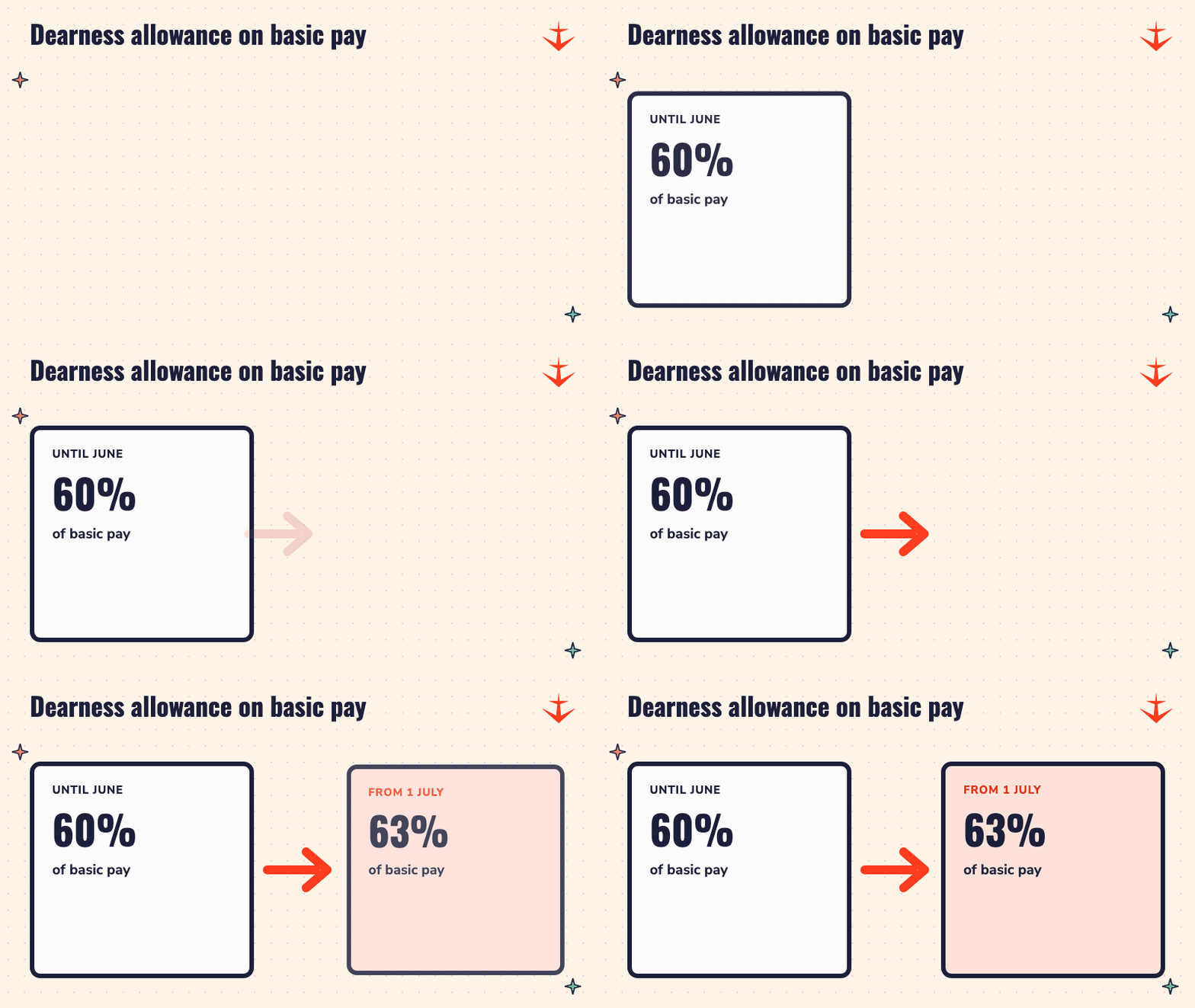
On Wednesday, 28 October 2026, the Union Cabinet approved a 3 percentage point rise in dearness allowance (DA) for central government employees and dearness relief (DR) for pensioners. The rate goes up to 63% of basic pay from 60%. The new rate counts from 1 July 2026, so the months since July will be paid as arrears.
First, what is DA?
Think of DA as a "price rise top up". Every year, chai, rice, bus tickets and rent cost a little more. If a salary stays the same, the same money buys less. DA is an extra amount added on top of basic pay to cover that gap.
According to Wikipedia's page on dearness allowance, DA is a cost of living top up, worked out as a percentage of basic pay, and it is fully taxable. DR is the same idea for retired people: it is added to their pension.
Basic pay means the fixed core of a salary, before any allowances. If someone earns Rs 18,000 as basic pay and DA is 60%, the DA part is Rs 10,800. Their pay slip shows both lines, plus other allowances like house rent.
Who gets the extra money?
The government's official statement, quoted by PSU Watch, says the rise will cover about 48.54 lakh central government employees and 68.71 lakh pensioners. That is about 1.17 crore people in all.
The Business Standard report says Union minister Ashwini Vaishnaw shared the news after the Cabinet meeting. PSU Watch reports he called it a "Diwali gift" for employees and pensioners.
This is only for staff and pensioners of the central government. State government staff follow their own state's rules, and private company workers depend on their own employer.
How does the government pick the number?
The 3% is not a random gift. The number comes from a formula set by the 7th Central Pay Commission, a panel that decides how central government pay is built. The same report says DA and DR are revised twice a year, usually from January and July, to help people cope with inflation. Inflation simply means prices going up over time.
The formula looks at a price index called CPI-IW, the Consumer Price Index for Industrial Workers. A price index is like a shopping basket. Every month, officials check what the same basket of everyday things costs. If the basket costs more, the index goes up.
A Business Today explainer from June says the DA rate uses the 12 month average of CPI-IW, and is usually rounded down to a whole number. Back then, the paper expected the July rate to land at 63%. On 28 October, that is exactly where the Cabinet fixed it.
What does 3% mean on a real pay slip?
Here is the easy part. The rise is 3% of basic pay, so the extra money each month equals basic pay multiplied by 0.03.
The Business Today explainer uses a Level 1 employee, the lowest step of central government pay, with a minimum basic pay of Rs 18,000. At 60%, DA is Rs 10,800 a month. At 63%, DA becomes Rs 11,340. The gap is Rs 540 a month.
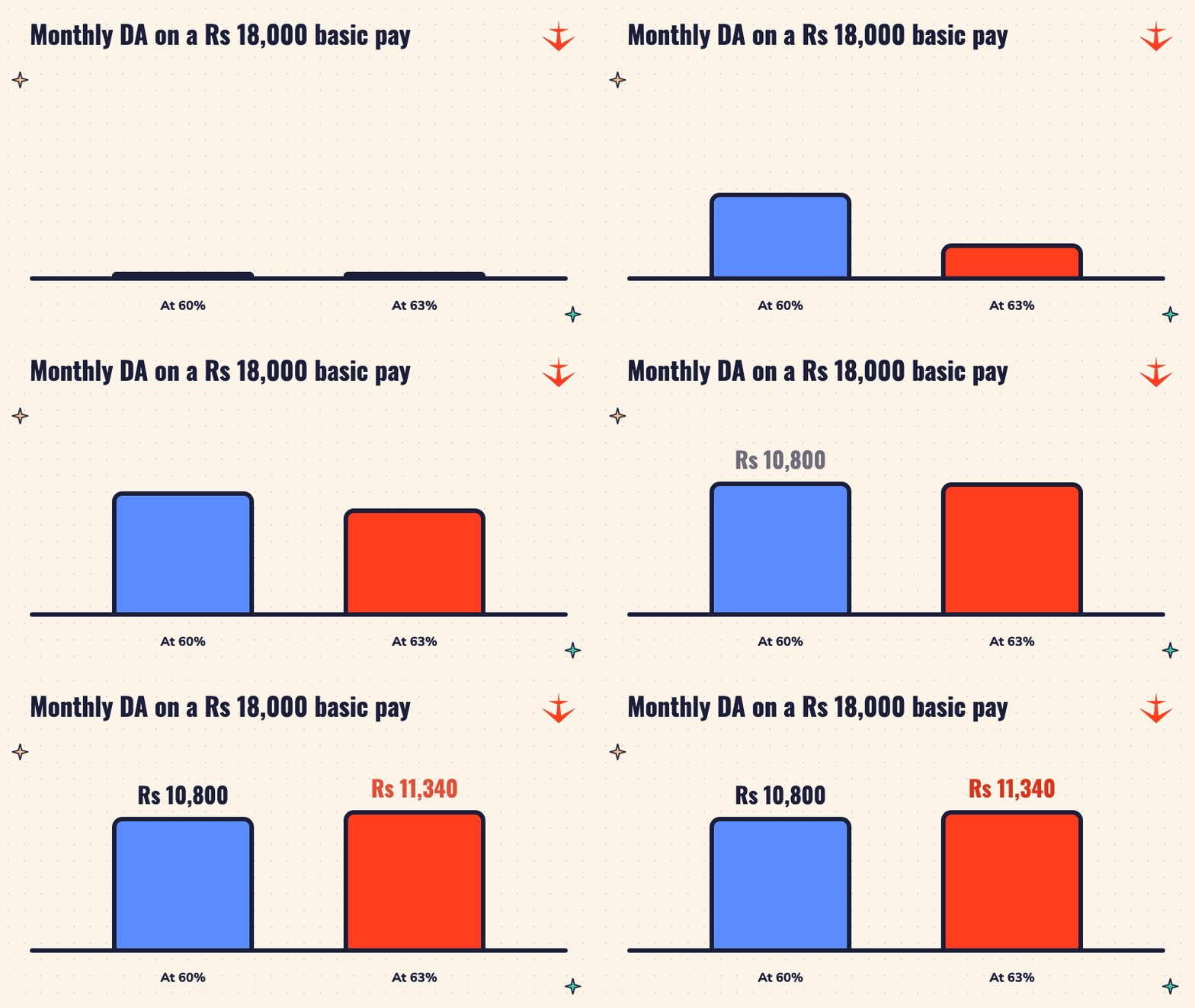
Since the new rate counts from 1 July, July, August, September and October are already behind. Four months of Rs 540 each add up to Rs 2,160 in arrears for that employee. Arrears simply means money owed for past months that gets paid later.
Bigger basic pay means a bigger rise. PSU Watch gives another example: an employee with a basic pay of Rs 50,000 gets Rs 1,500 more in DA every month. A pensioner with a basic pension of Rs 25,000 gets Rs 750 more in DR every month.
So for the peon from the start, Rs 540 a month works out to about Rs 18 a day, roughly a cup of chai. That is the point of DA: it is not a big jump, it is a top up so that rising prices do not quietly eat into his salary.
How much does this cost the government?
All those small amounts add up. The official statement, as reported by PSU Watch, puts the extra cost at Rs 10,016.10 crore a year for DA and DR together. Divide that by 365 days and it is about Rs 27 crore a day.
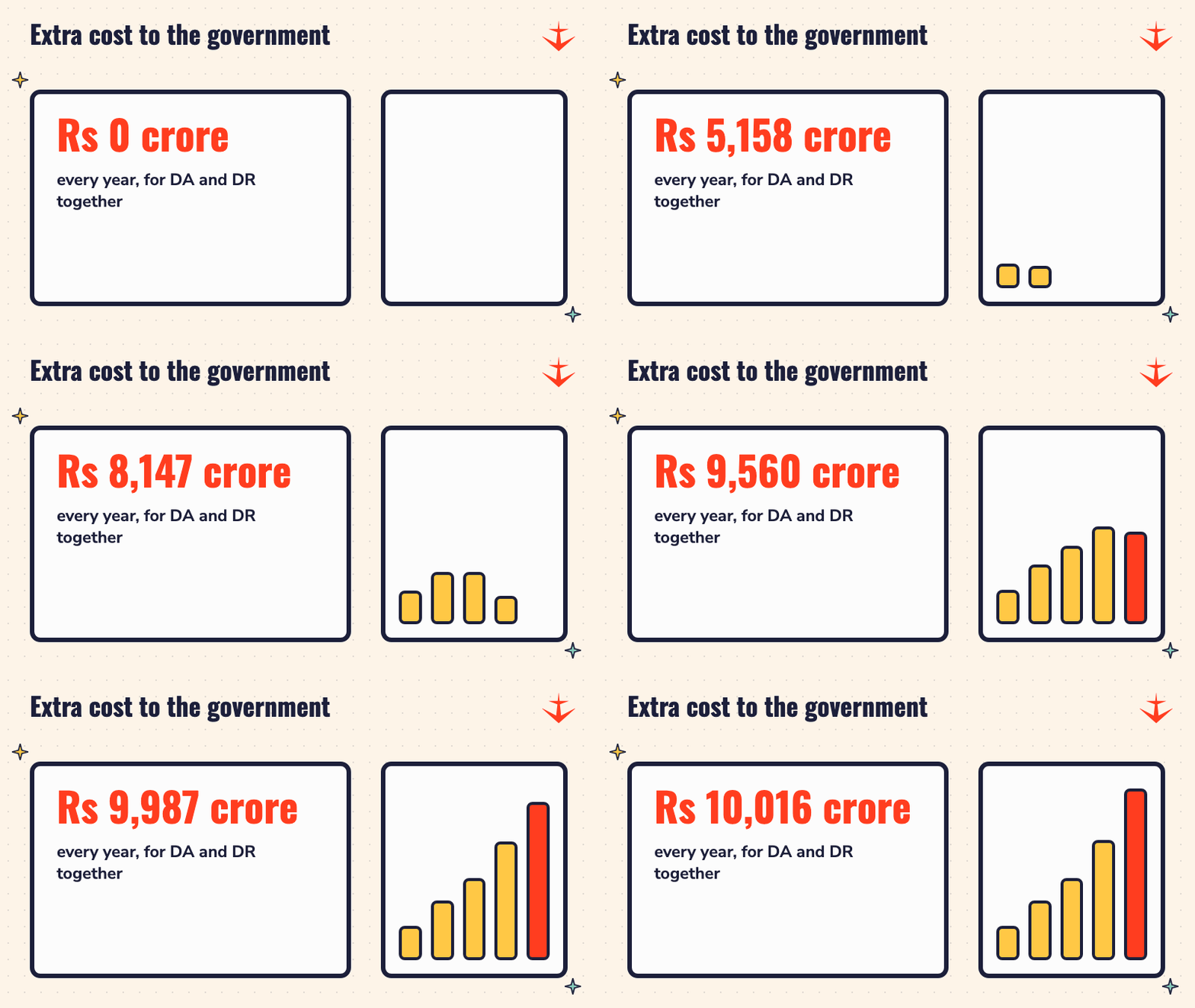
For comparison, the previous rise was a smaller one. In April 2026, the Cabinet approved a 2% rise, taking DA to 60% from 58%, counted from 1 January 2026. The Press Information Bureau said that one cost Rs 6,791.24 crore a year.
PSU Watch also notes the other side: the money gives families more to spend, which can help shops and businesses, but the rise also adds over Rs 10,000 crore a year to what the Centre has to pay regularly.
What about older pay scales?
Some employees are still paid under older pay structures, from the 5th and 6th Pay Commissions. Their DA is counted on a different basic pay, so the percentages look huge. The Federal reports that for staff under the 6th Pay Commission, DA goes up to 269% from 262%. For those under the 5th Pay Commission, it rises to 497% from 483%. These new rates also count from 1 July 2026.
The Economic Times adds that executives at central public sector companies got a separate revision of their own allowance, set by the Department of Public Enterprises.
Why should a young reader care?
Even if nobody at home works for the government, this story shows how pay can be linked to prices. DA works like a scoreboard in cricket: the runs on the board, here the price index, decide the result, not a debate in the dressing room.
It also shows that a "small" 3% can be big money when multiplied by more than a crore people. Rs 540 for one person becomes over Rs 10,000 crore a year for the country.
This video, in Hindi, was made a few days before the decision and walks through how a DA rise changes salary and arrears.
Sources
- The Economic Times: Union Cabinet approves 3% DA hike
- Business Standard: Cabinet approves 3% DA, DR hike for central govt staff, pensioners
- PSU Watch: Cabinet hikes DA by 3% to 63%
- The Federal: Cabinet approves 3 pc DA and DR hike effective July 1, 2026
- Business Today: July DA hike, how much more salary and pension
- Press Information Bureau: DA and DR instalment from 1 January 2026
- Wikipedia: Dearness allowance
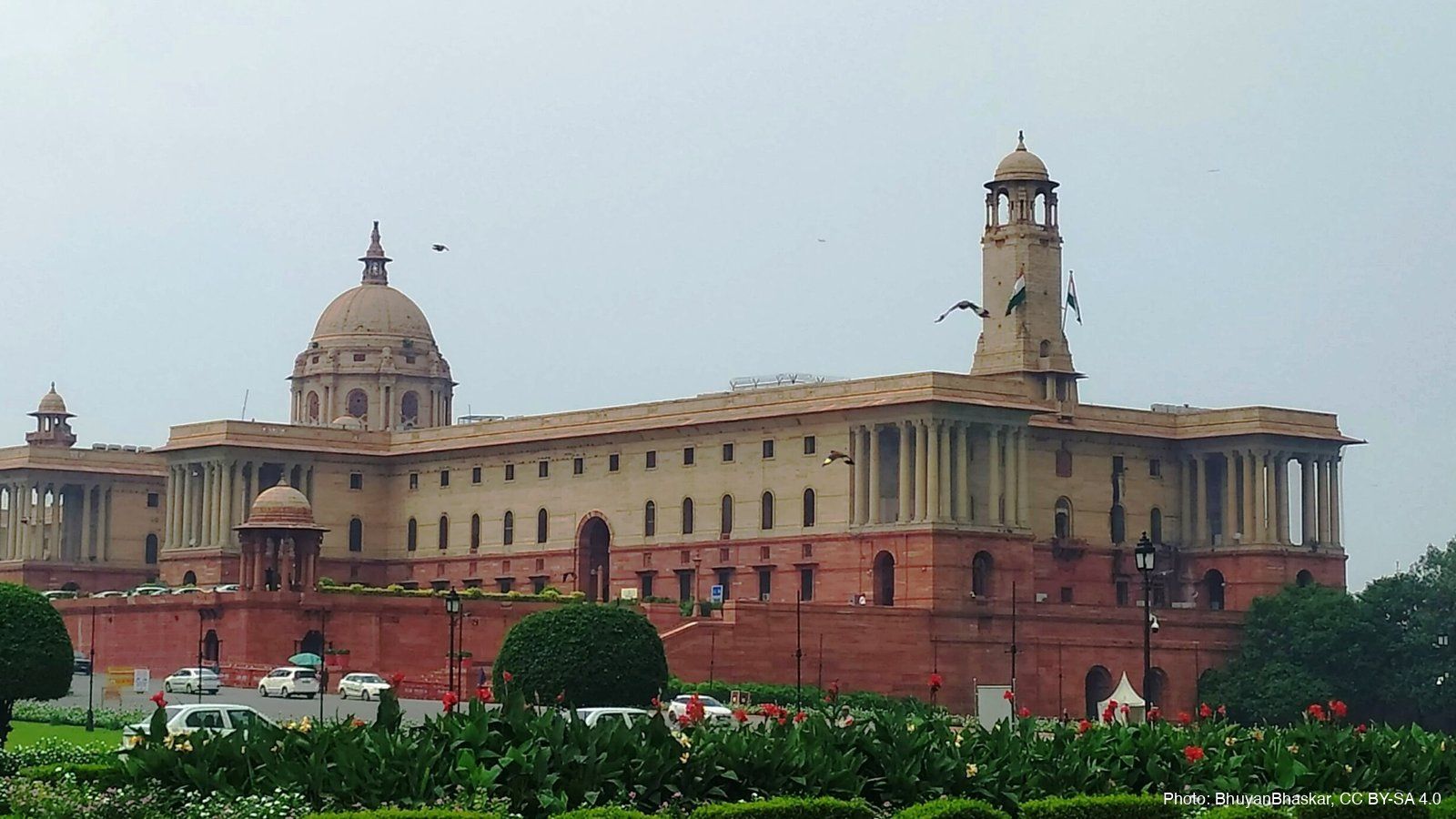
- Cover photo: North Block of Central Secretariat, New Delhi, by BhuyanBhaskar, CC BY-SA 4.0

You may republish this story under CC BY 4.0: credit Pranav Sharma and link to this page.