RBI eases forex form rules for freelancers paid from abroad
Version 1 of 1 saved 4 Nov 2026, 10:50 am IST · Chain line 347
As it was first published
RBI eases forex form rules for freelancers paid from abroad
A person in India selling services abroad no longer files a separate export form, and firms get the same relief for payments up to Rs 10 lakh.
Picture a student in India who teaches maths online to a child in another country and gets paid in dollars. Until this week, the written rules said that student had to fill an export form to report that money. On Tuesday, 3 November 2026, the Reserve Bank of India (RBI) eased those reporting rules. Now, for a person like that student, simply giving the bank the payment details counts as filing the form.
The change comes from an RBI notification dated 2 November 2026. It works backwards too: the new lines count from 1 October 2026, the day the bigger rule book started.
First, what is an EDF?
EDF stands for Export Declaration Form. An export is anything you sell to someone outside India. A service export is work, not goods: teaching, coding, design, writing, advice. The EDF tells the RBI, through your bank, what you sold abroad and for how much. Think of it like a notebook where every sale is written down, and the principal checks the notebook.
Under the new rules that began on 1 October 2026, all exporters of services had to file an EDF, declaring the value of each deal. The form went in through the bank that handles the foreign money, generally within 30 days of the end of the month in which the bill (the invoice) was raised.
For software exporters, this was a small change. They earlier used a form named Softex. But many consultants, designers and tutors had no form to fill before 1 October. Suddenly they did.
Why were freelancers worried?
A freelancer is someone who works for many clients on their own, not as a staff member of one company. The Wire reported that the new form had become a big paperwork load for such small earners, and that many were hiring consultants just to help with it.
In early October, RBI Governor Sanjay Malhotra said individuals had no reason to worry. Business Today, in a report on 7 October, quoted him naming people who work on their own, "could be tutoring services, could be some small software", and saying they did not need to report.
But the written rules had not changed yet. By 24 October, some banks were still asking individuals to fill EDFs, while others had stopped. A BusinessLine study quoted there found that only two of 19 listed banks had published their step by step guides for the new process. A small business group, India SME Forum, had asked for a 90 day pause in the monthly filings for micro and small exporters of services.
The new rule in plain words
The 2 November notification adds a new term: a "resident individual". That means a real person living in India, not a company or a business.
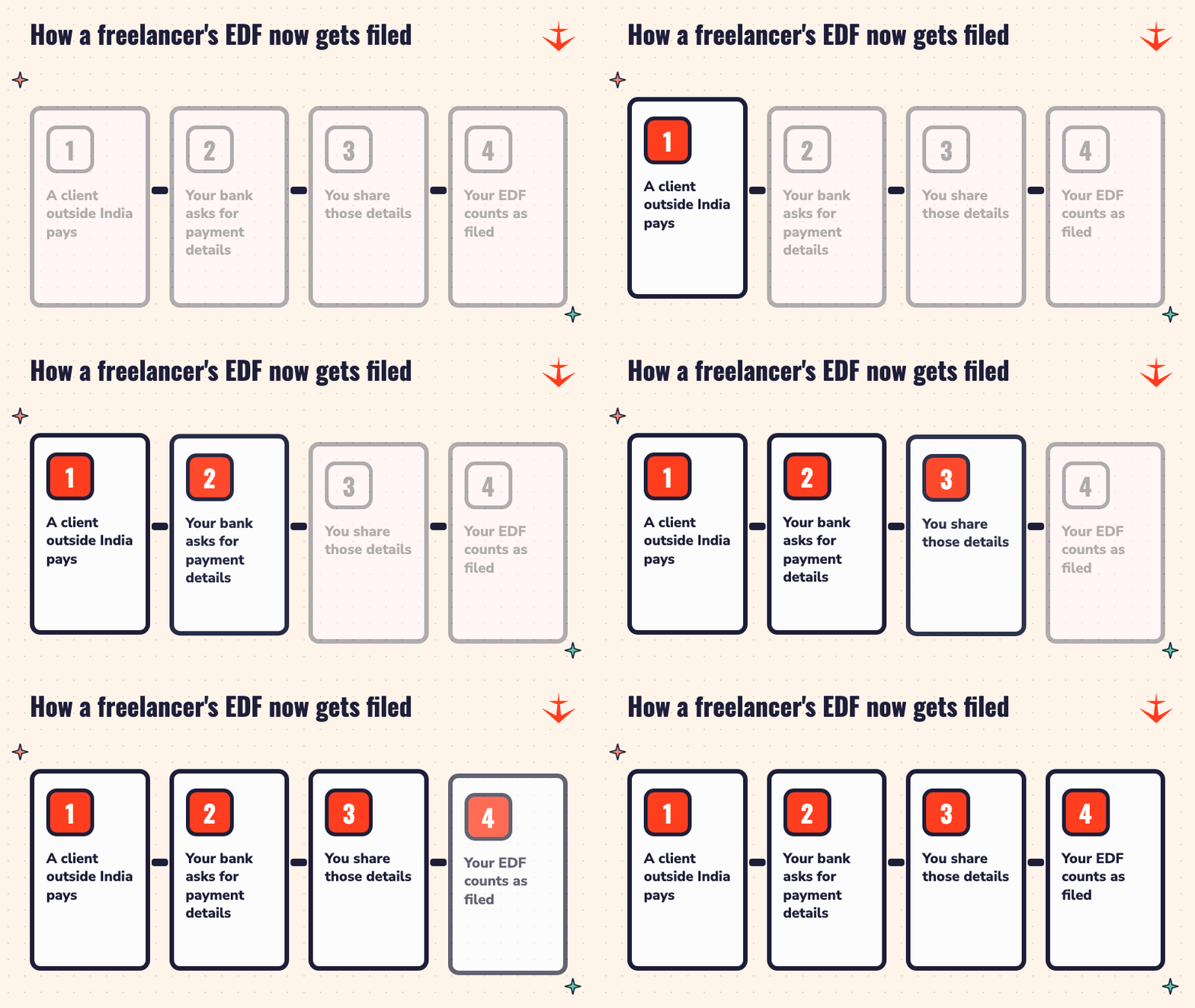
For such a person, the EDF is now "deemed" to be submitted. Deemed means "counted as done". It is like a teacher marking you present the moment she sees you in the line, without you raising your hand. Here, the moment you give your bank the details it needs to put the foreign payment into your account, your EDF counts as filed. The notification sets no money limit for individuals.
What about small firms?
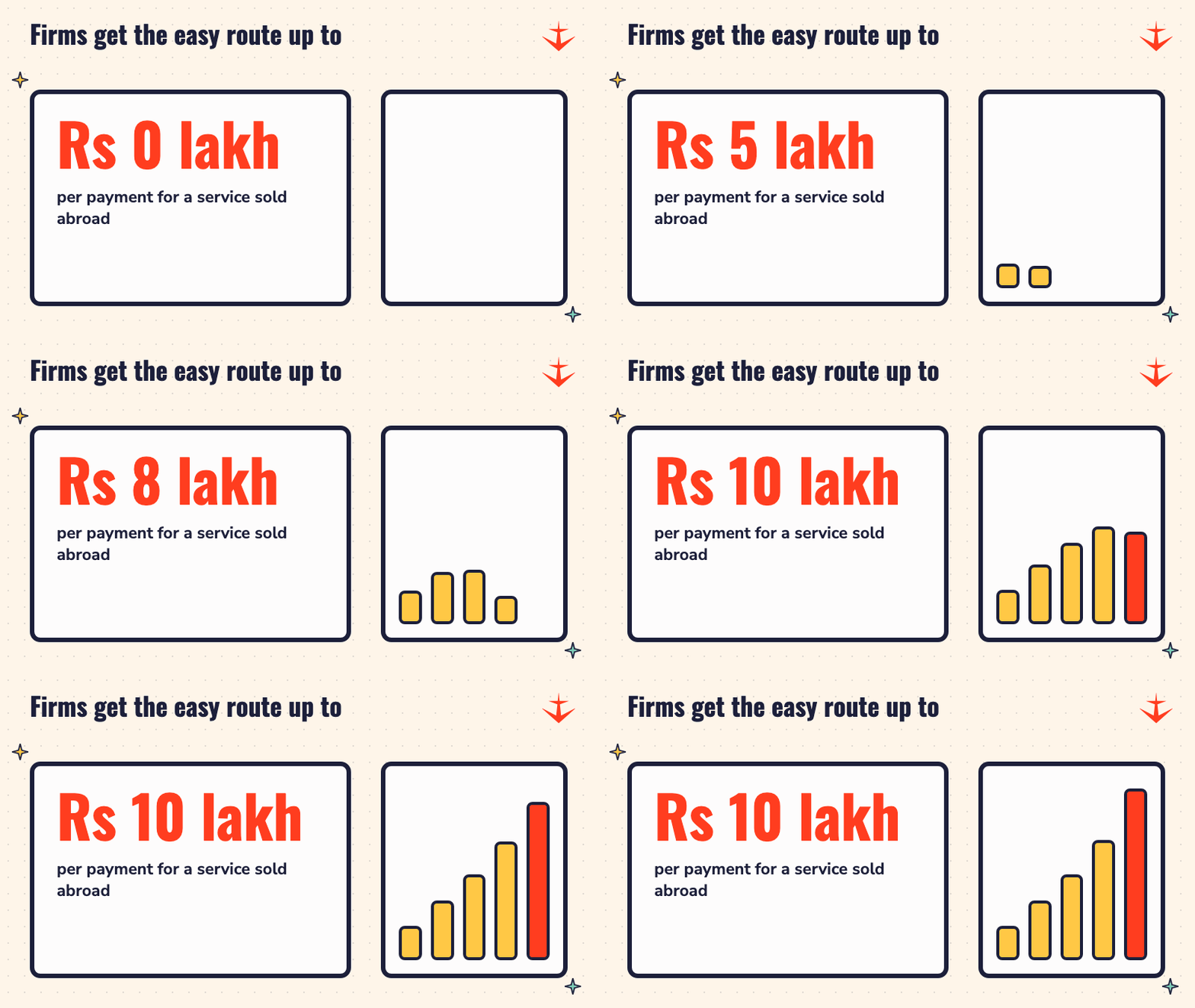
Firms get a smaller version of the same relief. If the exporter is not an individual (say a small agency or a company), the same easy route applies when the money coming in for the service is up to Rs 10 lakh, or the same amount in a foreign currency. For bigger payments, the full EDF rules still apply.
Think of a samosa stall that sells to a school canteen in the next town. Small orders need only a note in the register. A giant order still needs a proper bill with stamps.
And when Indians pay for services from abroad?
An import of a service is the opposite of an export: someone in India pays a person or company outside India for work. Banks record such imports in the RBI's system named IDPMS (Import Data Processing and Monitoring System), a kind of digital record book for imports.
Under the 2 November notification, the bank needs to enter an import of services in IDPMS only when two things are both true. The buyer is not an individual, and the bill or contract is worth more than Rs 10 lakh. The bank then has five working days from getting the details to make the entry. So a person in India paying for a service abroad, or a small firm paying a small bill, drops out of this record book.

What does not change
The rest of the new rule book stays. From 1 October, the time allowed to bring export money back to India was cut from 15 months to nine months, Business Today reported. For exports billed or settled in Indian rupees, the window went from 18 months to 12 months. Those deadlines are separate from the EDF.
Firms with payments above Rs 10 lakh still file the full EDF. And individuals still need to give their bank the details it asks for when the money arrives. Skip that, and the "deemed" filing does not happen.
Why this matters to young earners
Many young Indians now earn from abroad on their own: online tutoring, coding, video editing, design, writing. For them, the RBI's change means one less form and one less worry. The bank needs some payment details before it credits foreign money anyway. Now those same details do the job of the EDF.
For small agencies and two or three person studios, the Rs 10 lakh line matters most. Each payment up to that amount can go the easy way. Only the bigger ones need the full EDF.
For the RBI, the goal stays the same: knowing how much India earns from selling services to the world. The Governor had said in early October that the new reporting would improve the data on service exports. The 2 November change keeps that data coming in through the banks, without asking every tutor and coder to fill a form.
Watch: the EDF rule explained
This video by Skydo, a cross-border payments platform, explains the EDF rule for freelancers and agencies as it stood before the 2 November change.
Sources
- RBI notification: Foreign Exchange Management (Export and Import of Goods and Services) (Second Amendment) Regulations, 2026, dated 2 November 2026
- The Economic Times: India eases forex reporting rules for small value service exports, imports
- Business Today: Individuals not covered, RBI clears air on new EDF framework (7 October 2026)
- Business Today: Freelancers and service exporters face confusion over EDF filings (24 October 2026)
- The Wire: The RBI's new forex dragnet leaves freelancers upset and scrambling
- Cover photo: Reserve Bank of India, Mumbai HQ in September 2024, by DesiBoy101, CC BY 4.0
