RBI clears Emirates NBD's India branches to join RBL Bank from 1 December
The Dubai bank's three Indian branches will become RBL Bank branches, the last step of a Rs 26,000 crore deal. Here is how it works.
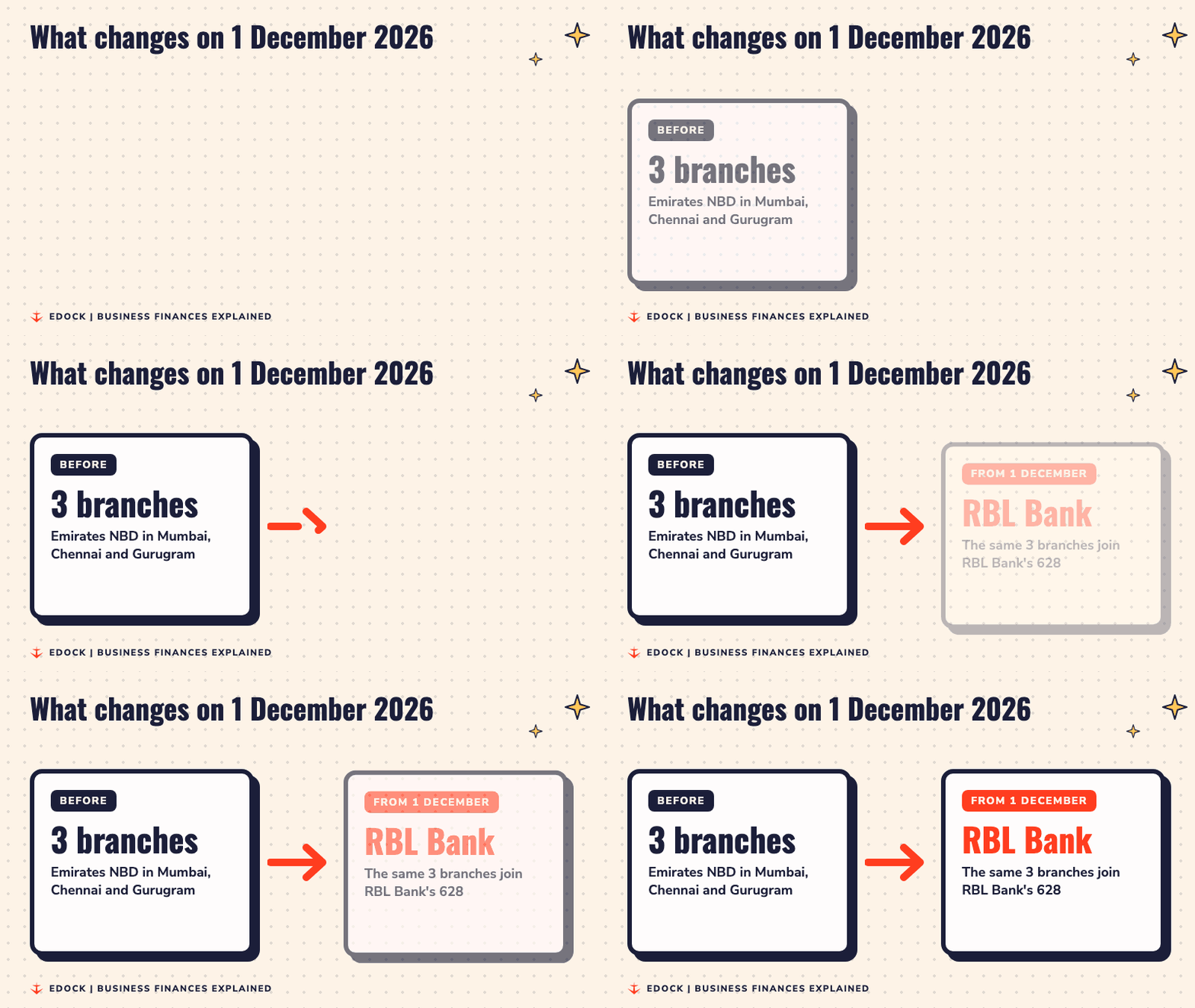
Picture a bank from Dubai that has three branches in India. One in Mumbai, one in Chennai, one in Gurugram. In a few weeks, all three will switch their name board and become branches of an Indian bank instead.
That is what the Reserve Bank of India (RBI) cleared on Friday, 16 October 2026. The RBI said the Indian branches of Emirates NBD will join RBL Bank, and the change starts on 1 December 2026.
From that day, in the RBI's words, all the Indian branches of Emirates NBD "will function as branches of RBL Bank Limited".
First, who are these two banks?
Emirates NBD is a big bank based in Dubai, in the United Arab Emirates. It has had a small office in India since March 2000. It got the RBI's nod for its first Indian branch, in Mumbai, in 2016, and that branch opened in July 2017. Later it added Gurugram and Chennai.
RBL Bank is an Indian private bank. It is much bigger here, with 628 branches. Its shares are listed, which means anyone can buy a small piece of it on the stock market.
So this is like a tiny tea stall with three counters joining a big chain that already has hundreds of shops. The three counters keep running, but under the bigger name.
What does "merger" or "amalgamation" mean?
A merger is when two businesses join and become one. The RBI used a longer word, amalgamation, which means the same thing here.
Think of two cricket teams from the same school. One team has only three players. The other has a full squad. The coach says: from next month, the three players wear the bigger team's jersey. Same players, same skills, one team.
The RBI approved this under a rule called Section 44A(4) of the Banking Regulation Act, 1949. Banks in India cannot just join hands on their own. The RBI is the referee of Indian banking, and it has to say yes first.
Wait, didn't Emirates NBD already buy RBL Bank?
Yes, a big part of it. This is the second half of a bigger deal.
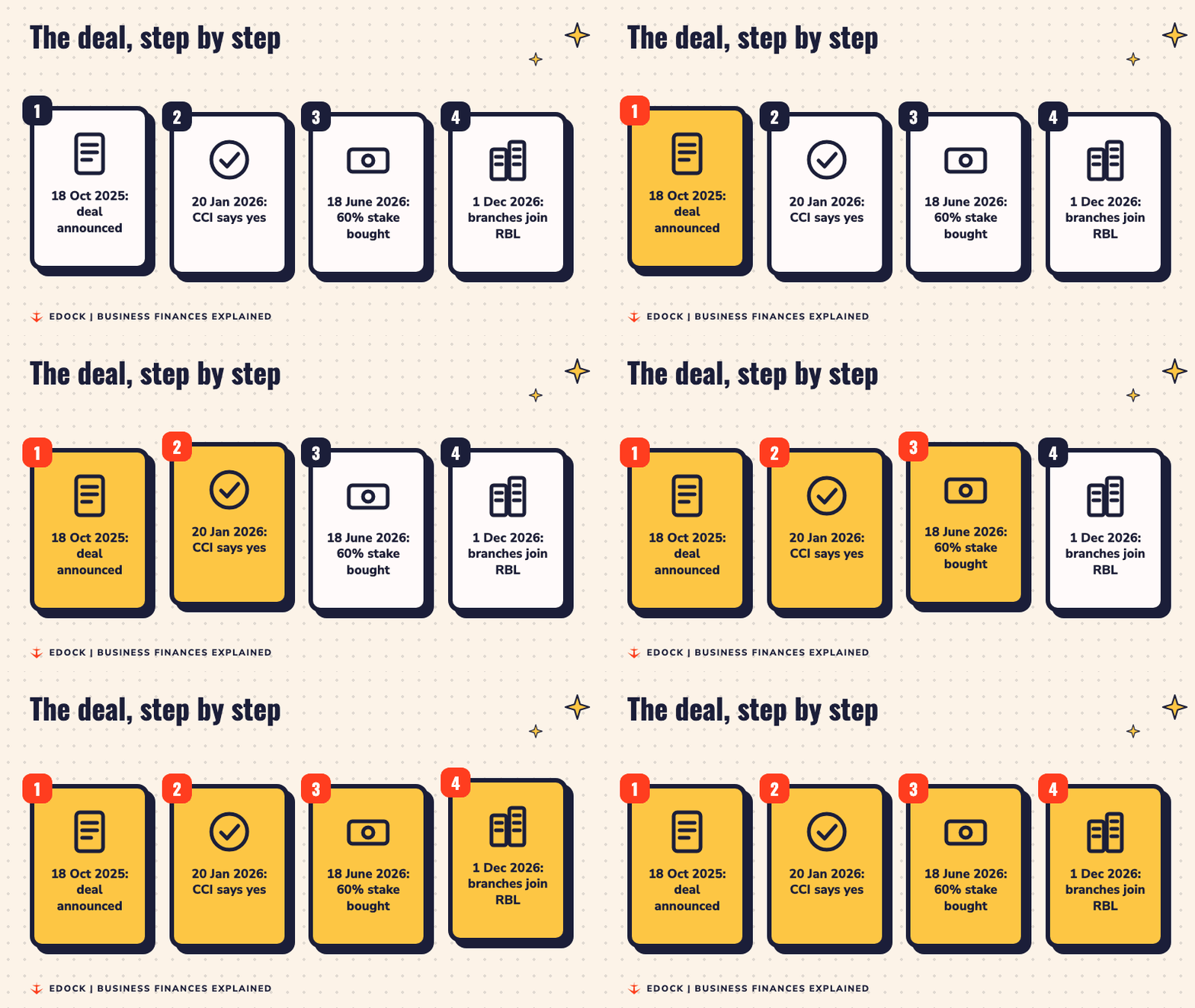
On 18 June 2026, Emirates NBD finished buying a 60% stake in RBL Bank. A stake is a share of ownership. If ten friends own a samosa stall together and you own six of the ten parts, you own a 60% stake, and you get the biggest say.
Emirates NBD put in about $2.75 billion, or around Rs 26,000 crore. It did this by getting brand new RBL Bank shares: 929.1 million shares at Rs 280 each, worth about Rs 26,016 crore in total.
Selling fresh shares to one chosen buyer like this has a name: a preferential allotment. It is like a stall owner printing new ownership slips and selling them only to one big partner. The money goes straight into the stall, so it can grow.
That last part matters. The cash did not go to old owners walking away. It went into RBL Bank itself, giving the bank more money to support its growth plans.
How long did all this take?
More than a year. The deal was first announced on 18 October 2025. Then it had to cross many gates, like a train stopping at stations.
The Competition Commission of India (CCI) cleared it on 20 January 2026. The CCI checks that one company does not get so big that it can bully everyone else. In May, the Finance Ministry approved Emirates NBD owning up to 74% of RBL Bank. In June, the stake purchase was done. Now, in October, the RBI has fixed the date for the branches to join.
Why is this such a big deal?
The two banks have called it the largest foreign direct investment in India's banking sector. Foreign direct investment, or FDI, is when a company from another country puts money straight into a business here and gets a real say in running it.
They also said it was the first time a foreign bank bought a majority of a profitable Indian bank. "Majority" means more than half. In the samosa stall, it means you are the boss.
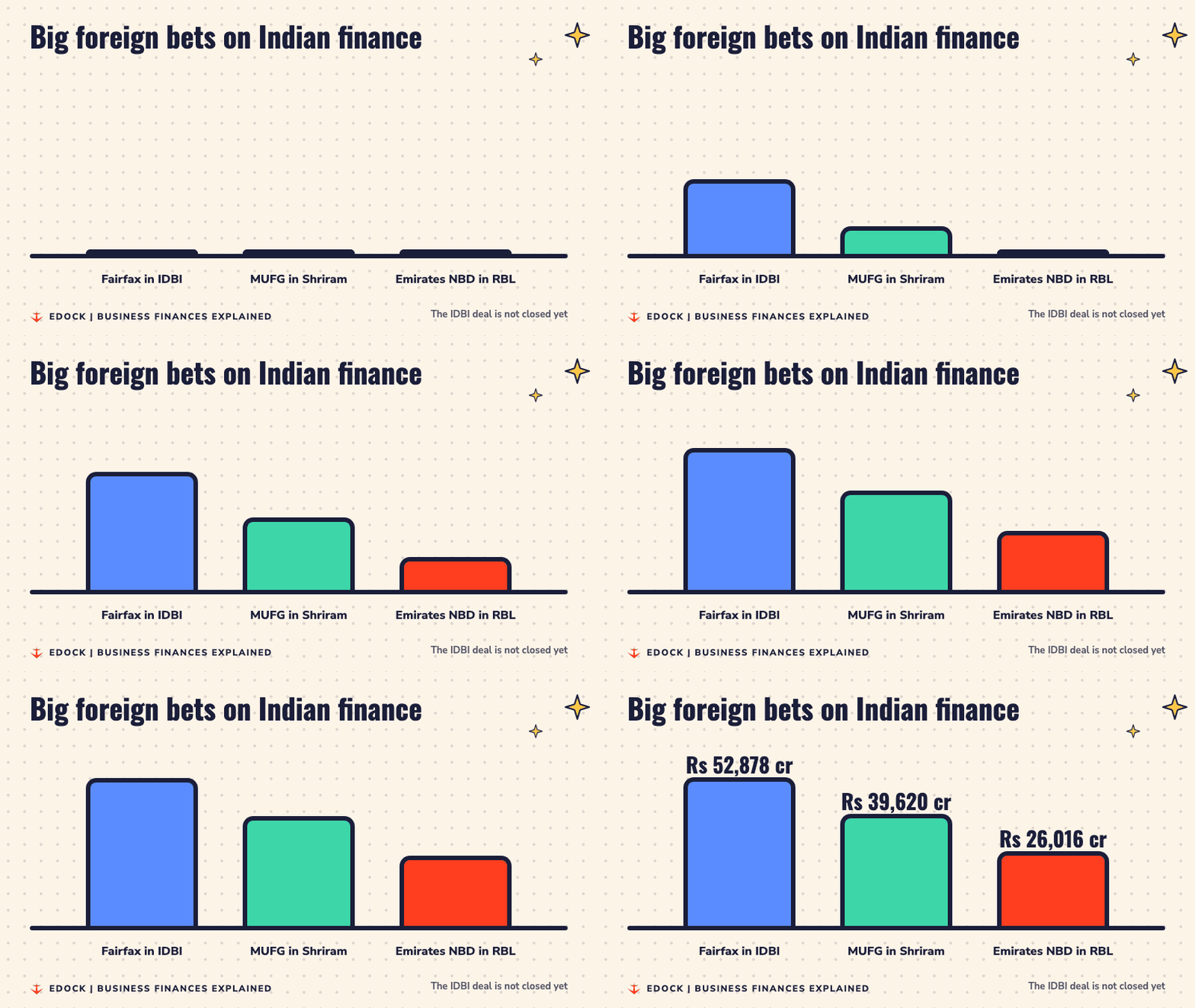
And it is not alone. Foreign giants have been putting big money into Indian finance this year. The Economic Times listed four such deals: Canada's Fairfax with IDBI Bank at Rs 52,878 crore, Japan's MUFG with Shriram Finance at Rs 39,620 crore, Emirates NBD with RBL Bank at Rs 26,016 crore, and Japan's SMBC with Yes Bank at Rs 13,483 crore. Together, that is about Rs 1,31,997 crore. The IDBI deal still needs approvals before it closes.
How is RBL Bank doing now?
For the July to September quarter, RBL Bank said its net profit jumped 170% to Rs 482 crore compared with a year earlier. Net profit is what is left after paying every bill, like the coins left in your pocket after buying chai, bus fare and lunch.
On the day of the RBI news, RBL Bank's share closed at Rs 378.25, up 1.10%. That is about 35% more than the Rs 280 per share Emirates NBD paid in the deal. Share prices go up and down every day, so this is only a snapshot, not a promise.
What changes for customers?
Not much is known yet. The RBI statement did not give details on changes to customer services or other day to day arrangements.
What is clear is the big picture. After 1 December, there is one bank in India where there used to be two. Emirates NBD stays the controlling shareholder, the owner with the biggest say. RBL Bank stays an Indian, listed bank, but with a Dubai partner holding the steering wheel.
For anyone starting a career in finance, this is a useful story to remember. Big bank deals happen in stages: agree, get approvals, put in the money, then join the pieces. The RBI's note on 16 October was the last big stamp before that final step.
Sources
- Mint: RBI approves Emirates NBD merger with RBL Bank from December 1, 5 key things to know
- The Economic Times: RBI approves merger of Emirates NBD's India branches with RBL Bank
- BusinessLine: RBI approves merger of Emirates NBD's India branches with RBL Bank from December 1
- BusinessLine: RBI okays Scheme of Amalgamation of Indian branches of Emirates NBD with RBL Bank
- The Economic Times: Canadian billionaire and Asian banking titans find Rs 1.32 lakh crore worth of interest in India
- Mint: RBL Bank Q2 results and share price
- Cover photo: Dubai skyline, by Robert Bock, CC0 1.0
You may republish this story under CC BY 4.0: credit Manpreet Kaur and link to this page.