Piyush Goyal wants India to sell far more to China and Southeast Asia
China sold India about 6.5 times more than India sold China this year. The commerce minister hopes Indian factories can change that.

Picture a samosa stall that buys its potatoes, oil and flour from the big shop next door. Every day the stall pays the shop. Now picture the stall owner hoping that, one day, the same shop will buy samosas from the stall too. That, in short, is what India's Commerce Minister said about China this week.
On Tuesday, 27 October 2026, in The Hague in the Netherlands, Piyush Goyal told reporters he hopes India will become a major exporter to China and to ASEAN, a group of 10 Southeast Asian countries. He also said India is open to Chinese suppliers selling to India, while the government will act through legal steps if prices are unfair.
So what does selling to China really mean for Indian factories and the people who work in them? Here is the story in simple words.
What did Goyal actually say?
Goyal was on a two-day official visit to the Netherlands. A reporter asked him about India and China's trade in the coming years. His answer had two parts.
First, India still needs things made in China. In his words, China is providing India "important intermediate goods, important raw materials." Intermediate goods are parts that go into making something else. Think of the tiny chips and boards inside a phone, or the chemicals used to make medicines.
Second, India wants to sell more there. "I do hope that in the years to come, we will see India becoming a major exporter of goods and services to China and the ASEAN region also," he said. Goods are things you can touch, like rice or phone parts. Services are work you cannot touch, like software or design.
The ten ASEAN countries are Brunei, Cambodia, Indonesia, Laos, Malaysia, Myanmar, the Philippines, Singapore, Thailand and Vietnam, as listed by Daily Excelsior.
What is an export, and why does it matter?
An export is something made in one country and sold to a buyer in another. When a factory in Noida sells phone parts to a buyer in China, that is an export for India. An import is the opposite: India buying something made abroad.
Exports matter because the money comes in from outside. More orders from abroad can mean more shifts at a factory, more trucks at the port and more work for the people along the way.
How big is India and China's trade right now?
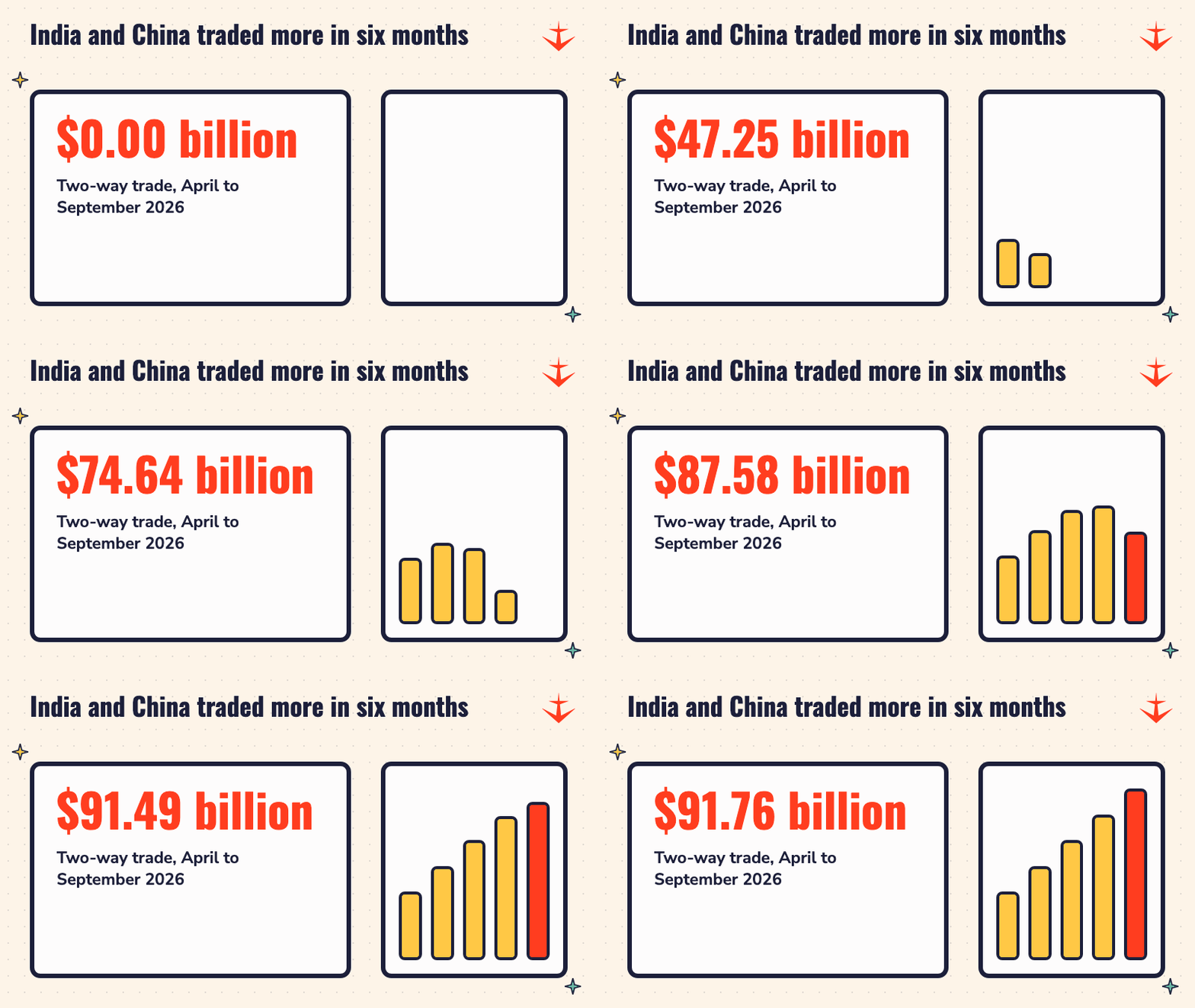
Very big, and growing fast. Between April and September 2026, trade both ways between India and China rose about 29% to $91.76 billion, up from $71.24 billion a year earlier, based on commerce ministry data. That made China India's largest trading partner in the first half of this financial year.
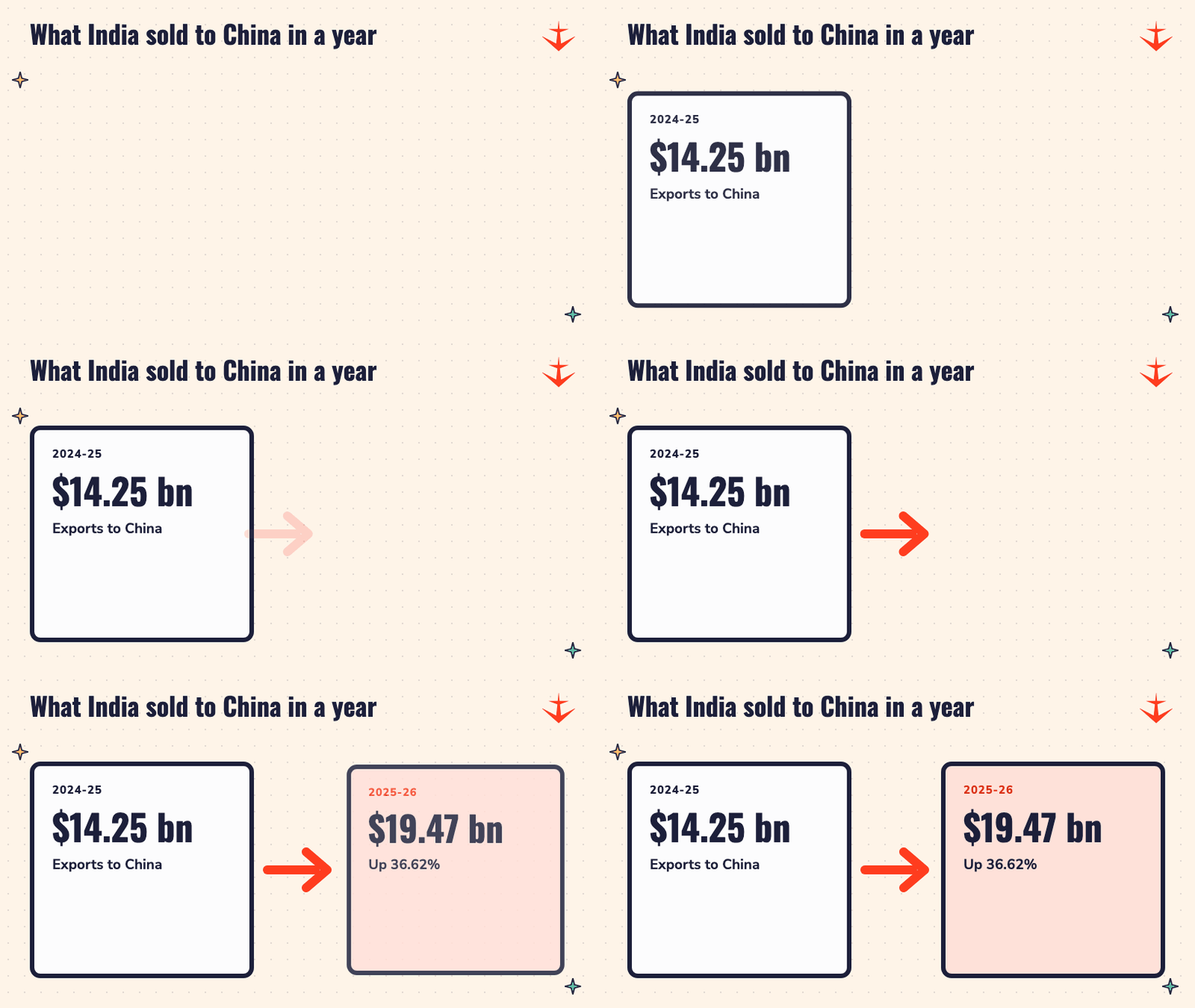
India's own sales to China are rising too. In the year 2025-26, India's exports to China grew 36.62% to $19.47 billion, up from $14.25 billion the year before, The Economic Times reported.
This year the push has kept going. For April to September 2026, exports to China were up 36.07% over the same months last year, government data showed. China was among the top five markets where India's exports grew the most in that period.
So why is the gap still so wide?
Because India buys far more than it sells. China's own customs data, reported by Maritime Gateway, says India sold China goods worth $19.26 billion between January and September 2026. In the same months, China sold India goods worth $125.19 billion. That is about 6.5 times more.
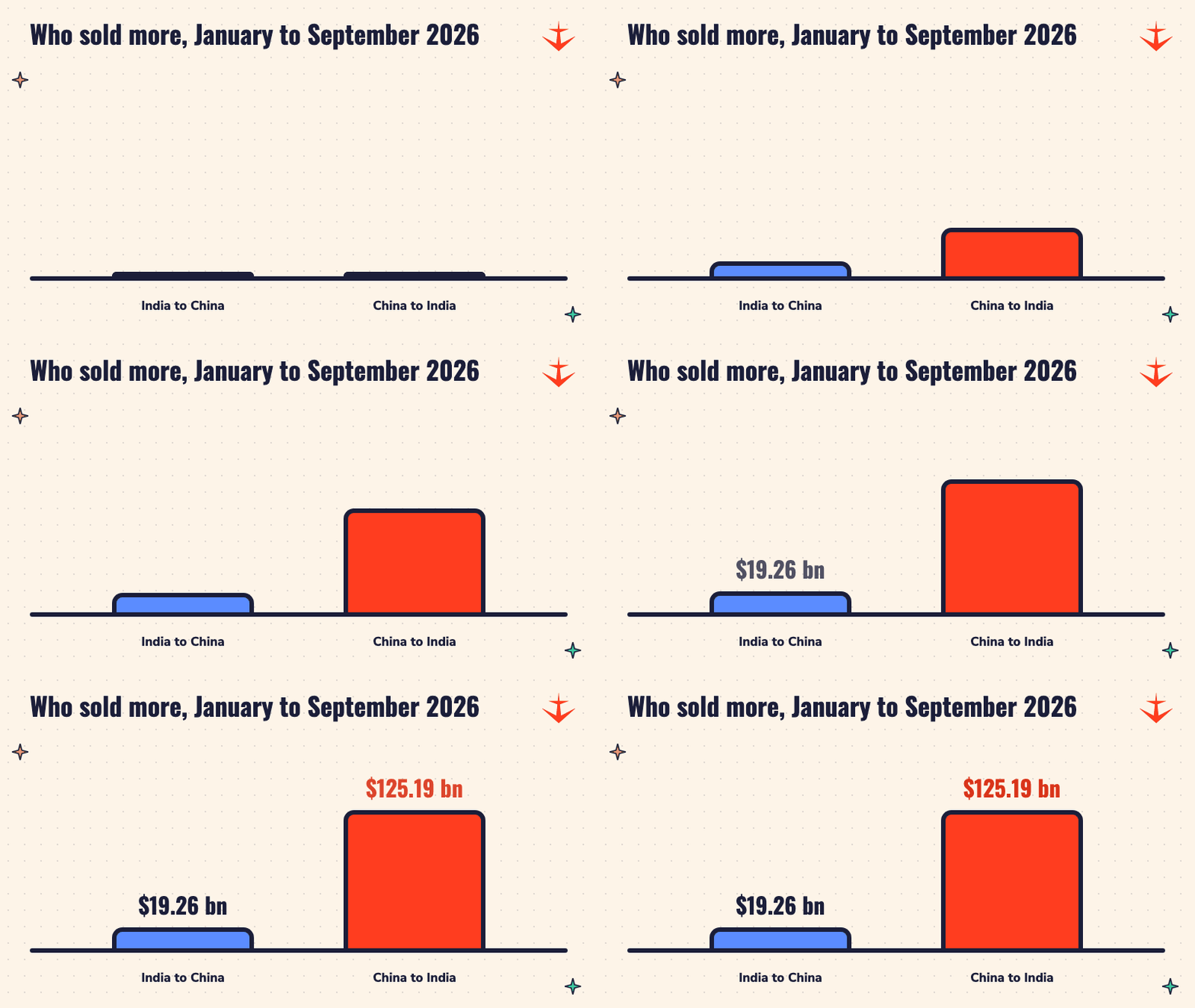
This gap is called a trade deficit. This is like your monthly pocket money going mostly to one canteen, while that canteen rarely buys anything from you. A large part of what India buys is electronics, machinery and chemicals that feed India's own factories.
What is India already selling to China?
The growth is led by printed circuit boards, display modules, refined petroleum and naphtha, says the same report. A printed circuit board is the green board inside a phone or TV that holds the chips together. A display module is the screen part. Naphtha is an oil product used to make plastics and chemicals.
The report also says India keeps asking China to open its doors wider to Indian IT, medicines and farm products. A bigger opening there could mean new buyers for Indian software firms, drug makers and farmers.
Electronics is a big part of the picture. In September 2026 alone, India's exports of electronic goods were up 70.44% over September 2025, the same government data showed.
Where does ASEAN fit in?
Two ASEAN countries are already among India's fastest growing buyers. From April to September 2026, exports to Singapore jumped 103.05% and exports to Malaysia rose nearly 83%, based on commerce ministry figures.
India and the ASEAN group traded about $128 billion of goods in 2025-26, around 11% of all of India's trade, Maritime Gateway reported. The two sides have also been reviewing their old trade deal, which sets the import taxes each side charges the other.
What does "unfair pricing" mean here?
Imagine a new stall opens next to yours and sells samosas at half the cost of making them, only to push you out. Goyal said that if India finds "fair play or pricing is not proper" for a product, an "established judicial process" will follow, The Hans India reported. In simple words, India can look into the case through its legal system instead of shutting the door on all Chinese goods.
There are also worries. China has put new export controls on key machinery, including tunnel boring machines, the giant drills used to dig metro and rail tunnels. Asked about this, Goyal said, "We will work on it," ET reported.
What else came out of the Europe trip?
Goyal spent six days in Germany and the Netherlands. He also said India is in talks with the European Union on an investment protection agreement, and that India expects to get better terms than other countries under the trade pact being negotiated with the US, The Economic Times reported.
In this video, the minister speaks about India and Europe's trade deals.
In this interview, Goyal talks about hopes for a better relationship with China.
What does this mean for young Indians?
For now, it is a hope, not a deal. But the direction matters. If Indian factories sell more phone parts, screens, medicines and software to China and Southeast Asia, those factories could need more people on the floor, more engineers and more export staff.
The numbers show sales by India to China are rising quickly, but from a small base. Closing a gap of over $100 billion will take years of steady work, one order at a time.
Sources
- ThePrint (PTI): We will see India becoming major exporter of goods and services to China, says Goyal
- The Hans India: We will become major exporter to China, says Goyal
- Daily Excelsior: India set to expand exports to China, ASEAN in coming years
- The Economic Times: We will see India becoming major exporter of goods and services to China
- The Economic Times: India to emerge as major exporter to China, ASEAN, get edge in US trade pact
- Telangana Today: India's total exports rise 10.99% to $80.75 billion in September
- Maritime Gateway: India's trade deficit with China, January to September 2026
- Maritime Gateway: India ASEAN trade touches $128 billion in 2025-26
- Cover photo: G20 Summit, Gurugram 2023, Piyush Goyal (Union Minister, India), by Shariquejamalworld, CC BY-SA 4.0

You may republish this story under CC BY 4.0: credit Arshdeep Singh and link to this page.