Over 100 Japanese companies grow their tech centres in India, shifting to AI and engineering
A Cushman & Wakefield report says Japanese GCCs in India are moving from support work to AI, engineering and cybersecurity.

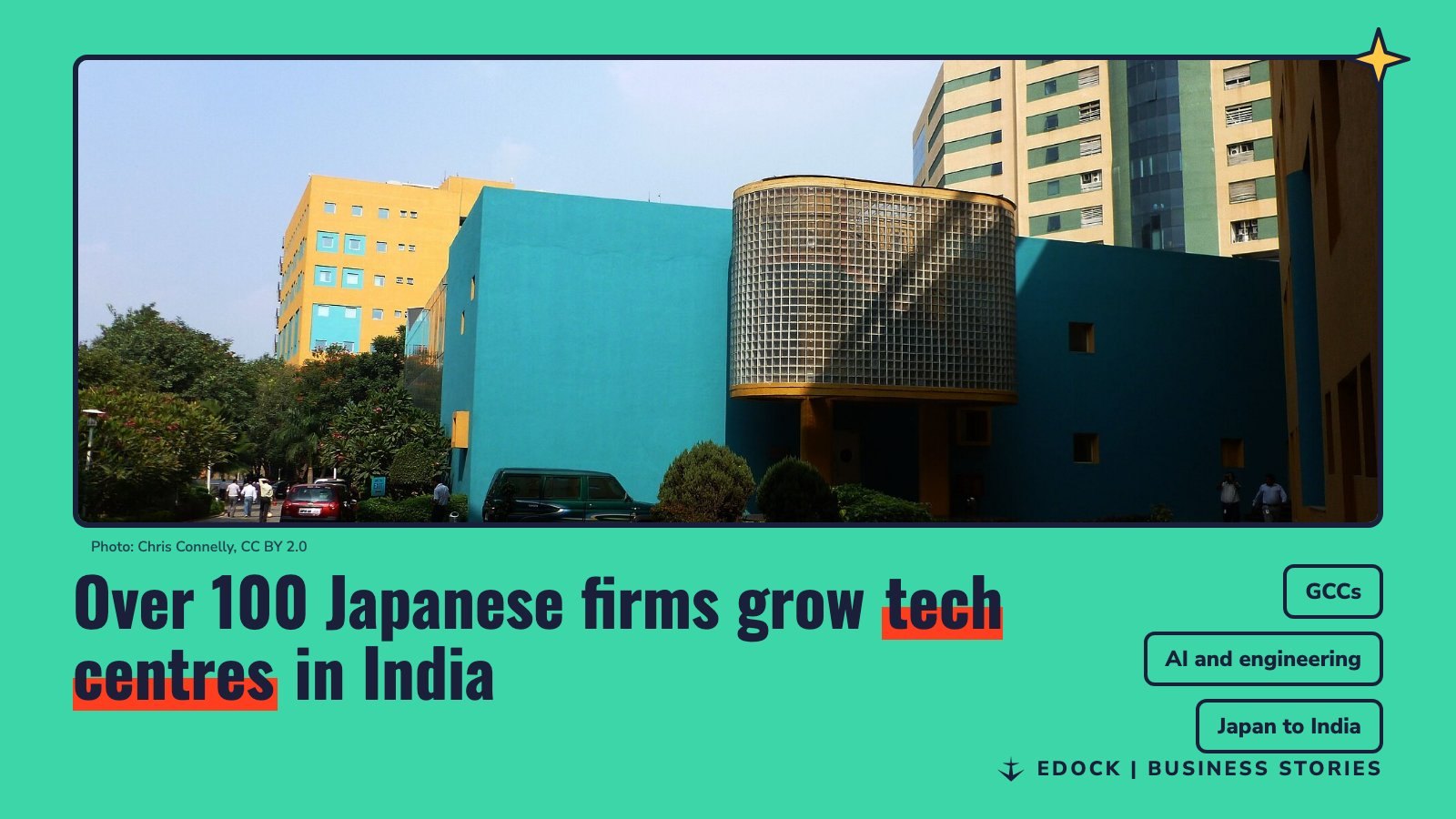
Picture a big Japanese company. Its head office is in Tokyo. But some of its smartest new work, like building AI tools and designing car parts on a computer, now happens in an office in Bengaluru, Hyderabad or Pune. That is no longer rare. On 21 October 2026, BusinessLine reported that more than 100 Japanese companies have set up or grown such offices in India, based on a new report by the real estate firm Cushman & Wakefield.
The bigger surprise is the kind of work these offices do. It is shifting away from simple support tasks and towards artificial intelligence (AI), engineering, product development and cybersecurity, the report said.
First, what is a GCC?
GCC stands for Global Capability Centre. It is a big company's own office in another country, doing tech, engineering and business work for the whole company around the world.
Think of a famous restaurant chain with its main kitchen in Tokyo. One day it opens a second kitchen in India. This kitchen is not a separate shop. It cooks for every branch of the chain, everywhere. The people in it work for the same company, under the same name. That second kitchen is like a GCC.
This is different from outsourcing. Outsourcing means paying another company to do a task for you, like hiring a caterer for a party. With a GCC, the company does the work itself, with its own team.
What did the new report say?
The report by Cushman & Wakefield, a firm that helps companies find and rent offices, made a few clear points, as BusinessLine reported:
- More than 100 Japanese companies have set up or grown GCCs in India.
- These centres now work as "centres of excellence", which means teams that are among the best in the company at one skill. Their skills include AI and automation, advanced data analysis, cybersecurity and engineering.
- The centres are becoming more closely linked to the company's global work and decision-making.
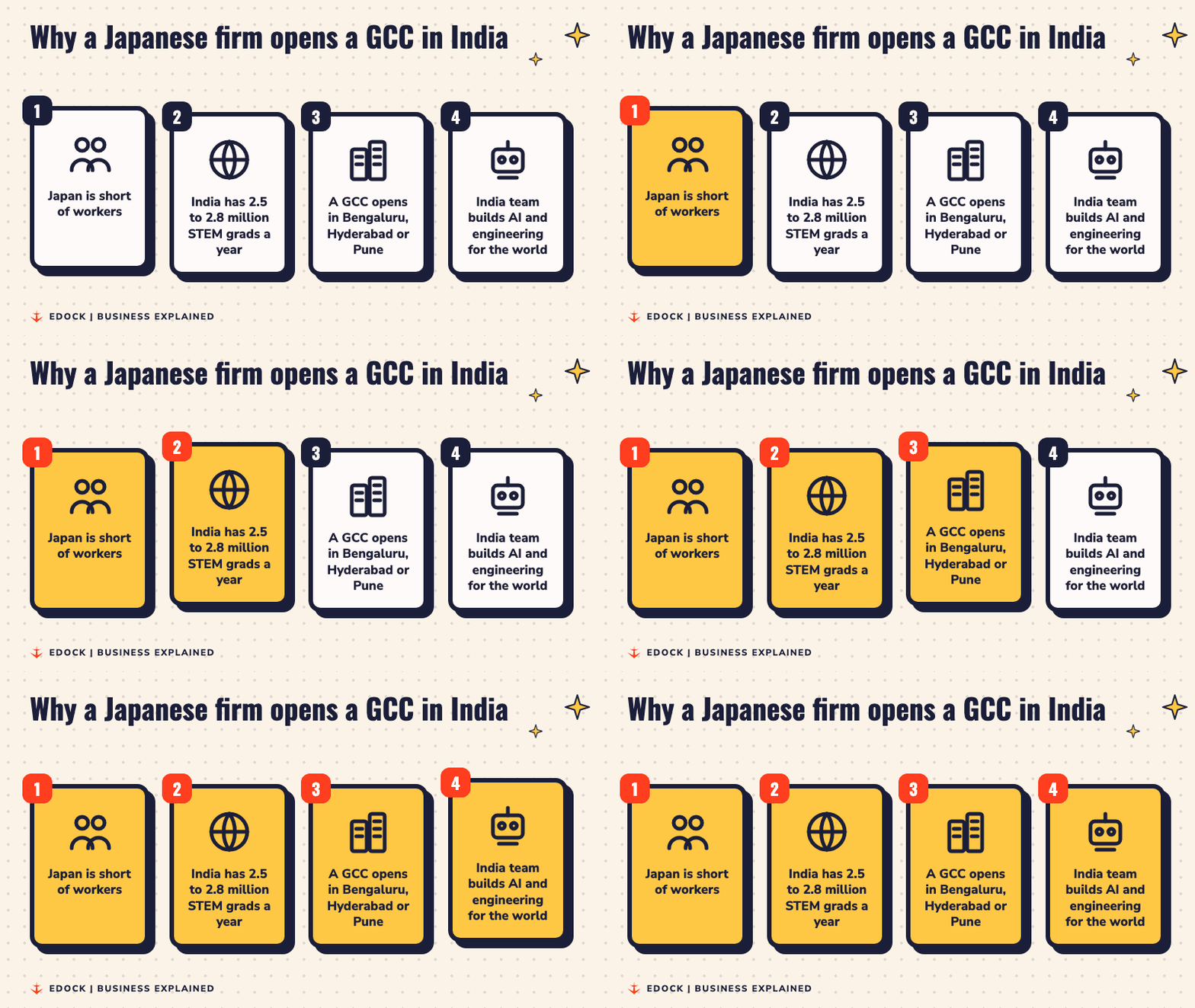
- Bengaluru, Hyderabad and Pune remain the top cities, while companies are also looking at newer cities to find special skills.

Arpita Srivastava, Managing Director for APAC Tenant Representation and GCC Advisory at Cushman & Wakefield, put it simply: "This is no longer a story of outsourcing," she said. She added that Japanese companies are not coming to India only to cut costs, but to build centres that create business value and drive new ideas.
From back office to brain office
A "back office" is the part of a company that customers never see: paperwork, accounts, data entry. For years, many foreign companies came to India mainly for this kind of work, because it cost less. Cushman & Wakefield itself, in a 2024 announcement, described India as the "outsourcing epicenter and call centre of the world 25 years ago" that has since become a place for new ideas.
The new report says Japanese GCCs are moving beyond back-office support and cost cutting, towards higher-value tech and innovation work. In cricket terms, it is like a player who first joined the team only to field, and is now opening the batting.

Why Japan is looking at India
The report gave three main reasons, according to the same coverage:
- Japanese firms need more digital and engineering talent.
- India has a huge STEM talent pool. STEM means science, technology, engineering and maths. India produces an estimated 2.5 million to 2.8 million STEM graduates every year, the report said. That is enough people to fill a cricket stadium of 50,000 seats 50 to 56 times, every single year.
- India has the setup. Office buildings, tech clusters and an investment system are already in place.
Other studies point the same way. A 2025 survey by staffing firm JoulestoWatts, which spoke to senior leaders from over 50 Japanese firms, found that 72% named Japan's own shortage of workers as the leading reason to invest in India-based GCCs. High costs at head office (64%) and slow digital change (48%) came next.
Is Japan a big player in India's GCC story?
Yes, and it has been growing for a while. In July 2026, a Deloitte India report said Japan, with over 100 centres, had become the largest contributor to India's GCC system from the Asia Pacific region. It said technology (20%), industrials (15%), and automotive and healthcare (11% each) make up the core of Japan's GCC footprint in India.
The same Deloitte report said cities like Ahmedabad, Jaipur, Coimbatore, Kochi and Indore are gaining attention for the next wave of GCCs. That matches the new report's point about companies looking at newer cities.
For a sense of scale, Cushman & Wakefield said in its 2024 announcement that India had over 1,600 GCCs as of 2023, from companies all over the world, with a workforce of 1.6 million people.
Money into India, beyond offices
This is also a money story. The new report said the trend is creating chances in commercial real estate, which means buildings used for business, like offices. Japanese money is helping pay for office campuses, technology parks and real estate platforms in India, the report said.
Think of a samosa stall that gets so popular that a big buyer from another city starts ordering daily. Soon the stall needs a bigger kitchen, more cooks and a new shop. The order brings money not just to the stall, but to the builder, the landlord and the vegetable seller too.
What comes next?
Srivastava said companies are now focused on how fast they can grow their skills in India, rather than whether to set up a centre at all. Cushman & Wakefield expects AI, engineering, new ideas and teamwork between Indian and Japanese teams to drive the next phase, the report said.
For students and first-jobbers, the takeaway is simple. Some of the most advanced work for big global names, in AI, cybersecurity and engineering, is being done from Indian cities. And the reports say the reason is talent, not just low cost.
Sources
- Over 100 Japanese companies expand GCCs in India, shift focus to AI and engineering, BusinessLine, 21 October 2026
- Over 100 Japanese companies set up, expand GCCs in India as focus shifts to AI, engineering: Report, The Tribune, 21 October 2026
- Japan becomes the largest contributor to India's GCC ecosystem in Asia Pacific, Deloitte India, 3 July 2026
- Japanese corporates accelerate India GCC expansion, Business Today, 8 September 2025
- Cushman & Wakefield launches GCC Advisory practice, Cushman & Wakefield, July 2024
- Cover photo: Hyderabad office buildings, HiTec City, by Chris Connelly, CC BY 2.0

You may republish this story under CC BY 4.0: credit Pranav Sharma and link to this page.