Otter.ai gets $320 million for its AI meeting notes, without selling any shares
Version 1 of 1 saved 21 Oct 2026, 12:17 am IST · Chain line 97
As it was first published
Otter.ai gets $320 million for its AI meeting notes, without selling any shares
General Catalyst's Customer Value Fund pays for Otter's marketing and gets paid back from new customers. Here is how the deal and the app work.
Picture a robot that sits quietly in your class, writes down every word the teacher says, and hands you neat notes at the end. Now picture investors giving that robot's makers $320 million, without taking a single piece of the company in return.
That is what happened to Otter.ai on Tuesday, 20 October 2026. The AI meeting notes company announced on October 20, 2026 that the money comes from General Catalyst's Customer Value Fund, or CVF. The deal is unusual, and it says a lot about how some software companies now pay for growth.
First, what does Otter do?
Otter is a meeting note-taking tool. It joins your online meeting, listens, and turns the talk into written text. This is called a transcript. Then its AI writes a short summary and a list of things people promised to do.
Think of a cricket scorer who writes down every ball, every run and every wicket. Otter is the scorer for office meetings.
The company says it has transcribed more than 1 billion meetings. It also says teams at over 86% of the Fortune 500, the list of the 500 biggest US companies, use it.
Otter is based in Mountain View, California. Its co-founder and CEO is Sam Liang.
How many people use it?
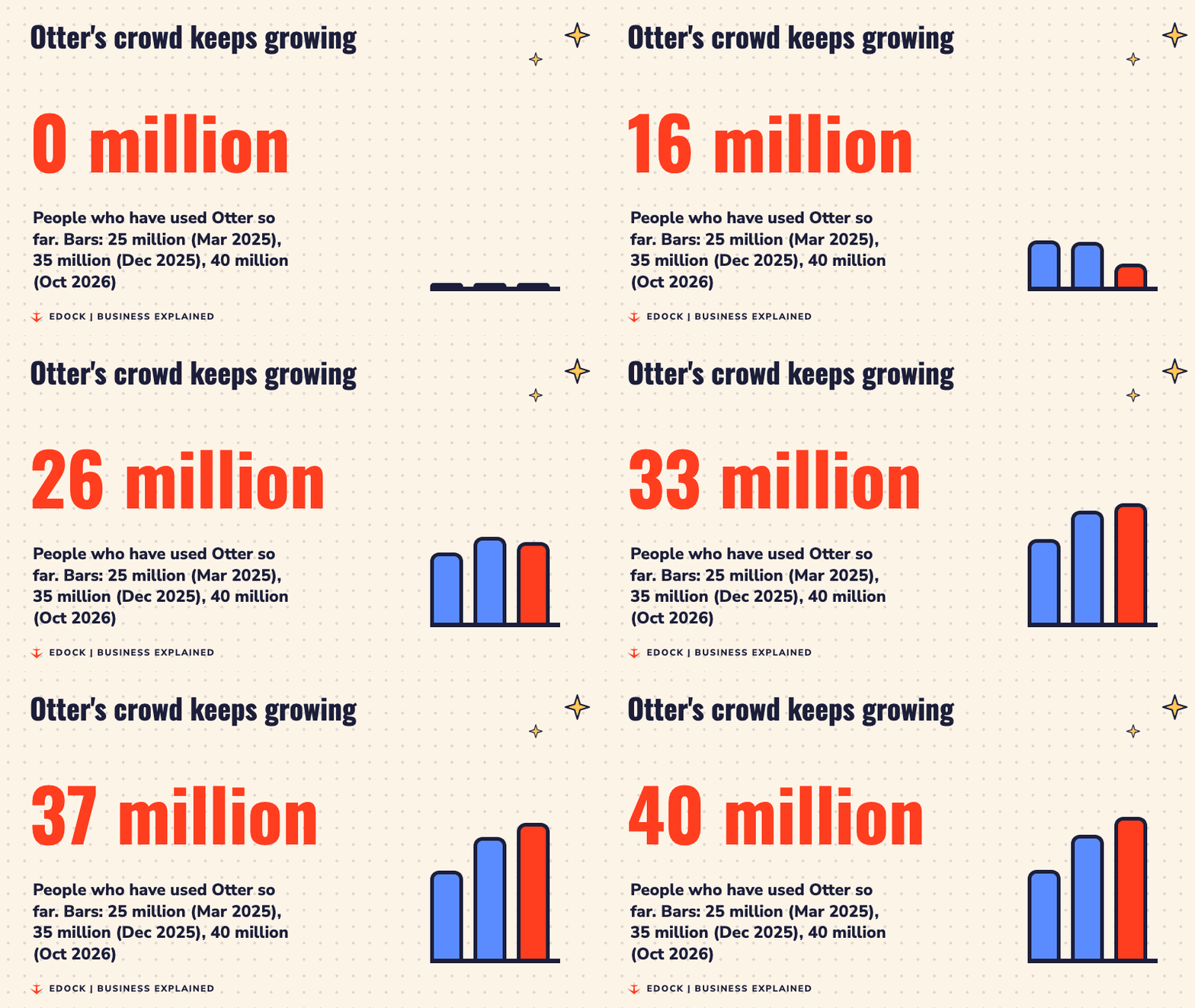
Otter says 40 million users have used its product so far. That is up from 25 million last year.
In March 2025, the number was over 25 million users. By December 2025, Otter said it had more than 35 million.
One thing is missing, though. TechCrunch notes that Otter did not share how many people use it every month, or how many leave. In a crowded market, keeping users is the hard part.
How does Otter earn money?
Otter sells plans. On its pricing page, there is a starting plan called Otter Basic, and paid plans such as Pro and Business. Bigger plans give more features, like more AI chat questions per user each month and links to sales software such as Salesforce.
Students and teachers with a .edu email get 20% off Pro. With that discount, Pro Annual costs $79.99 for the year, or about $6.67 a month.
Because customers keep paying every month or every year, Otter tracks a number called ARR, or annual recurring revenue. It is the money a company expects to get in a year from customers who keep paying, a bit like a chai stall that knows 50 regulars will buy a cup every single morning.
In March 2025, Otter said it had crossed $100 million in ARR. It did this with a team of fewer than 200 people, which works out to more than $500,000 of revenue per employee. Otter says it is now near new milestones, but it did not give updated figures.
Why is this money so different?
Usually, when a startup raises money, it sells shares. A share is a small slice of the company. If you own a samosa stall and a friend gives you money for a 10% share, that friend now owns 10% of the stall forever. This is called dilution: your own slice gets smaller.
The Customer Value Fund works another way. TechCrunch says the CVF gives startups money without diluting equity, and earns its return from the results of marketing spend.
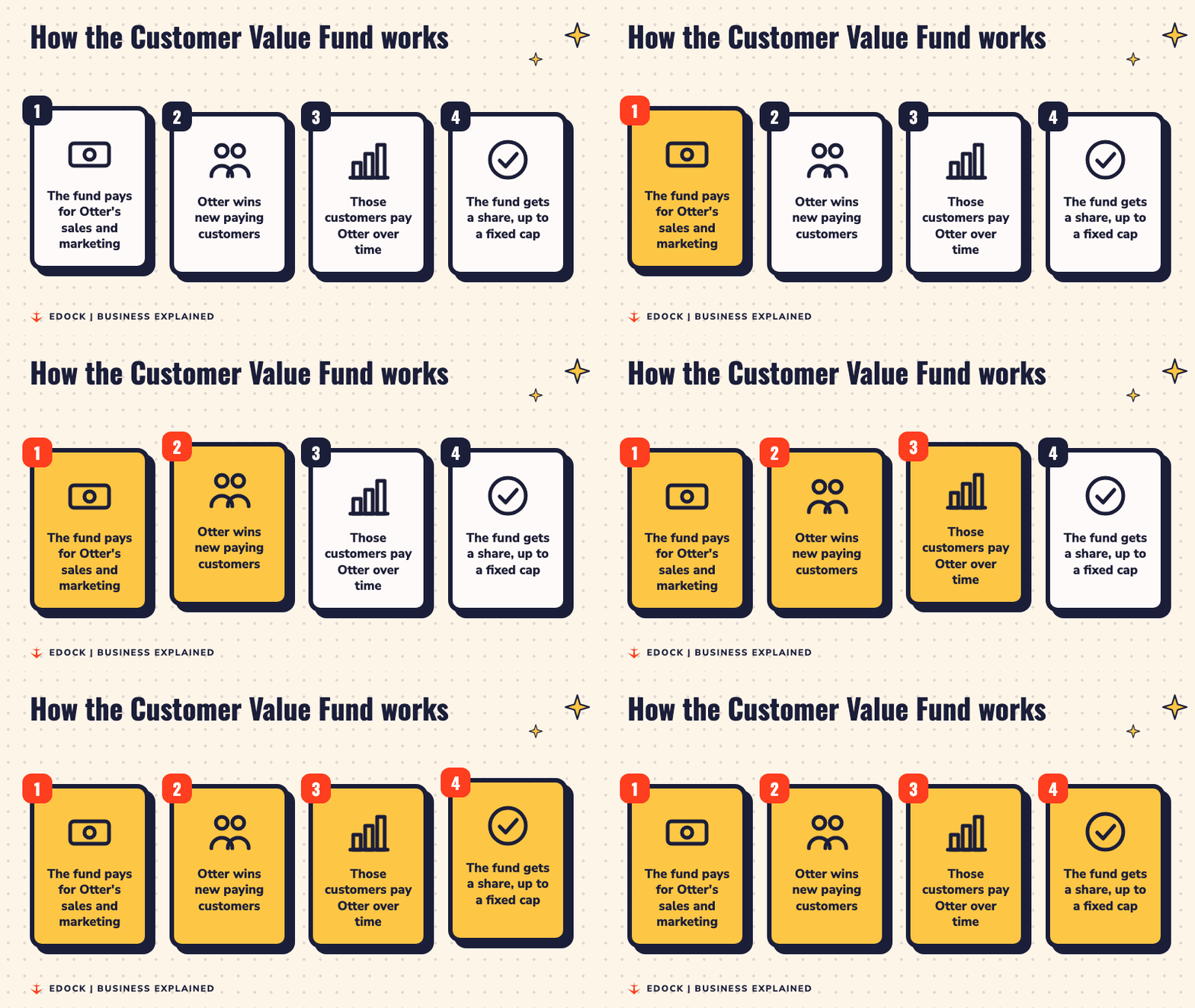
Here is the idea, as General Catalyst's essay The Unbundling of "Growth" Equity and a Unite.AI report lay it out:
- The fund pays in advance for a company's sales and marketing.
- In return, it gets only the customer money that this spending brings in.
- That share is capped at a fixed amount. After the cap, the rest of the money from those customers stays with the company.
- If the marketing does not work, the fund takes the loss. The company never pays it back from its own pocket.
Why not just take a loan?
A normal loan has to be paid back on fixed dates, whether customers show up or not. General Catalyst's essay says this is why debt has to be repaid or refinanced on a fixed schedule, while the payback from sales and marketing goes up and down.
So most companies use share money for marketing. The essay says most founders own less than 20% of their companies by the time of their IPO, when a company first sells shares to the public. Some own less than 5%. For comparison, it says Microsoft's founders owned almost four-fifths of their company at IPO.
On its capital page, General Catalyst pitches the CVF to companies that already have a product people want and now need to win new customers.
How big is this compared to before?
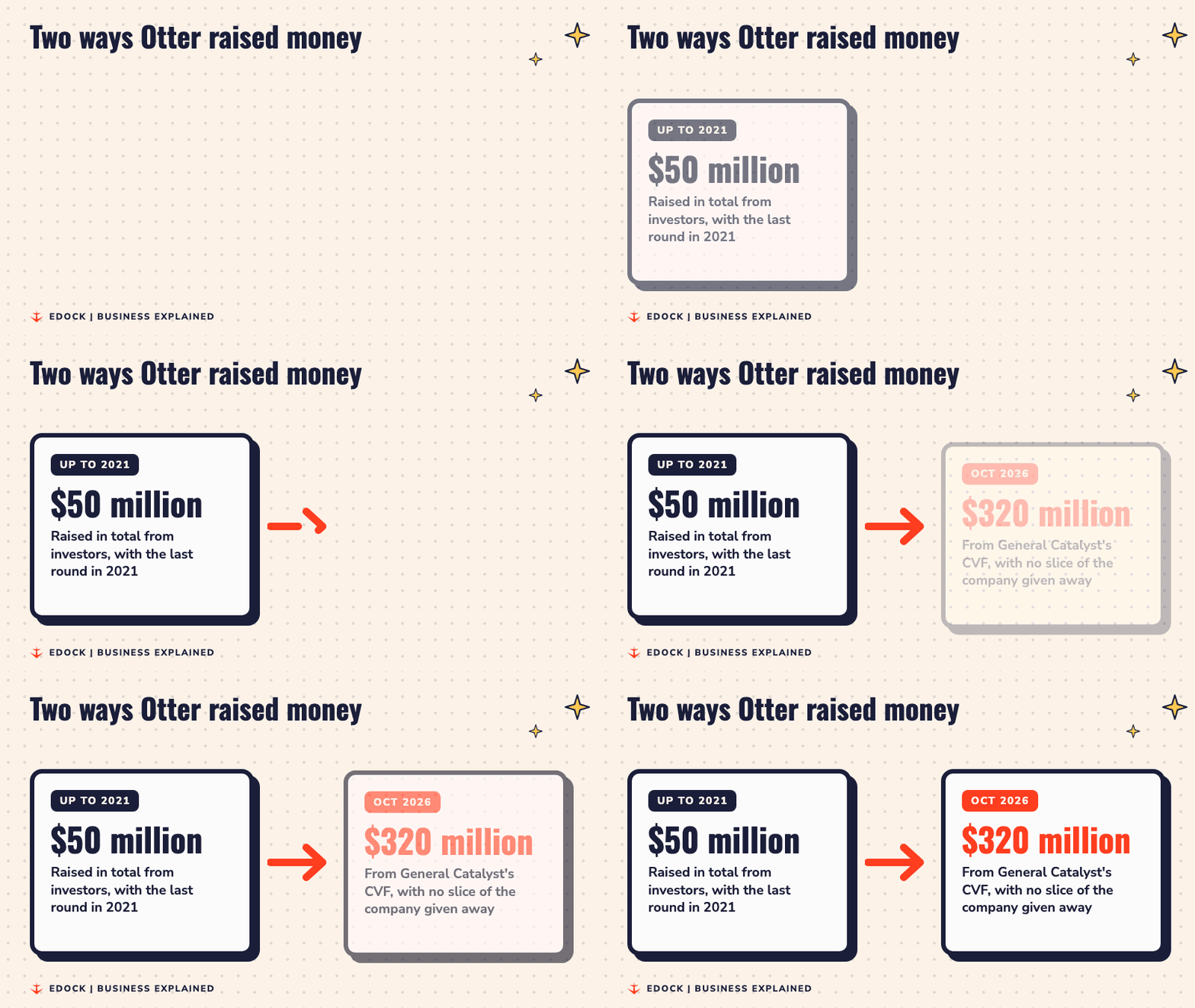
According to PitchBook data quoted by TechCrunch, Otter had raised $50 million in total, with its last round in 2021. The new $320 million is 6.4 times that amount.
Otter says it will spend the money on enterprise growth, its plan to reach customers, expansion into other countries, and new product features.
Why are investors interested?
Pranav Singhvi, a partner and co-founder of CVF at General Catalyst, said: "Voice is one of the biggest untapped opportunities in enterprise AI, and Otter is at the forefront of it." He also said that when Otter helps companies capture voice data and turn it into useful business insights, teams move faster and decisions get sharper.
Otter is also adding more than notes. In 2025 it launched AI meeting agents: one answers questions during a meeting, one coaches salespeople on live calls, and one gives product demos to visitors on its own site.
It is now testing a pre-brief, a note sent before a meeting with background from past chats, and a Live Assist feature that lets you ask the AI questions during a meeting, says TechCrunch. Otter's new marketing head, Alex Gay, told TechCrunch that people often spend the first twenty minutes of a meeting recapping what was said before.
Who else wants this job?
Plenty of rivals. TechCrunch lists Fireflies.ai, Granola and Read AI, plus newer players like Calendly, Wispr, and Superhuman, which bought the notetaker Fathom. Most of them want to plug into office software and turn meeting talk into automatic work.
So the race is not just about writing notes. It is about who becomes the place where a company's spoken knowledge lives.
Why should a student care?
If you have ever recorded a lecture to listen to later, Otter does a similar thing for office meetings, and then writes the notes and to-do list for you.
The money story matters too. Selling shares is not the only way to grow. If a company can show that each rupee or dollar spent on marketing brings back more, some investors will pay for that marketing and get paid only from the results.
Sources
- TechCrunch: Otter.ai raises $320 million from General Catalyst's growth fund for its meeting tool
- Unite.AI: Otter.ai closes $320M growth financing from General Catalyst's CVF
- Otter.ai: Otter.ai breaks $100M ARR barrier (March 2025)
- Otter.ai: Pricing
- General Catalyst: The Unbundling of "Growth" Equity
- General Catalyst: Capital and the Customer Value Fund
- Cover photo: Conference room table, by Breather, CC0
