Nepal sells $39 million of electricity to India in one month, despite flood damage
Nepal's power sales to India rose to NPR 5.93 billion from mid-September to mid-October, and its 40 MW supply to Bangladesh restarted on 23 October.

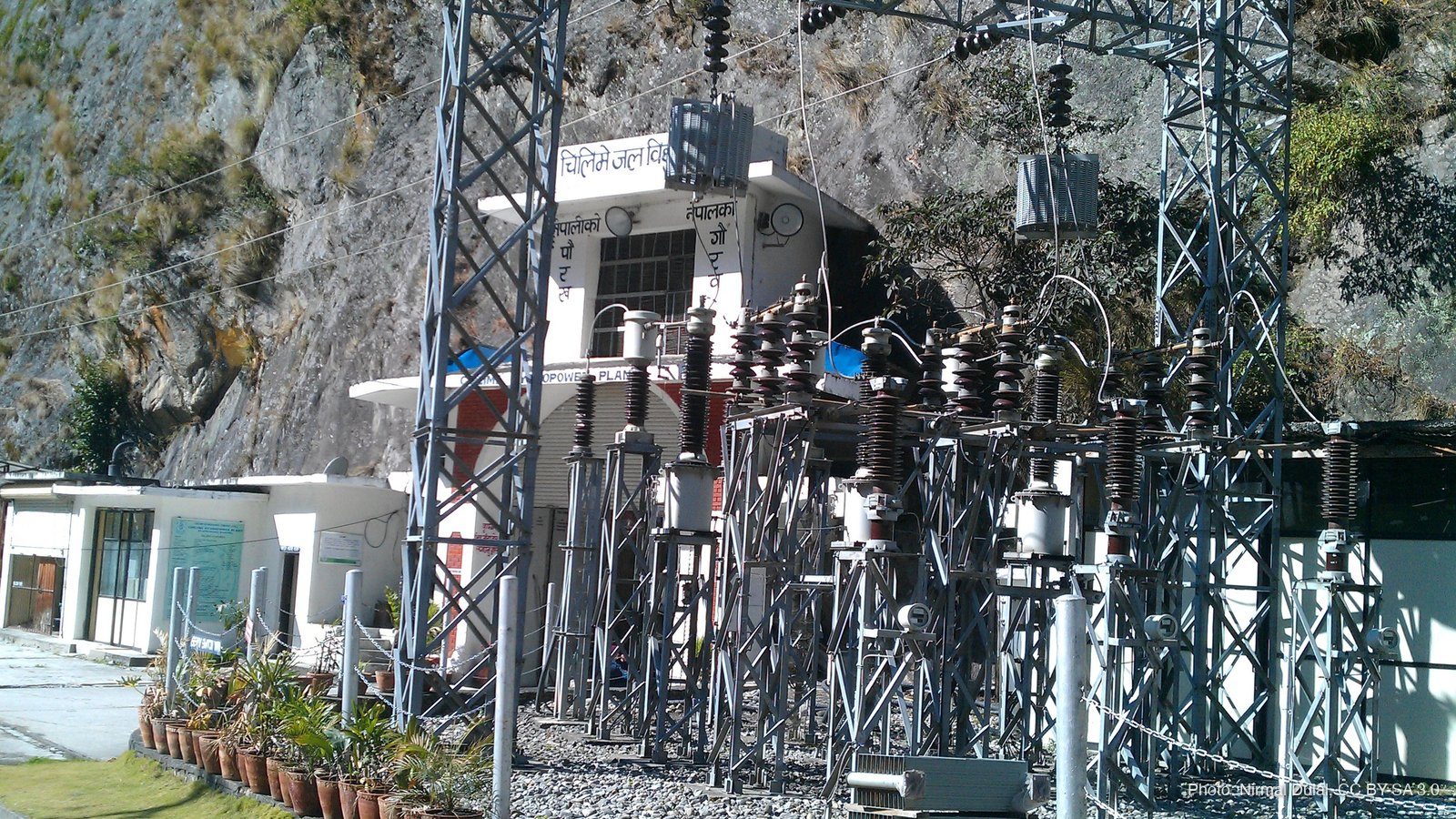
Picture a small hill country where rivers rush down from the Himalayas so fast that they make more electricity than its own homes can use. So it sells the extra to its big neighbour. In just one month, from mid-September to mid-October 2026, that extra power earned Nepal about $39 million from India. The numbers came out on Sunday, 25 October 2026.
The surprising part: this happened only weeks after floods had shut down some of Nepal's power plants. Sales did not fall. They went up.
What exactly did Nepal sell?
Nepal's main power company is the Nepal Electricity Authority, or NEA. First it meets the power needs of homes and shops in Nepal, then it sells the extra abroad. Its data shows Nepal sent 633.986 million units of electricity to India in that month and earned NPR 5.925 billion for it. NPR means Nepali rupees, the money used in Nepal.
A unit of electricity is one kilowatt-hour. That is roughly the power a 1,000-watt iron uses if it runs for one full hour. Your home's electricity bill counts the same units. So imagine more than 600 million hours of ironing, all powered by Nepal's rivers and sent across the border.
A simple division of those two numbers works out to about NPR 9.3 for each unit sold. That is only an average. Prices change by deal and by day, as the next sections show.
Up from last year, and from last month
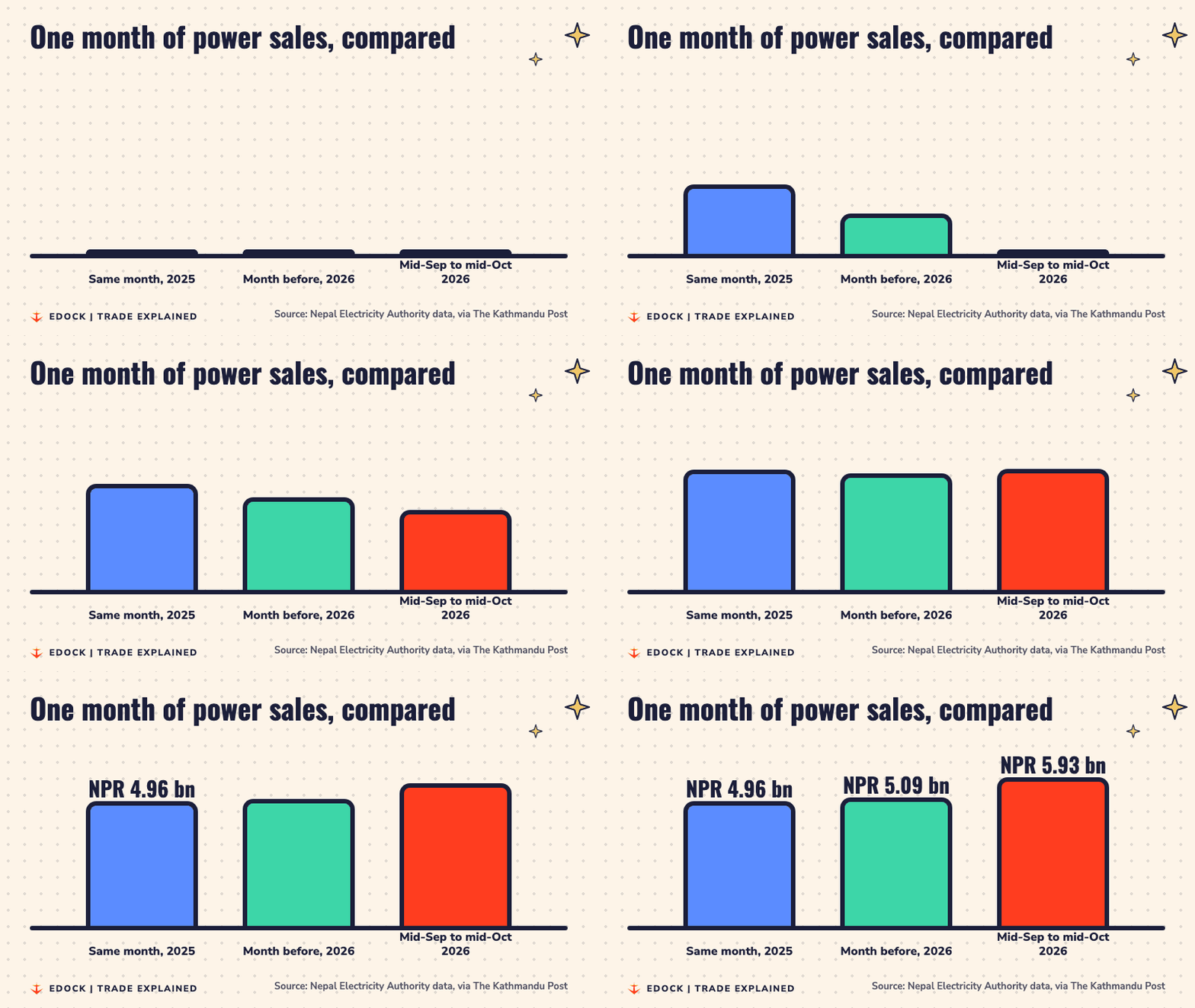
According to NEA data reported by Onlinekhabar, the same month last year earned NPR 4.963 billion. The month just before this one earned NPR 5.0925 billion. So this month's NPR 5.925 billion was:
- NPR 962 million more than the same month last year, a rise of about 19%.
- NPR 832.5 million more than the month before, a rise of about 16%.
Add up the first three months of Nepal's money year, from mid-July to mid-October, and the total is NPR 16.1513 billion. Nepal's money year starts in mid-July, the way India's starts in April.
Why does Nepal have extra power at all?
Most of Nepal's electricity comes from hydropower. Water from fast rivers spins big wheels called turbines, and the turbines make electricity. Many of Nepal's plants are "run-of-river". They do not store much water in a big lake. They use whatever the river brings that day.
So the season matters a lot. During the monsoon, rivers are full and plants make more power than Nepal needs. In the dry winter, rivers shrink, and Nepal has for years had to buy electricity from outside instead.
Think of a family with one cow. In a good season the cow gives more milk than the family can drink, so they sell the extra to the neighbours. In a lean season, they have to buy milk. Nepal has the same kind of up and down, only with electricity.
Who in India buys it, and how?
Nepal sells its power through two routes, as the NEA explained to The Kathmandu Post:
- Fixed deals with two Indian states. Under bilateral agreements, meaning a deal between two sides, Nepal supplies Haryana and Bihar from June to October each year. This is like a milk delivery you book for the whole season.
- A power market. The rest is sold on the Indian Energy Exchange, or IEX. It works a bit like a vegetable mandi for electricity. Buyers and sellers bid every day, in a "day-ahead" market for tomorrow's power and a "real-time" market for power needed almost right now.
NEA chief Dirghayu Kumar Shrestha said nearly two-thirds of the power sent to India in this month went through the fixed deals. The rest went through the IEX.
The floods, and the comeback
On 26 August 2026, an ice-rock avalanche high in the Himalayas set off flash floods in northern and central Nepal. Around 1,400 people were killed, and roads, bridges and hydropower projects were damaged.
After the floods, power generation stopped at 12 hydropower projects. Nepal had been sending an average of about 1,000 megawatts across the border in the wet season. That dropped to around 650 megawatts. A megawatt is a measure of how much power flows at one moment, like the width of a water pipe.
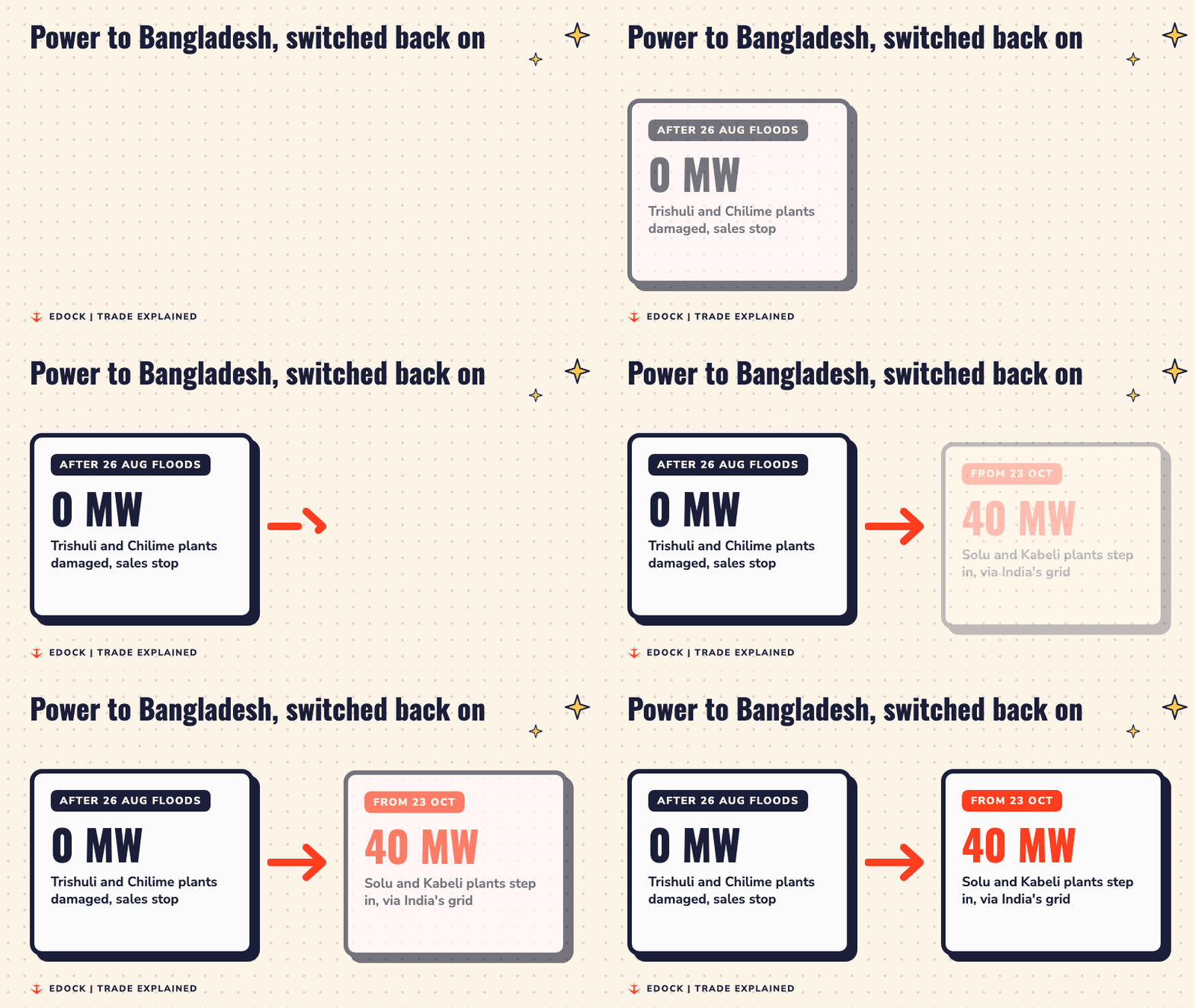
Two of the damaged plants, Trishuli and Chilime, had been approved to send power to Bangladesh. So those sales stopped completely.
Bangladesh gets its power back
Here is a fun twist. Nepal and Bangladesh do not share a border. So Nepal's electricity reaches Bangladesh by travelling through India's power lines, the way a parcel can pass through a courier hub in another city before it reaches you.
The NEA and the Bangladesh Power Development Board signed a five-year deal on 3 October 2024. Under it, Nepal sends 40 megawatts to Bangladesh every year from 15 June to 15 November.
On the evening of Friday, 23 October 2026, those 40 megawatts started flowing again. India's Central Electricity Authority, the body that approves power trade across the border, cleared power from other plants to stand in for the damaged ones. The Solu Khola and Kabeli plants now supply Bangladesh, and the Lower Modi Khola plant supplies Haryana, The Kathmandu Post reported.
How big can this trade get?
Every Nepali plant needs India's approval before it can sell across the border, and these approvals are renewed each year. India has just approved another 31 megawatts. That takes Nepal's total approved export capacity to India to about 1,179 megawatts.
For buyers in Haryana and Bihar, it means extra power from June to October. For Nepal, it turns a seasonal surplus, power left over after its own needs, into earnings. And the Bangladesh link shows how power can now cross more than one border in South Asia, using India's grid as the road.
Sources
- The Hindu: Nepal exports electricity worth $39 million to India a month after flash floods
- The Kathmandu Post: Nepal resumes power exports to Bangladesh after flood disruption
- The Kathmandu Post: Bhotekoshi floods halt Nepal's electricity exports to Bangladesh
- Onlinekhabar: Nepal earns NPR 5.92 billion from electricity exports to India
- myRepublica: Electricity worth NPR 5.92 billion exported to India in one month
- Cover photo: Chilime Hydropower, by Nirmal Dulal, CC BY-SA 3.0

You may republish this story under CC BY 4.0: credit Arshdeep Singh and link to this page.