Naukri's founder Sanjeev Bikhchandani takes the top job as Hitesh Oberoi steps down
Info Edge's founder becomes Group CEO on 3 December, while profit nearly doubled on the back of a jump in other income.

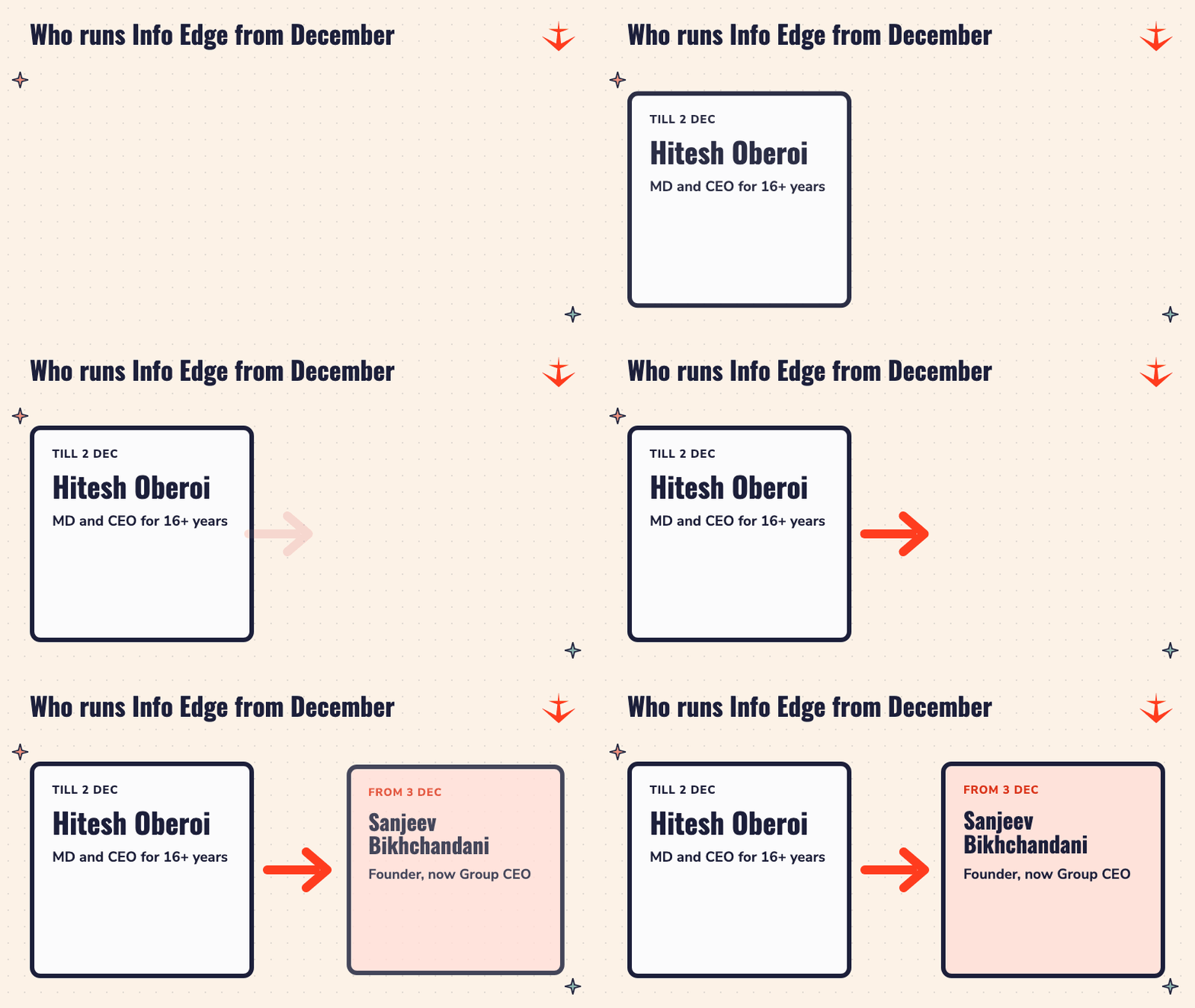
Picture a cricket team where the captain of 16 years hands over the captaincy to the player who first built the team. That is what happened at Info Edge, the company behind Naukri, on Wednesday, 28 October 2026. In a filing to the stock exchange, the company said founder Sanjeev Bikhchandani will become Executive Vice Chairman, Managing Director and Group CEO from 3 December 2026. Hitesh Oberoi, the boss for more than 16 years, will step down on 2 December, after nearly 27 years with the company.
On the very same day, Info Edge also shared its results for July to September 2026. Profit almost doubled. But a big part of that jump came from somewhere other than Naukri itself. Here is the full story, in simple words.
Who is taking over, and who is stepping back?
A CEO, or Chief Executive Officer, is the person who runs a company every day. Think of the head chef in a busy dhaba. The owner may sit at the counter, but the head chef decides what gets cooked, how fast and by whom.
Hitesh Oberoi has been that head chef at Info Edge. He first worked as Chief Operating Officer and then became CEO, BestMediaInfo reported. In his letter to the board, dated 27 October, he wrote, "it is time for me to step back from my full-time operating role." He said he wants more time for higher education, entrepreneurship, investing, philanthropy and his family.
He is not leaving fully. From 3 December, he will stay on the company's board as a non-executive director. The board is a group of senior people who guide and check the company, a bit like a school's managing committee. A non-executive director gives advice but does not run daily work. Both changes still need a yes from shareholders, the people who own the company's shares.
Sanjeev Bikhchandani's new term will run until 26 April 2031, in line with his present term on the board. In the company's press release, he called Oberoi "an extraordinary partner" and said he would rely a lot on his guidance.
Why does the founder taking the top job matter?
In this story, the top job goes to the person who started the company. Bikhchandani left a marketing job at the company that made Horlicks in 1990 to start his own business. He set up Info Edge in 1995 and launched Naukri.com in 1997, when the internet was new in India.
He is also a co-founder of Ashoka University and received the Padma Shri in 2020. Info Edge also put money into young startups, including Zomato and Policybazaar, long before they became famous names.
The company's chairman, Kapil Kapoor, said in the release that Info Edge was the first Indian internet company to go public, which means the first to sell its shares to ordinary people on the stock market.
How does Naukri actually make money?
Most people who look for work on Naukri use it for free. Where does the money come from, then? Companies pay for it.
Think of a big mela. Visitors walk in for free. The stall owners pay rent to set up shop, because that is where the crowd is. On Naukri, companies are the stall owners. They pay to post openings and to search a giant pile of CVs. Oberoi's letter mentions Resdex, the tool firms use to dig through that pile.
And the pile really is giant. According to the company's results presentation, Naukri holds 120 million resumes. About 20,000 new resumes get added daily, and around 46,000 companies paid Naukri in the July to September quarter. There were 699,000 openings listed in that period.
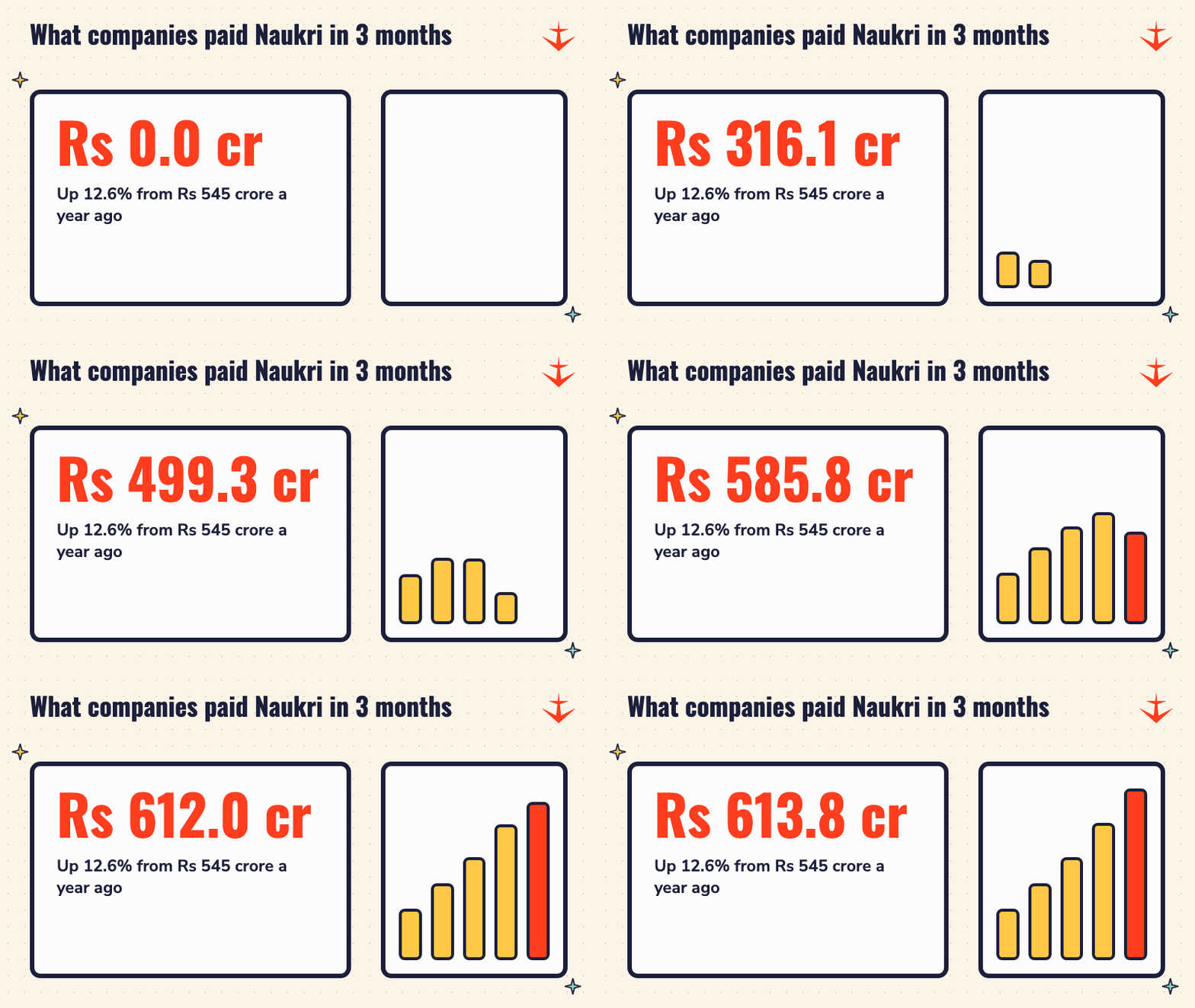
The money companies agree to pay in a quarter is called "billings". It is like the total of all the stall bookings at the mela, even if some rent gets counted later. For the recruitment business, led by Naukri, billings rose 12.6% to Rs 613.8 crore, up from Rs 545 crore a year earlier.
What does this say about hiring?
When companies plan to hire more, they spend more on tools like Naukri. So billings are a rough hint of how keen firms are to hire.
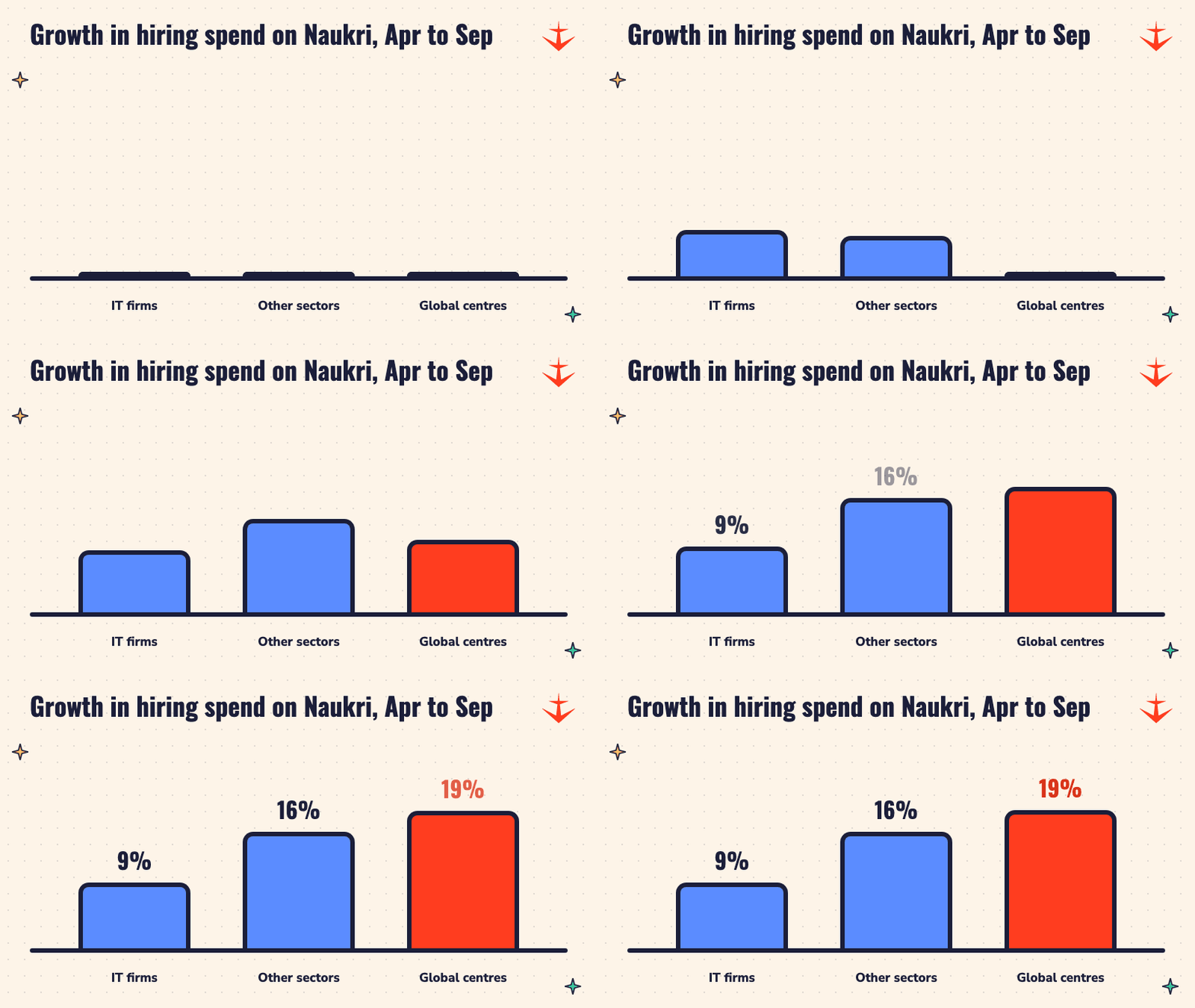
The results presentation splits this by type of employer, for April to September 2026. Billings from tech and IT companies grew 9%. Billings from Global Capability Centres grew 19%. These centres are big offices that foreign giants run in India for tech, finance and support work. Billings from all other sectors grew 16%.
So the strongest push came from these global offices and other non-IT employers, while IT firms grew slower. For a young graduate, this hints that spending on hiring grew faster outside traditional IT companies.
AI is also changing how the company earns. Oberoi said AI and data products now bring in a "high single-digit share" of recruitment sales, with a yearly run rate of about Rs 240 crore. A run rate is a guess of a full year's sales if the latest quarter's pace continues. One AI tool, AI Rex, has more than 2,000 paying customers and cuts the time to find and screen candidates from 10 to 15 days to a few hours, the presentation says.
Profit almost doubled. Where did that come from?
Info Edge's consolidated net profit, which means the profit of the whole group added together, rose 87% to Rs 649.8 crore, up from Rs 347.5 crore a year earlier. Revenue from operations, the money earned from its actual services, grew 12.2% to Rs 903.9 crore.
Here is the twist. "Other income" rose 164.8% to Rs 428.4 crore, up from Rs 161.8 crore. Other income is money that does not come from selling services. It can come from interest and returns on money the company has invested. Think of a samosa stall owner who also earns interest on savings in the bank. If that interest jumps, total earnings rise, even if samosa sales grow only a little.
Entrackr noted that other income played a key role in the profit jump. The core business still did well. Total expenses rose only 4.1% to Rs 587 crore, slower than revenue. On a standalone basis, which means Info Edge alone without the group units, operating profit before tax grew 29.8% to Rs 347.3 crore, the company said.
What changes for people who use Naukri?
Nothing changes overnight. Naukri, 99acres, Jeevansathi and Shiksha keep running as before. Oberoi wrote that Naukri has a clear AI and data plan, 99acres has become a cash-generating business, and Jeevansathi and Aisle are now profitable.
The big question now is what the founder does with the steering wheel. He takes over a company whose main money machine is still Naukri, with AI tools growing fast inside it and a cash balance of Rs 4,976 crore, as per the results presentation.
This video shows how Sanjeev Bikhchandani built Naukri and the lessons he shares with young founders.
And in this one, he talks about whether AI will take away work.
Sources
- Info Edge: board meeting outcome, resignation letter and press release on the leadership change, 28 October 2026
- Info Edge: Q2 FY27 results, press release and earnings presentation, 28 October 2026
- Inc42: Sanjeev Bikhchandani to take over as Info Edge group CEO
- Entrackr: Info Edge profit and other income in Q2 FY27
- BestMediaInfo: Hitesh Oberoi to step down as Info Edge MD and CEO
- Storyboard18: Hitesh Oberoi to exit MD and CEO role after 27 years
- Storyboard18: Who is Sanjeev Bikhchandani
- Indian Television: Info Edge Q2 billings update
- Wikipedia: Sanjeev Bikhchandani
- Cover photo: A "Now Hiring" sign in Pittsboro, North Carolina, by DiscoA340, CC0 (public domain dedication)

You may republish this story under CC BY 4.0: credit Pranav Sharma and link to this page.