Microsoft made its own AI chip to need Nvidia less. Here is how it works
Maia 300 is Microsoft's newest AI chip. It says the chip gives 40% more AI answers for the same electricity. Explained in easy words.

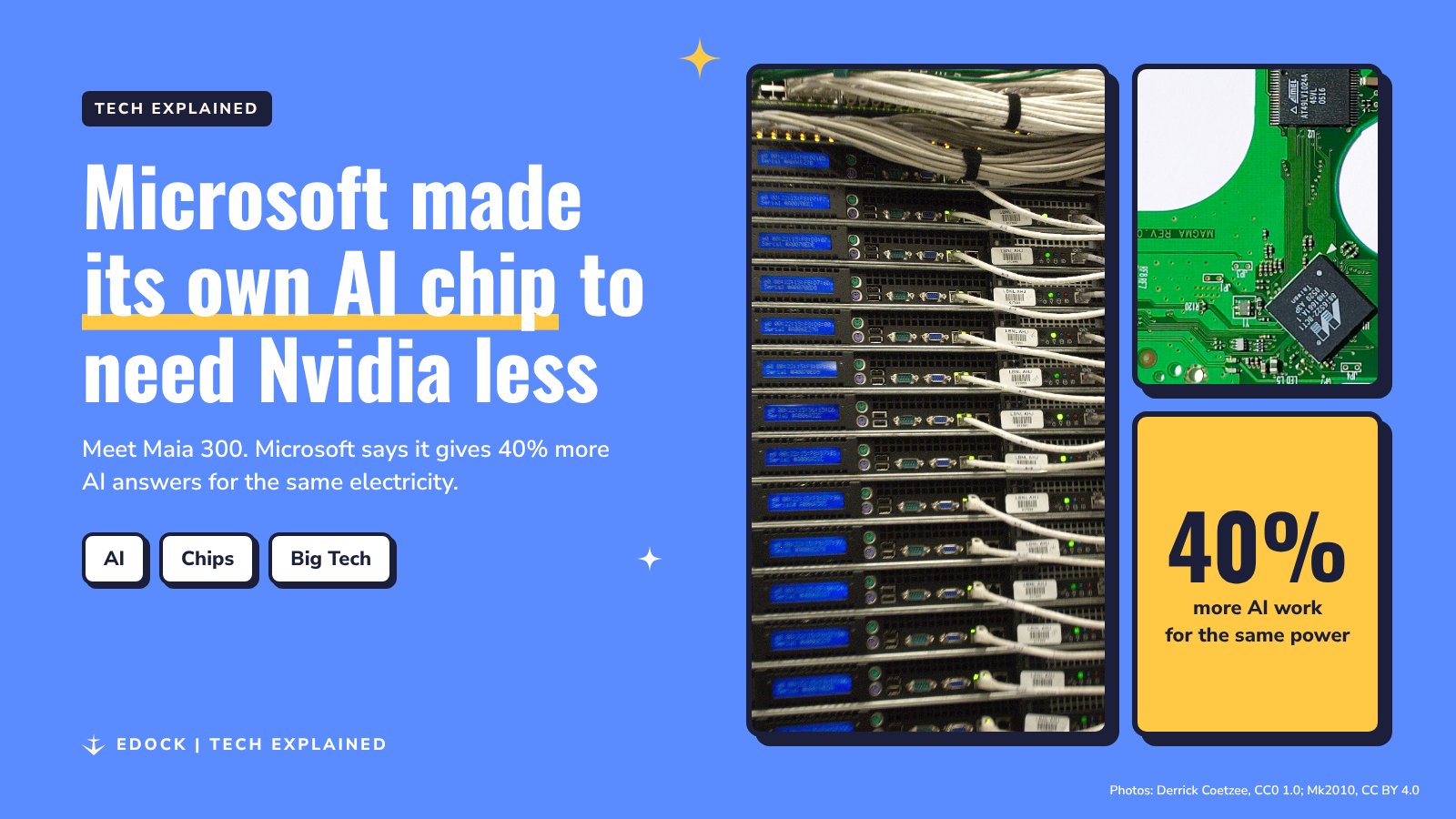
Every time someone asks Copilot a question, a computer chip somewhere has to do the thinking. Microsoft spends huge amounts on these chips, and a big share of that money has gone to one company: Nvidia. Now Microsoft wants more of that thinking to happen on chips it designs itself.
On October 12, 2026, Microsoft announced a new AI chip called Maia 300. Reuters reported that Microsoft could put more than a million of these chips to work next year. Let us break down what this chip is, and why it matters.
First, what is an AI chip?
A chip is a tiny piece of silicon that does calculations very, very fast. Your phone has one. Your laptop has one.
AI needs special chips because it does millions of small sums at the same time. The most famous chips for this are called GPUs. GPU stands for graphics processing unit. They were first made to draw pictures on screens, like in video games, but they turned out to be great at AI too. Nvidia is the best-known maker of GPUs.
Big tech companies buy huge numbers of these chips and keep them in giant buildings called data centres. A data centre is like a huge warehouse, but instead of sacks of rice, it is full of computers, stacked in tall metal frames called racks.
What does Maia 300 actually do?
AI work has two big parts.
- Training: teaching the AI, like a student studying for months before an exam.
- Inference: using what it learned to answer questions, like the student actually writing the exam.
Maia 300 is built for the second part. Microsoft's own technical blog says the chip is designed to make the whole system better at inference. Training the biggest AI models is still a job where Nvidia leads, as The Tech Portal points out.
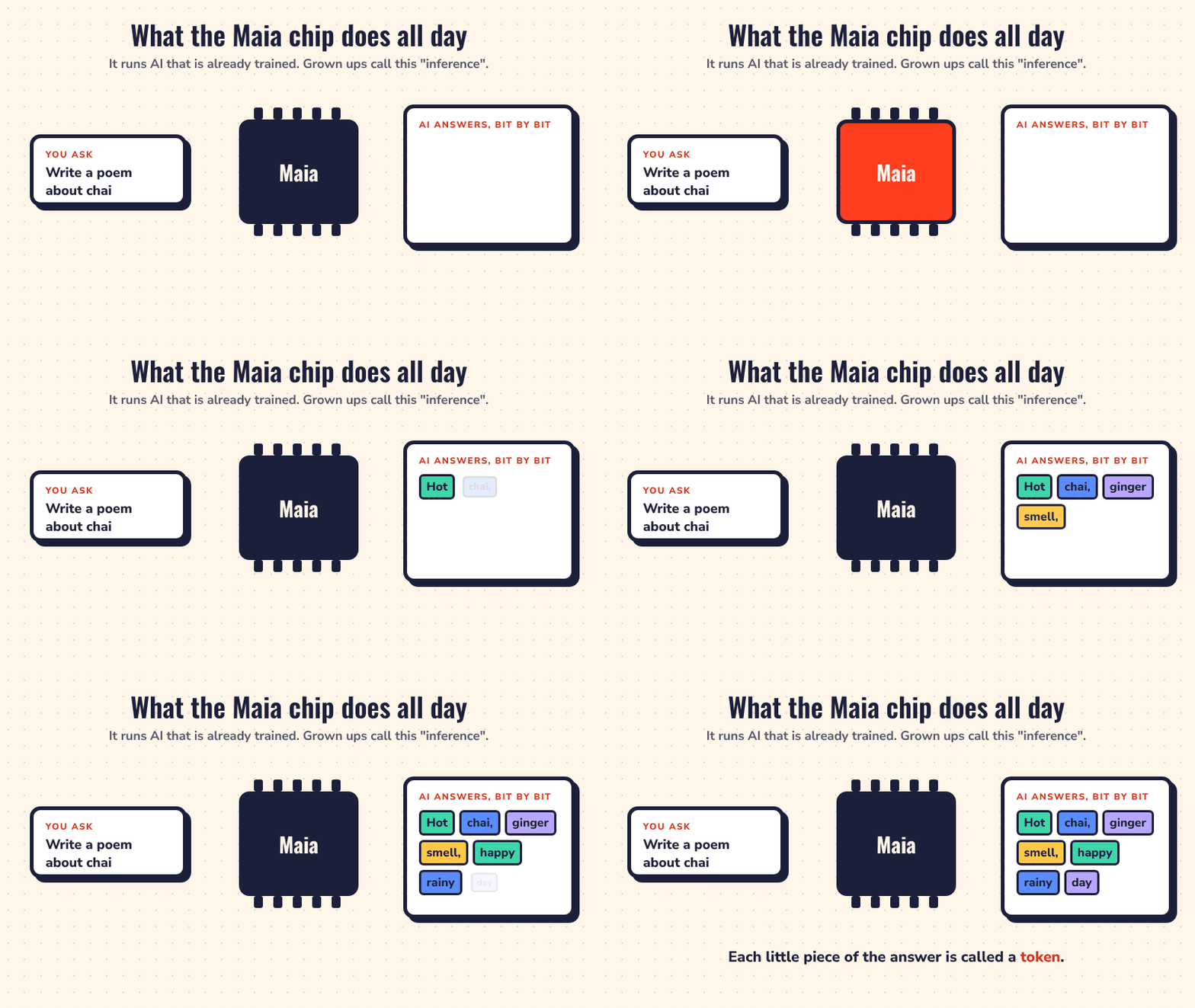
When an AI answers you, it builds the reply in small pieces called tokens. A token can be a short word or part of a word. The more tokens a chip can make, the more answers it can give.
The big claim: 40% more for the same electricity
AI chips eat a lot of electricity. So companies care a lot about how much work they get for every unit of power.
Microsoft says Maia 300 is expected to give 40% more tokens per megawatt than leading GPU-based systems. A megawatt is a big amount of electrical power. So in simple words: same electricity bill, 40% more answers.
Think of two chai stalls that use the same amount of gas in a day. If one stall makes 100 chais and the other makes 140, the second one is getting much more out of its gas.
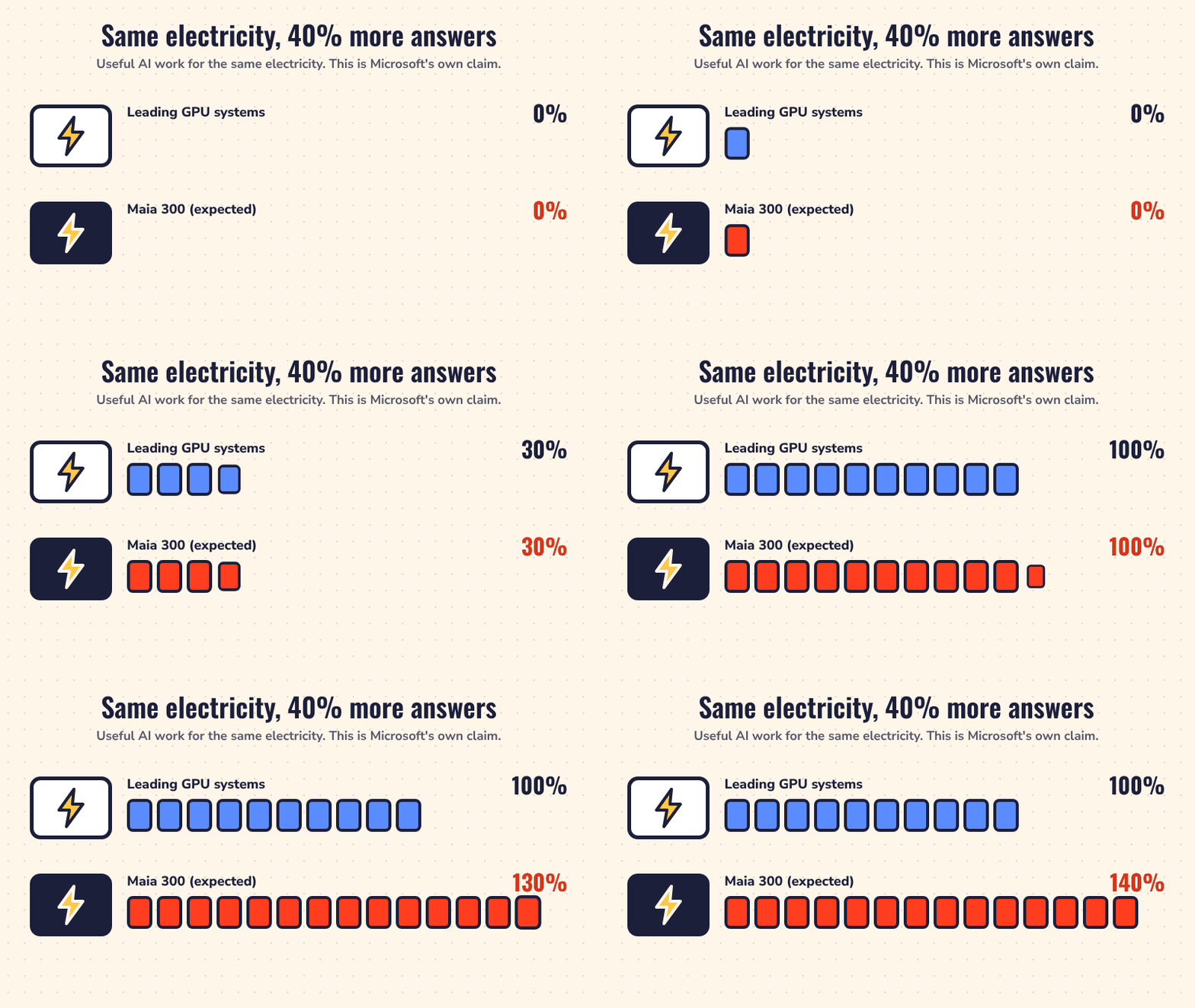
One thing to remember: this is Microsoft's own claim. The company did not name which GPU systems it compared against.
How big is it?
Here are a few numbers from Microsoft's announcement:
- One rack holds 96 Maia 300 chips.
- A full rack of 96 chips can make up to 7 times as many tokens as a rack of the older Maia 200.
- The chips are made by TSMC, the giant chip factory company from Taiwan, using its tiny 2-nanometer technology for the main part of the chip. A nanometer is one billionth of a metre.
Microsoft says each Maia 300 chip comes with 288 GB of super-fast memory to hold what the AI is working on.
Wait, there was a Maia before this?
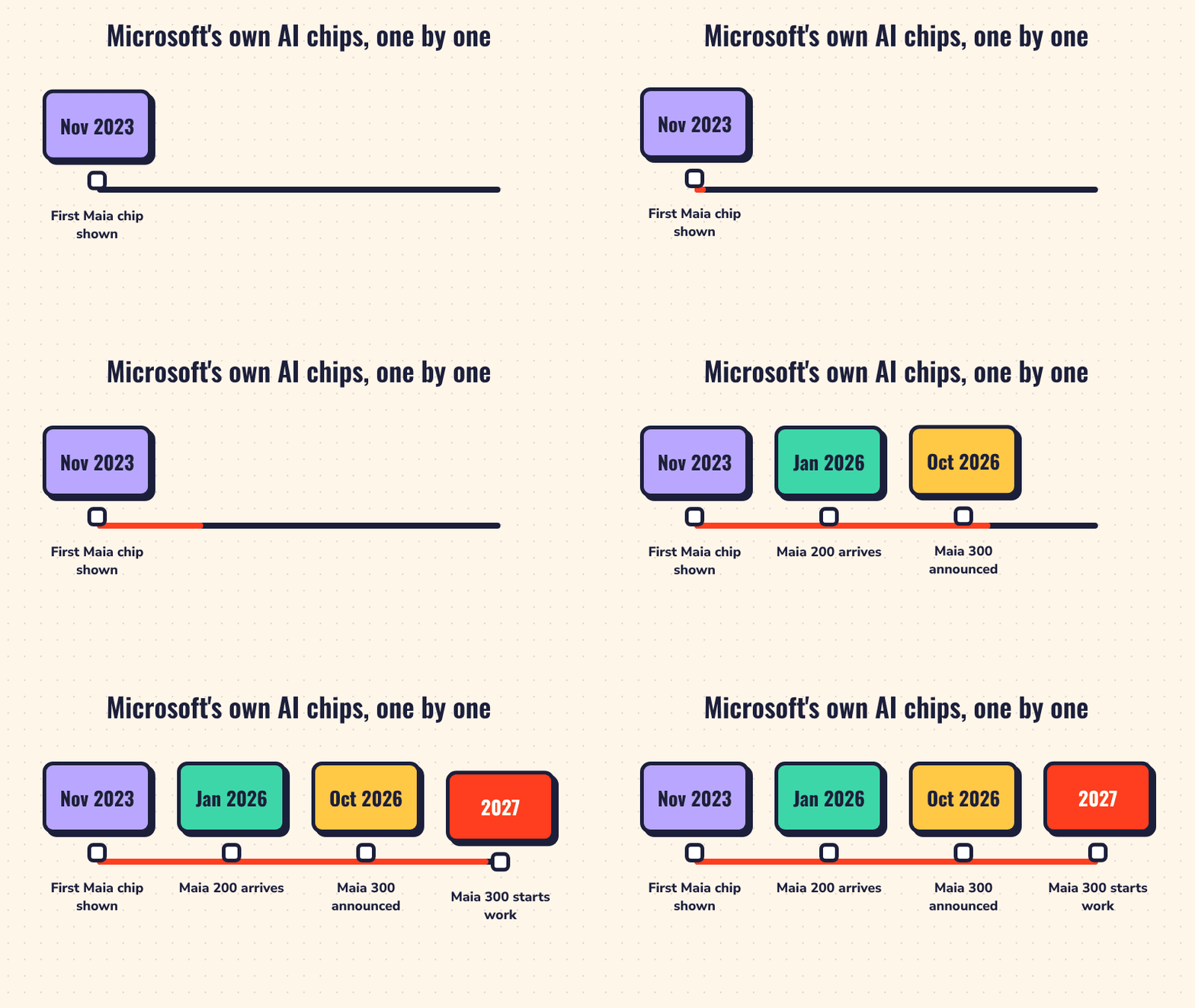
Yes. Maia 300 is the third chip in the family.
- In November 2023, Microsoft showed its first Maia AI chip.
- In January 2026, it launched Maia 200.
- In October 2026, it announced Maia 300, which will start real work in 2027.
Maia 200 is already being used. Microsoft says it now runs work for Microsoft Copilot, and that GitHub Copilot, a coding helper used by programmers, will follow by the end of the year. Microsoft also says Maia 200 can run OpenAI's models.
So why build your own chip?
Imagine your cricket team buys every single bat from one shop. The shop is great, but it sets the price, and when everyone wants bats at the same time, you wait in line. Now imagine your team learns to make its own bats for practice. You still buy the best match bats from the shop, but you depend on it less.
That is roughly what Microsoft is doing. Microsoft expects to spend more than $175 billion this calendar year on things like data centres and chips, and a big share of that has gone to Nvidia. Making some of its own chips could help it control costs.
Microsoft is not the only one doing this. Google has its own AI chips called TPUs, and Amazon has chips called Trainium.
Here is a short news video about the launch:
Can anyone buy Maia 300?
No. Microsoft will use these chips for its own services, like GitHub Copilot and Microsoft 365 Copilot. There is no sign that outside customers will get to use them. Microsoft also still buys a lot of Nvidia chips.
Microsoft says it will share more about its plans at its Ignite 2026 event next month in San Francisco.
What this means for you
You will never see a Maia chip. It sits inside a data centre far away. But the next time Copilot answers your question, there is a growing chance the answer was made on a chip Microsoft designed itself, not one it bought.
The real test comes in 2027, when Maia 300 starts doing real work. Then the world will see if the 40% claim holds up.
Sources
- The Official Microsoft Blog: Microsoft to expand Azure Maia system to multi-gigawatt deployments (October 12, 2026)
- Microsoft Azure Blog: Deep dive into Azure Maia 300 architecture
- The Tech Portal: Microsoft to deploy over a million Maia 300 AI chips to cut Nvidia reliance (October 12, 2026)
- Unite.AI: Microsoft announces Maia 300 AI chip (October 12, 2026)
- Microsoft Source: Microsoft unveils its first in-house AI chip at Ignite (November 15, 2023)
- Cover photos: Rear of rack at NERSC data center, closeup, by Derrick Coetzee, CC0 1.0; Circuit board of a hard disk, by Mk2010, CC BY 4.0


You may republish this story under CC BY 4.0: credit Pranav Sharma and link to this page.