Meesho cuts its quarterly loss by 68% without taking a cut from sellers
Version 1 of 1 saved 28 Oct 2026, 9:38 pm IST · Chain line 309
As it was first published
Meesho cuts its quarterly loss by 68% without taking a cut from sellers
Revenue grew 34% to Rs 4,132 crore in July to September 2026, while costs grew slower, as ads and delivery fees did the earning.
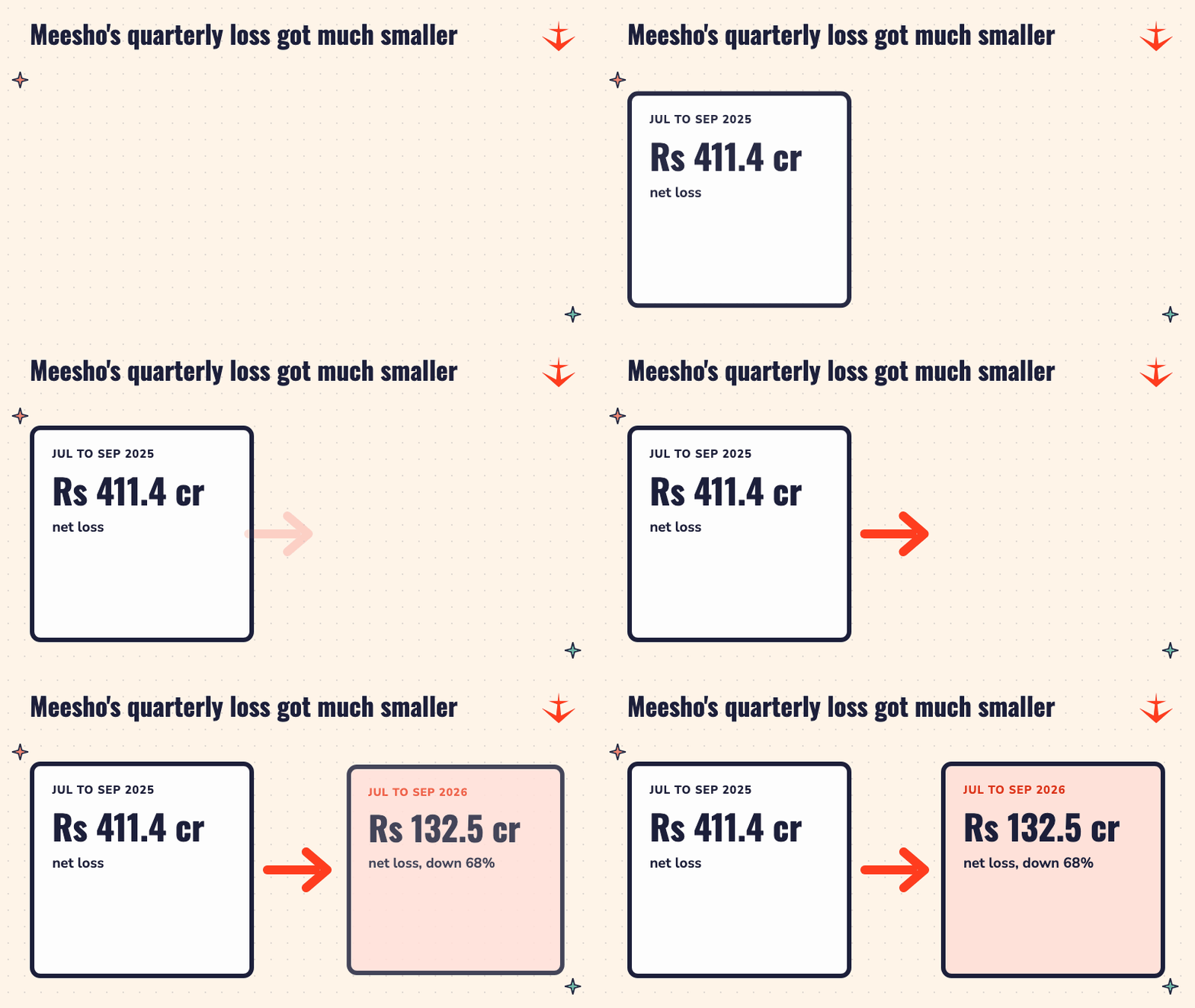
Picture a shopping app where sellers pay no cut on a sale. Now picture the same app losing far less money than a year ago. On Wednesday, 28 October 2026, Meesho said its loss for July to September 2026 fell 68%, to Rs 132.5 crore, from Rs 411.4 crore a year earlier. Over the same three months, the money coming in from its main work grew 34%.
So how does an app that takes no commission from sellers earn money? And why does a smaller loss matter so much? Here is the simple version.
First, what is Meesho?
Meesho is an online shopping app from Bengaluru. Two IIT Delhi graduates, Vidit Aatrey and Sanjeev Barnwal, started the company in December 2015. The name is short for "Meri shop", or "my shop". The app sells low-priced sarees, kitchen items, bedsheets, beauty products and many other things.
Its main buyers do not live in big metros. According to an Inc42 explainer on Meesho's model, the main customer lives in Tier III and Tier IV towns and beyond. Goods are often unbranded, cheaper, and take a little longer to arrive. Meesho joined the stock market in December 2025 and raised over Rs 5,400 crore in its first share sale.
The numbers in plain words
Every company reports its results each quarter. A quarter is three months, like one term at school. This report covers July, August and September 2026.
- Revenue: Revenue means the money a company earns from selling its services, before costs. Meesho's revenue from operations rose to Rs 4,132 crore, up from Rs 3,074 crore a year ago. Compared with April to June 2026, revenue rose 11% from Rs 3,713 crore.
- Costs: Total expenses grew 24% to Rs 4,382 crore. Pay for staff rose 18% to Rs 281 crore.
- Loss: A loss means the company spent more than it earned. Meesho's loss fell to Rs 132.5 crore.
Think of a samosa stall. If daily sales go up by Rs 34 for every Rs 100, while costs go up by only Rs 24 for every Rs 100, the gap between money in and money out keeps shrinking. That is the big reason behind the smaller loss.
Wait, there is a small catch
Part of the drop came from one-time costs in last year's numbers. In the July to September 2025 quarter, Meesho paid Rs 45 crore in exceptional expenses linked to a business merger and a vendor dispute. There was also a Rs 64.4 crore tax charge. These costs did not come back this year.
If those one-time items and tax are kept aside, the loss still narrowed 57%, to Rs 123.3 crore. So the improvement is real, just a little smaller than 68%. Also, the loss was almost the same as in April to June 2026, when Meesho lost Rs 132.8 crore.
How does Meesho earn without a commission?
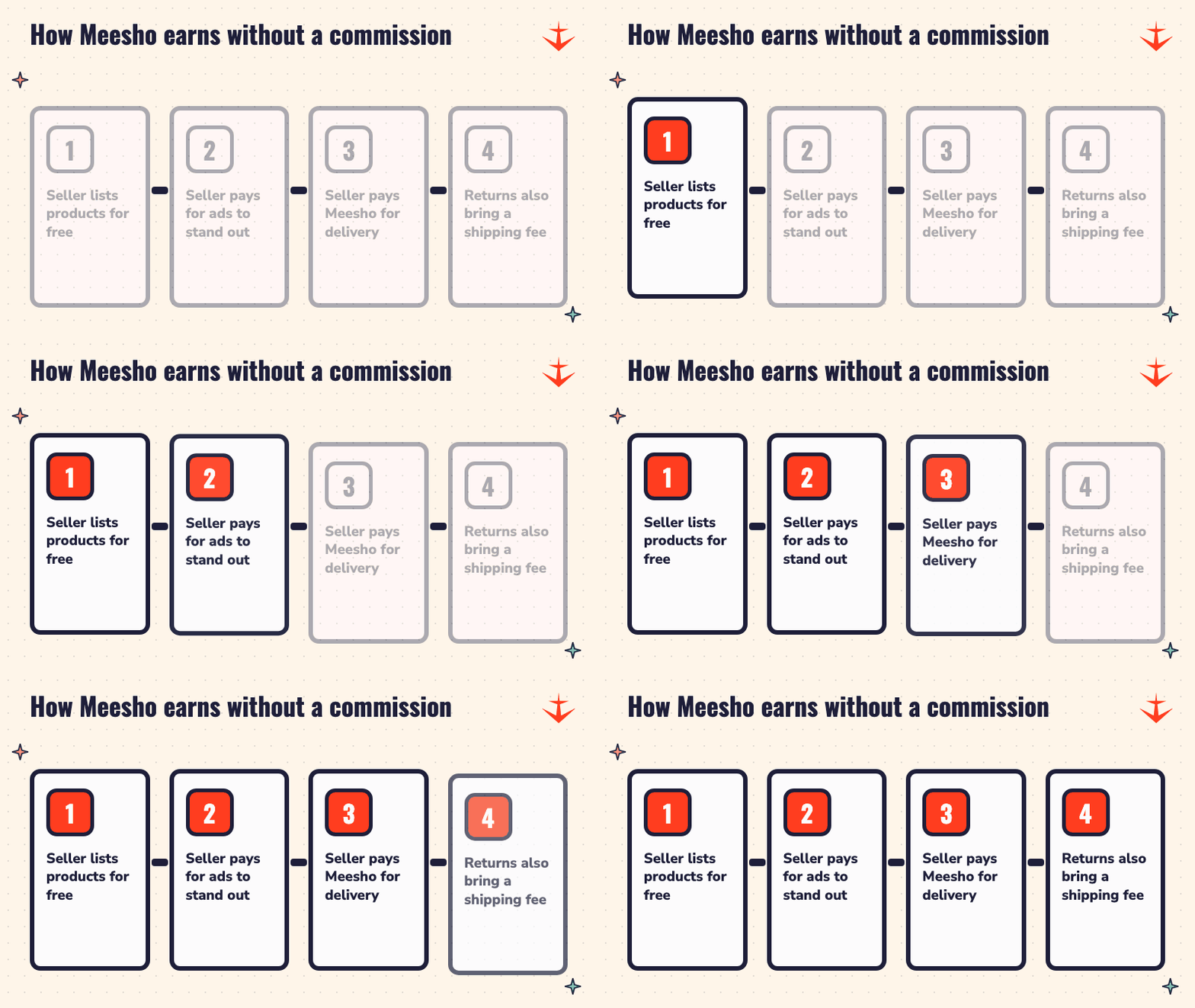
Most shopping apps take a small cut, called a commission, from every sale. If a seller sells a Rs 500 kurta, the app may keep a part of that money. Meesho does not charge sellers this cut. Instead, the company earns in other ways.
Imagine a village mela. The organiser gives stalls for free. But he sells the loudspeaker slots, so a stall owner can announce "fresh jalebis here!" He also runs the tempo that carries goods to buyers' homes, and charges for each trip. Meesho works a bit like that organiser.
- Ads: Sellers pay to push their products higher in search results. Meesho charges them each time a shopper clicks the ad.
- Delivery: Meesho runs a delivery platform called Valmo, which works with other delivery partners. Sellers pay shipping charges based on the parcel's weight, the delivery zone and the payment mode.
- Returns: When a buyer sends something back, the seller pays a return shipping charge too.
- Videos: Sellers can pay a fee to work with content creators who show their products in videos.
Sellers do not have to use any of these. They can use their own delivery partner and bring their own buyers.
This quarter, the main shopping business earned Rs 4,120 crore, up 34%. Meesho said stronger ad earnings and better matching of sellers' goods with what shoppers wanted helped this rise.
More people, more orders
The shopping numbers grew too, as reported by Upstox from the company's results:
- Shoppers: 284 million people bought something on Meesho in the past year, 21% more than a year ago.
- Orders: Shoppers placed 819 million orders in the quarter, up 17%.
- How often: On average, each shopper bought 10.4 times in a year.
- New faces: First-time buyers grew 16% compared with April to June 2026.
- Goods sold: The value of goods sold on the app rose 23% to Rs 12,911 crore.
Why only 23%? Meesho's big sale, the Mega Blockbuster Sale, moved from July to September last year to October to December this year. When the company compared the same 90 days before Dussehra in both years, the value of goods sold grew 33%.
Meesho's founder and CEO, Vidit Aatrey, said: "More consumers are shopping on Meesho, and they are shopping more frequently."
A bigger slice from every sale
There is one more useful number. Contribution margin is the money left from each sale after paying the direct costs of that sale, like delivery. Office rent and many other costs are not counted yet.
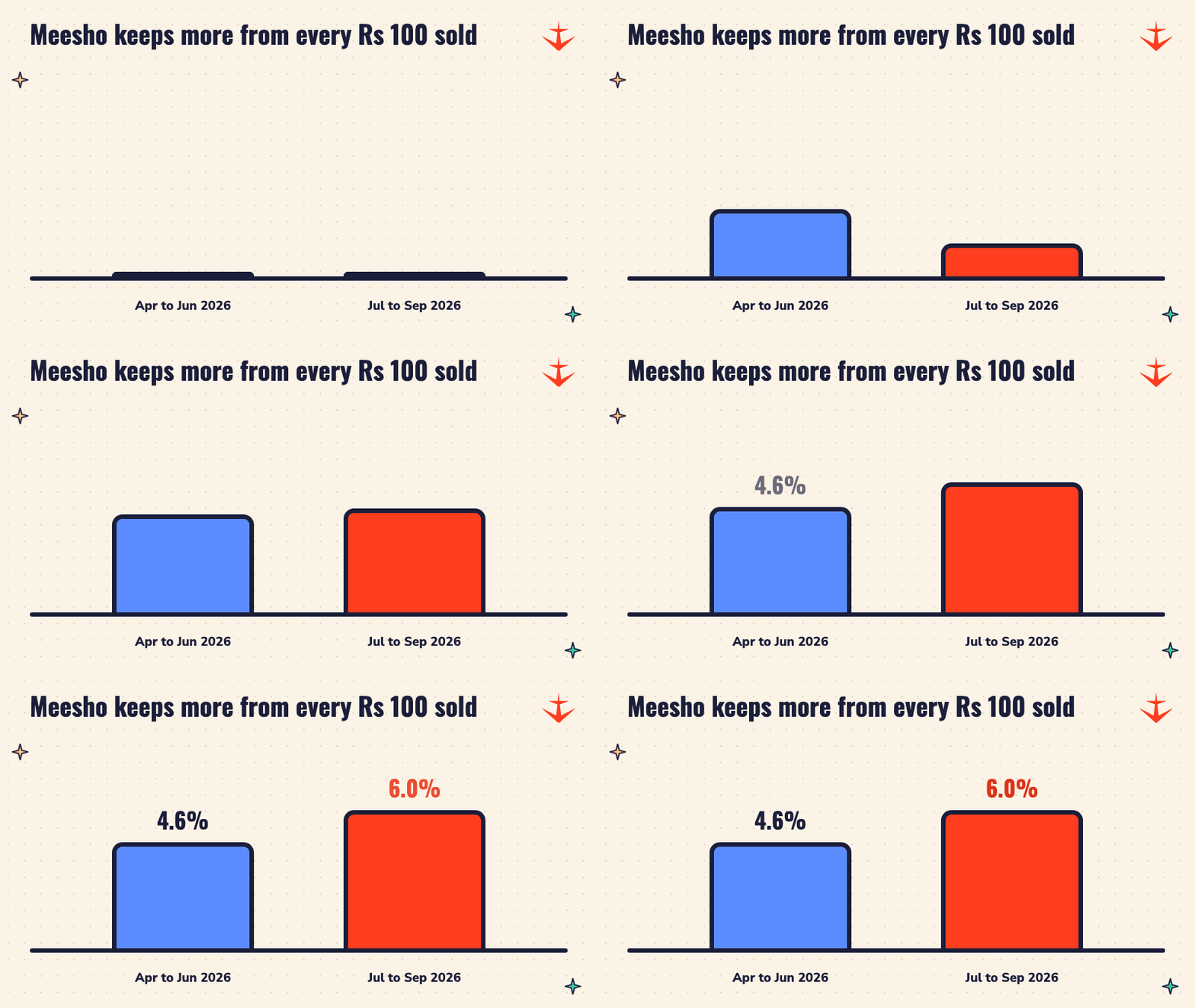
For Meesho, this rose to 6.0% of the value of goods sold, from 4.6% in April to June 2026. In simple words, out of every Rs 100 of goods sold, Meesho kept about Rs 6 after direct costs, up from about Rs 4.60. The company said cheaper delivery and better earnings from the platform drove this.
Cash in the pocket
Meesho also brought in Rs 345 crore of free cash flow in the quarter. Free cash flow is the cash left after paying for running the business and its big purchases, like pocket money left at the end of the month. In April to June 2026, more cash went out than came in, an outflow of Rs 226 crore. Meesho said a seasonal boost to its working capital helped. Working capital is the everyday money a business uses to pay bills and buy stock. At the end of September 2026, Meesho had Rs 7,048 crore of cash.
Why a smaller loss matters
A company losing money is like a cricket team chasing a big target. Each over where the gap shrinks brings it closer to a win. For Meesho, the "win" is a profit. Back in January to March 2026, the loss was Rs 166.3 crore.
The free stalls bring crowds. Inc42 notes that the zero-commission model brought in millions of buyers and sellers, but also limited how much Meesho earns per order. So the open question is whether ads and delivery fees can grow enough to turn the loss into a profit.
Watch: how Meesho grew
This video, from the startup programme Y Combinator, tells how Meesho became one of India's biggest shopping apps.
This video explains how Meesho's zero-commission model works.
Sources
- Inc42: Meesho Q2 loss narrows 68%, revenue jumps 34%
- Entrackr: Meesho posts Rs 4,132 crore revenue in Q2 FY27
- Upstox: Meesho Q2 FY27 results, net merchandise value grows 23%
- Inc42: Decoding Meesho's zero-commission model
- Wikipedia: Meesho
- Cover photo: Meesho homepage under a magnifier, by Jernej Furman, CC BY 2.0