Mankind Pharma's profit jumps 38% to Rs 716 crore, led by long-term medicines
Version 1 of 1 saved 27 Oct 2026, 12:22 am IST · Chain line 252
As it was first published
Mankind Pharma's profit jumps 38% to Rs 716 crore, led by long-term medicines
The maker of Manforce and Prega News grew sales 17% in July to September, as repeat heart and diabetes medicines did the heavy lifting.
Picture a chemist shop near your home. A man walks in with the same slip he brought last month and buys the same strip of tablets again. Now multiply that small, boring moment by crores of people. That repeat visit is a big reason Mankind Pharma's profit jumped 37.7% to Rs 716 crore in July to September 2026. The Delhi company shared its results on Monday, 26 October 2026.
Mankind is the company behind famous chemist-counter names like Manforce and Prega News. But the real money story this quarter is not those brands. It is long-term medicines that people buy month after month.
First, the big numbers
In the three months from July to September, Mankind earned Rs 4,338 crore from sales, up 17.3% from Rs 3,697 crore a year earlier. This money coming in from selling things is called revenue. Think of it as everything a samosa stall collects in its cash box in a day.
Profit is what is left after paying for everything. Mankind's profit after tax was Rs 716 crore, up from Rs 520 crore a year ago, according to Business Standard. That is Rs 196 crore more profit in the same three months of the year.
One small note on the numbers. Upstox reports a slightly different line, Rs 711 crore against Rs 512 crore, a 39% jump. Big companies report profit in more than one way, for example the whole group's profit or only the part that belongs to the company's own shareholders. This post uses Rs 716 crore, the figure Fortune India and Business Standard give for the whole group.

How much of each Rs 100 stayed with the company
A margin tells you how much of every Rs 100 of sales a company keeps. Imagine a chai stall that sells a cup for Rs 10. If milk, tea leaves, sugar and gas cost Rs 7, the stall keeps Rs 3. That Rs 3 out of Rs 10 is a 30% margin.
Mankind's operating profit, called EBITDA (earnings before interest, tax and the slow wear and tear of machines), rose 27.2% to Rs 1,175 crore. Its EBITDA margin went up from 25% to 27.1%. Fortune India puts this as a rise of 210 basis points. A basis point is just a tiny slice: 100 basis points make 1 percentage point.
So out of every Rs 100 of sales, about Rs 27 was left after paying for raw material, salaries, rent and ads. After interest and tax too, the profit margin was 16.5%, as per The Economic Times. That means about Rs 16.5 of real profit from every Rs 100 of sales.
Chronic vs acute: the milk plan and the sweet box
Drug makers split their medicines into two big groups.
- Acute medicines are for short problems that go away, like a cough or a stomach upset. People buy them once or twice. It is like buying a box of sweets for Diwali.
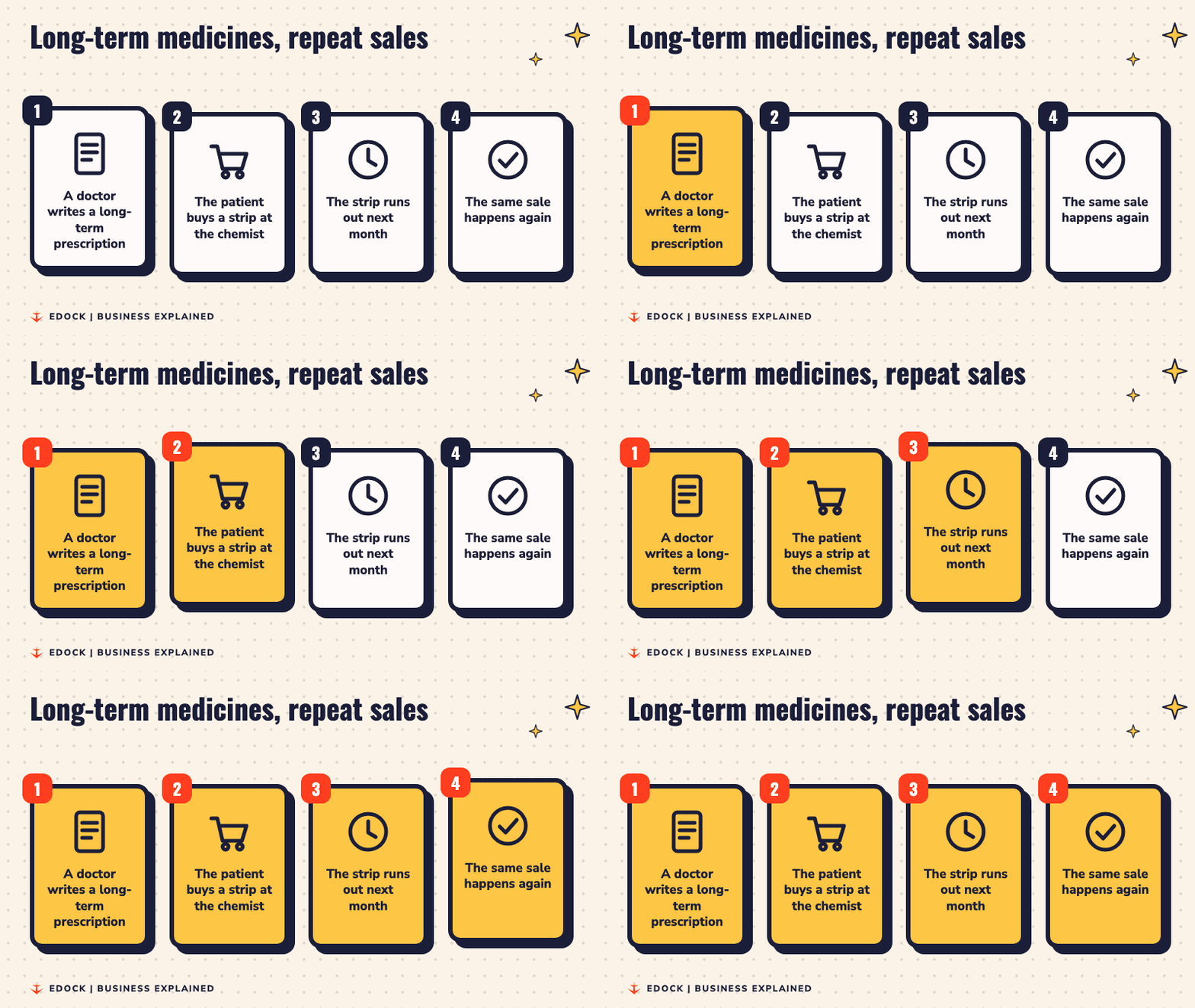
- Chronic medicines are for long-term conditions, where a doctor may ask a patient to take them every day for months or years. It is like a monthly milk delivery plan: the same order, again and again.
For a business, chronic sales are gold, because they repeat. A shop that knows the same buyers will come back next month can plan better than a shop that waits for random customers.
That is where Mankind grew. Vice Chairman and Managing Director Rajeev Juneja said its chronic business beat the market by 1.1 times, led by 19% growth in cardiac and 16% in anti-diabetes therapies, which means heart and diabetes medicines. Its acute side also did well, with gastro medicines up 19% and vitamins and minerals up 26%.
Where the Rs 4,338 crore came from
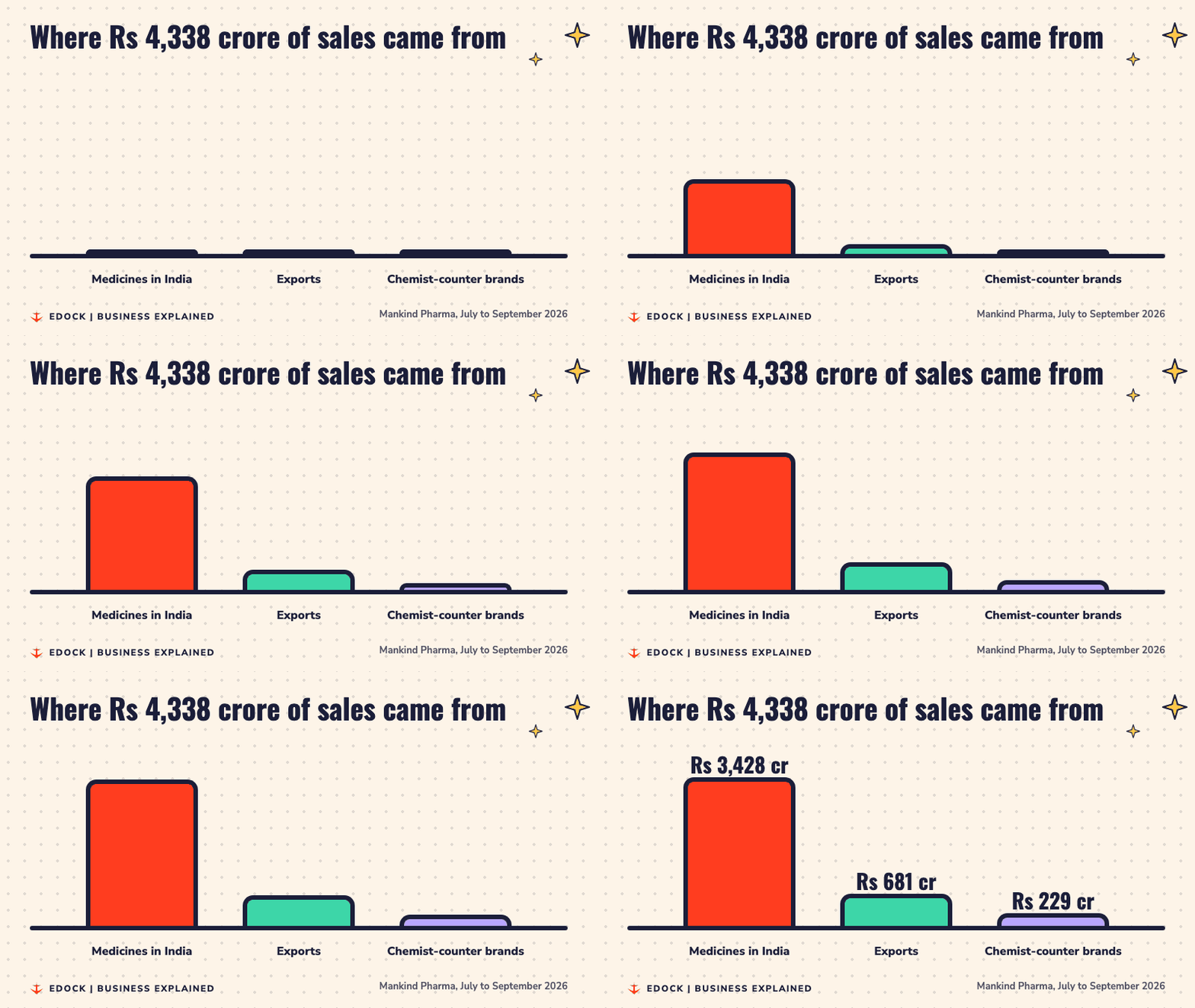
Mankind sells in three main ways. Fortune India gives the split:
- Medicines in India (not counting chemist-counter brands): Rs 3,428 crore, up 15.9%. This includes Bharat Serums and Vaccines, part of the Mankind group.
- Exports, medicines sold in other countries: Rs 681 crore, up 32.7%.
- Consumer healthcare, products you pick up at a chemist's counter without a doctor's slip, like Manforce and Prega News: Rs 229 crore, up just 1.2%.
Add them up and you get Rs 4,338 crore, the full sales figure. India is by far the biggest piece, about four out of every five rupees.
Brands that doctors write again and again
Here is a quiet part of the pharma business that most people never see. A doctor writes a brand name on a prescription, and the chemist sells that brand. So a drug maker's real customer is often the doctor's pen.
Mankind is very good at this. The Economic Times reports it kept its No. 1 rank in India by prescriptions for the ninth year in a row, with a 15.2% share. In simple words, by that measure, about 15 of every 100 prescriptions name a Mankind medicine.
Its list of big brands is also growing. The number of brands selling more than Rs 100 crore a year rose to 26, from 22 in the last financial year. Brands selling more than Rs 50 crore a year went up to 63, from 54.
The slow part: chemist-counter brands
Not everything grew fast. Consumer healthcare sales rose only 1.2%. The company blamed slower buying across the whole category and weak demand in eastern and southern India. Still, it said Manforce and Prega News gained market share, which means they won a bigger slice of their category.
One change is worth noticing. Online shopping and big modern stores now bring in 18% of this business, up from 12% a year ago, after growing 55%. Even chemist-counter products are slowly moving from the corner shop to the phone screen.
Selling abroad, and a bet on research
Exports were the fastest-growing piece, up about a third. Mankind also launched one new product in the United States during the quarter, taking its total there to 50.
The company also pointed to its recent purchase of Armed Cell Therapeutics. Juneja described it as Mankind's entry into next-generation CAR-T therapies, a research-heavy kind of medicine, to build its research and development (R&D) for the future. Spending on research today is like a cricket academy training young players now to win matches years later.
The half-year picture
Looking at April to September together, sales rose 15.1% to Rs 8,368 crore and profit grew 33.7% to Rs 1,290 crore. So this was not a one-quarter jump. Profit has been growing about twice as fast as sales for six months.
That gap is the key lesson. When sales grow 17% but profit grows close to 38%, it usually means the company is spending less to make each rupee of sales. Mankind's own explanation points to more medicines sold in India and abroad, led by its long-term medicines.
Why this matters to you
Mankind is a Delhi company that, as of 2023, had 25 factories in India. Its results show how a big Indian drug maker really earns: not from one blockbuster, but from many brands that doctors keep writing and patients keep buying.
For anyone thinking about a career in sales, marketing or finance, this is a neat business lesson. Repeat customers, like a monthly milk delivery plan, make a business steady. And a business that grows its sales while keeping costs in check can grow its profit much faster than its sales.
Sources
- Fortune India: Mankind Pharma Q2 results, PAT rises 38% to Rs 716 crore
- Business Standard: Mankind Pharma Q2 PAT rises 37.7% on strong domestic chronic business
- Upstox: Mankind Pharma Q2 results, profit rises 39% to Rs 711 crore
- The Economic Times: Mankind Pharma shares key business developments from Q2 and H1 of FY27
- Wikipedia: Mankind Pharma
- Cover photo: Small pharmacy in Kerala, by Rathfelder, CC BY-SA 4.0 (a stand-in: a chemist shop in Kerala, not a Mankind store)
