Lemon Tree Hotels will run 4,000 rooms that Omaxe is building in 8 cities
Version 1 of 1 saved 17 Oct 2026, 11:37 am IST · Chain line 64
As it was first published
Lemon Tree Hotels will run 4,000 rooms that Omaxe is building in 8 cities
A new pact lets Lemon Tree add thousands of rooms without paying for the buildings. Here is what hotel keys, an MoU and asset-light growth mean.
Picture this: 4,000 hotel rooms, spread across eight cities, from a bus terminal in Lucknow to temple towns like Vrindavan. One company will build them. Another company will run them. On Friday, 16 October 2026, Lemon Tree Hotels said it had signed a deal with real estate developer Omaxe to operate about 4,000 rooms. Lemon Tree called it its largest single operating arrangement ever.
Wait, what is a "key"?
News reports say Lemon Tree will run "4,000 keys". In the hotel world, a key simply means one room you can book. Every room has its own key (or key card), so hotel people count rooms in keys. So 4,000 keys means 4,000 rooms.
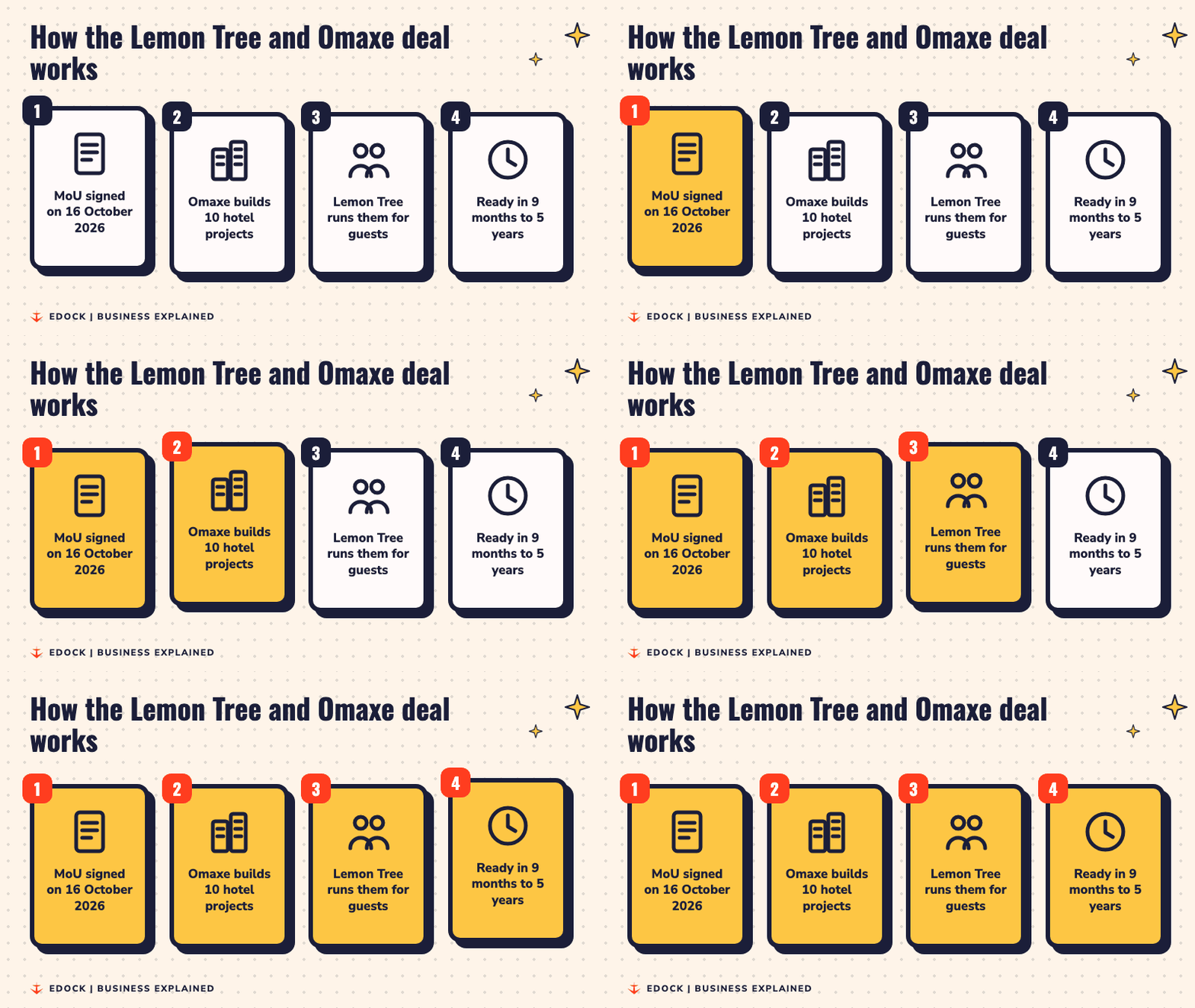
The deal itself is an MoU, short for Memorandum of Understanding. An MoU is like two friends writing down a plan before they start a lemonade stall together: who does what, and where. It is an early step. Moneycontrol calls it an "initial pact". The MoU was signed by Carnation Hotels, a company fully owned by Lemon Tree Hotels.
Who are these two companies?
Lemon Tree Hotels is an Indian hotel chain. Its managing director, Neelendra Singh, said Lemon Tree brings over two decades of hospitality expertise.
Omaxe is a builder. It was set up in 1987 and has delivered 145.50 million square feet of real estate across 32 cities in 8 states and Union Territories, including Punjab, Haryana, Uttar Pradesh and Delhi. That is a lot of homes, shops and offices.
Where will the rooms be?
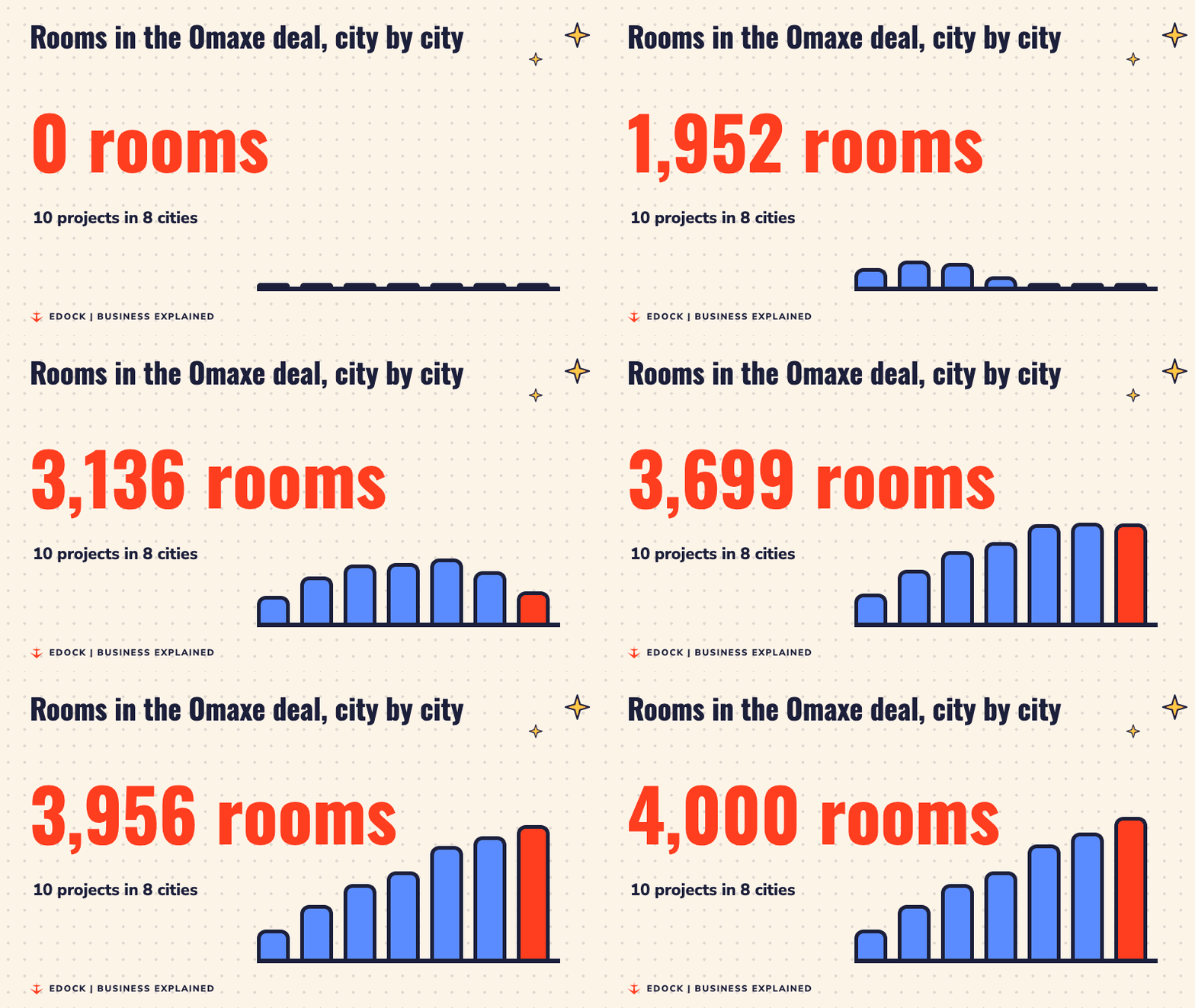
The rooms sit inside 10 hotel projects in Lucknow, Vrindavan, Amausi, Ghaziabad, Greater Noida, Amritsar, Kaushambi and Faridabad. Omaxe expects to invest about Rs 4,000 crore in them.
CNBC TV18 listed the room count for each project:
- Lucknow: two bus terminal projects with 500 and 330 rooms
- Amausi, near the airport: 693 rooms
- Vrindavan: two projects with 501 and 81 rooms
- Ghaziabad: 215 rooms
- Greater Noida: 150 rooms
- Amritsar: serviced apartments with 745 rooms
- Kaushambi: 350 rooms
- Faridabad: 435 rooms
Add them up and you get exactly 4,000 rooms. The biggest single project is in Amritsar with 745 rooms. The smallest is in Vrindavan with 81.
A quick sum: Rs 4,000 crore for 4,000 rooms works out to about Rs 1 crore per room on average. Building a hotel is costly.
Why temple towns and bus stations?
Think about where people actually travel. Families visit Vrindavan and Amritsar to pray. Workers pass through bus terminals and airports. Business people go to busy office areas. Lemon Tree said the sites are in travel stops, pilgrimage destinations and commercial districts.
These are mostly Tier 2 and Tier 3 cities. That is a simple way of grouping cities by size: Tier 1 is the giant metros like Delhi and Mumbai, and Tier 2 and Tier 3 are the smaller, fast growing cities after them.
Singh said these cities have long been central to Lemon Tree's growth plan in India, and that this deal lets the company grow there faster, from Lucknow's travel stops to temple towns like Vrindavan, as reported by Business Today.
Omaxe's managing director, Mohit Goel, said: "India's hospitality opportunity is expanding beyond established metropolitan markets, with Tier 2 and Tier 3 cities emerging as important destinations for business, leisure and pilgrimage travel," according to Moneycontrol.
Building a hotel vs running one
Here is the clever part. Lemon Tree does not have to pay to build these hotels. Omaxe builds them. Lemon Tree runs them: the staff, the bookings, the service. CNBC TV18 reports the hotels will operate under Lemon Tree Hotels' brand portfolio.
This is called an asset-light model. An asset is something valuable a company owns, like land or a building. "Asset-light" means growing without owning many of those heavy, costly things. Imagine a chai seller who does not buy a shop, but runs the tea counter inside someone else's office canteen and gets paid for it.
Singh said the deal will "accelerate Lemon Tree Hotels' asset-light growth strategy". The financial terms of the arrangement were not disclosed. Lemon Tree has said earlier that more than 75% of its properties are managed or franchised, which means other owners hold the buildings.

How Omaxe plans to pay for it
These 10 projects are part of a bigger plan. Omaxe plans to spend Rs 6,200 crore on 19 hospitality projects across five states. So this deal covers 10 of those 19 projects and about Rs 4,000 crore of the Rs 6,200 crore, roughly two-thirds of the money.
Omaxe follows a sale-led development model, paying for the work through property sales rather than borrowing. Think of it like a samosa stall that sells today's samosas to buy tomorrow's potatoes, instead of taking a loan.
How big is 4,000 rooms for Lemon Tree?
Hotel chains keep a "pipeline": a list of hotels that are signed but not open yet. This deal takes Lemon Tree's pipeline to nearly 16,000 keys. So this one deal is about a quarter of everything in that list.
For comparison, in the April to June 2026 quarter, Lemon Tree signed 13 properties with 1,020 rooms and opened six managed or franchised hotels with 334 rooms. This single MoU brings almost four times the rooms it signed in that whole quarter.
When will guests check in?
Not tomorrow. CNBC TV18 reports that building and opening the projects will take from nine months to five years, depending on the project. Like a Test match, this plays out over a long time, and construction, approvals and readiness will decide the pace.
What did the share market do?
On the day of the news, Lemon Tree's shares rose about 2% to a high of Rs 115.25, from Rs 112.60 the day before. Omaxe's shares closed at Rs 113.51, up 4.43% for the day.
The big idea
One company is good at building. The other is good at running hotels. By teaming up, Omaxe gets an experienced operator, and Lemon Tree gets thousands of new rooms without paying for the bricks. And India's smaller cities, where pilgrims, travellers and business visitors need a bed for the night, may get many more hotel rooms over the next few years.
Sources
- Lemon Tree Hotels announces signing of MoU with Omaxe for operating 4,000 keys, The Economic Times
- Omaxe inks pact with Lemon Tree to manage 10 upcoming hotels worth Rs 4,000 crore, Moneycontrol
- Omaxe inks pact with Lemon Tree to manage 10 upcoming hotels, BusinessLine
- Lemon Tree Hotels shares gain 2% after Omaxe pact, Business Today
- Omaxe partners with Lemon Tree Hotels for Rs 4,000 crore hotel expansion, CNBC TV18
- Lemon Tree Hotels signs 4,000-key operating pact with Omaxe, DSIJ
- Omaxe's Rs 6,200 crore hospitality expansion plan, Omaxe Limited on YouTube
- Cover photo: Rempart Boutique Hotel Diyarbakir Suite Room Interior, by Ouuzo, CC BY 4.0
