L&T wins a "large" order to build offices in Delhi and Amaravati
L&T kept the exact price private and only said Rs 2,500 to 5,000 crore. A simple guide to order size bands, order books and building contracts.

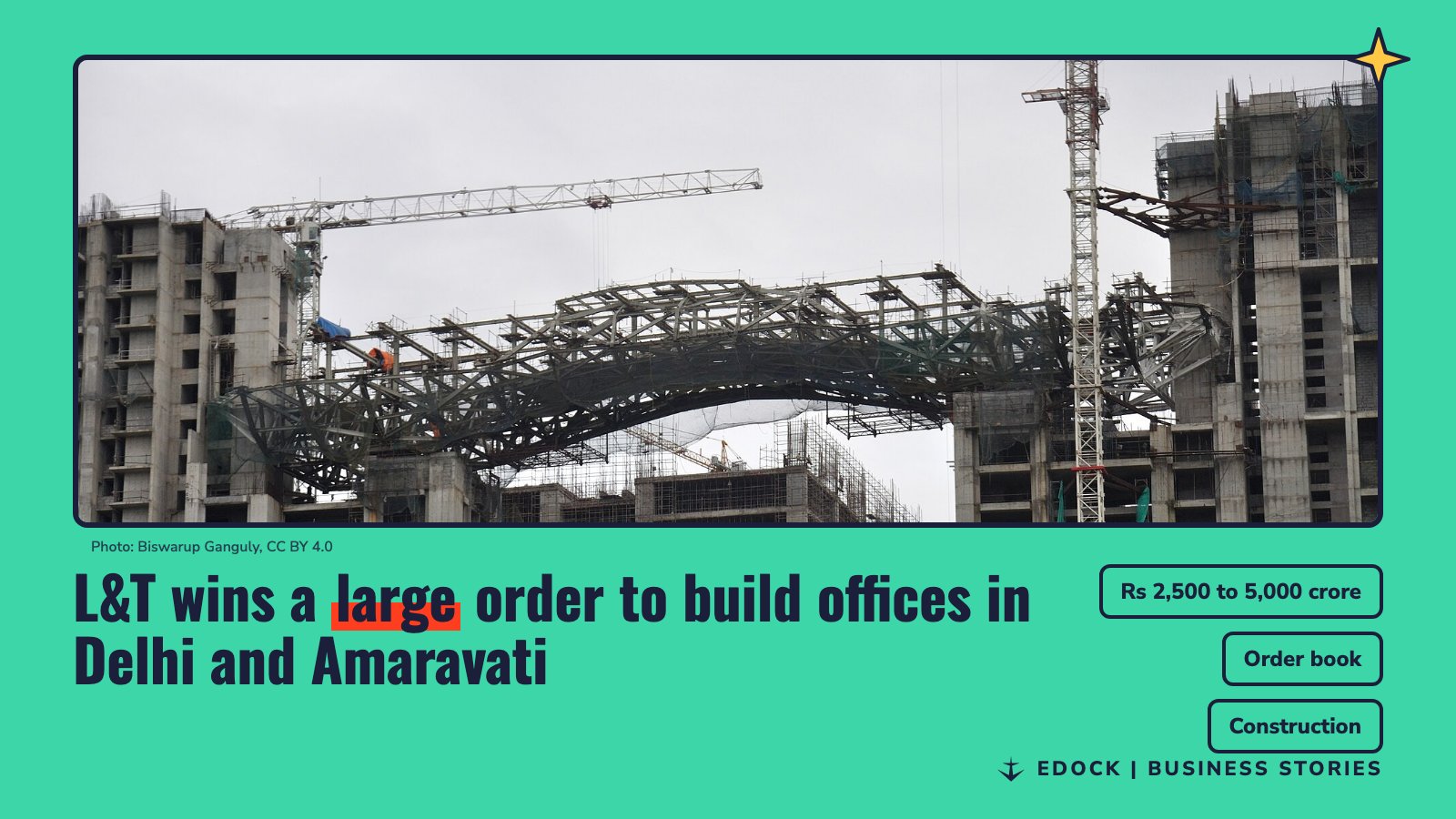
Picture two office towers in Andhra Pradesh, each with 47 floors stacked above the ground floor, and two more large buildings in New Delhi. One company has just been handed the job of building all of them. On Wednesday, 21 October 2026, Larsen & Toubro (L&T) said in a regulatory filing that it has won two building orders, one in New Delhi and one in Amaravati.
There is a twist. L&T did not say the exact price. It only called the orders "large". So what does "large" mean, and what happens after a company like L&T wins an order? Here is the simple version.
What did L&T actually win?
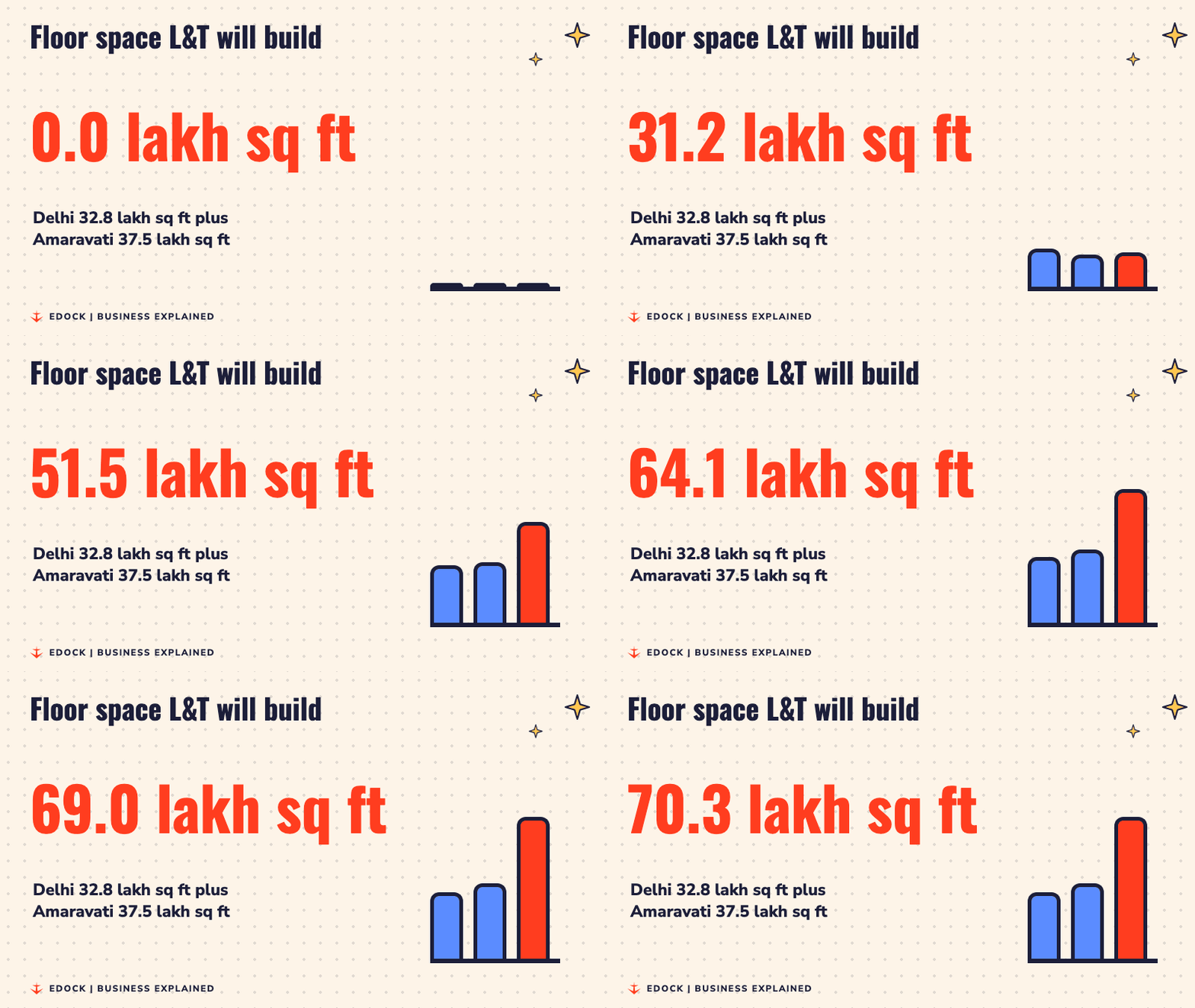
The first order comes from the Central Public Works Department (CPWD), the government team that looks after central government buildings. L&T will build Common Central Secretariat buildings 4 and 5 along Kartavya Path in New Delhi. Each has a basement, a ground floor and 7 floors above it. Together they will have 32.8 lakh square feet of built-up area.
The second order comes from the Government of Andhra Pradesh. L&T will build two office towers on either side of the Amaravati Quantum Computing Centre. Each tower will have a basement, a ground floor and 47 floors above. Together they cover 37.5 lakh square feet.
Both orders went to one part of L&T called Public Spaces, Airports and Health. Big companies split their work into teams like this, the way a school splits students into houses.
What is "built-up area"?
Built-up area is the total floor space inside a building, floor after floor. Think of it like this: if a building has 10 floors and each floor is 1,000 square feet, its built-up area is 10,000 square feet. One lakh is 1,00,000. So 32.8 lakh square feet means 32,80,000 square feet of floors to build. Add both orders and L&T has 70.3 lakh square feet of floor space to build.
Why "large" and not an exact number?
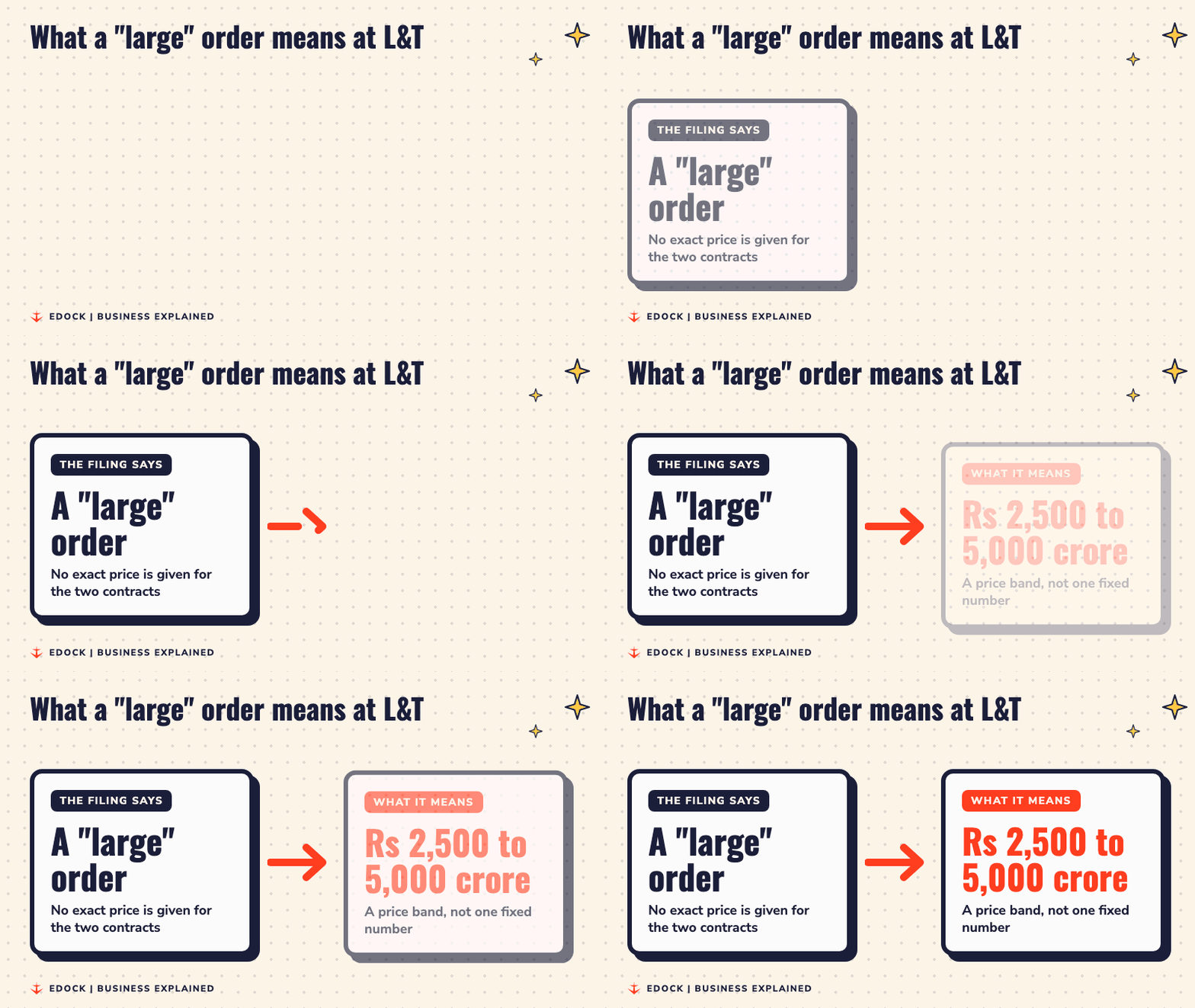
L&T often keeps the exact price of a contract private. Instead, it puts each new order into a size band, like T-shirt sizes: S, M, L, XL. You know roughly how big it is, but not the exact number.
According to The Economic Times, orders worth Rs 2,500 crore to Rs 5,000 crore are called "large". So these two contracts fall somewhere in that range. They could be near Rs 2,500 crore or near Rs 5,000 crore. Nobody outside the company and its clients knows yet.
There are bigger bands too. CNBC-TV18 listed them while tracking L&T's orders earlier this year:
- Large: Rs 2,500 crore to Rs 5,000 crore
- Major: Rs 5,000 crore to Rs 10,000 crore
- Mega: Rs 10,000 crore to Rs 15,000 crore
- Ultra-mega: above Rs 15,000 crore
So when a headline says L&T won a "mega" order, it means a price band, not a vague word.
What is an order book?
Imagine a samosa stall that takes advance orders for a wedding. The stall owner writes each order in a notebook: 500 samosas for Saturday, 300 for Sunday. Those samosas are not made yet, but the money is likely to come once they are delivered. That notebook is the stall's order book.
For L&T, the order book is the total value of work it has won but not yet finished. When it reported results for April to June 2026, its consolidated order book stood at around Rs 7.8 lakh crore, as Moneycontrol reported. In that same quarter, it won new orders worth Rs 1,08,014 crore.
A big order book is a bit like having many matches already fixed in a cricket season. It tells you how much work is lined up for the next few years. But winning a match fixture is not the same as winning the match. The work still has to be done well, on time and within budget.
How does a construction order work?
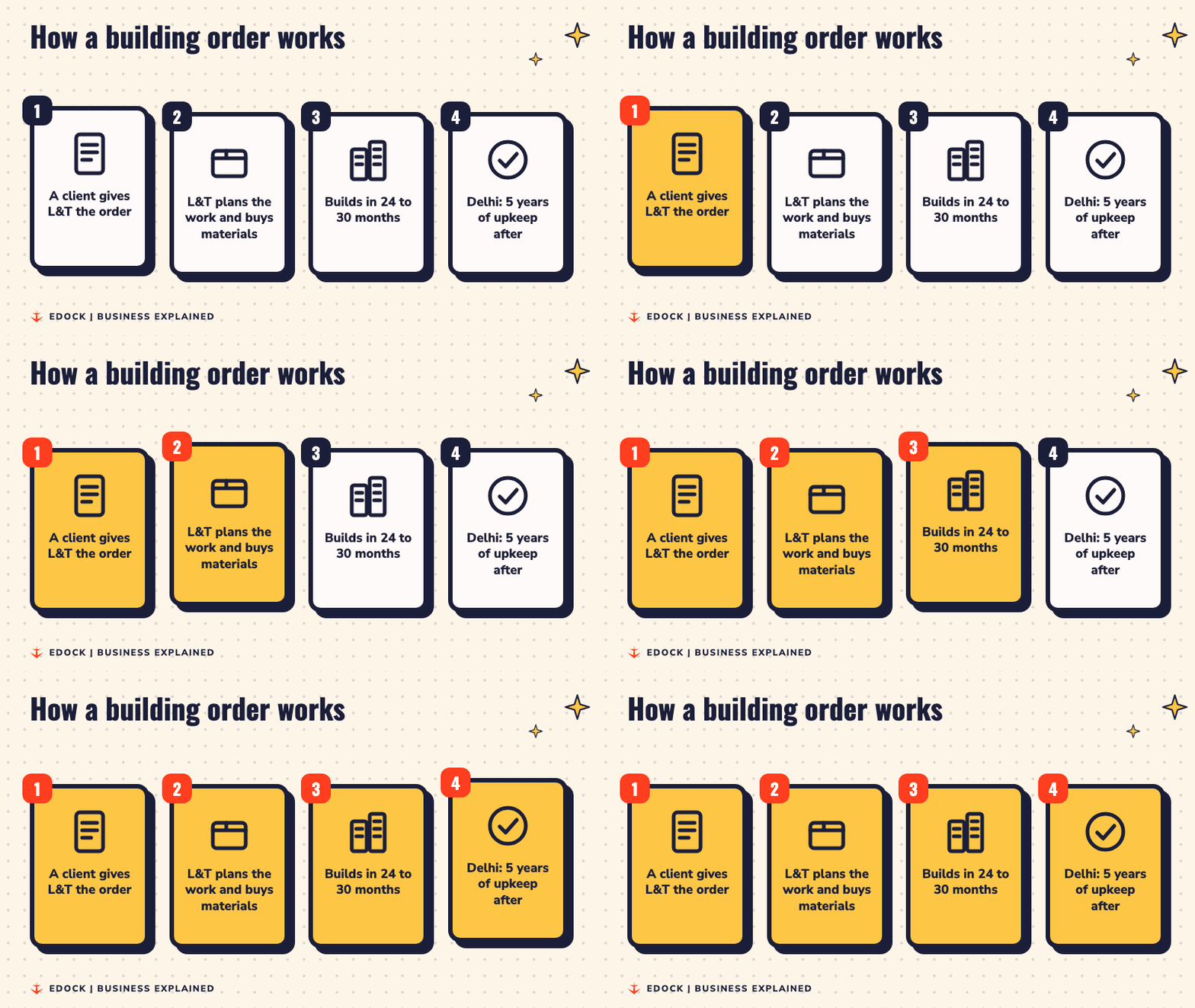
Here is the simple path for these two orders, as the reports describe them.
Step 1: The client gives the order. Here the clients are the CPWD and the Andhra Pradesh government.
Step 2: The builder plans and buys. The Delhi order is on an engineering, procurement and construction (EPC) basis. In plain words: L&T does the engineering (the detailed plans), the procurement (buying cement, steel, pipes and wires) and the construction itself. One company handles the whole job, like a caterer who plans the menu, buys the vegetables and cooks the food.
The Amaravati order is a design-and-build contract for "shell and core" works. Shell and core means the main frame, the outer walls and the central parts like lift shafts and stairs. Think of it as building the empty box of a phone, with the screen and the inside parts added later by others.
Step 3: The building goes up. In Delhi, L&T's work covers the structure, the architecture, mechanical, electrical and plumbing (MEP) services, and work around the buildings. MEP is everything that makes a building usable: fans and air conditioning, lights and power, taps and drains. The Delhi project is due in 24 months. The Amaravati towers are due in 30 months.
Step 4: Looking after it. For Delhi, the job does not end at handover. L&T will also run the operation and maintenance for five years after construction. That is like a bike shop that sells a bike and then services it for five years.
See it for yourself
This construction update video shows earlier Common Central Secretariat buildings coming up in Delhi. These are not the new buildings L&T just won, but they show the kind of work involved.
And this video shows other large towers already being built in Amaravati, to give an idea of how tall projects rise there.
What L&T said
In its statement, quoted by Swarajya, L&T said the orders "further reinforce the confidence" that government agencies place in its ability to take on demanding projects.
Why this matters to you
When you read "company wins order" in the news, now you know three things to look for. First, the size band, which tells you roughly how much money is involved. Second, the deadline, which tells you how quickly the work must happen. Third, the order book, which tells you how much work the company already has waiting.
For L&T, this pair of orders adds new work to a big pile of projects. For anyone curious about how cities get built, it is a reminder that every tall office tower starts as an order on paper, then becomes plans, materials and many months of building.
Sources
- L&T wins large orders for Central Secretariat, Amaravati office towers, Business Standard
- L&T to build govt buildings in Delhi, AP under large order, The Economic Times
- L&T bags large orders for Central Secretariat buildings and Amaravati towers, Swarajya
- L&T secures ultra-mega order, with order size bands, CNBC-TV18
- L&T Q1 results and order book, Moneycontrol
- Cover photo: Office building under construction, Kolkata, by Biswarup Ganguly, CC BY 4.0

You may republish this story under CC BY 4.0: credit Arshdeep Singh and link to this page.