L&T will build the brains of Dhaka's first underground metro
Orders worth Rs 5,000 crore to Rs 10,000 crore cover tracks, power, signals and platform doors for Dhaka Metro Line 1, paid for with Japanese aid.
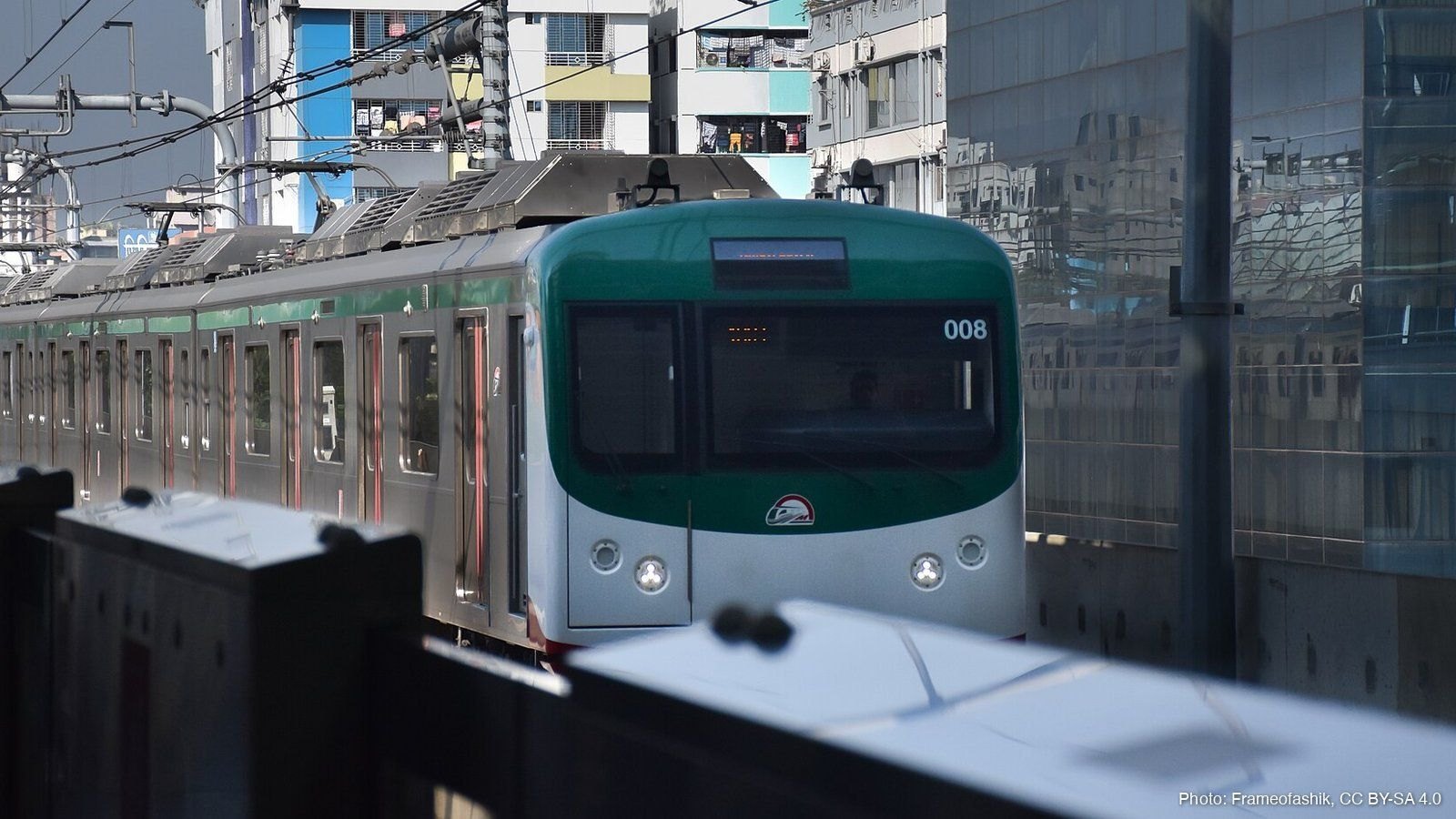
An Indian company will lay the tracks, bring in the power and fit the "traffic lights" for Bangladesh's first metro line that runs under the ground. On Tuesday, 27 October 2026, Larsen and Toubro (L&T) said it had won orders worth Rs 5,000 crore to Rs 10,000 crore for Dhaka Metro Line 1.
The money for the line comes from Japan. The owner is Bangladesh. And a big part of what makes the trains actually move will be built by a company from Mumbai. Here is how a deal like this works, in plain words.
What exactly did L&T win?
A metro is not built by one company. It is cut into pieces called packages. Think of a big Indian wedding: one team does the food, another does the lights, another does the tent. Each team gets its own contract.
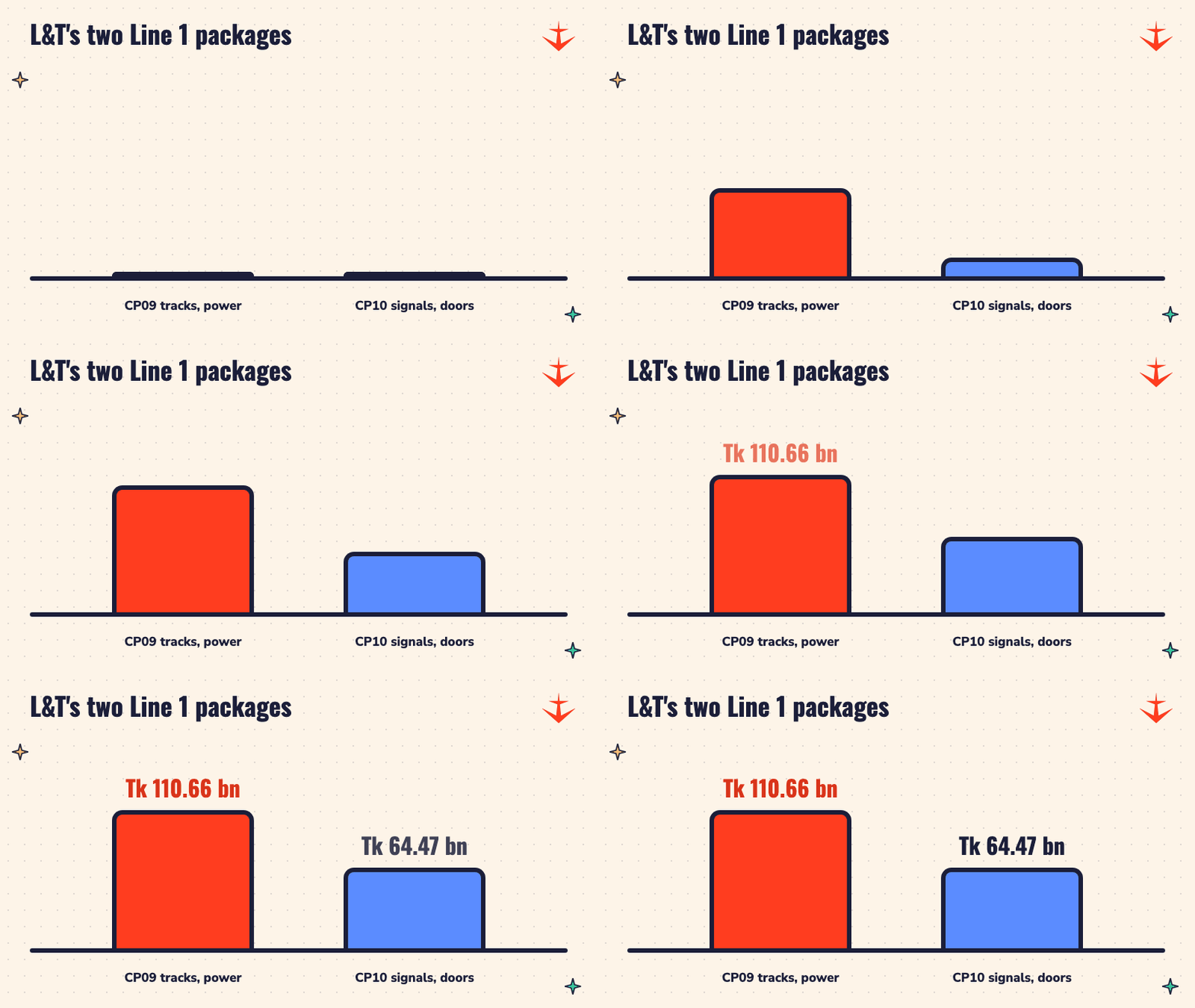
L&T won two of these packages, called CP09 and CP10.
- CP09, tracks and power. Together with its Japanese partner Sumitomo Corporation, L&T will design, buy, fit, test and switch on the track, the power supply, the overhead wires that feed the trains and the other electrical parts along the route.
- CP10, signals, phone lines and platform doors. L&T alone will put in the signalling, the telecom system and the platform screen doors for the whole network.
Signalling is like traffic lights for trains. It tells each train when the track ahead is safe. Platform screen doors are sliding doors along the edge of a platform. These doors open only when a train is standing there, so nobody can fall onto the track.
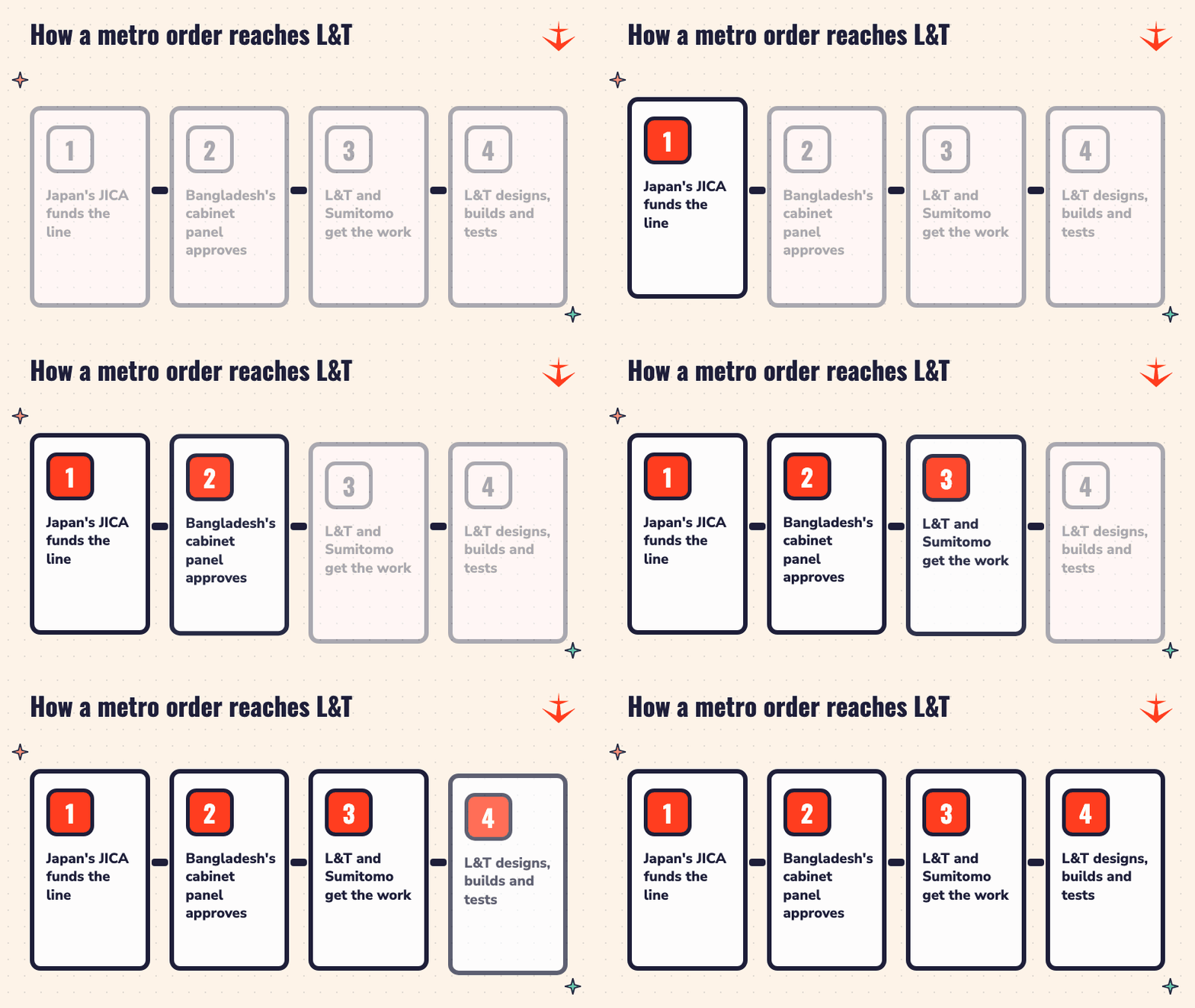
Both orders are "design and build". That means L&T draws up the plan and also does the work, like a tailor who measures you, cuts the cloth and sews the shirt. The company says the two packages together form the core operating systems of the line.
How big is Dhaka Metro Line 1?
The line will run for about 31 km with 19 stations and a depot at Pitalganj, L&T said in its filing. A depot is a big yard where trains are parked, cleaned and repaired, like a bus depot.
The line has two routes. The Airport route goes from Kamalapur to the airport. The Purbachal route goes from Natun Bazar to Purbachal Terminal. According to Wikipedia, the Airport route will be underground and the Purbachal route will run on a raised track above the road.
Work on the line began on 2 February 2023, and the opening is planned for December 2033. Once running, it is expected to carry about 800,000 riders a day. The budget was set at Tk 52,561.43 crore, and Japan's aid agency agreed to pay for 75% of it.
Who pays, and who picks the builder?
The project is funded by the Japan International Cooperation Agency (JICA). Through JICA, Japan gives aid to Bangladesh for its metro, a bit like a rich uncle who helps pay a nephew's college fees.
The final yes came from Bangladesh. On 1 October 2026, a cabinet committee that signs off on big government purchases approved several Line 1 contracts. The L&T and Sumitomo group got CP09 for Tk 110.66 billion. L&T on its own got CP10 for Tk 64.47 billion.
Other pieces went to other teams. For example, a group called Nishimatsu-TPL-Toda will build the main line and stations under one package worth Tk 115.91 billion. So L&T is one player in a big crowd of builders.
Many of these teams are joint ventures. That is when two or more companies join hands for one job, like two friends running a samosa stall together: one makes the samosas, the other handles the cash.
Why did Dhaka come back to L&T?
This is a repeat customer. Back in 2018, L&T and the Japanese firm Marubeni won a Rs 3,191 crore order for the electrical and mechanical systems of Dhaka Metro Line 6, Bangladesh's first metro. That order was won through open international bidding. Bidding is like several caterers quoting prices for a wedding, and the family picking one.
Line 6 is now carrying riders. Its first 11.4 km stretch was flagged off on 28 December 2022, and commercial runs began once L&T switched on its systems. L&T's work there included the signalling, the platform screen doors, lifts and escalators. The line now carries an estimated 400,000 riders a day.
Ramkumar S, who heads L&T's transport building arm, said the company is "well positioned to leverage our experience" in joining many systems together. He also pointed to its work on the Jakarta Metro in Indonesia, which is still under way.

This short video shows the day Line 6, the line L&T fitted out, opened to the public in 2022.
Why a range and not an exact number?
L&T did not share one exact rupee figure. Instead, it puts each new order into a size band. According to L&T's size bands, orders between Rs 5,000 crore and Rs 10,000 crore count as "major".
These orders go into what companies call an order book. An order book is the list of work a company has promised to do but has not finished yet. Picture a tiffin service that already has bookings for the next six months. It knows money will keep coming in, as long as it keeps cooking well.
For a builder like L&T, orders like this mean work lined up for years, because metro systems take a long time. Line 1 is not planned to open before the end of 2033.
What does this mean for India?
L&T is an Indian multinational that works in over 50 countries. Here, an Indian company is being paid to design, fit and test systems in another country. That is a way of selling skills, not just goods.
For a student thinking about engineering, a metro is a good way to see how many fields meet in one place: civil work for tunnels, electrical work for power, electronics for signals and software that ties it all together. Line 1 will need all of them.
This Bengali news report from The Business Standard, a Dhaka newspaper, shows how far work on Line 1 had reached.
Sources
- The Economic Times: L&T wins orders worth Rs 5,000 to 10,000 crore for Dhaka Metro
- Upstox News: L&T Dhaka Metro order, 27 October 2026
- PSU Connect: L&T wins major orders for Dhaka Metro Line 1 systems packages
- bdnews24: Government approves Dhaka metro contracts, 1 October 2026
- Business Standard: L&T Construction and Marubeni win Dhaka Metro order, 2018
- L&T press release: Dhaka Metro Line 6 phase 1 begins operations, January 2023
- Wikipedia: MRT Line 1 (Dhaka Metro Rail)
- Wikipedia: MRT Line 6 (Dhaka Metro Rail)
- Cover photo: A Dhaka Metro Line 6 train at Agargaon station, by Frameofashik, CC BY-SA 4.0

You may republish this story under CC BY 4.0: credit Manpreet Kaur and link to this page.