Kotak Mahindra Bank's group profit rises 26% to Rs 5,645 crore in July to September
Bad loans fell and interest earnings grew 16%, but a flood of foreign currency deposits made the bank's margin thinner. Here is how a bank earns, in plain words.
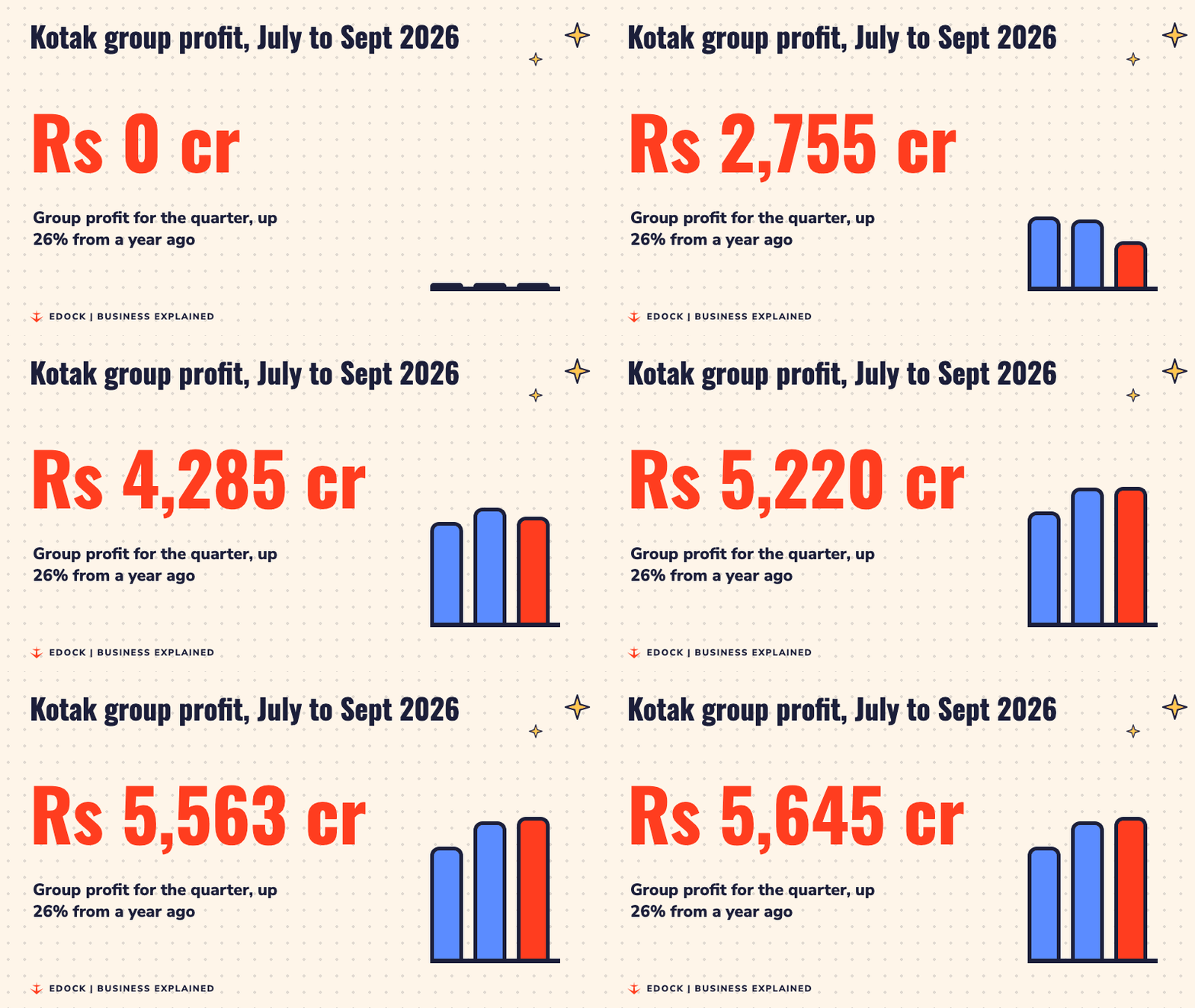
Picture this: every single day from July to September, one Indian bank group made a profit of more than Rs 60 crore. On Saturday, 24 October 2026, Kotak Mahindra Bank said its group profit for those three months was Rs 5,645 crore, up 26% from Rs 4,468 crore a year earlier.
That is a big number. But the more interesting story is how a bank earns it, why one part of the report went down, and why fewer people failed to pay back their loans.
First, who is Kotak?
Kotak did not start as a bank. It began in the mid 1980s as a small firm that did "bill discounting". Think of a shopkeeper who sold goods and will be paid in 90 days. A bill discounting firm pays the shopkeeper now, a little less than the full amount, and collects the full amount later. The small difference is its earning.
The firm was started by Uday Kotak, who turned down a job offer to build his own business in the early 1980s. He stepped down as CEO in September 2023 and is now a non-executive director.
In 2003, Kotak got a banking licence from the Reserve Bank of India. The bank's own release says it became the first non-banking finance company in India to turn into a bank. Today it has 5.1 crore customers.
Two kinds of profit: standalone and consolidated
News reports gave two profit numbers, and both are right. Here is why.
- Standalone means the bank alone. Its profit rose 29% to Rs 4,212 crore, from Rs 3,253 crore a year ago.
- Consolidated means the whole family: the bank plus its other companies, like the share trading arm, the mutual fund arm, the car loan arm and the life insurance arm. That total was Rs 5,645 crore.
Think of a family that runs a main shop and three small stalls. The main shop's earnings are "standalone". The earnings of the shop plus all the stalls are "consolidated".
The gap between the two numbers is about Rs 1,433 crore. Most of it came from the family's other companies. Kotak Securities earned Rs 348 crore, the mutual fund company Rs 287 crore, Kotak Mahindra Prime (car loans) Rs 251 crore, and the life insurance company Rs 198 crore. The insurance arm made only Rs 49 crore in the same quarter last year, so it grew the fastest.
How does a bank actually make money?
A bank's main earning is called net interest income, or NII. It is simple. The bank pays you a little interest on the money you keep with it. Then it lends that money to others at a higher interest rate. NII is the gap between the interest it earns and the interest it pays.
It is like a chai stall. The stall buys milk, tea and sugar for a cup, then sells the cup for more. What stays in the drawer after paying for the ingredients is the stall's margin.
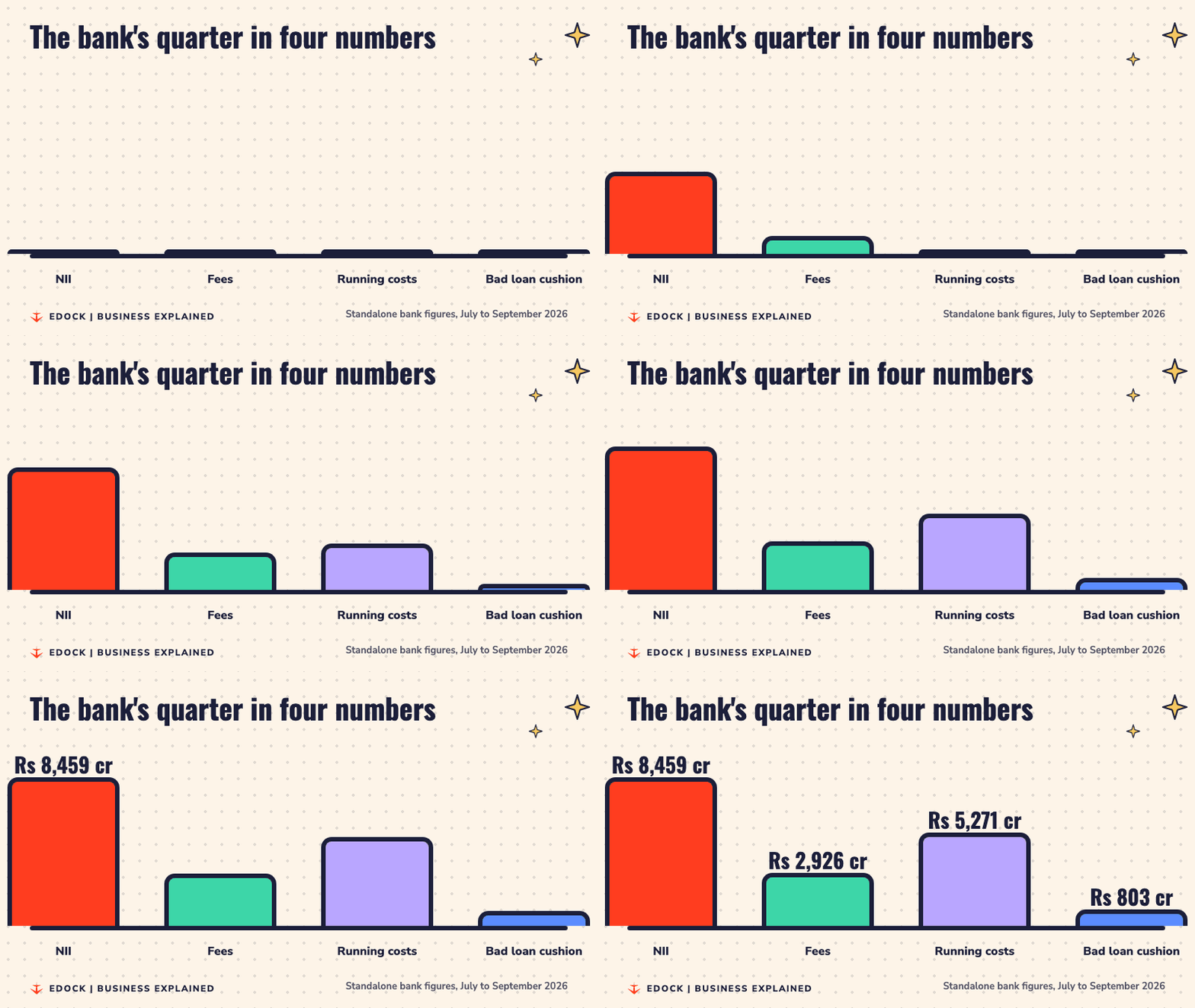
Kotak's NII rose 16% to Rs 8,459 crore for the quarter, from Rs 7,311 crore a year earlier. Fees, the money it charges for services such as cards and accounts, rose 21% to Rs 2,926 crore.
On the other side, running costs such as salaries, rent and technology rose 14% to Rs 5,271 crore. The money set aside for loans that may not come back, called "provisions", fell 15% to Rs 803 crore.
So why did one number go down?
There is a number called the net interest margin, or NIM. It shows how much the bank earns on every Rs 100 of its loans and other assets after paying interest. Kotak's NIM fell to 4.31%, from 4.54% a year ago and 4.53% in the April to June quarter.
The reason is a special kind of deposit. During the quarter, Kotak collected about Rs 55,344 crore in FCNR(B) deposits. These are fixed deposits that Indians living abroad keep in foreign money, like US dollars. The Hindu reports that Kotak raised them under a special Reserve Bank of India window for such accounts.
The bank lent only about Rs 16,110 crore of this through its branches outside India. So a lot of new money came in, but not all of it was earning a high rate yet. Imagine a stall owner who suddenly gets lots of extra milk but has not found buyers for all the extra chai. Total earnings can still rise, but the earning per cup looks smaller. Kotak's release says the fall in NIM was largely because of these FCNR(B) deposits.
Bad loans got smaller
When a borrower stops paying for a long time, the loan is called a non-performing asset, or a bad loan. It is like lending Rs 500 of pocket money to a friend who keeps saying "next week" for months.
At Kotak, gross bad loans fell to 1.04% of all loans on 30 September 2026, from 1.39% a year earlier. After the money already kept aside, net bad loans were just 0.24%, down from 0.32%.
New loans turning bad during the quarter, called "slippages", fell 24% to Rs 1,230 crore, from Rs 1,629 crore a year ago. Fewer bad loans meant the bank needed to keep less money aside, and that helped profit grow.

The bank got bigger too
Kotak's loans grew 25% to Rs 5,77,295 crore, and its deposits grew 23% to Rs 6,51,491 crore, as per the results report. Leaving out loans given against the FCNR(B) deposits and loans it took over from a group company, Kotak Mahindra Investments, loan growth was 19%.
One more number shows the change. The share of cheap money from current and savings accounts, called the CASA ratio, fell to 38.2% from 42.3% a year ago. The bank says this happened because the big FCNR(B) inflow added to its fixed deposits. Without that inflow, the ratio was 41.8%.
Did it meet what experts expected?
The Hindu reports that the group profit beat analysts' estimates based on LSEG data, but was lower than some Indian brokerage firms had projected. They had expected growth of 27% to 32%. So the same result can look good or a bit short, depending on whose guess you compare it with.
What this means for you
If you have a savings account, a fixed deposit or a credit card, this is the machine your money sits inside. A bank grows when people trust it with deposits, when it lends that money wisely, and when borrowers pay back on time. Kotak's quarter shows all three moving, with one trade-off: a flood of new foreign currency deposits made its earning per rupee look thinner for now.
This post explains the results. It is not advice to buy or sell any share.
Sources
- Kotak Mahindra Bank, Q2FY27 media release (24 October 2026)
- Business Standard: Kotak Mahindra Bank's Q2 consolidated net profit rises 26%
- Moneycontrol: Kotak Mahindra Bank's Q2 net profit jumps 26%
- The Hindu: Kotak Mahindra Bank Q2 net up 26%
- Wikipedia: Kotak Mahindra Bank
- Wikipedia: Uday Kotak
- Cover photo: ATM of Kotak in Shyambazar, Kolkata, by Indrajit Das, CC BY-SA 4.0

You may republish this story under CC BY 4.0: credit Manpreet Kaur and link to this page.