KFC grows 26% while Pizza Hut stays in the red at Sapphire Foods
The company that runs KFC and Pizza Hut outlets in India grew revenue to Rs 888 crore in July to September 2026, but pizza still costs more to sell than it earns.
Picture two shops owned by the same person, side by side. One is packed: people queue for Rs 99 burger meals and buckets of fried chicken. The shop next door sells pizza, and it is still losing money on every plate after paying its bills. That is the real picture inside Sapphire Foods, the company that runs many KFC and Pizza Hut outlets in India.
On Thursday, 22 October 2026, Sapphire Foods shared its results for July to September 2026. Its revenue rose 19.7% to Rs 888 crore from Rs 742 crore a year earlier. KFC had its best growth in four years. Pizza Hut grew too, but much more slowly, and it is still in the red.
Wait, Sapphire does not own KFC?
No. Sapphire Foods is a franchise operator. Think of an IPL team. The league owns the IPL name and the rules. A team owner pays to be part of it, then buys the players, runs the team and keeps what it earns. In the same way, the KFC and Pizza Hut names belong to a global brand owner. Sapphire uses those names and recipes, but it opens the restaurants, hires the staff, pays the rent and keeps the sales.
Sapphire runs KFC and Pizza Hut restaurants in India and Sri Lanka. By 30 September 2026 it had 1,086 restaurants. In this quarter alone it added 15 KFC outlets and one Pizza Hut in Sri Lanka.
So did the company make money or lose money?
It lost a tiny amount. Two reports give slightly different figures. ETRetail says the net loss was Rs 1.1 crore, against a profit of Rs 14.2 crore in April to June 2026. Business Standard puts the consolidated net loss at Rs 1.5 crore. Consolidated simply means the numbers for the whole group added together, including Sri Lanka.
Both reports agree on the big point. A year ago, in July to September 2025, the loss was Rs 12.8 crore. So the loss has shrunk a lot. That is why one headline says it "swung to a loss" (compared with the last quarter) and another says the "loss narrowed" (compared with last year). Both are true. It depends on which period you compare with.
That old loss had a story of its own. Last year, the company said the Navratri season hurt KFC sales, and Pizza Hut India's revenue fell 6% in that quarter.
EBITDA, the samosa stall way
Results often talk about EBITDA. Imagine a samosa stall. You sell samosas worth Rs 1,000 in a day. You pay Rs 700 for potatoes, oil, gas and your helper. The Rs 300 left is roughly your EBITDA: what the stall earns from daily work, before loan interest, tax and the slow wearing out of your frying pan are counted.
Sapphire's EBITDA rose 23.5% to Rs 126 crore from Rs 102 crore. Its EBITDA margin, the share of every Rs 100 of sales left over as EBITDA, went up to 14.2% from 13.7%. So for every Rs 100 of food sold, about Rs 14 was left after daily running costs. Business Standard uses a close cousin of this measure, PBIDT, which rose 19% to Rs 132.5 crore.
Why fried chicken is flying
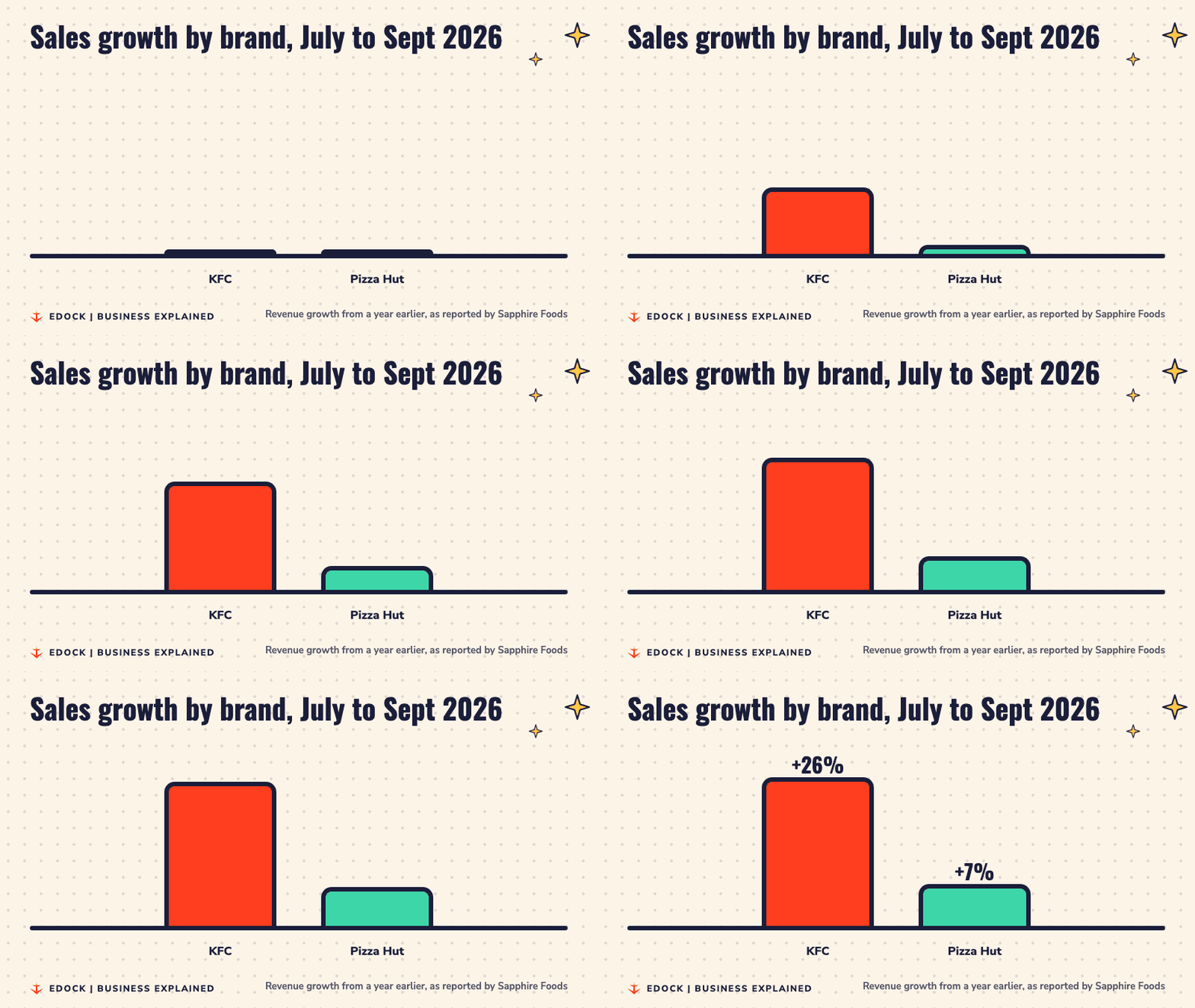
KFC's revenue grew 26%, the highest in the last 16 quarters. That is four whole years.
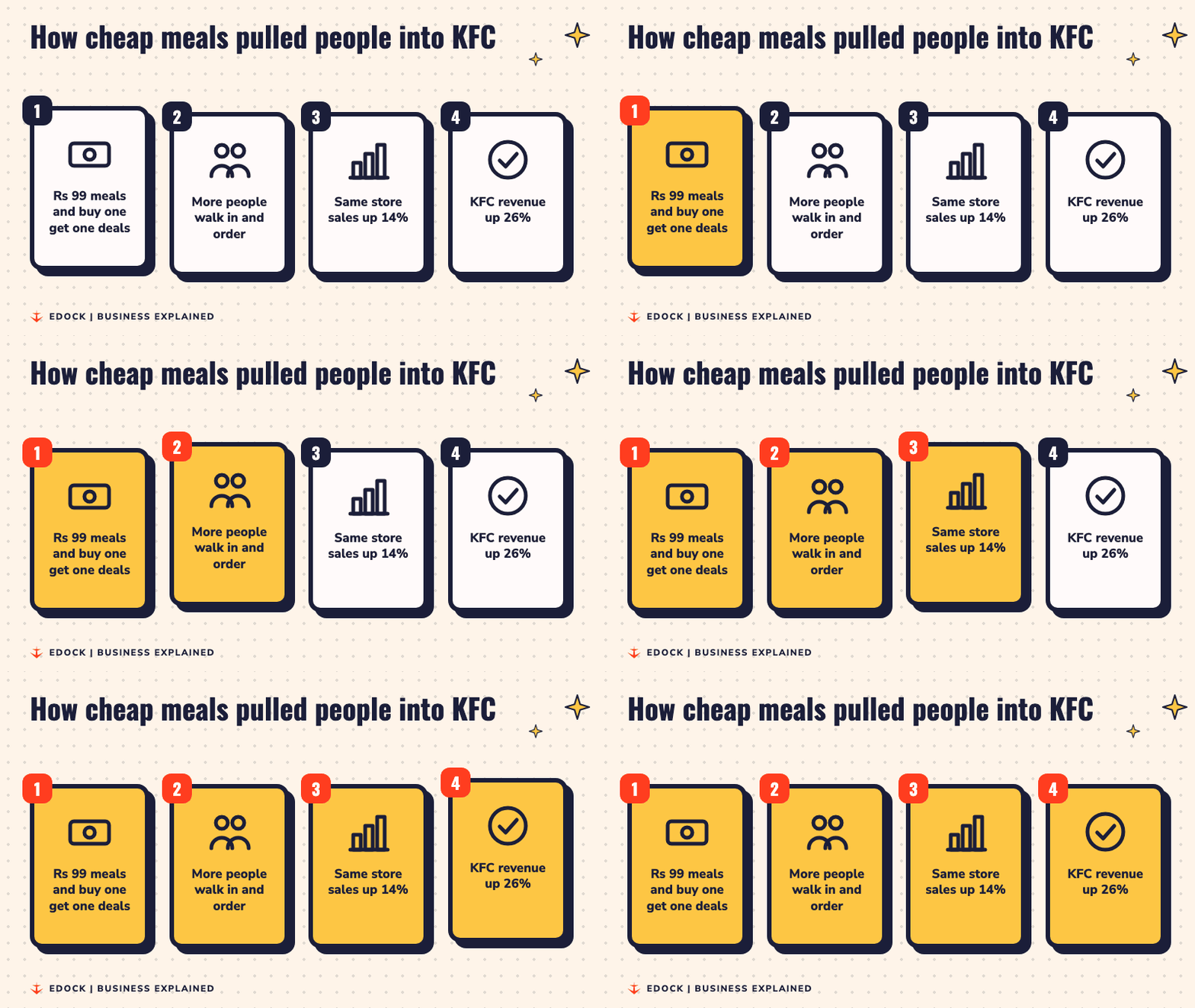
Another number matters even more: same store sales growth. It only looks at restaurants that were already open a year ago. New outlets do not count. It is like checking whether your old chai stall sold more cups, not whether you opened a second stall. For KFC, this number was 14%. People walked in and picked up food more often too: dine-in and takeaway did better than delivery.
What pulled them in? Cheap meals. The company pointed to the Rs 99 Chicken Krisper Burger Meal, a Rs 149 Thalaiva Meal in Tamil Nadu and buy one get one offers on chicken buckets, along with more spending on marketing.
There is one more reason. Business Standard notes that the Navratri festival moved to October to December this year, from July to September last year. So part of KFC's jump comes from comparing with a weak quarter last year. The company says same store growth would still be close to double digits after adjusting for this.
And why is pizza struggling?
Pizza Hut India's revenue rose 7% this quarter. Same store sales grew 5%, says Business Standard. ETRetail adds that this was the best in seven quarters, helped by deals like a Rs 99 four-course meal. That is good news on the surface.
But zoom out to the full year. Pizza Hut India's restaurant sales fell 7% in FY26 to Rs 506.5 crore, from Rs 545 crore in FY25. FY26 is the money year from April 2025 to March 2026.
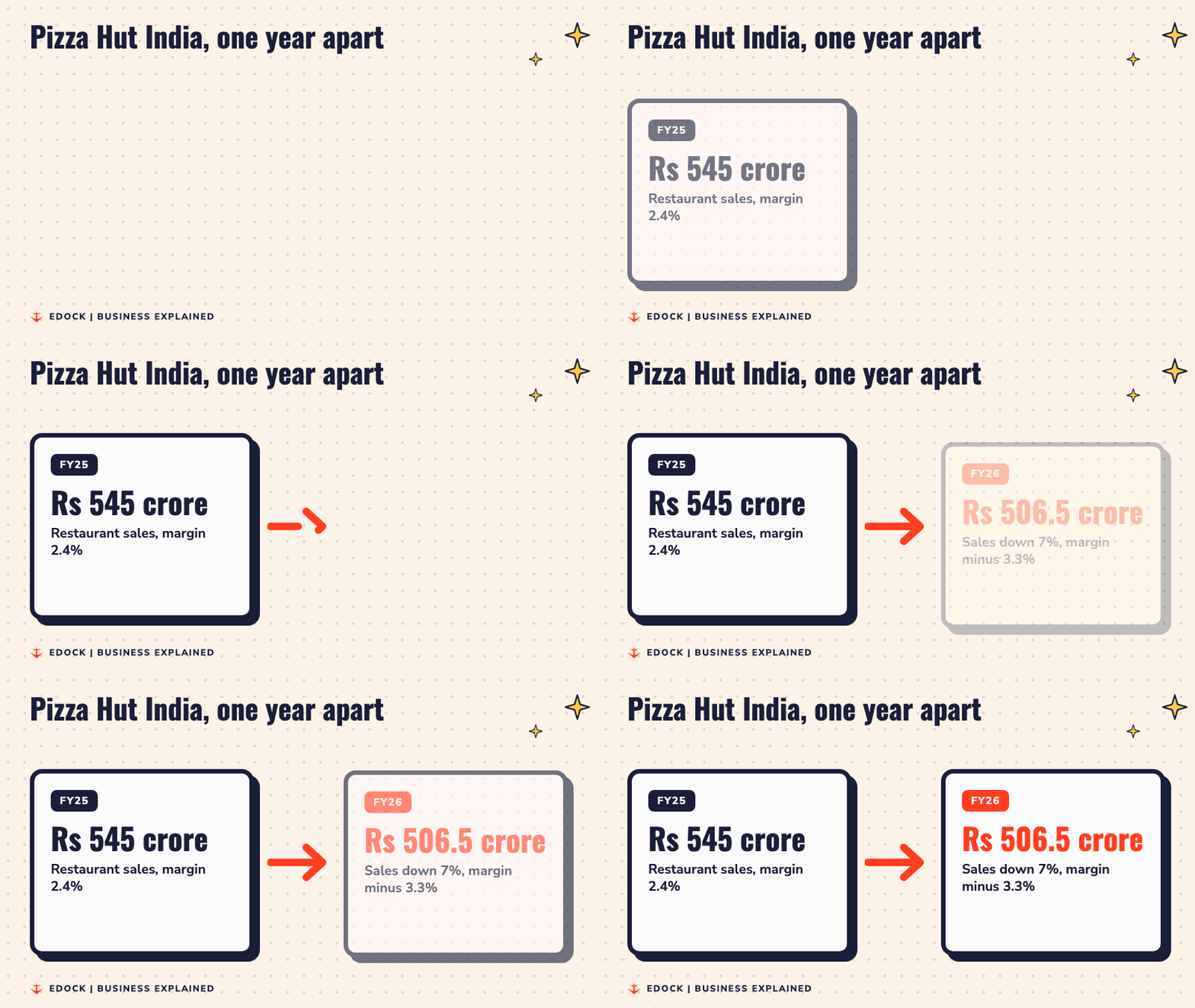
The margin story is even sharper. Pizza Hut's restaurant EBITDA margin was 13.3% in FY23. It fell to 4.9% in FY24, then 2.4% in FY25, and turned negative at minus 3.3% in FY26. A negative margin means the samosa stall spends more on potatoes, oil and rent than it earns from samosas, even before loans and tax.
In July to September 2026, the margin was minus 2.8%. That is better than minus 3.6% in the quarter before, but worse than a year ago, mainly because of higher energy costs. Pizza ovens need a lot of power.
One more clue is average daily sales, the money one restaurant takes in on a normal day. For a Pizza Hut, it was Rs 44,000 in July to September 2026. Over the full FY26 it averaged Rs 41,000, down from Rs 46,000 in each of FY24 and FY25.
What to watch for next
Here is the simple lesson. Selling more is not enough. A brand also needs each restaurant to keep some money after rent, staff, cheese and electricity. KFC is doing both right now. Pizza Hut is selling a bit more again, but it still spends more than it makes at the restaurant level.
Next time you see a Rs 99 meal on a poster, remember: it is not only a deal for you. It is a careful bet by a company that more people at the counter will cover the lower price.
Want to hear it from the company itself? Here is the recording of Sapphire's call with analysts about these results.
Sources
- ETRetail: KFC, Pizza Hut operator Sapphire Foods swings to loss in Q2 FY27
- Business Standard: Sapphire Foods India Q2FY27 net loss narrows, revenue up 20%
- The Economic Times: Pizza Hut India's restaurant sales fall 7% in FY26
- Storyboard18: KFC operator Sapphire Foods Q2 FY26 loss on Navratri impact
- Video: Sapphire Foods India Q2 FY27 earnings conference call, Concall on YouTube
- Cover photo: Pizza slices with various toppings, by Christian Jensen, CC BY 2.0

You may republish this story under CC BY 4.0: credit Manpreet Kaur and link to this page.