Jio wants ₹30,213 crore in India's biggest IPO. Here is how it works
Version 1 of 1 saved 15 Oct 2026, 9:26 am IST · Chain line 26
As it was first published
Jio wants ₹30,213 crore in India's biggest IPO. Here is how it works
Jio Platforms' share sale opens on October 21. Here is what an IPO, a price band and a lot mean, in simple words.
Picture this. A company that sells you mobile data every month is about to sell you something new: tiny pieces of itself.
That is what Jio is getting ready to do. On Wednesday, October 14, 2026, Reliance Industries announced the price band for the IPO of Jio Platforms, its digital company. Each share will cost between ₹1,065 and ₹1,119. The sale opens on October 21 and closes on October 23.
At the top price, Jio would raise ₹30,213 crore. That would make it India's largest IPO ever by size. Let us break it down, step by step.
First, what is an IPO?
IPO stands for initial public offering. It is the first time a company sells its shares to the public.
A share is a tiny piece of a company. Think of a giant pizza cut into crores of slices. If you buy one slice, you own a very small part of the pizza shop.
Before an IPO, only a few big owners hold these slices. After an IPO, anyone with a trading account can buy and sell them on the stock market. It is a bit like swapping cricket cards at school, but with real money and lots of rules.
Who owns Jio right now?
Jio Platforms is part of Reliance Industries. Right now, Reliance owns 66.43% of it. Meta, the company behind Instagram and WhatsApp, owns 9.98%. Google owns 7.73%.
Jio Platforms runs Reliance Jio Infocomm, the phone network many Indians use every day. In June 2026, that network had 533.3 million customers. That is more than 53 crore people. Of them, 284.9 million were on 5G.
What is a price band?
Jio did not fix one single price. It gave a range, from ₹1,065 to ₹1,119. This range is called a price band.
People who want shares say how many they want, and at what price inside this range. This is called bidding. Think of an auction at a school fair, but with the lowest and highest prices already fixed.
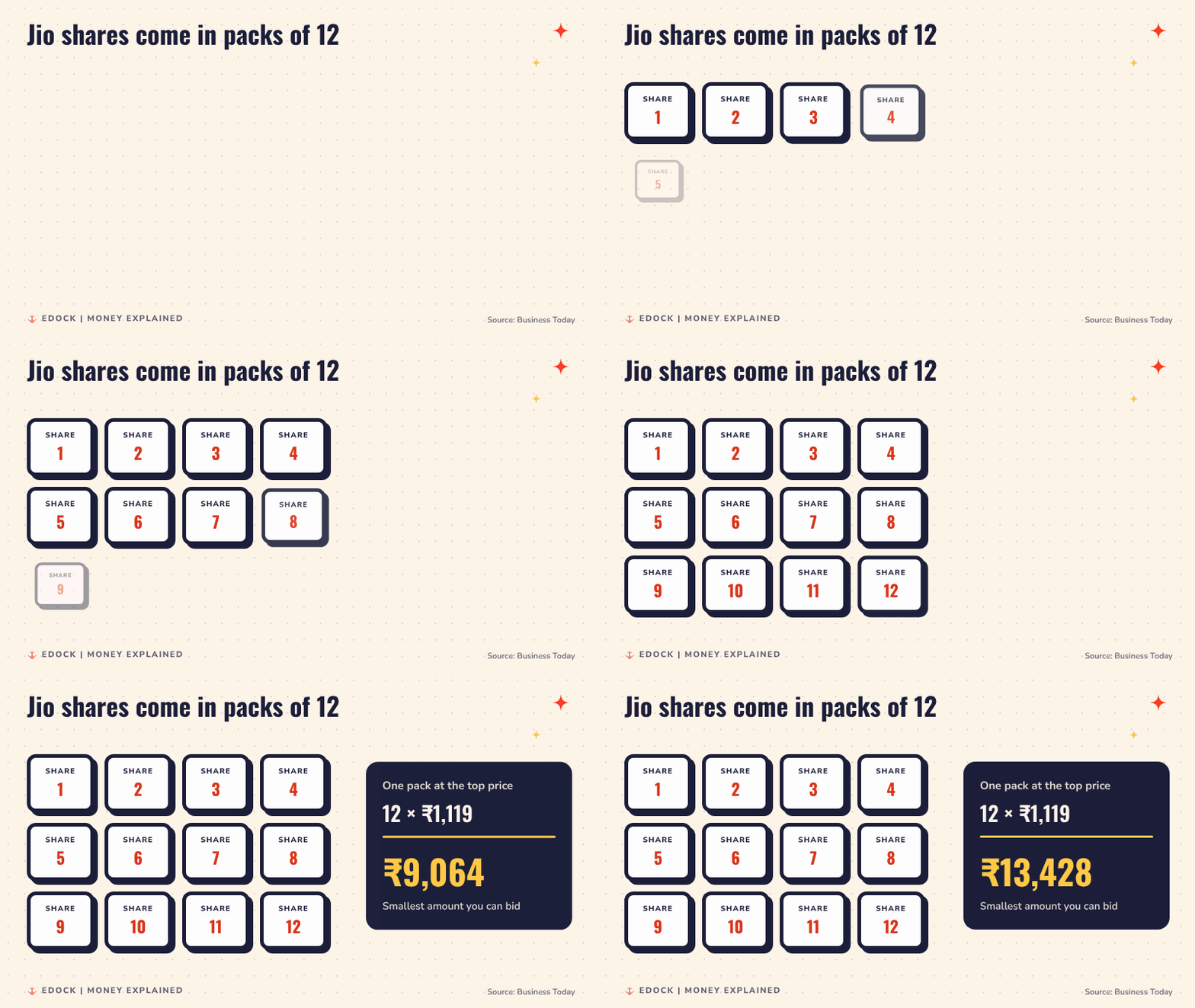
In this IPO, you also cannot bid for just one share. Shares come in packs called lots, and one lot has 12 shares. So at the top price, the smallest bid is 12 × ₹1,119. That is ₹13,428.
How big is ₹30,213 crore?
Jio plans to sell up to 27 crore new shares. Multiply 27 crore shares by ₹1,119 and you get ₹30,213 crore. At the lowest price of ₹1,065, it would be ₹28,755 crore.
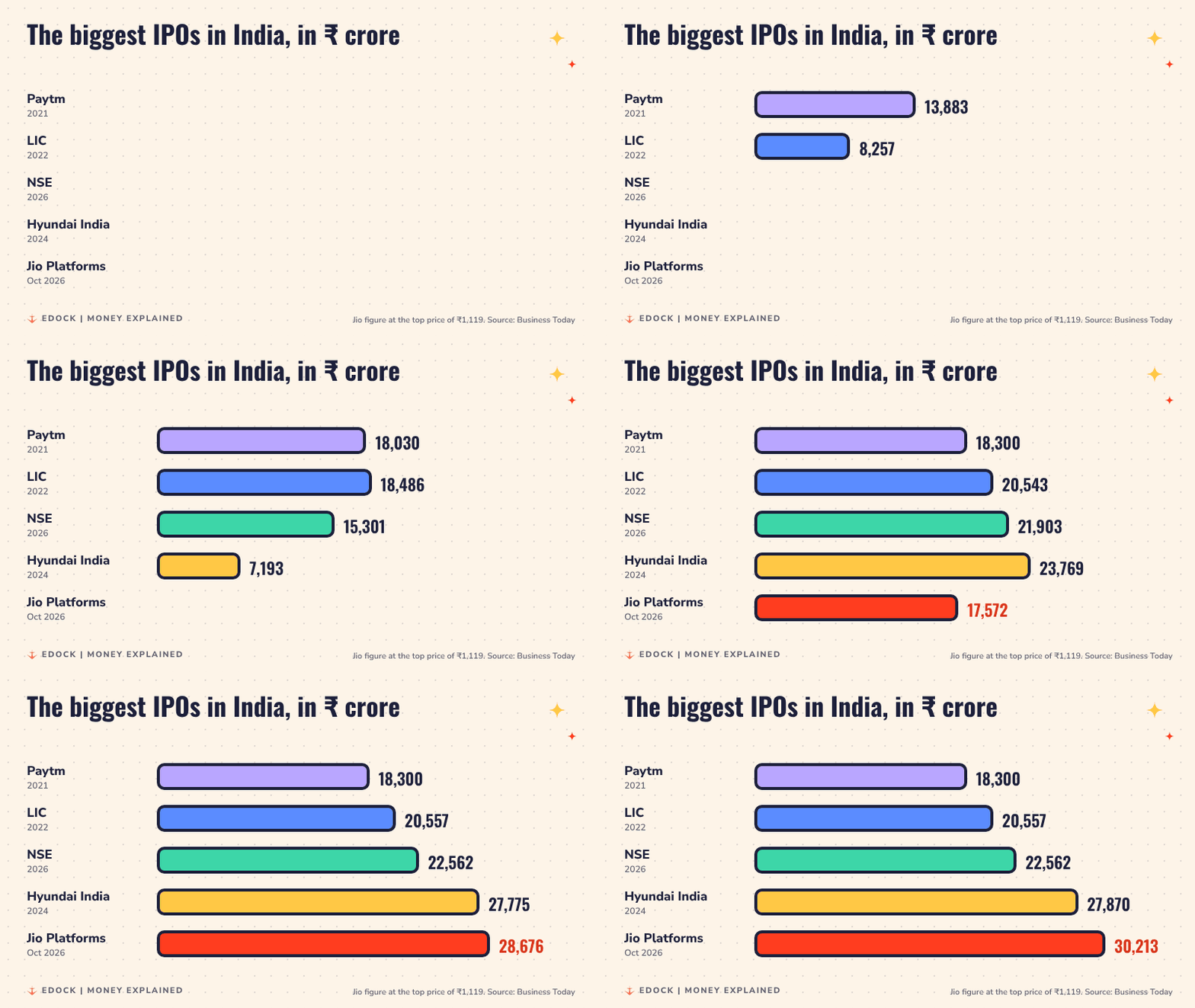
Until now, the biggest IPO in India was Hyundai Motor India in 2024. It raised ₹27,870 crore. At the top price, Jio's IPO would beat that record by ₹2,343 crore.
Other giant IPOs include NSE (₹22,562 crore in 2026), LIC (₹20,557 crore in 2022) and Paytm (₹18,300 crore in 2021).
At the top price, the whole company would be worth about ₹10.3 lakh crore. This number is called the valuation. It is the price tag on the whole pizza, not just one slice.
Where does the money go?
Here is a big difference between Jio and Hyundai.
In Hyundai's IPO, the Korean parent company sold its own old shares. This is called an offer for sale. So none of that money went to the Indian company. It went to the seller.
Jio is doing the opposite. All its shares are new. This is called a fresh issue. Nobody is selling old shares, so the money goes to the company itself.
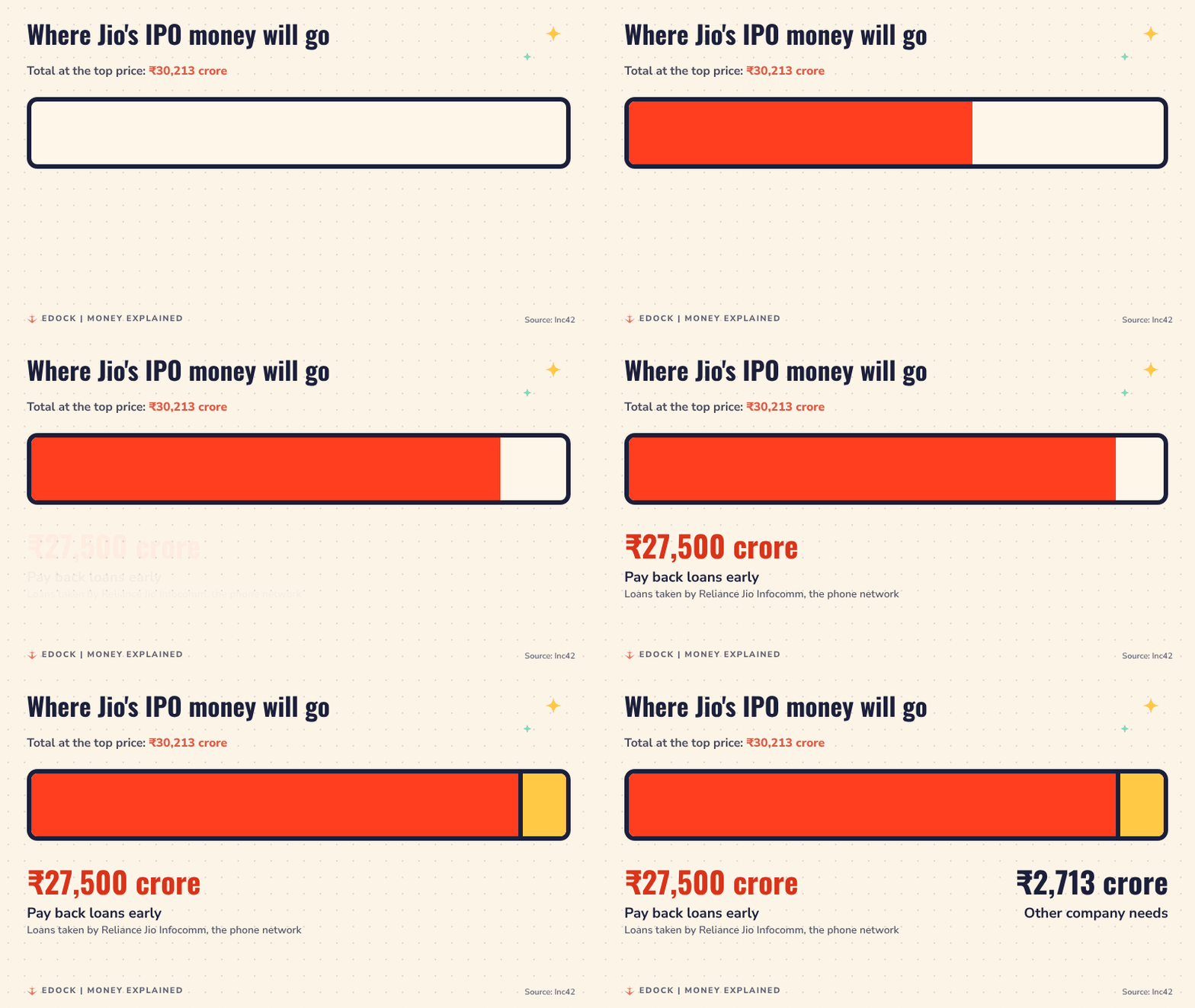
Jio already has a plan for it. It will use ₹27,500 crore to pay back loans of Reliance Jio Infocomm early. The other ₹2,713 crore is for general company needs.
Paying back a loan early is like clearing your bill at the chai stall before the end of the month. These loans were due between March and June 2028.
Who gets to bid first?
The sale has a few special parts:
- Anchor investors go first, on October 19. These are big investors, like large funds, who agree to buy a big chunk before everyone else.
- Jio employees have ₹500 crore of shares kept aside for them, and they get ₹54 off on each share.
- Reliance shareholders have up to ₹2,500 crore of shares kept aside for them.
Everyone else can bid from October 21 to October 23.
How is Jio doing as a business?
In the three months from April to June 2026, Jio Platforms made a profit of ₹7,764 crore. That is 9.2% more than a year before. Its revenue from operations was ₹39,173 crore, up 11.8%.
Revenue is all the money a business earns from selling things. Profit is what is left after paying all the costs. If a lemonade stall sells ₹500 of lemonade and spends ₹300 on lemons, sugar and cups, its revenue is ₹500 and its profit is ₹200.
Watch: the news in a few minutes
What happens next?
Jio filed its final offer papers, called the Red Herring Prospectus, on October 14. Think of it as a very detailed menu card. It tells buyers everything about the dish before they order.
After bidding closes on October 23, shares are handed out to the people who bid. Then Jio's shares start trading on the stock market, where their price can go up or down every day.
Nobody can say today where that price will go. What is clear is that a company most Indians know through their SIM card is about to make stock market history.
An IPO is a company selling pieces of itself to the public for the first time. At the top price, Jio's would be the biggest India has seen.
Sources
- Business Today: Jio Platforms IPO price band announced at Rs 1,065 to 1,119
- Inc42: Jio Platforms sets stage for India's largest IPO at ₹10.3 lakh crore valuation
- Inc42: Jio Platforms IPO to open for subscription on October 21
- Autocar Professional: Hyundai India IPO price band set, issue to open on Oct 15 (2024)
- Cover photos: Lattice cell tower, by Wikideas1, CC0 1.0; Cell tower in Peristeri, Greece, by Spilol22, CC0 1.0; Fiber optical cable, by Bquast via Pixabay, CC0 1.0. Not Jio sites.


