Jindal Steel opens its own cargo terminal at Paradip Port in Odisha
Version 1 of 1 saved 16 Oct 2026, 11:02 pm IST · Chain line 48
As it was first published
Jindal Steel opens its own cargo terminal at Paradip Port in Odisha
Phase I of a Rs 3,393 crore dry bulk terminal started work on 15 October 2026. Here is what a port terminal does and why steel makers want one.
Picture a ship almost as long as three football fields, sitting deep in the water off the coast of Odisha. It is carrying more than 1.5 lakh tonnes of coal from Australia. Now picture a steel company that no longer has to wait in line to unload it, because the gate at the port is its own.
That is what changed this week. On 15 October 2026, Jindal Paradip Port Ltd, a unit of Jindal Steel, started commercial operations at the first phase of a new cargo terminal at Paradip Port in Odisha. Jindal Steel shared the news in a stock exchange filing, reported on Friday, 16 October.
What just opened?
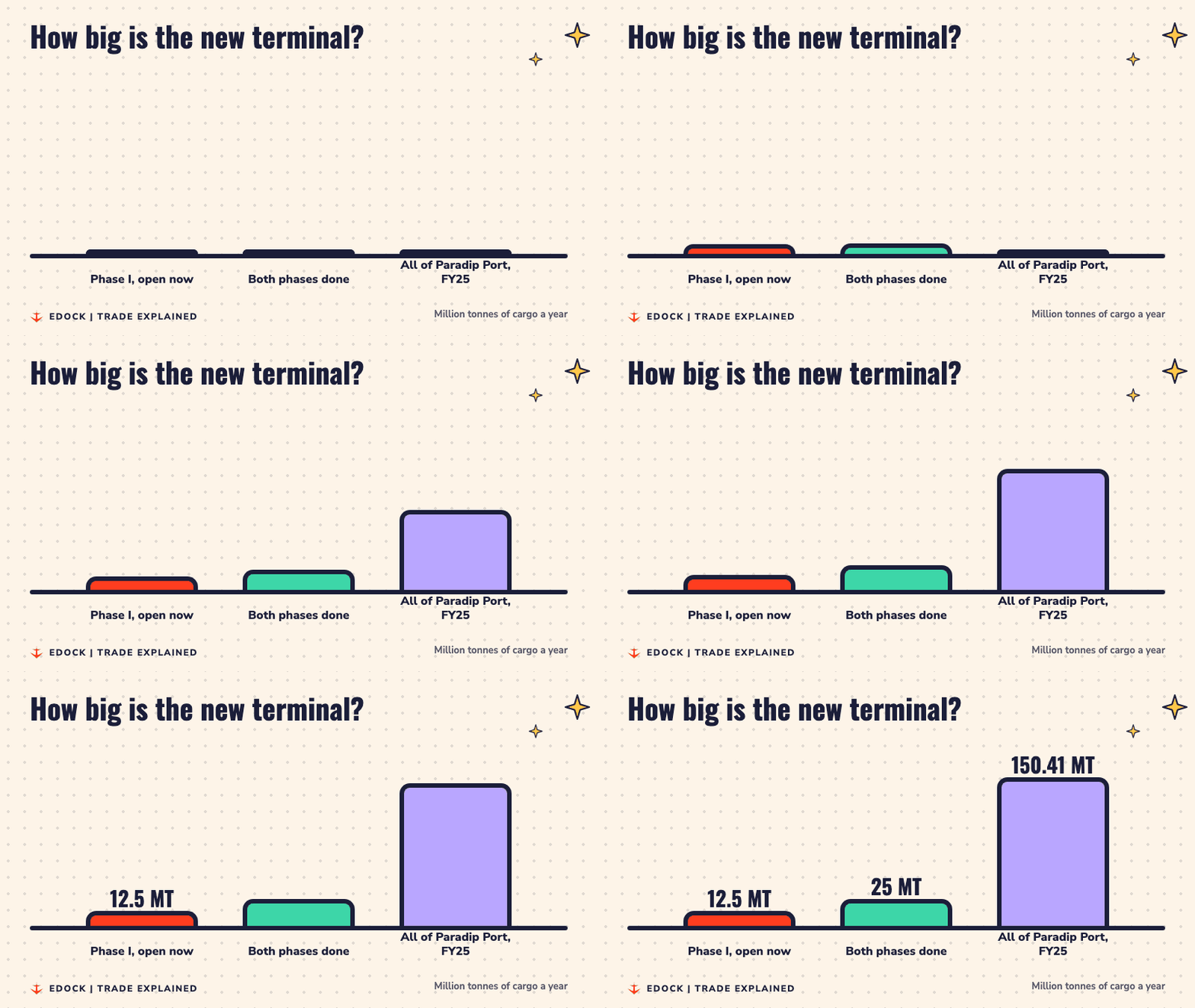
The new terminal sits at the Western Dock of Paradip Port. Its first phase can handle 12.5 million tonnes of cargo a year. When the second phase is ready, the full terminal will handle 25 million tonnes a year. The total cost of both phases is Rs 3,393 crore.
It also opened early. Under its deal with the port, Phase I had to start within 1,095 days, which is three years, from the date the deal was awarded. That deadline was 16 October 2026. The company got its completion certificate on 12 October and started work on 15 October, one day before the deadline.
Both phases are being built at the same time, the company said in its filing.
Wait, what is a port terminal?
A port is like a big railway station for ships. A terminal is one platform inside that station, built for one kind of cargo. Some terminals handle containers, the big metal boxes you see stacked on trucks. Some handle oil. This one is a dry bulk terminal.
"Dry bulk" means loose, dry stuff poured straight into the belly of a ship, with no boxes or bags. Think of it like buying rice loose from a sack at the kirana shop instead of in small packets. Coal, limestone and iron ore travel this way.
The Jindal Ports site says the Western Dock is meant for coal, limestone and steel products. Coal and limestone come in, steel goes out.
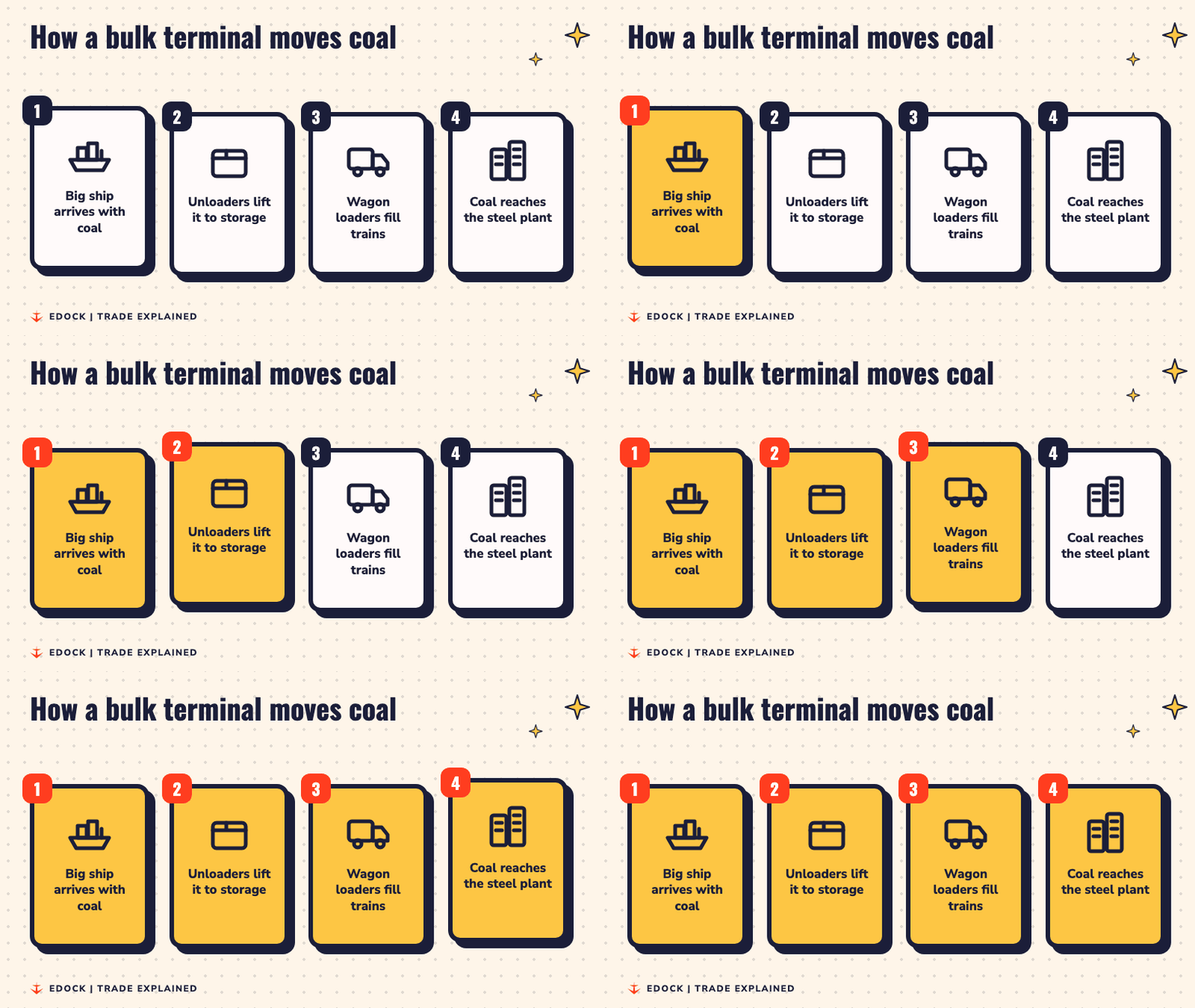
A terminal is not just a parking spot for ships. It is a whole chain of machines. The project's equipment list includes ship unloaders, coal silos, wagon loaders, mobile harbour cranes and stacker reclaimers. A stacker reclaimer is a giant machine that piles up coal in long heaps and then scoops it back out when a train is ready.
What does 12.5 million tonnes really mean?
Big numbers are hard to feel, so here is one way to see it.
Earlier, Paradip Port berthed its first ever Capesize ship at Western Dock 1. A Capesize ship is one of the biggest kinds of cargo ship. This one, the MV Mineral Kwangyang, was 292 metres long and carried 152,702 tonnes of coking coal from Hay Point in Australia. Coking coal is the special coal used to make steel.
That ship also had a 16.5 metre draft. Draft is how deep the bottom of a ship sits under the water. A deep port lets heavier, fuller ships come in.
Now the sum. If 12.5 million tonnes is split into loads of 152,702 tonnes, that comes to about 82 shiploads of that size in a year. Spread over 365 days, it is about 34,000 tonnes of cargo every single day.
And Paradip is already a giant. The whole port handled 150.41 million tonnes of cargo in 2024 to 2025, the most of any major port run by the government that year. So Phase I alone adds capacity equal to about 8 percent of everything the port moved in that year.
In September 2026, the government also named Paradip a "Mega Port", the only one on India's east coast.
Why would a steel company want its own terminal?
Imagine running a samosa stall. Potatoes and flour come in every morning, and samosas go out all day. Now imagine your potatoes arrive at six different markets across the city, and you must send someone to each one and wait your turn. That is slow and costly. A steel maker has the same problem, only with millions of tonnes.
Steel plants eat huge amounts of coal and limestone. Some of that coal is shipped in from abroad, like the load from Australia. Then the finished steel is sent out to buyers, some of them overseas.
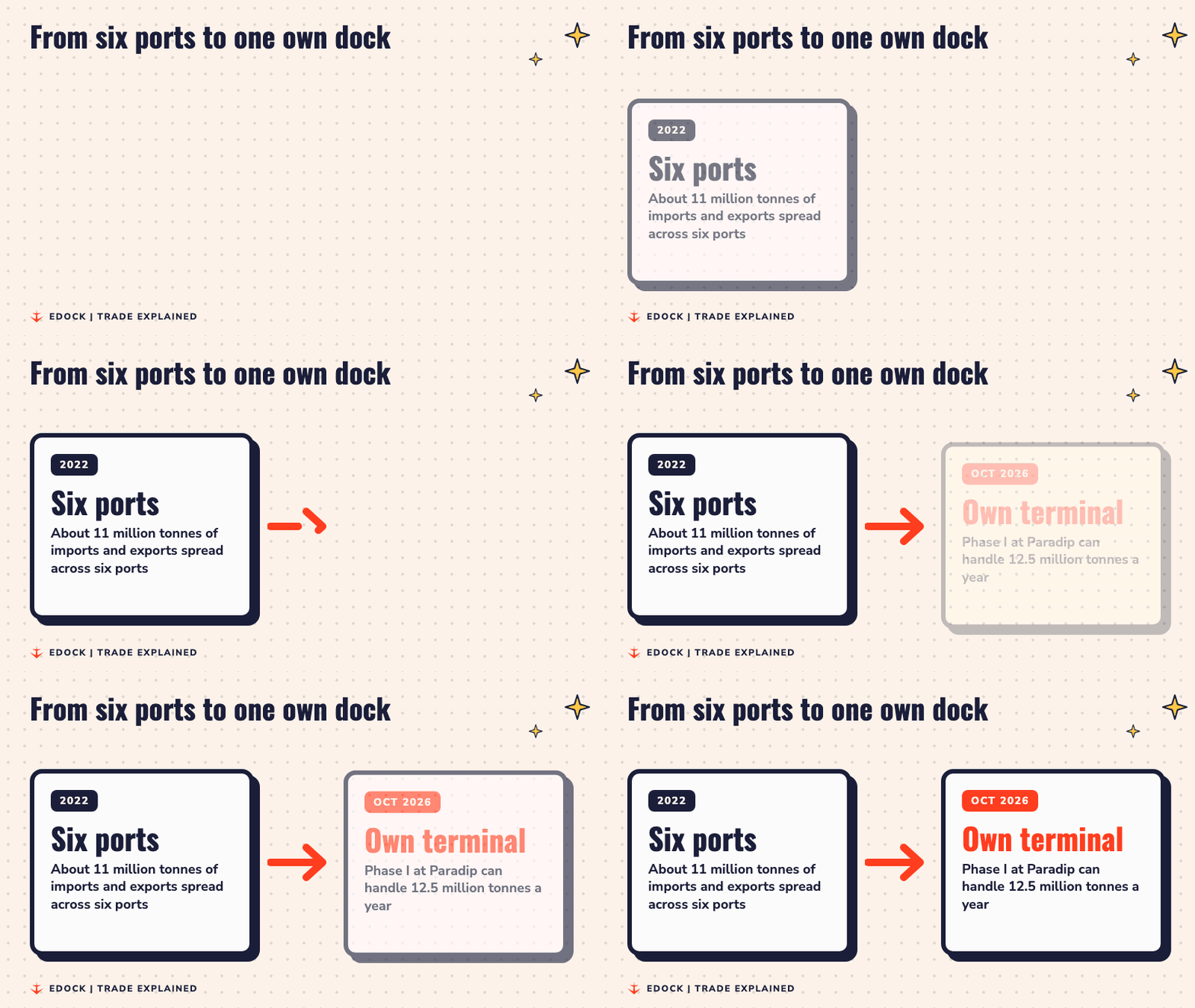
Back in 2022, when the company was still called Jindal Steel and Power, its managing director V R Sharma explained the problem to Maritime Gateway. He said the company exported over 3 million tonnes of steel a year and imported almost 8 million tonnes of coal and limestone. That is 11 million tonnes moving through six ports: Haldia, Dhamra, Paradip, Gopalpur, Visakhapatnam and Gangavaram.
The same report said Paradip is close to the company's plants at Angul in Odisha and Raigarh in Chhattisgarh, which should save money on freight and time. Freight is the fee paid to move goods from one place to another.
An own terminal is called a "captive" terminal in business language. Captive just means it mainly serves its owner's needs, the way a school bus mainly carries that school's children. The Economic Times report said the new terminal gives Jindal Steel dedicated long-term access to a port as it works to make more steel in India.
So does Jindal own part of the port now?
Not exactly. The terminal was built on a BOT basis, which stands for build, operate, transfer. Here is how that works, in simple words.
- Build: the company pays to build the terminal on port land.
- Operate: it runs the terminal and earns from it for a fixed number of years.
- Transfer: when that time ends, the terminal goes back to the port.
It is a bit like a friend who sets up a chai stall on the school ground. The friend buys the kettle and the stove, sells chai for some years, and then hands the stall over to the school.
Here, the port is owned by the Paradip Port Authority, which is owned by the Government of India. The authority awarded this deal to Jindal Paradip Port on 17 October 2023.
Why should anyone outside the steel world care?
Ports decide how fast and how cheaply goods move. When a steel maker saves time and money on moving coal, it can make steel more easily. Steel goes into the bridges, metro lines, cars and buildings around all of us.
It also shows a bigger pattern. Maritime Gateway's 2022 report said other steel makers were also turning to their own ports and ships to cut costs. Companies are not just making products anymore. Many are building the roads, rails and ports that carry those products too.
What happens next?
The next big step is Phase II, which will take the terminal to 25 million tonnes a year. The Jindal Ports site says the full capacity is planned within five years of the concession award. A concession is simply permission to use something for a fixed time on agreed terms.
For now, the first half is open, a day early, and the coal ships at Paradip have a new place to unload.
Sources
- Jindal Steel arm commissions Phase-I cargo terminal in Odisha, The Economic Times
- Paradip Port berths first Capesize vessel with 16.5 metre draft, The Economic Times
- Paradip Port gets Mega Port status, The Economic Times
- Jindal Steel arm commissions Phase-I cargo terminal in Odisha (PTI), HDFC Sky
- The Western Dock Project, Jindal Ports
- Steel companies opt for captive ports and ships, Maritime Gateway
- Paradip Port cargo results for FY 2024 to 2025, Paradip Port Authority
- Paradip Western Dock Terminal, Global Energy Monitor
- Paradip Port, Wikipedia
- Cover photo: Ocean Cobalt at Port of Rotterdam, by Alf van Beem, CC0
