IndiGo's CEO says fares must rise: why jet fuel decides your ticket price
India's biggest airline lost Rs 1,879 crore in three months as its fuel bill jumped 67%, and its boss says higher fares cannot be avoided.
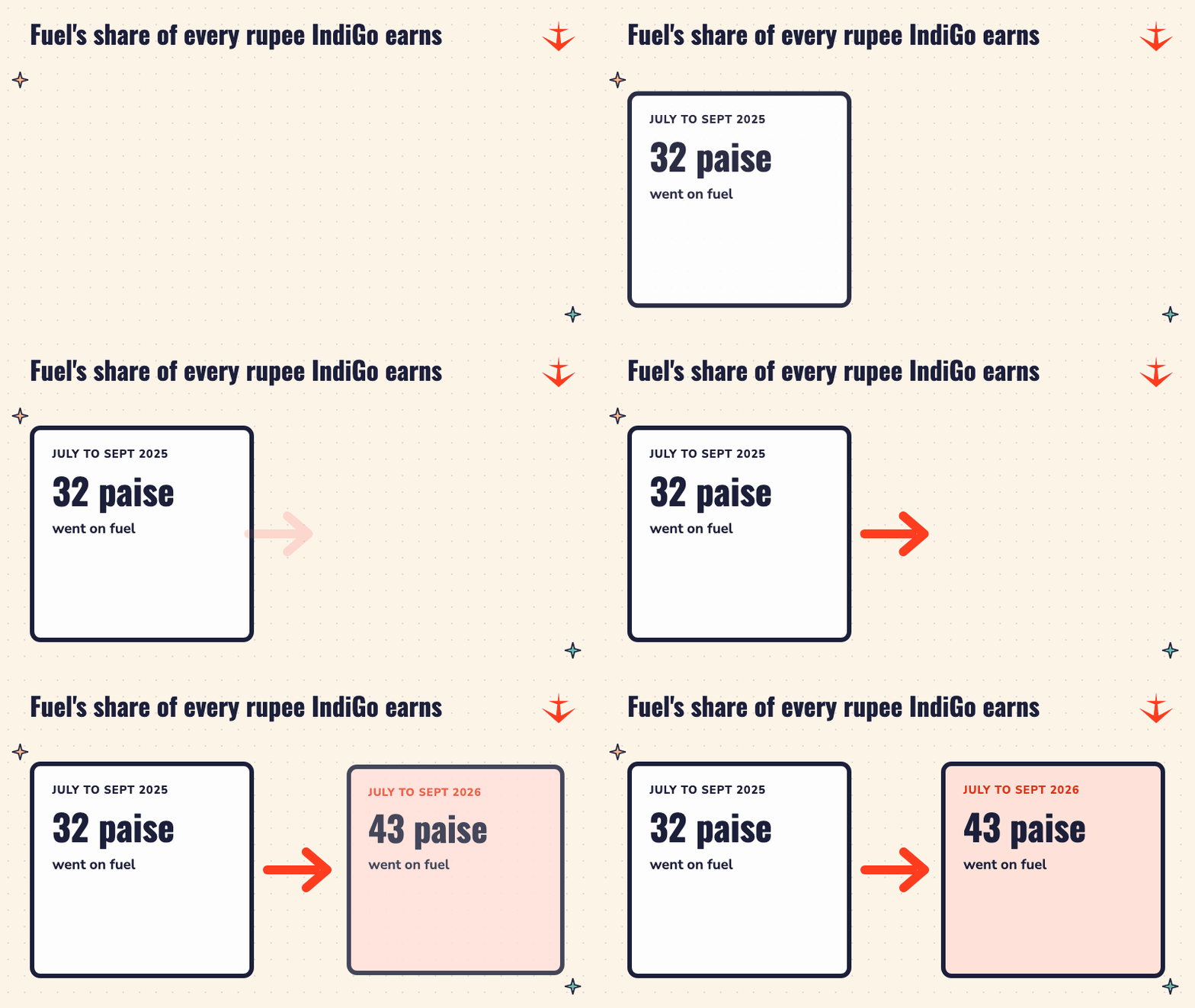
Picture this. For every Rs 100 that IndiGo earned from flying people between July and September 2026, about Rs 43 went on fuel alone. A year earlier, the same Rs 100 needed only Rs 32 for fuel. Mint worked out these numbers from the airline's results.
On Thursday, 29 October 2026, India's biggest airline shared those results. IndiGo lost Rs 1,879.1 crore in the three months. Its chief executive, Willie Walsh, then said plainly: "We have no choice but to look to increase fares to offset very significant rise in fuel bill." In simple words, your next flight ticket may cost more.
What happened in IndiGo's three months?
A company's "quarter" is a block of three months. This one ran from July to September 2026, the second quarter of the airline's money year.
Think of a samosa stall. If the stall takes in Rs 1,000 in a day but spends Rs 1,100 on potatoes, oil and gas, it has made a loss of Rs 100. IndiGo had the same problem, only much bigger. Its total income was Rs 24,311.9 crore, but total expenses were Rs 26,188.4 crore.
- The loss of Rs 1,879.1 crore was 27.2% smaller than the Rs 2,582.1 crore loss of the same three months last year, Business Standard reported.
- But the loss was far bigger than the Rs 238 crore loss of April to June.
- Revenue from operations, the money from tickets and other flying business, rose 25.9% to Rs 23,364 crore.
- This was the airline's third quarterly loss in a row.
Why fuel is an airline's biggest bill
Planes run on aviation turbine fuel, or ATF, a kind of jet fuel made out of crude oil. IndiGo's fuel bill jumped 67% to Rs 9,967 crore, up from Rs 5,962 crore a year earlier, The New Indian Express reported.
Why so steep? Crude oil got costlier after the war in West Asia began on 28 February. But jet fuel rose even faster than crude. The extra price of jet fuel over crude is called the "crack spread". Think of milk and paneer: if milk costs more, paneer costs more, but if making paneer itself gets harder, paneer jumps even more.
Walsh, who ran the world airline body IATA before joining IndiGo, said this spread usually averages about 21 to 22%, but is likely to average around 65% this year, because refineries have been badly disrupted. He took charge of IndiGo in August and has worked in airlines for 47 years. About these fuel costs, he told reporters: "I've never seen anything like this."
In India, ATF for domestic flights cost 13.2% more in October than in September, and 46.2% more than a year ago. Global jet fuel stood at $196 a barrel last week, more than double the level before the war, the same report said.
The weak rupee makes it worse
Many airline bills are paid in US dollars, such as rent for planes. When the rupee gets weaker, each dollar needs more rupees. It is like your pocket money staying the same while your favourite snack, priced abroad, keeps getting costlier.
During the quarter, one dollar cost IndiGo Rs 95.09 on average, compared with Rs 87.06 a year earlier, Business Standard noted. Walsh said 50 to 60% of IndiGo's non-fuel costs are in dollars.
So why did the loss get smaller?
Two reasons. First, the loss caused by currency swings was lower: Rs 1,333.2 crore this time against Rs 2,892.1 crore a year ago. Without those currency effects, IndiGo lost Rs 723.7 crore, while it made a profit of Rs 103.9 crore in the same quarter last year, Fortune India reported.
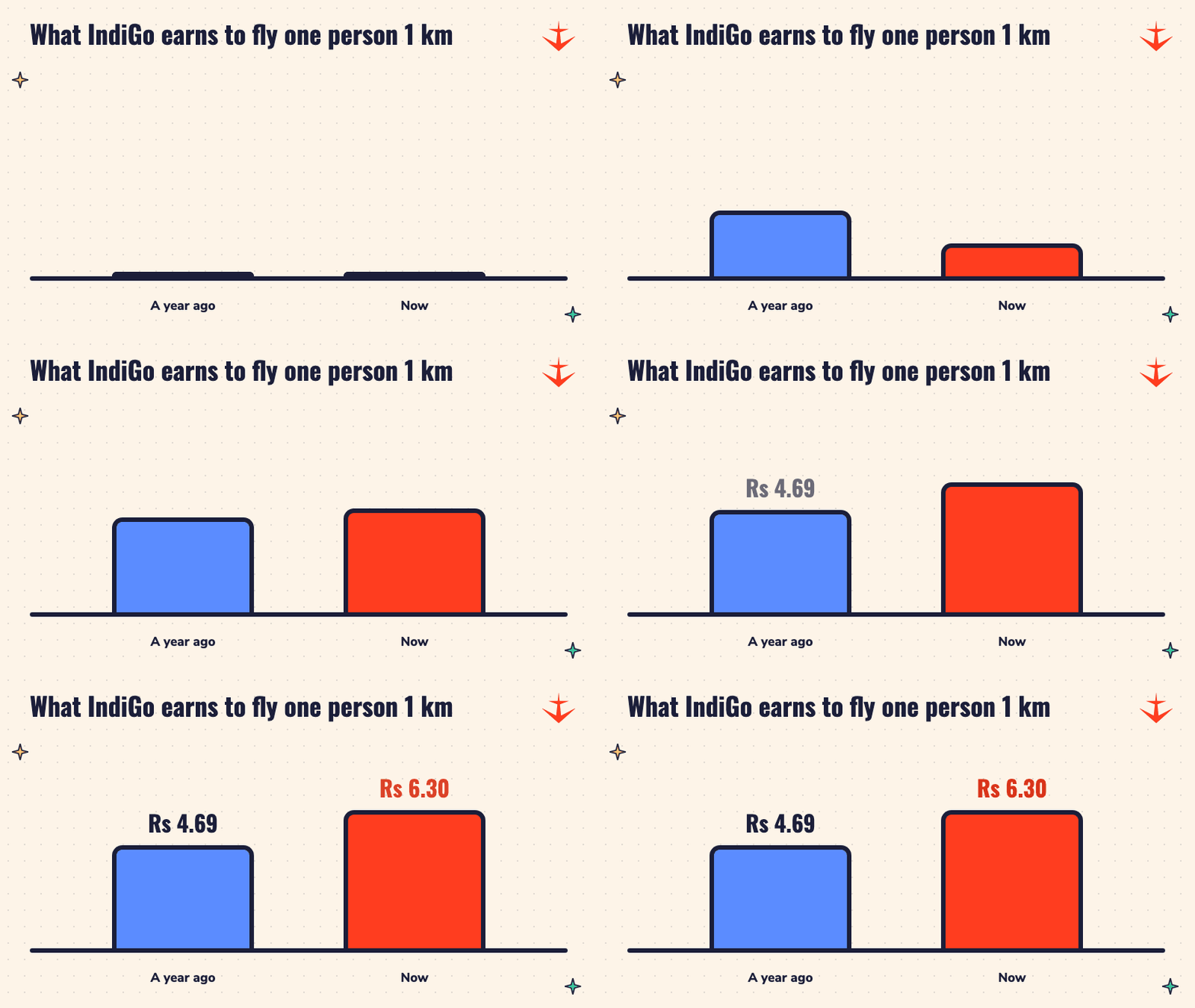
Second, fares went up. Airlines track "yield", the money earned for carrying one person for one kilometre. IndiGo's yield rose to Rs 6.30 from Rs 4.69 a year earlier. At those rates, a 1,000 km trip earns the airline about Rs 6,300 now instead of Rs 4,690.
Higher fares kept some people at home. IndiGo carried 27.5 million flyers, 4.7% fewer than a year earlier. Its "load factor", the share of seats with someone sitting in them, fell to 80.3% from 82.5%. So out of every 100 seats, about 80 were filled.
Even with higher fares, the airline has not covered its full fuel bill. "We estimate, similar to many airlines around the world, that we've recovered about 60%," Walsh said after the results.
What an airline does when fuel jumps
An airline cannot stop buying fuel, just as a chai stall cannot stop buying milk. So IndiGo is pulling a few levers at once.
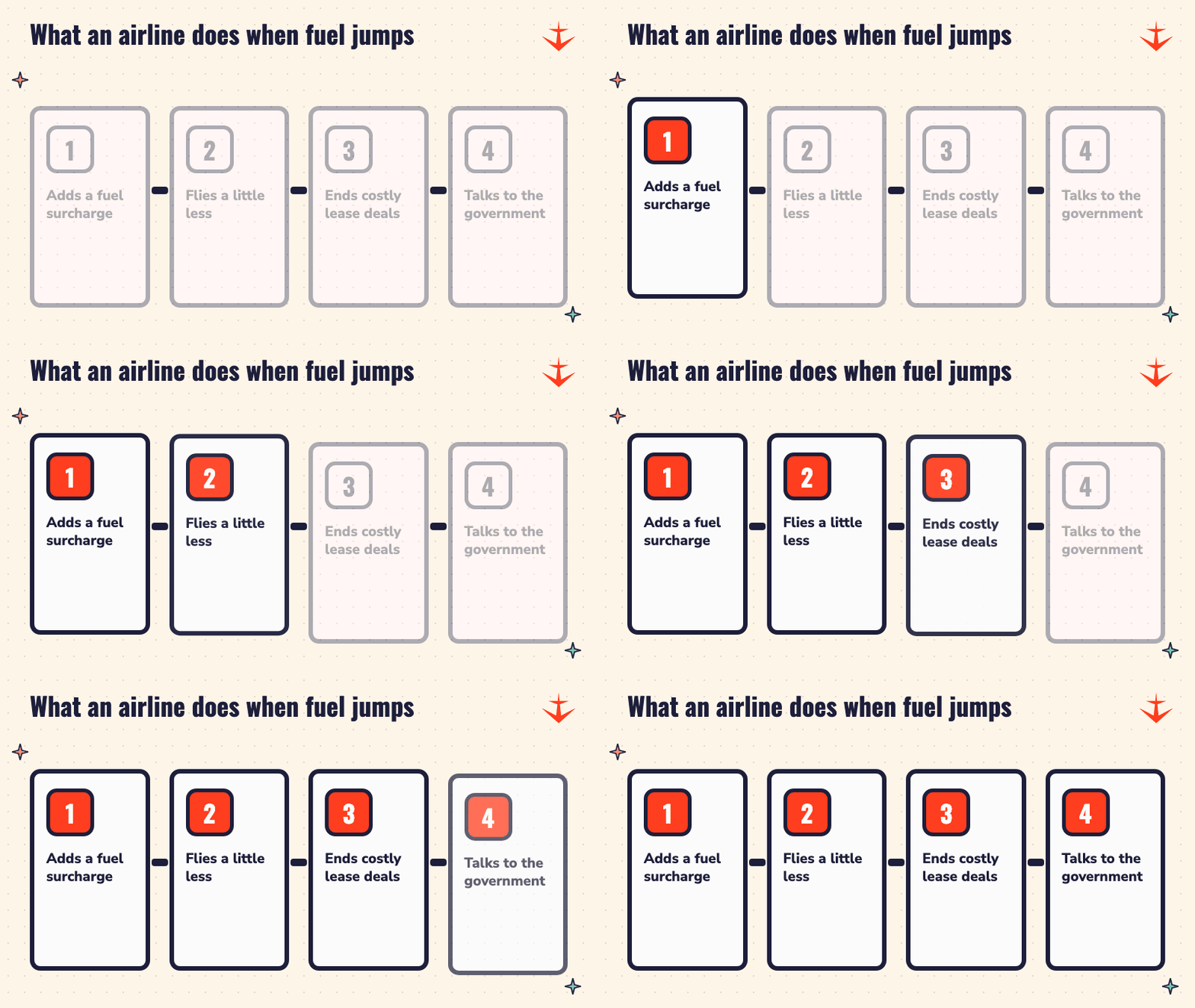
- Add a fuel surcharge. A surcharge is an extra fee on top of the base fare. Earlier this month, IndiGo brought back fuel surcharges of Rs 375 to Rs 10,000, depending on the route.
- Fly a little less. Airlines measure how much they fly in "available seat kilometres", or ASK: one seat flown for one kilometre. A plane with 180 seats flying 1,000 km offers 1,80,000 ASKs. IndiGo cut this by 1% to 40.8 billion in the quarter. For October to December, it expects only small growth, with cuts falling more on international routes, since domestic travel is expected to stay strong in the festive season.
- Drop costly deals. IndiGo is ending a "wet lease" with Norse Atlantic, where planes came with their own crew, because high fuel prices made the deal less attractive, Business Standard reported.
- Talk to the government. Walsh said IndiGo could join the government's fuel price stabilisation scheme, meant to soften sharp jumps in fuel prices, if the terms make sense.
Big savings elsewhere are unlikely. "We will continue to look at measures to trim expenses but should not expect any significant cost measures," Walsh said. The airline still had free cash of about Rs 39,929 crore at the end of September, a cushion for hard months.
What this means for your next ticket
IndiGo flies nearly two out of every three people who take a domestic flight in India, so its fares touch most Indian flyers. Walsh said fuel prices and ticket prices move closely together. "My experience is that there's almost a direct correlation between the fuel price and ticket prices," he told analysts.
He also said other airlines will likely do the same, because "everybody has ultimately to pay the same price for the fuel," as Moneycontrol reported. Based on trends seen in October, IndiGo expects the money it earns from each seat kilometre to rise by more than 25% in October to December compared with a year ago.
Walsh expects "a period of elevated fuel costs for some time to come", so fares for festive and winter trips may stay high too. He still called the fuel shock "a temporary issue" and said India's long-term prospects for flying remain "very, very strong".
Sources
- The Economic Times: IndiGo may hike ticket prices to offset soaring fuel bills, says CEO Willie Walsh
- Business Standard: IndiGo Q2 net loss narrows 27.2% to Rs 1,879 crore despite fuel cost surge
- Mint: IndiGo raises fares, but fuel surge keeps losses high
- Mint: IndiGo CEO Willie Walsh says fare hikes unavoidable amid fuel cost surge
- Fortune India: IndiGo recovers only 60% of fuel cost surge, sees further pressure in Q3
- Forbes India: You can't avoid fare increases, says IndiGo CEO Willie Walsh as Q2 loss narrows
- Moneycontrol: IndiGo CEO Willie Walsh says airline has no choice but to raise fares
- The New Indian Express: IndiGo signals more fare hikes to offset high jet fuel prices
- Cover photo: IndiGo Airbus A320neo VT-IXE at Singapore, by S5A-0043, CC BY 4.0

You may republish this story under CC BY 4.0: credit Manpreet Kaur and link to this page.