Indian factories got export orders at the fastest pace in six months in October
Version 1 of 1 saved 3 Nov 2026, 2:45 pm IST · Chain line 346
As it was first published
Indian factories got export orders at the fastest pace in six months in October
India's monthly factory survey scored 54.7 in October. Overall growth slowed a little, but buyers abroad ordered more and prices rose gently.
Picture a factory getting new orders from buyers in Canada, Oman and Sri Lanka, all in one month. In October 2026, Indian factories reported gains from places like these. A survey released on Monday, 2 November 2026, showed that new orders from abroad grew at their fastest pace in six months.
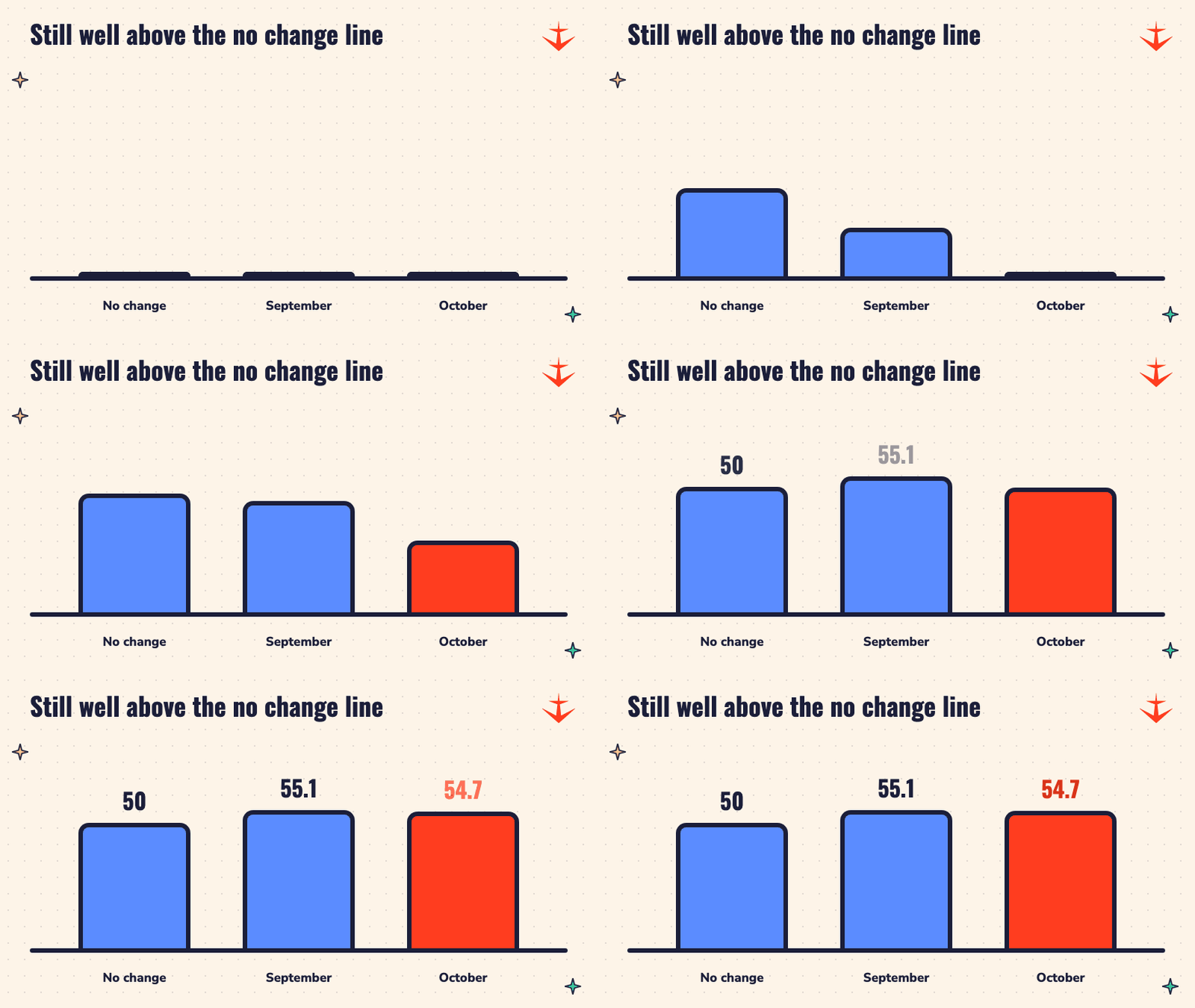
The same survey gave India's factories a score of 54.7 for October, a little lower than 55.1 in September. So the overall growth slowed a bit. But orders from other countries sped up, and prices rose more gently. This post explains what the score means and why export orders matter for factory work.
What is this survey, in simple words?
The survey is called the PMI, short for Purchasing Managers' Index. Think of it as a monthly report card for factories. A purchasing manager is the person who buys raw materials for a factory, like the cotton for a shirt maker or the steel for a cycle maker. These managers see early when business is picking up or slowing down.
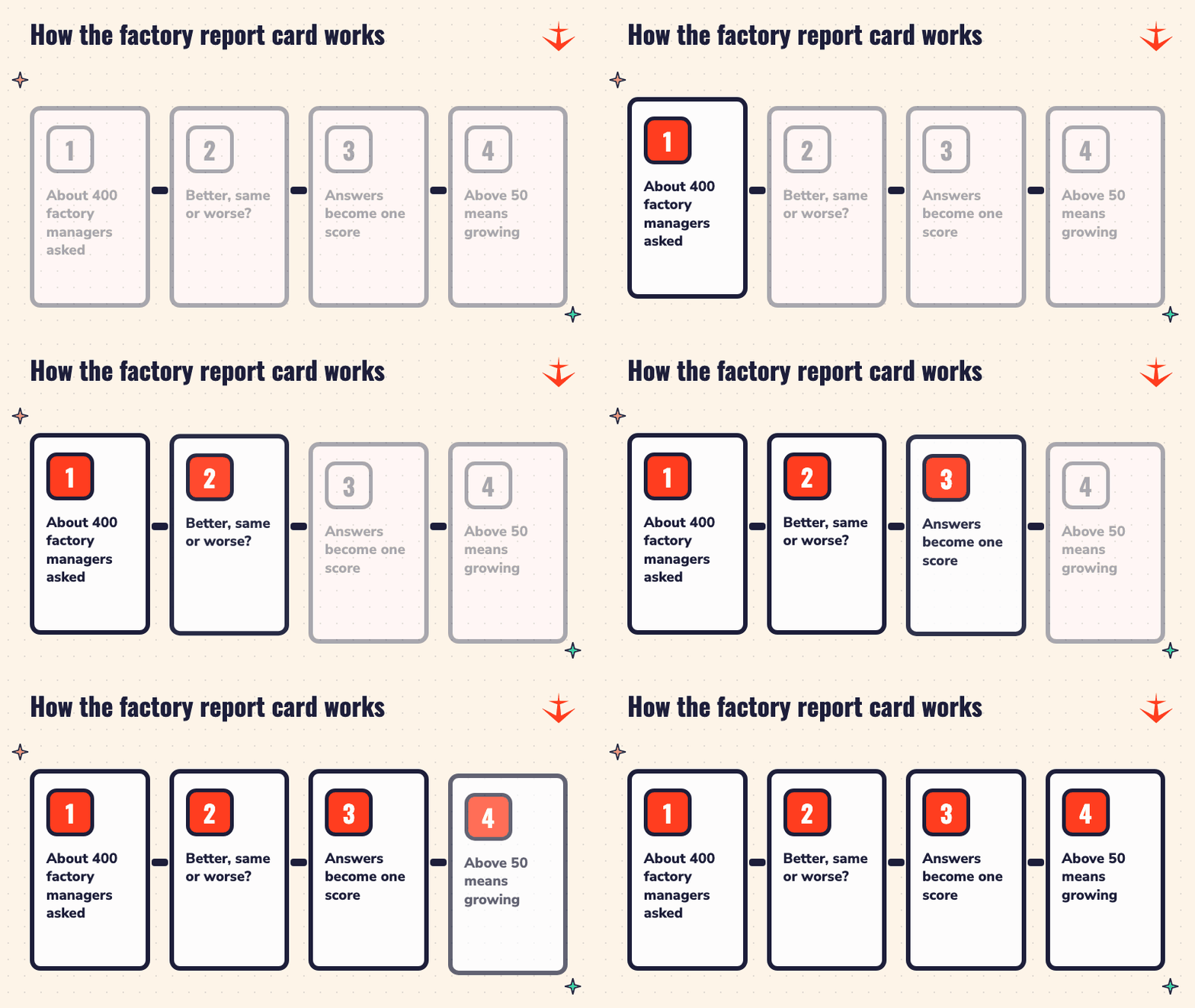
India's factory PMI is put together by S&P Global, a data company. It sends questions to purchasing managers at a panel of about 400 manufacturers, chosen by sector and by company size. The managers answer simple questions. Did you get more orders than last month, the same, or fewer? Did you hire more people? Did you pay more for materials?
Why is 50 the magic number?
The answers are turned into one number between 0 and 100. If every manager said things got better, the score would be 100. If every manager said things got worse, it would be 0. If everyone said nothing changed, it would be exactly 50, Wikipedia's page on the index explains. So 50 is the line between growing and shrinking.
It works like a cricket team's net run rate. Above zero, the team is doing well. Below zero, it is in trouble. For the PMI, the line is 50, and readings above 50.0 mean growth, The Economic Times reported.
India's score of 54.7 is well above that line. A first quick reading, called the flash estimate, had put October at 54.9. The final number came in slightly lower at 54.7, Trading Economics noted.
The big good news: orders from abroad
The brightest part of the report was export orders. These are orders from buyers in other countries. New export orders rose at their fastest pace in six months. Factories said the orders came from a broad range of places, including Bangladesh, Canada, Indonesia, Nepal, Oman, Saudi Arabia, Sri Lanka, the UK, the US and the UAE, Business Standard reported.
Pranjul Bhandari, chief India economist at the bank that sponsors the survey, said: "Strong international demand pushed growth of new export orders to a six-month high, supporting a robust rise in output." Output means the total amount of goods the factories made.
Why should a young reader care? Think of a samosa stall that sells to people on its own street and also gets orders from offices across town. If the street gets quiet, the office orders keep the stove busy. In October, orders at home slowed a little, but orders from abroad picked up, and Bhandari said this helped output keep rising.
Orders at home slowed a little
Orders from inside India did not grow as fast as in September. New orders eased from September's seven-month high, Business Standard reported, though they still grew sharply. Firms said they won business thanks to good demand, new clients and marketing campaigns.
Output also grew more slowly than in September. Business Standard said the slowdown came mainly from makers of intermediate goods. These are goods that go into other goods, like the thread that becomes cloth, or the chips that go into a phone.
Good news for prices
Here is a part that touches everyone's pocket money. Input cost inflation, which means how fast the prices of raw materials rise for factories, fell to its lowest since February, The Economic Times reported. Some materials and energy did cost more, but the overall rise was smaller.
Factories also raised their own selling prices only slightly. This was the weakest rise in nearly four years. That is good for buyers, because things made in factories, from biscuits to bicycles, do not get costlier as fast. This also means factories cannot easily charge more, which The Economic Times said points to limited pricing power.
What about factory work?
Factory employment grew for a second month in a row. But the pace of hiring slowed from September, and makers of capital goods cut staff, The Economic Times reported. Capital goods are the big machines and tools that other businesses buy to make things, like a lathe or a crane.
So more orders did not turn into a hiring rush in October. Mint reported that the rise in factory employment was only slight.
Shelves full, shopping slow
There was one odd pattern. Factories filled their warehouses with finished goods at a record pace in the survey's more than 21 year history, The Economic Times reported. Firms said they did this to meet strong demand and to avoid running out. Stocks of raw materials also rose at the fastest pace in eight months.
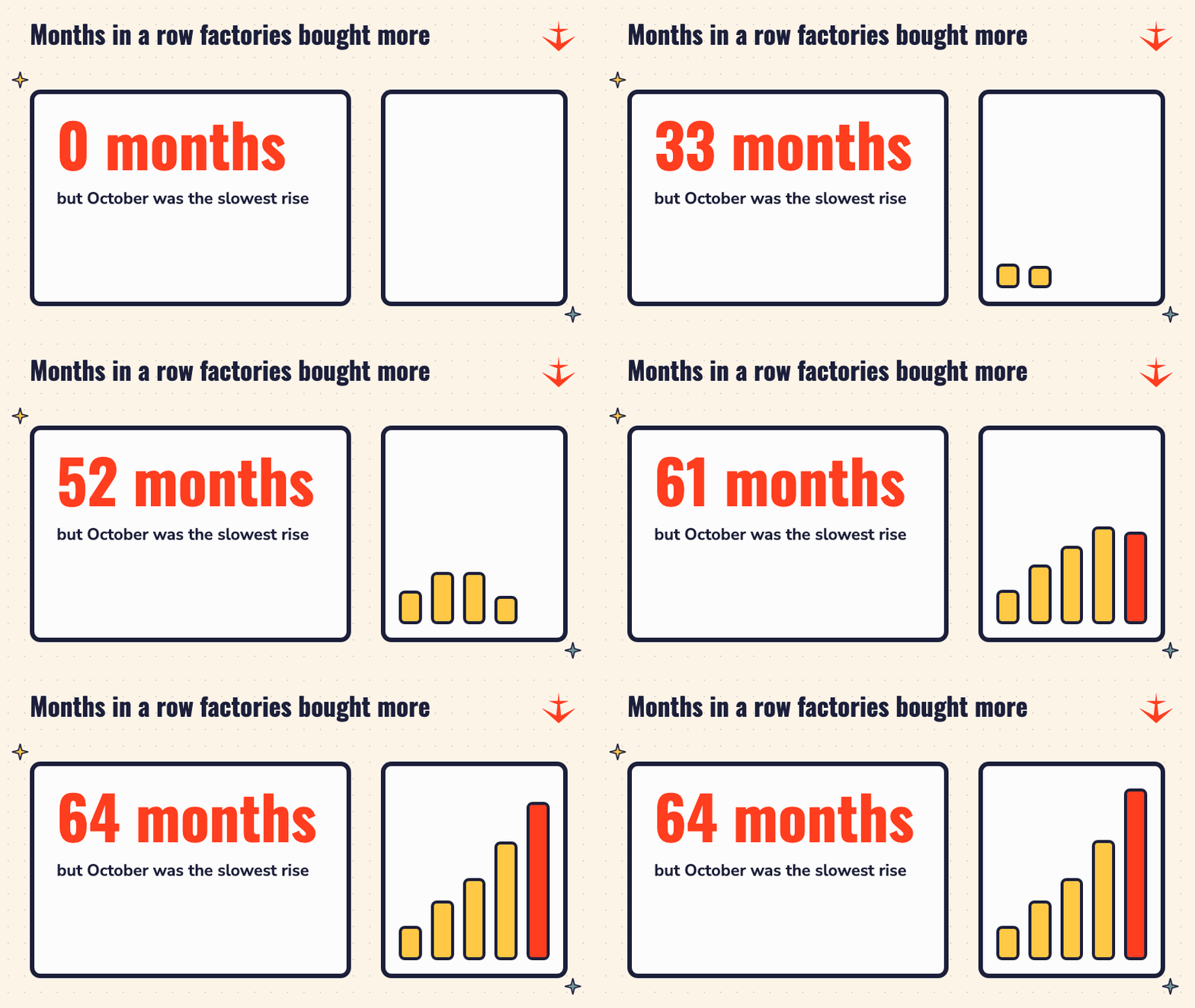
At the same time, growth in buying fresh raw materials slowed to its weakest in the 64 month run of growth. This run began in July 2021. It is like a shopkeeper stocking up on chips packets before a festival, while placing smaller new orders with the wholesaler. The Economic Times said firms may be guarding against a less certain future rather than gearing up for much bigger sales.
Are factory owners hopeful?
A little less than before. Business confidence dipped from September and stayed below its long-run average. Close to 18% of manufacturers expected higher output over the coming year, while the rest expected no change, Mint reported. Hopes rested on new client enquiries and demand for factory automation and technology.
What this means for exporters
For export firms, October's report gives three clear signals. Buyers abroad are placing more orders. Raw material prices are rising more slowly, which helps keep costs in check. And factories are holding more stock to avoid running out. The weak spots are slow hiring and softer confidence about the year ahead.
This video explains how the Purchasing Managers' Index works and why people watch it every month.
Sources
- Business Standard: Manufacturing PMI eases to 54.7 in October despite strong export demand
- Business Standard: Manufacturing PMI dips in October as output, orders see slow growth
- The Economic Times: India factory growth slows in October, export orders jump
- Mint: India's manufacturing growth in October, new export orders
- Trading Economics: India manufacturing growth revised down in October
- Trading Economics: India manufacturing growth slightly eases (flash estimate)
- Wikipedia: Purchasing Managers' Index
- Cover photo: Container handling on the JNPT Port, by Ccmarathe, CC BY-SA 4.0
