Indian Bank raises rates on two special FDs by 15 basis points
Version 1 of 1 saved 23 Oct 2026, 8:34 am IST · Chain line 161
As it was first published
Indian Bank raises rates on two special FDs by 15 basis points
From 23 October, the 555-day Ind Grow FD pays 6.80% and the 777-day Ind Prosper FD pays 6.75%, weeks after the RBI raised its repo rate.
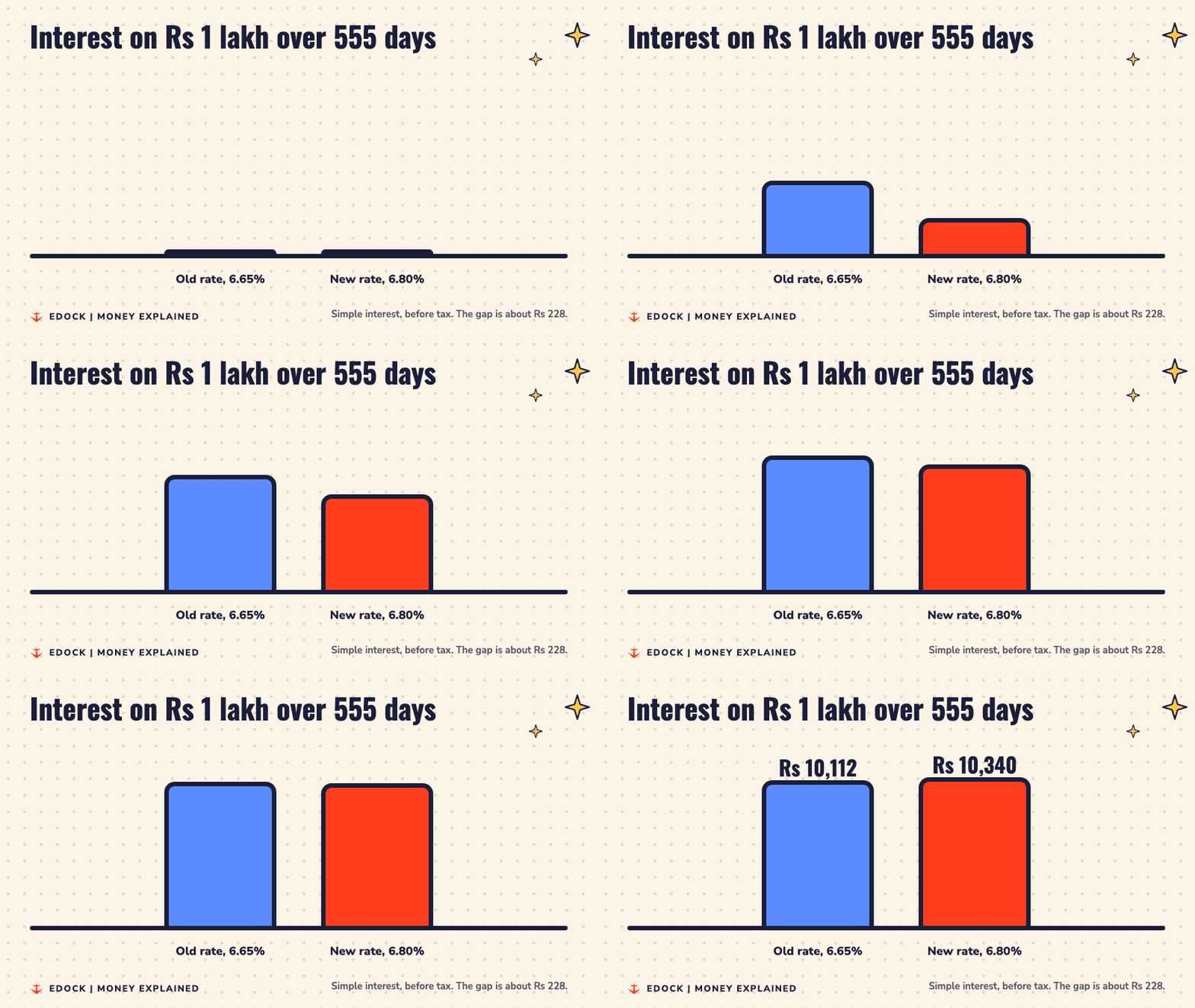
Picture two friends who each lock away Rs 1 lakh in the same bank, for the same 555 days. One signs up on Thursday. The other signs up on Friday. The Friday saver walks away with about Rs 228 more. Nothing else is different. Only the date.
That is what a small rate change can do. On Thursday, 22 October 2026, state-owned lender Indian Bank raised the interest rates on two special fixed deposit schemes by 15 basis points each, with the new rates starting on 23 October. Here is what that means, in plain words.
First, what is a fixed deposit?
A fixed deposit, or FD, is like lending your money to the bank for a fixed time. Think of lending a friend Rs 1,000 and agreeing that they will return Rs 1,070 after a year. The extra Rs 70 is your reward for waiting. In an FD, that reward is called interest, and the bank promises the rate on the day you open it.
The bank does not keep your money in a locker. It lends that money to other people and businesses, for homes, bikes and shops, and charges them a higher rate. The gap between what it pays you and what it earns from borrowers keeps the bank running.
What exactly changed?
The change covers two special schemes with odd-looking time periods. These are called tenures, which just means how long the money stays locked.
- Ind Grow (555 days): the rate went up to 6.80% from 6.65%. 555 days is a little over a year and a half.
- Ind Prosper (777 days): the rate went up to 6.75% from 6.60%. 777 days is a bit more than two years.
The new rates apply to deposits made on or after 23 October 2026. Money already sitting in these FDs keeps the rate it was promised on its opening day.

What is a basis point, and why not just say percent?
A basis point is one hundredth of one percent. So 100 basis points make 1%, and 15 basis points make 0.15%. Bankers use this tiny unit because rates often move by very small steps, and "0.15 percentage points" is a mouthful.
Think of it like cricket. A batter's strike rate going from 130 to 131 sounds tiny. But over a whole season of balls, it adds up. Interest works the same way: a small rise, applied to a big amount over a long time, becomes real money.
Show me the money
Start simple. Rs 10,000 kept for one year at 6.65% earns Rs 665 in simple interest. At 6.80%, it earns Rs 680. That is Rs 15 more, about the price of one cutting chai and a biscuit.
Now take a bigger amount for the full tenure. For Rs 1 lakh in Ind Grow, the higher rate earns roughly Rs 228 more over the 555 days. With simple interest, the old rate gives about Rs 10,112 and the new rate about Rs 10,340. For Rs 1 lakh in Ind Prosper, the gain over 777 days is about Rs 320.
Zee Business also worked out a bigger case. Rs 5 lakh in Ind Grow for the full 555 days could earn about Rs 51,800 at the new rate, against about Rs 50,600 at the old one. The exact amount depends on how the bank adds up interest and whether it is paid out monthly or at the end.
Who can open these deposits?
According to Zee Business, the main rules look like this:
- The smallest deposit is Rs 1,000.
- Deposits of Rs 3 crore and above are not eligible.
- Senior citizens get an extra 0.50% a year, and super senior citizens get an extra 0.75%.
- That extra rate does not apply to Non-Resident Indians with NRE or NRO accounts.
- If the scheme is stopped later, a maturing deposit is renewed for one year at the same rate, unless the customer tells the bank otherwise.
Why would a bank pay savers more?
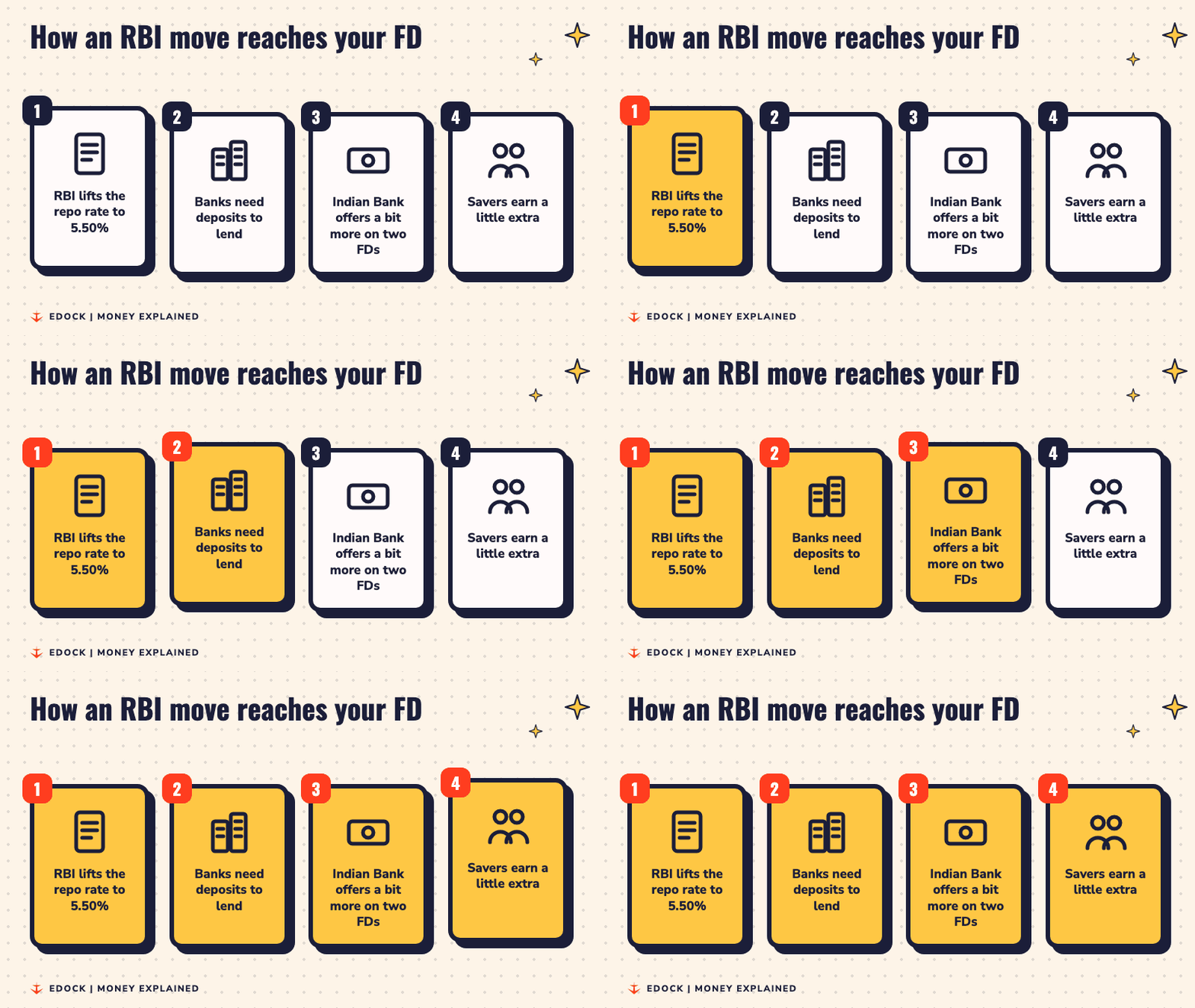
The story starts with the Reserve Bank of India, the RBI, which is the bank for all banks. Earlier this month, it raised the repo rate by 25 basis points to 5.50%. The repo rate is the cost at which banks borrow money from the RBI. Think of it as the wholesale price of money. When the wholesale price of tomatoes goes up, the sabzi seller's prices move too.
This was the first rate hike since February 2023. The RBI had kept the rate at 5.25% in August. Higher crude oil prices and pressure on the rupee were among the reasons given, and the RBI wants inflation, the slow rise in prices, near its target of 4%.
Indian Bank was the first major lender to raise deposit rates within 15 days of the RBI's move. Its managing director, Binod Kumar, said the bank does not have spare cash lying around. It had let go of Rs 10,000 crore of bulk deposits (very large deposits, usually from companies) and slowed down collecting term deposits in the July to September quarter.
That is the key point. A bank is like a samosa stall. Deposits are its potatoes. If it wants to keep making loans, it needs a steady supply of deposits. Offering a slightly better rate is one way to pull in more savers.
Is the whole banking system short of money?
Not quite. The wider banking system has been flush with funds after record inflows into FCNR-B deposits. These are foreign currency deposits that Indians living abroad keep with Indian banks. So this move says more about Indian Bank's own needs than about every bank in the country.
The bigger picture
Rates on loans and deposits often move together. After a repo rate hike, banks may raise lending rates, which can mean higher EMIs, the monthly loan instalments, for people with floating-rate loans. On the other side, savers can see slightly better FD rates, as Indian Bank's customers just did.
For a student or a first-jobber with a small savings pot, the change on its own is small. But it is a neat lesson in how money flows: one decision by the RBI can, within weeks, change the number printed on an FD receipt at a bank branch near home.
Sources
- Business Standard: Indian Bank raises special term deposit rates from October 23
- Zee Business: Indian Bank special FD rates revised
- Angel One: RBI increases repo rate to 5.50%
- Indian Opinion: Indian Bank raises deposit rates on select schemes
- Cover photos: Stacks of Coins, by Kevin Schneider, CC0; Stack of coins, by Dori, CC0; General Post Office and Reserve Bank of India, Kolkata, by Vyacheslav Argenberg, CC BY 4.0


