India will pay up to half the cost of risky deepwater oil wells
New rules for the Rs 84,084 crore Samudra Manthan plan explain who gets money, how much per well, and when it comes back.

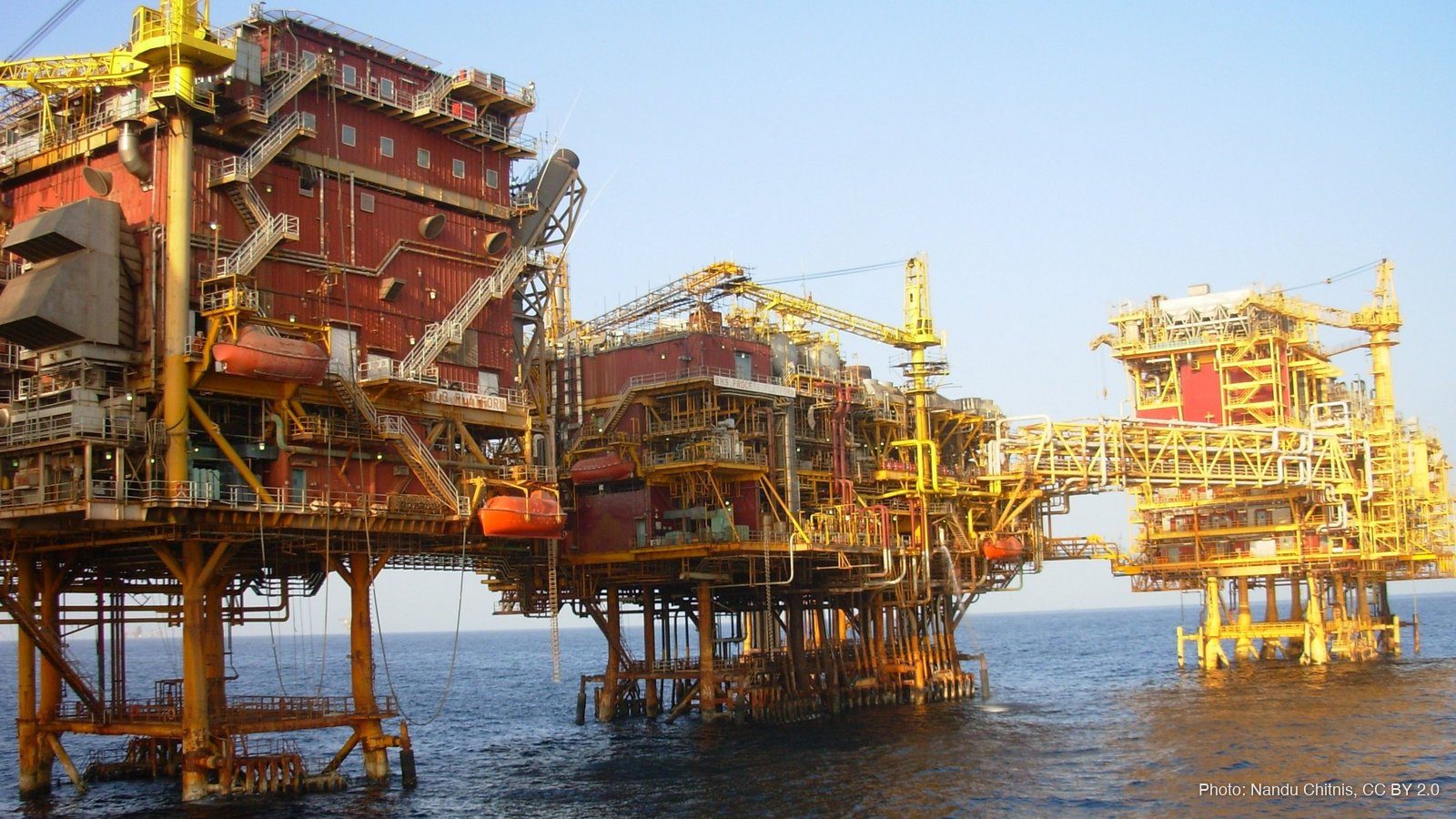
Picture drilling a hole more than 1.5 km under the sea, spending up to Rs 1,350 crore on that one hole, and still not knowing if you will find anything. That is the kind of gamble India wants more companies to take. On 23 October 2026, the oil ministry issued the rules for its Rs 84,084 crore "Samudra Manthan" plan, and the big promise is simple: the government will pay part of the bill.
Under these rules, the government will fund up to 50% of the cost of risky test wells in deep waters. If the well finds nothing, it does not ask for that money back.
First, what is this plan?
Samudra Manthan is also called the National Offshore Exploration Scheme. "Offshore" means out at sea, away from the coast. "Exploration" means searching for oil and gas that nobody has found yet, a bit like digging in a big garden for buried treasure without a map.
The Union Cabinet approved the plan with an outlay of Rs 84,084 crore to be spent up to the year 2030-31. An outlay is simply the total money set aside, like the full budget a family fixes for a wedding. The Cabinet cleared it on 31 July 2026, and the rules now explain how the money will actually flow.
The guidelines say the year 2026-27 is a getting ready year, and the main spending, called Phase I, runs from 2027-28 to 2030-31.
Why is deepwater drilling so scary for companies?
The rules define deepwater as sea deeper than 400 metres, and ultra deepwater as deeper than 1,500 metres. That is very deep, and that is only the water. The drill then has to go far into the rock below.
Think of it like digging a well in the middle of a huge lake from a boat. You need special ships, special machines and many skilled people for weeks. The cost is huge, and the rock under the sea may hold nothing at all. The Economic Times notes that high drilling costs and unsure rock conditions have held back investment in these areas.
Now imagine a chai stall owner who wants to try a new snack, but is scared it will flop. If a friend says, "I will pay half the cost of the trial batch, and if it fails, you owe me nothing," the owner is much more likely to try. That is the idea here. The government shares the risk so that oil companies are not scared to try.
How much money goes to each well?
The plan supports 60 wells in total. There are two kinds:
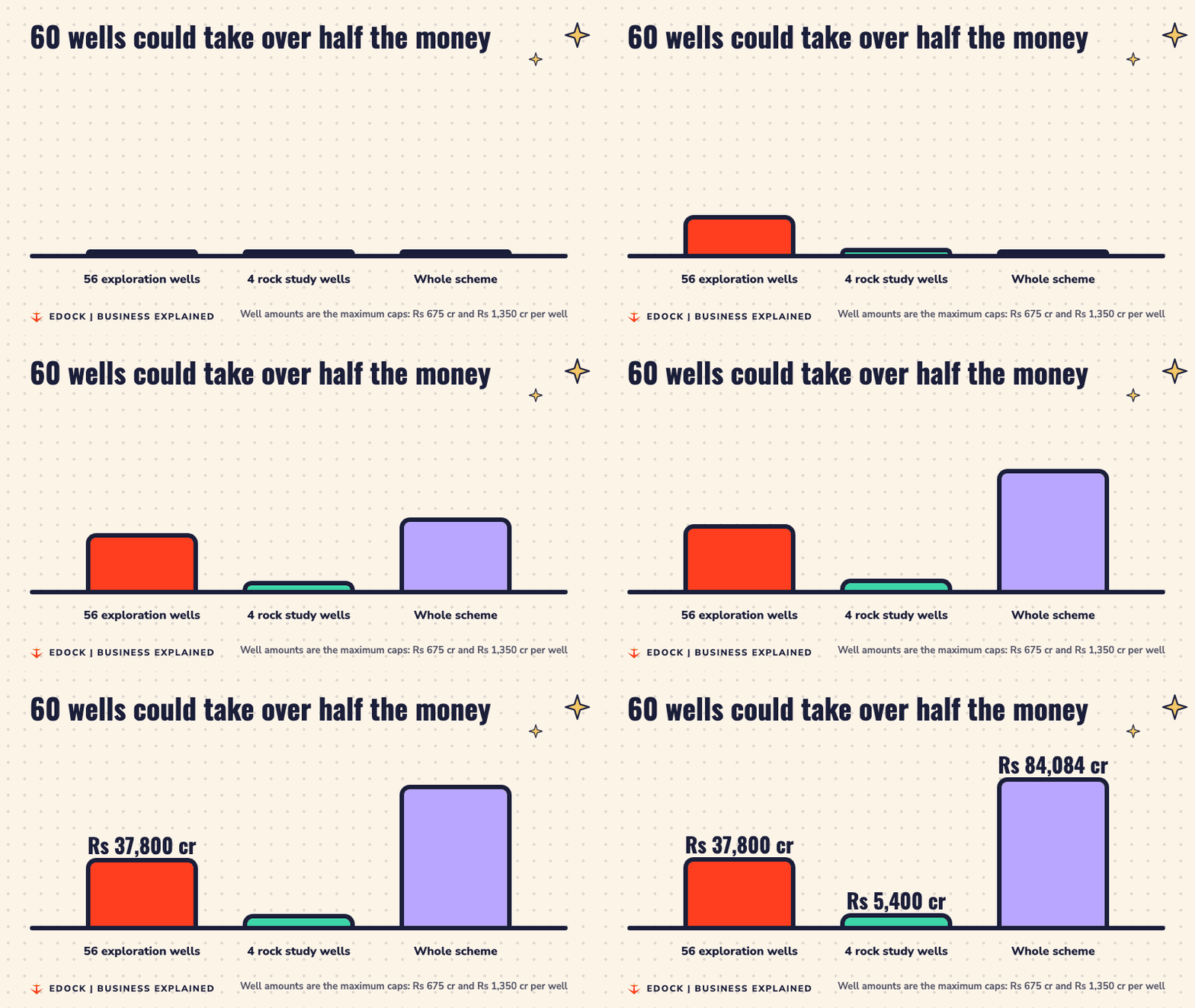
- 56 exploratory wells. These are test holes drilled to look for oil or gas. The government pays up to 50% of the real cost, with a limit of Rs 675 crore per well.
- 4 stratigraphic wells. These are drilled mainly to study the layers of rock under the sea, like cutting a slice of layered cake to see what is inside. The government pays up to 100% of the cost, with a limit of Rs 1,350 crore per well. Only state-owned companies, or groups led by them, can ask for this money.
Here is the maths. 56 wells at Rs 675 crore each is Rs 37,800 crore. 4 wells at Rs 1,350 crore each is Rs 5,400 crore. Together that is Rs 43,200 crore, which is more than half of the whole Rs 84,084 crore plan, if every well uses its full limit.
Costs above these limits stay with the company. There is no automatic top up if a well turns out costlier than planned.
How is the money paid, and when does it come back?
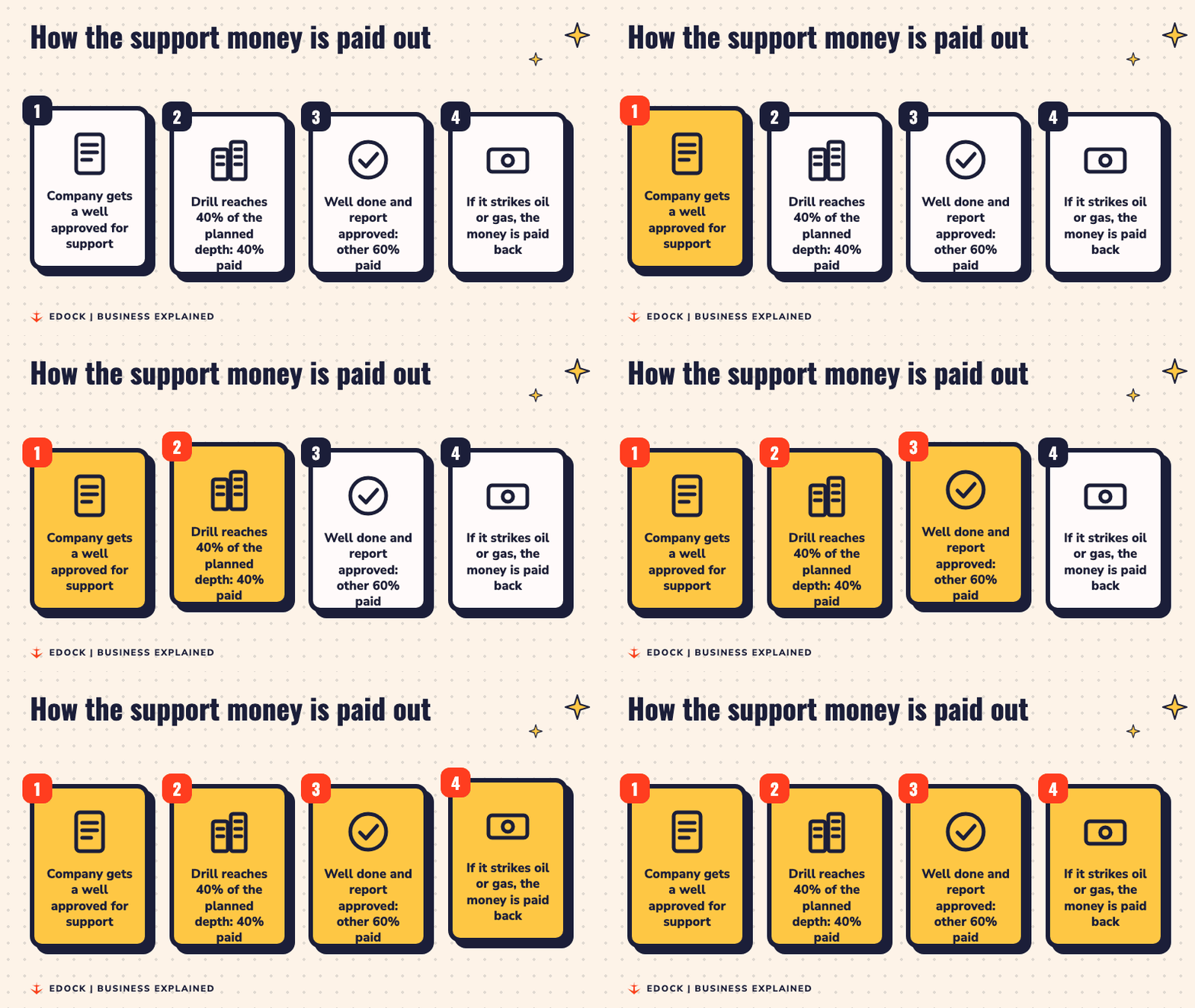
The money is not handed over in one go. It is linked to progress, like a parent who gives half the pocket money when the homework is half done:
- When drilling reaches 40% of the approved depth, the company gets 40% of the support.
- The other 60% comes after the well is finished and its report is approved.
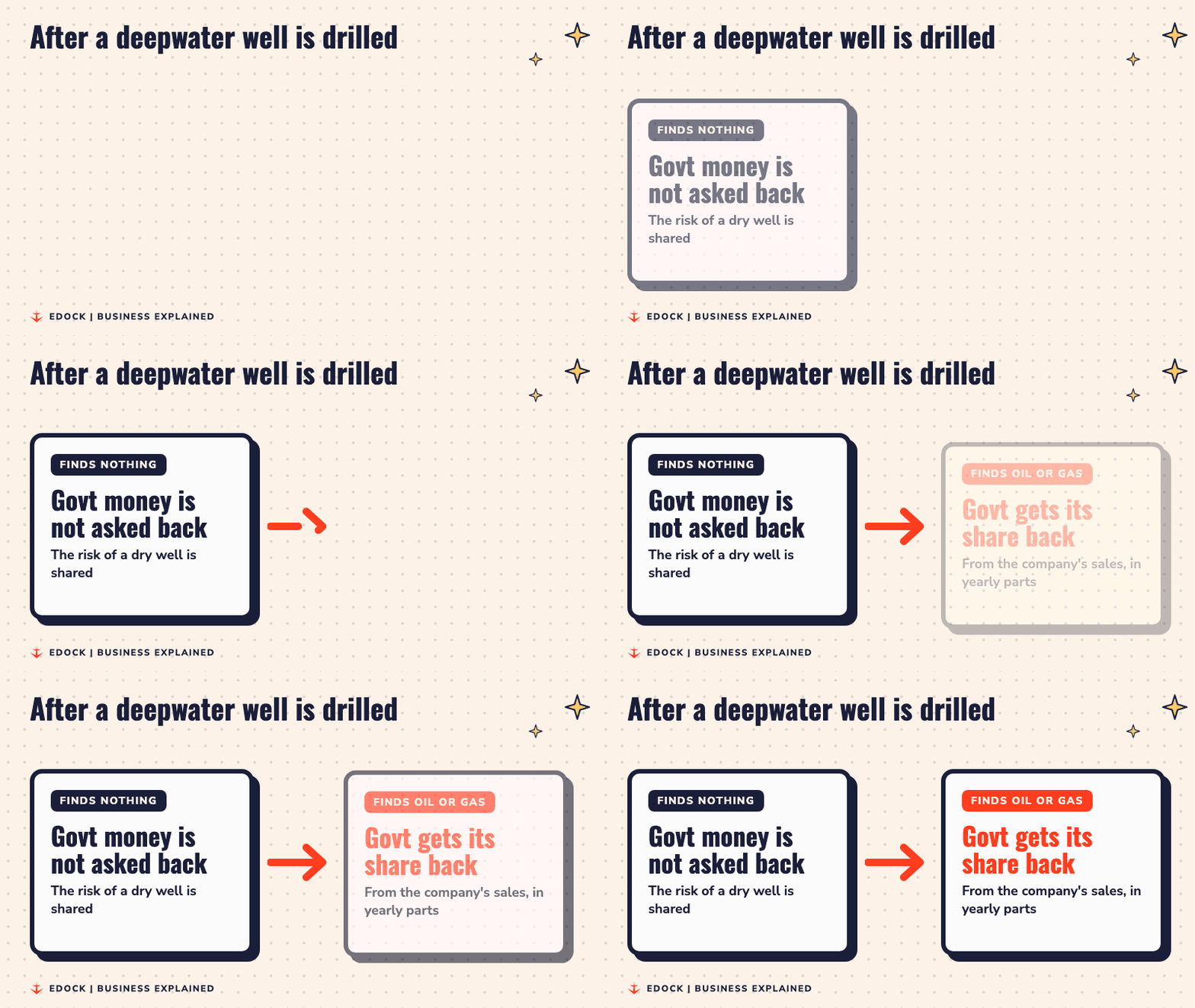
If the well finds oil or gas that can be sold, the government takes its money back. Recovery starts after seven years of selling, or once the company has earned back 50% of its own search and setup costs, whichever comes first. It is paid from the company's revenue (the money it earns from sales) in yearly parts. The amount is not raised for inflation, which is the slow rise in prices over time.
If a well is dry, the support for it is never taken back.
Which companies can use it?
Not every oil block qualifies. A block is a patch of sea a company has won the right to search. The scheme covers blocks given out under newer rounds, called OALP and DSF, including ones already awarded and future rounds. Older blocks given under earlier rules, called NELP and pre-NELP, and blocks handed out by nomination, are left out.
Not just wells: shared pipes and a services zone
Some small oil and gas finds sit unused because building pipes and platforms for each one costs too much. So the plan also offers viability gap funding. That is extra money to fill the gap when a useful project is not quite worth it on its own, like friends chipping in so a shared cab becomes cheaper than going alone.
This money can pay for shared items such as pipelines, central processing platforms and floating production units that join several small finds into one system. Support starts with the Mahanadi basin off Odisha, with token funding for Kutch in Gujarat. A third part of the plan funds one or more oil and gas manufacturing and services zones with shared testing and certification facilities.
Petroleum Secretary Neeraj Mittal, in the preface to the guidelines, said the plan could add "more than 600 million tonnes of oil equivalent" to India's reserves.
Why should a young Indian care?
India depends heavily on oil and gas bought from other countries. The scheme aims to cut this heavy reliance on imports. More oil and gas found at home could mean less money sent abroad for fuel, and more work in ships, engineering and factories that serve the sector.
The work has already started. State-run ONGC began drilling its first deepwater test well under the campaign on 25 July in the Mahanadi offshore basin, off the Odisha coast.
Same day, a gas find off Andhra
On the very day the rules came out, state-run Oil India said it had found natural gas in the Krishna-Godavari Basin, in shallow waters off India's east coast. The find is at a well called Godavari-1, at a depth of about 2,024 to 2,027 metres below the surface.
Testing began on 16 October 2026. Gas flowed at about 1 lakh standard cubic metres a day, with a top rate of 2 lakh during continuous testing. Oil India said the rock layer where gas was found, called the Matsyapuri formation, had not been checked for oil and gas before. This is a shallow water find, so it is not one of the deepwater wells in the new plan, but it shows the hunt under India's seas is very much on.
Whether the deepwater wells strike it rich is still unknown. That is the whole point of sharing the risk: nobody can see under the sea floor until someone drills.
Sources
- The Economic Times: Govt sets rules for Rs 84,084 crore offshore oil hunt
- The Economic Times: Govt to fund 50% of deepwater exploration costs
- PM India: Cabinet approves Samudra Manthan, the National Offshore Exploration Scheme
- Outlook Business: Cabinet approves Rs 84,084 crore for Samudra Manthan
- Business Standard: Oil India discovers natural gas in KG Basin's shallow offshore waters
- Cover photo: ONGC Oil Platform, Bombay High, by Nandu Chitnis, CC BY 2.0

You may republish this story under CC BY 4.0: credit Pranav Sharma and link to this page.