India's trade gap with China crosses $100 billion: what it means
Version 1 of 1 saved 17 Oct 2026, 11:43 pm IST · Chain line 80
As it was first published
India's trade gap with China crosses $100 billion: what it means
India bought $125.19 billion of goods from China and sold $19.26 billion from January to September 2026. Here is the gap, explained simply.
Picture a chai stall that buys Rs 650 worth of milk, sugar and tea leaves from one supplier, but sells that same supplier only Rs 100 worth of snacks. The stall keeps paying out far more than it gets back. That, in a much bigger form, is India's trade with China right now.
On Friday, 16 October 2026, Finance Minister Nirmala Sitharaman said China's trade barriers are the biggest hurdle in trade between the two countries. On the same day, China said it was ready to work with India on each other's trade concerns. Here is what the numbers say, explained simply.
First, what is a trade deficit?
When a country buys goods from another country, that is an import. When it sells goods to another country, that is an export. If a country imports more than it exports, the difference is called a trade deficit. People also call it a trade gap.
Think of pocket money. If a student spends Rs 500 at the canteen and earns only Rs 100 from selling old comics, the gap is Rs 400. That gap is the student's own trade deficit.
How big is the gap with China?
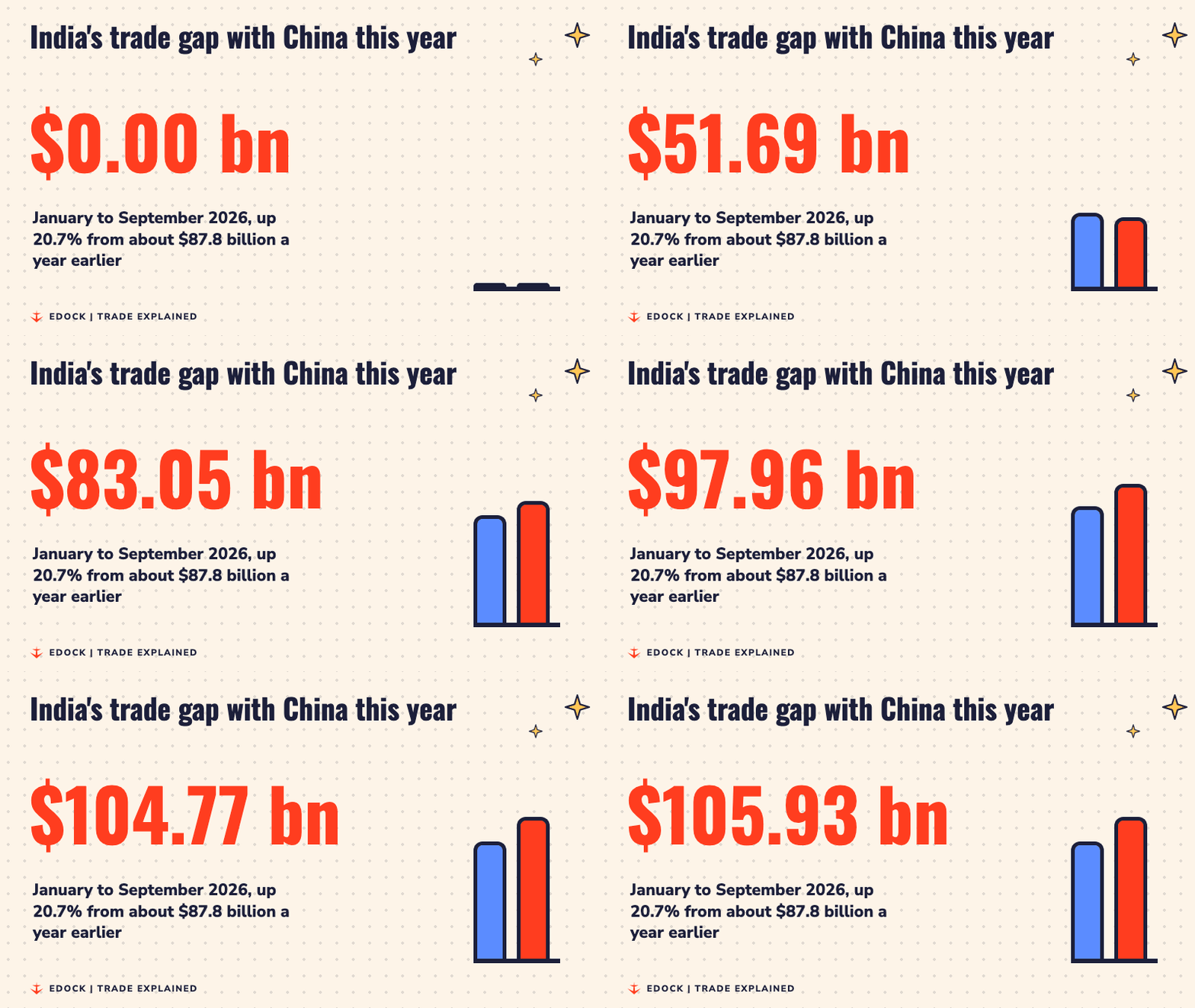
China's customs department released data for January to September 2026 on Wednesday, 14 October. It showed India's trade deficit with China at $105.93 billion, up 20.7% from the same period last year. That means the gap a year earlier was roughly $87.8 billion.
Here is how the gap is made:
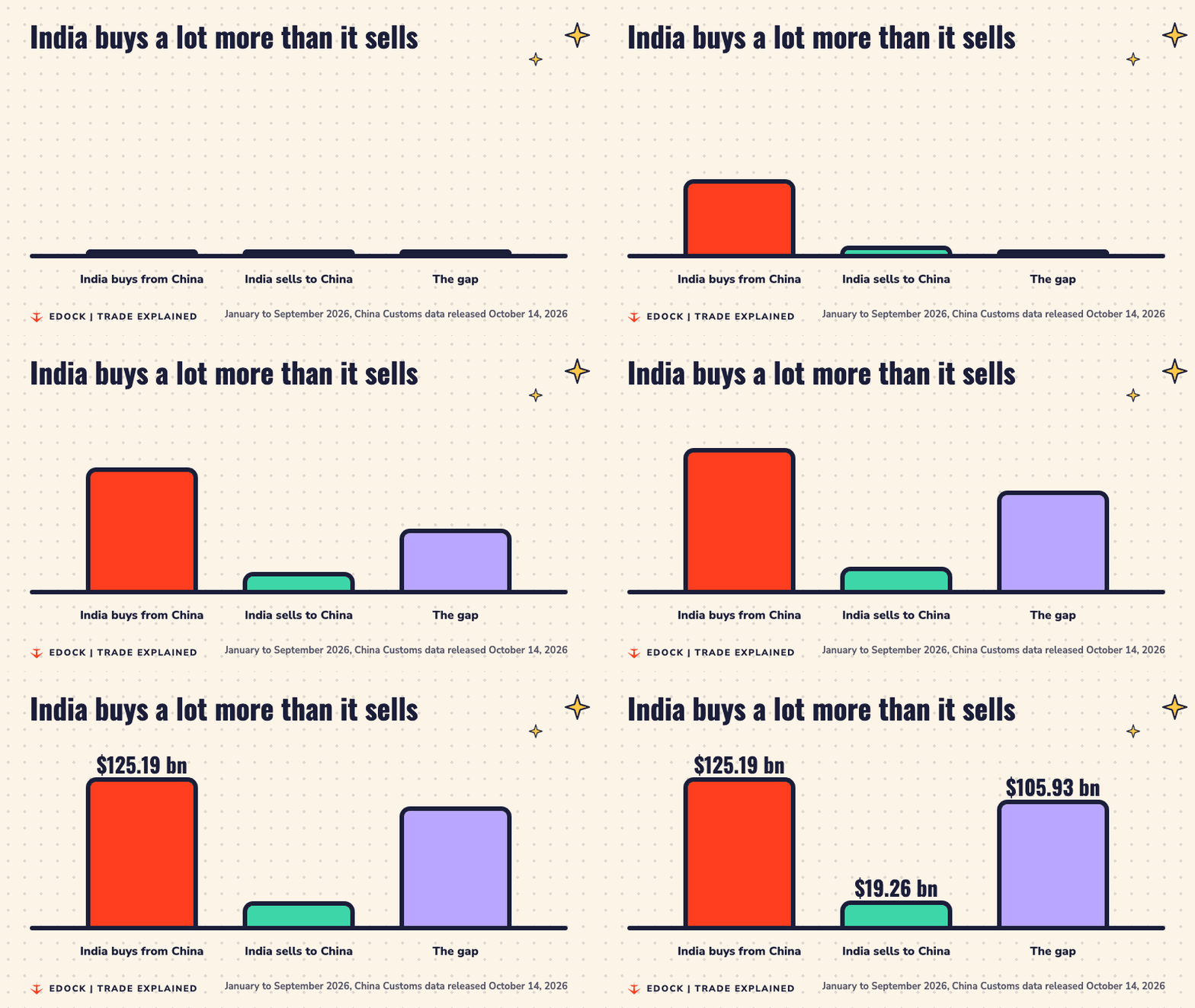
- China sold goods worth $125.19 billion to India, up 23.3%.
- India sold goods worth $19.26 billion to China, up 40.7%.
- Total trade between the two was $144.45 billion, up 25.4%.
Check the sum: $125.19 billion minus $19.26 billion is $105.93 billion. So for every $1 of goods India sold to China, it bought about $6.50 worth back. Spread over the 273 days from January to September, the gap works out to roughly $388 million every single day.
What does India buy from China?
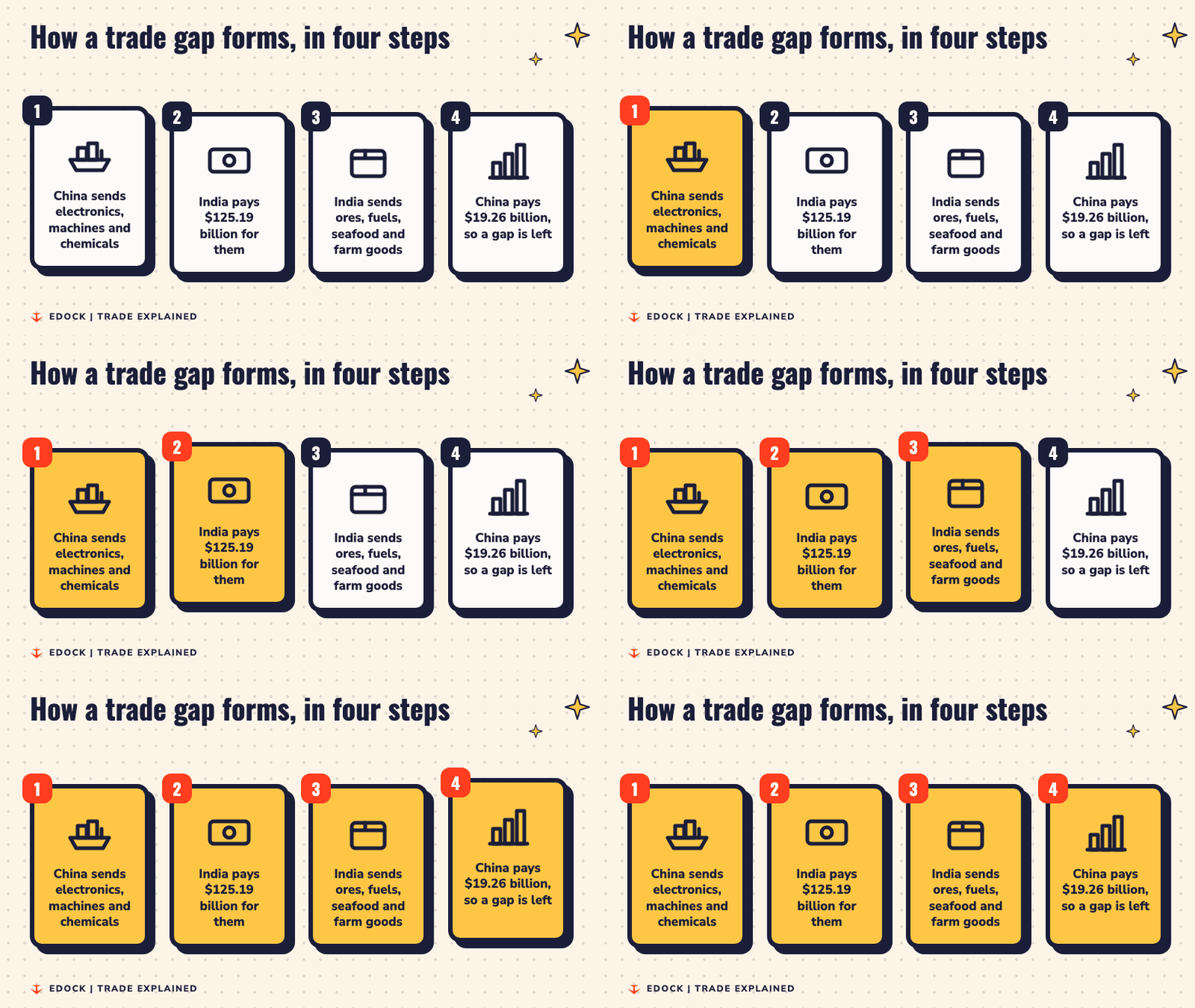
Mostly things that factories need. China's sales to India are led by electronics, heavy machinery and organic chemicals, which feed India's growing manufacturing.
And what does India sell to China?
Mostly raw materials. India's sales to China are largely mineral ores, refined fuels, seafood and farm products.
Here is why that matters. Raw items usually earn less than finished, high-tech goods. It is like selling mangoes to someone and buying back costly mango juice packs. Even if India sells a lot more mangoes, the bill for the juice stays bigger.
But India's sales to China are growing fast
That part is good news. India's own Commerce Ministry counts trade from April to March. In 2025 to 2026, India's exports to China rose over 36% to $19.47 billion, and total trade reached $151.1 billion, Commerce Secretary Rajesh Agrawal said. Imports from China in that year were $131.63 billion, up 16%. That leaves a gap of about $112 billion for the full year.
The push has continued. From April to August 2026, India's exports to China jumped 38.71% to $9.61 billion, from $6.93 billion a year earlier. Engineering goods, electronic goods, petroleum products, chemicals and iron ore drove most of that rise, according to the same Zee Business report.
The catch is simple maths. India's exports are growing faster in percentage terms, but they start from a much smaller number. A 40% jump on $19 billion is still far smaller, in dollars, than a 23% jump on $125 billion.
What did the Finance Minister say?
Speaking with the Atlantic Council on the sidelines of the IMF and World Bank meetings in Bangkok, Sitharaman said China uses non-tariff barriers and that these are the biggest hurdle in India China trade.
A tariff is a tax on goods entering a country. A non-tariff barrier is any other rule that makes selling harder, like extra paperwork, tough checks or approvals that take years. Imagine a cricket ground with no entry fee, but the gate stays locked unless you show ten different passes.
One example she gave was phytosanitary rules. These are rules meant to stop plant pests and diseases from spreading. She said Indian generic medicines, beef and vegetables face such barriers even though they have big potential in China. She also said India has not hit back with its own barriers or extra duties on Chinese goods.
What did China say?
Chinese Foreign Ministry spokesperson Mao Ning said at a media briefing that China never aims for a trade surplus. A trade surplus is the opposite of a deficit: selling more than you buy. She said China stands ready to work with India to address each other's economic and trade concerns in a balanced way.
Where does India want more access?
India has long asked China to open up to areas where India is strong, like IT, medicines and farm produce, with little success so far, The Economic Times reported. Agrawal named agriculture and marine products, pharmaceuticals, textiles, engineering goods and services as areas where Indian exports could grow.
The bigger picture matters too. In September 2026, India's imports rose sharply from China, Russia, Oman, South Korea and Hong Kong, and India's overall trade deficit with the world for April to September 2026 was $177.64 billion.
Watch: the numbers explained
The short version
- India bought $125.19 billion of goods from China and sold $19.26 billion from January to September 2026.
- The gap of $105.93 billion is 20.7% bigger than a year earlier.
- India's sales to China are growing fast, but from a small base.
- India says rules like plant safety checks keep its goods out. China says it is ready to work on both sides' concerns.
Sources
- The Economic Times: China's trade barriers biggest hurdle, says Sitharaman
- The Economic Times: India's trade deficit with China crosses USD 100 bn in first 9 months
- The Hindu: China says ready to address each other's concerns
- Financial Express: India's exports to China jump 40%, yet trade deficit widens
- Zee Business: India calls for greater market access as exports to China rise
- BusinessLine: India's September exports jump 23%
- Cover photo: Shipping containers stacked in Mogadishu port, by AMISOM Public Information, CC0