India's job ads fell just 5%. AI job ads grew 60%
A Bain report shows fewer job ads in most big countries, but India held up better and AI roles kept growing. Here is what it means for freshers.
Here is a number that sounds scary. Between April and June 2026, job ads in France fell by 40% compared with a year before. That is like a street with 10 "We are hiring" boards suddenly having only 6.
Now here is the surprise. In India, the drop was just 5%. On October 12, 2026, Indian news sites reported these numbers from a report by Bain & Company, a big consulting firm. The report is called Global Job Market Trends.
The report has good news and bad news for anyone looking for a first job. Let us go through it, one simple step at a time.
First, what is a job ad?
A job ad (grown ups call it a job posting) is a notice that says "We are hiring".
Bain has a tool called Aura that tracks job postings across online platforms. It counts how many ads are out there and what kind of work they are for.
Why count ads? Bain calls them a leading indicator. That means an early sign. Think of dark clouds before rain. Ads show where companies want people, before official job numbers come out.
But here is the catch. Job ads do not measure how many people actually have jobs, Bain says. They only show how many new people companies are looking for.
India did better than most
Bain looked at 10 big markets. It compared April to June 2026 with April to June 2025. Every one of the 10 had fewer job ads.
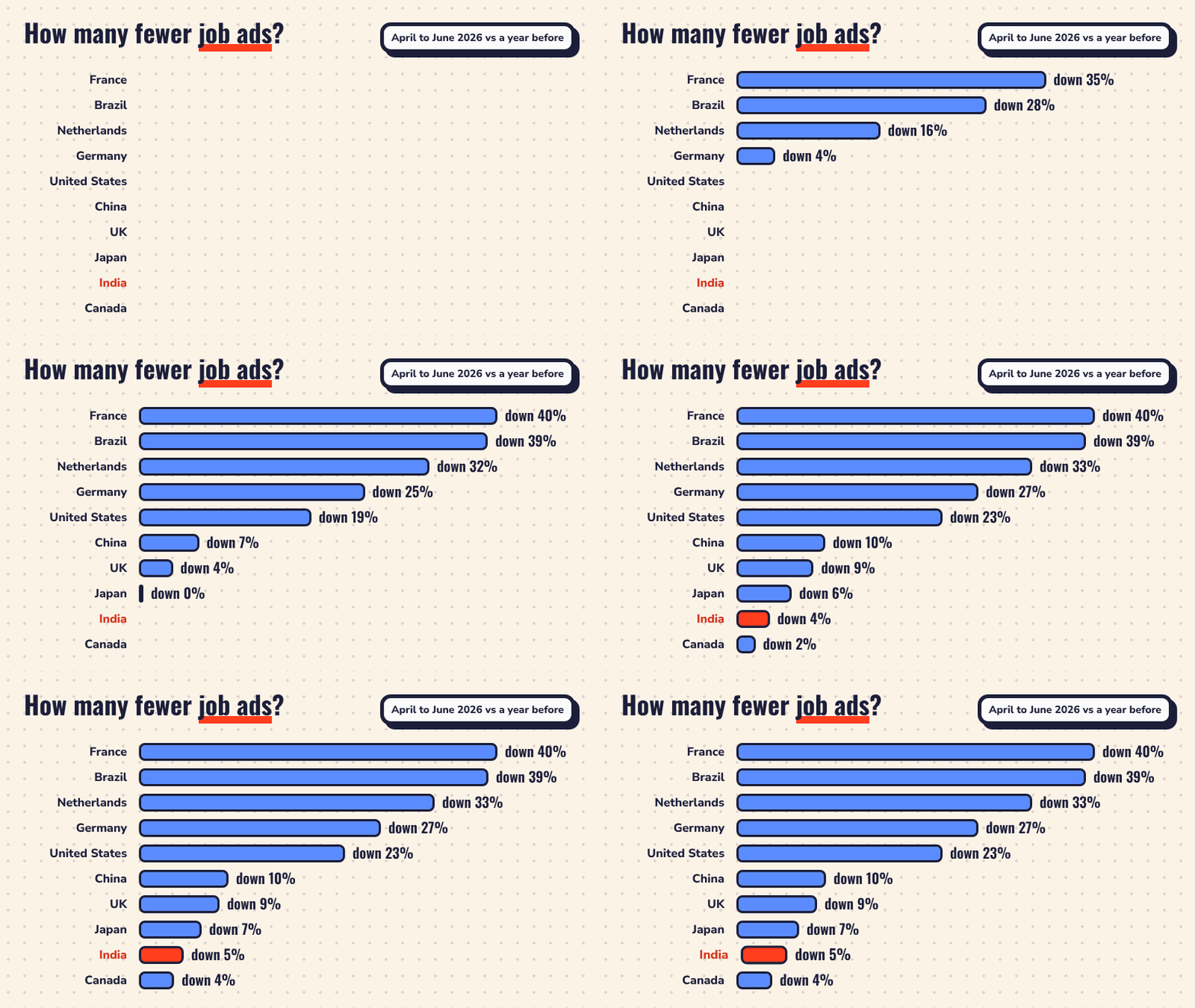
Here is the scoreboard, from the ANI report carried by Asianet Newsable:
- Biggest falls: France down 40%, Brazil down 39%, Netherlands down 33%.
- Middle: Germany down 27%, the United States down 23%.
- Smaller falls: China down 10%, the UK down 9%, Japan down 7%, India down 5%, Canada down 4%.
So India had the second smallest drop. Only Canada did a little better.
One small warning from Bain. Its tool only sees online ads. So it can miss jobs that are filled offline, like in farming, building work and household help. Bain also says that in India and Brazil, these numbers may not match other job surveys.
Which jobs saw fewer ads?
Bain also sorted ads by the kind of work. Most kinds of work had far fewer ads than a year before. According to Mint:
- Research, design and development: down 37%
- Sales: down 32%
- Marketing: down 32%
- Strategy and analytics: down 27%
- IT: down 25%
- Finance: down 24%
Engineering held up better, with ads down only 7%.
Some industries fell hard too. Bain says ads in hospitals and healthcare fell 28%, restaurants fell 27% and computer software fell 23%. Ads from staffing and recruiting firms, the companies that help others hire, fell only 5%.
But AI jobs are growing
Now for the good news. While most job ads went down, ads for AI-related jobs went up.
Between April and June 2026, there were roughly 351,000 AI-related job ads. That is 60% more than a year before, and 12% more than in the three months just before.
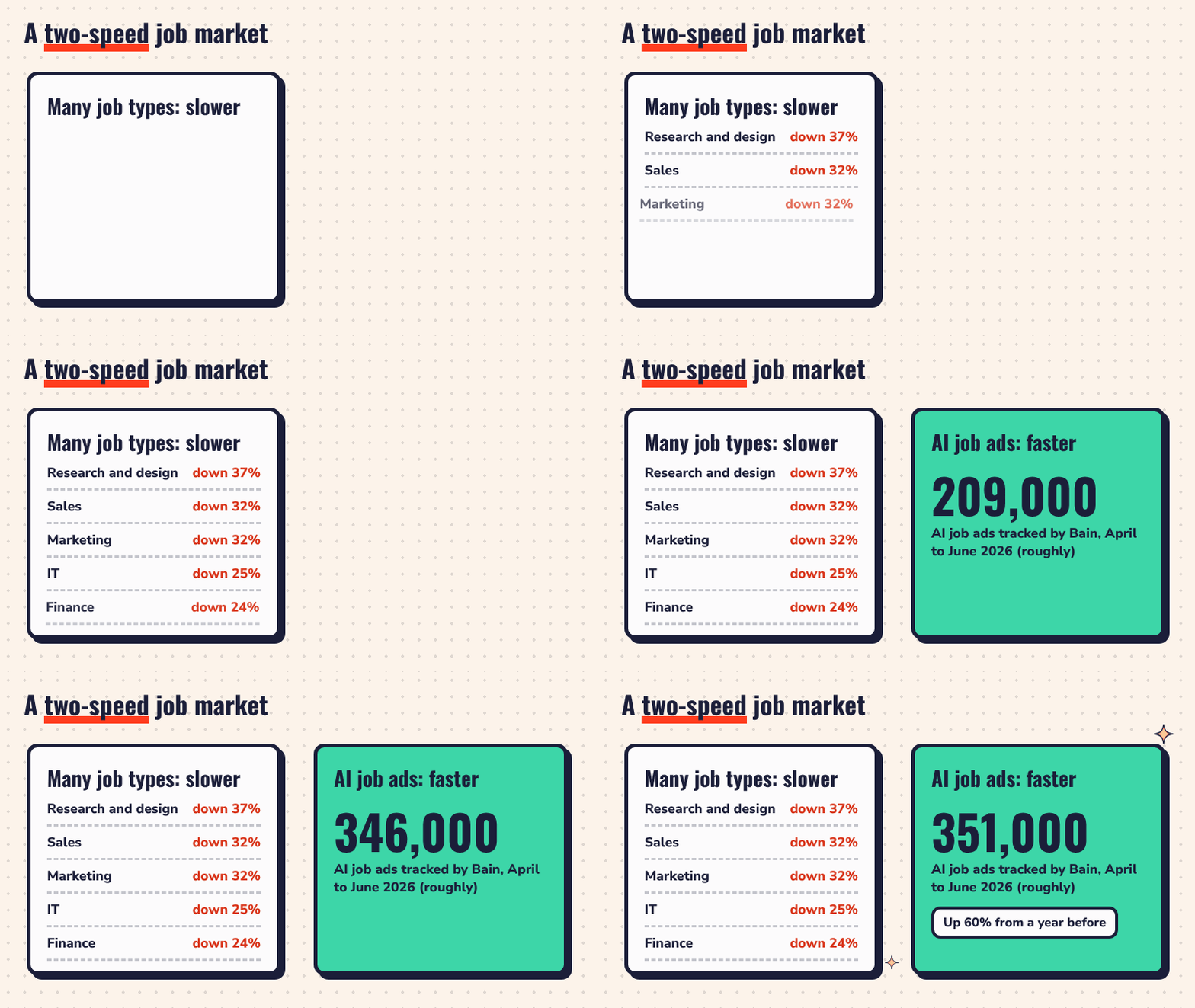
Bain calls this a "two-speed labor market". Picture a highway where most cars are slowing down, but one lane is speeding up.
Still, keep it in proportion. Bain says AI jobs are still a small part of all job ads, even if that part is bigger than a year ago.
A few other areas grew too, according to the same report:
- Venture capital and private equity (firms that invest in companies): up 47%
- Capital markets (where shares and bonds are bought and sold): up 26%
- Computer and network security (keeping computers safe from hackers): up 19%
- Defence and space: up 13%
What about first jobs?
This part matters most for students and freshers.
A junior job or entry-level job is the first rung on the ladder. It is the kind of job you get when you are just starting out.
Here is the surprising part. Junior jobs made up 95% of all job ads from April to June 2026. That is 95 out of every 100 ads.
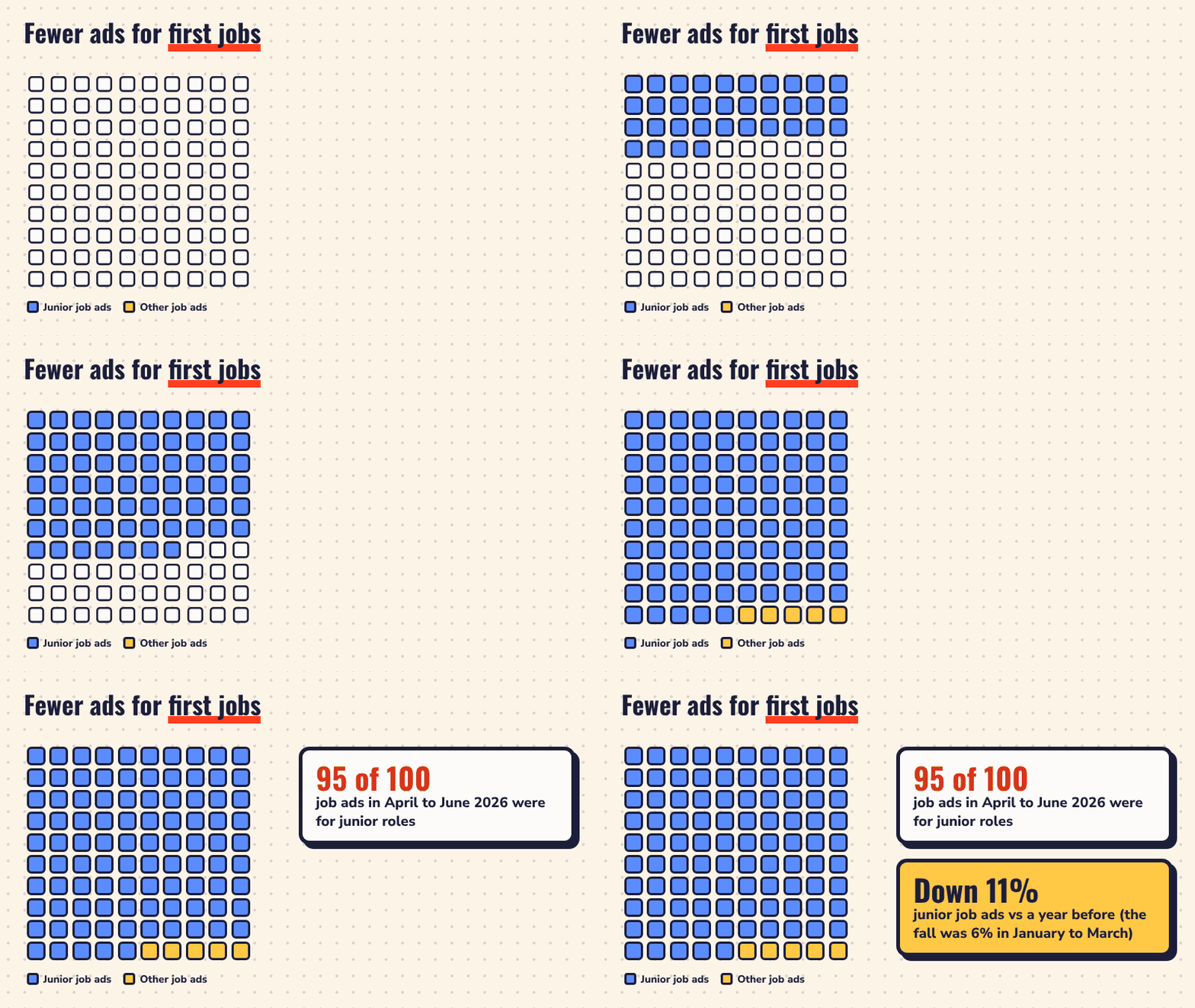
But those junior ads fell 11% compared with a year before. Think of it like this: if there were 100 junior ads last year, there were about 89 this year. And the fall is getting bigger. In January to March, the drop was 6%.
This CNBC Television clip looks at how AI is affecting young workers and entry-level jobs:
So what is the big picture?
Bain says companies are now hiring in a more careful way. Instead of hiring lots of people for general roles, many are hiring for specific skills that matter to them. Mint notes that the report says employers are directing hiring towards specialised skills.
Here is the quick recap:
- Job ads fell in all 10 big markets Bain tracked, from April to June 2026.
- India's fall was just 5%, the second smallest after Canada.
- Ads for most kinds of work, like sales, marketing and IT, fell by a lot.
- AI-related job ads grew 60%, to roughly 351,000.
- Junior jobs are 95% of all ads, but those ads fell 11%.
One last thing to remember: fewer ads does not mean no jobs. Bain itself says job ads do not measure how many people have work. They show where companies are looking, and right now some lanes are moving faster than others.
Sources
- Global Job Market Trends: What the Latest Bain Data Reveals Worldwide, Bain & Company
- India sees 5% drop in job postings in Q2: Bain & Company, Mint
- India's job market shows resilience amid global slowdown: Bain report, Asianet Newsable (ANI)
- Cover photo: Desktop with laptop and calculator, by an unknown author via Unsplash, CC0 1.0

You may republish this story under CC BY 4.0: credit Manpreet Kaur and link to this page.