India's GCCs could add up to 1.4 million roles by 2031, says a new report
Version 1 of 1 saved 23 Oct 2026, 2:29 pm IST · Chain line 176
As it was first published
India's GCCs could add up to 1.4 million roles by 2031, says a new report
Global Capability Centres may grow from 2.3 million people to as many as 3.7 million, with AI, data and cybersecurity skills in demand.
Picture a giant foreign bank or tech company. Its head office is in New York or London. But a big part of its brain, the people who build its apps, check its accounts and test its new ideas, sits in an office in Bengaluru or Hyderabad. Now picture up to 1.4 million more people joining offices like that by 2031.
That is the forecast in a new report covered by ETHRWorld on 23 October 2026. It says India's Global Capability Centres could add 1 million to 1.4 million roles by 2031. For students and people in their first roles, this is one of the biggest work stories of the year. Here is what it means, in simple words.
First, what is a GCC?
A Global Capability Centre, or GCC, is an office that a big foreign company runs in India for its own work. It is not an outside firm doing work for hire. It is the company's own team.
Think of a big school chain with branches in many cities. Instead of each branch making its own timetable and exam papers, the chain sets up one central team that does it for all of them. A GCC is like that central team, but for a global company, and it sits in India.
GCCs do tech work, finance work, research and more. Once, people saw them mostly as back offices. A Business Today report from May 2026 says they are now turning into command centres that handle AI, engineering, product building and cybersecurity for their parent companies.
How big are GCCs in India today?
Already very big. The same Business Today report, quoting a Nasscom and Zinnov study, says India is home to 2,117 GCCs that employ 2.36 million professionals. It also says the country added more than 500 new GCCs in the last five years, and that GCC revenues in India are around $98.4 billion in the year to March 2026.
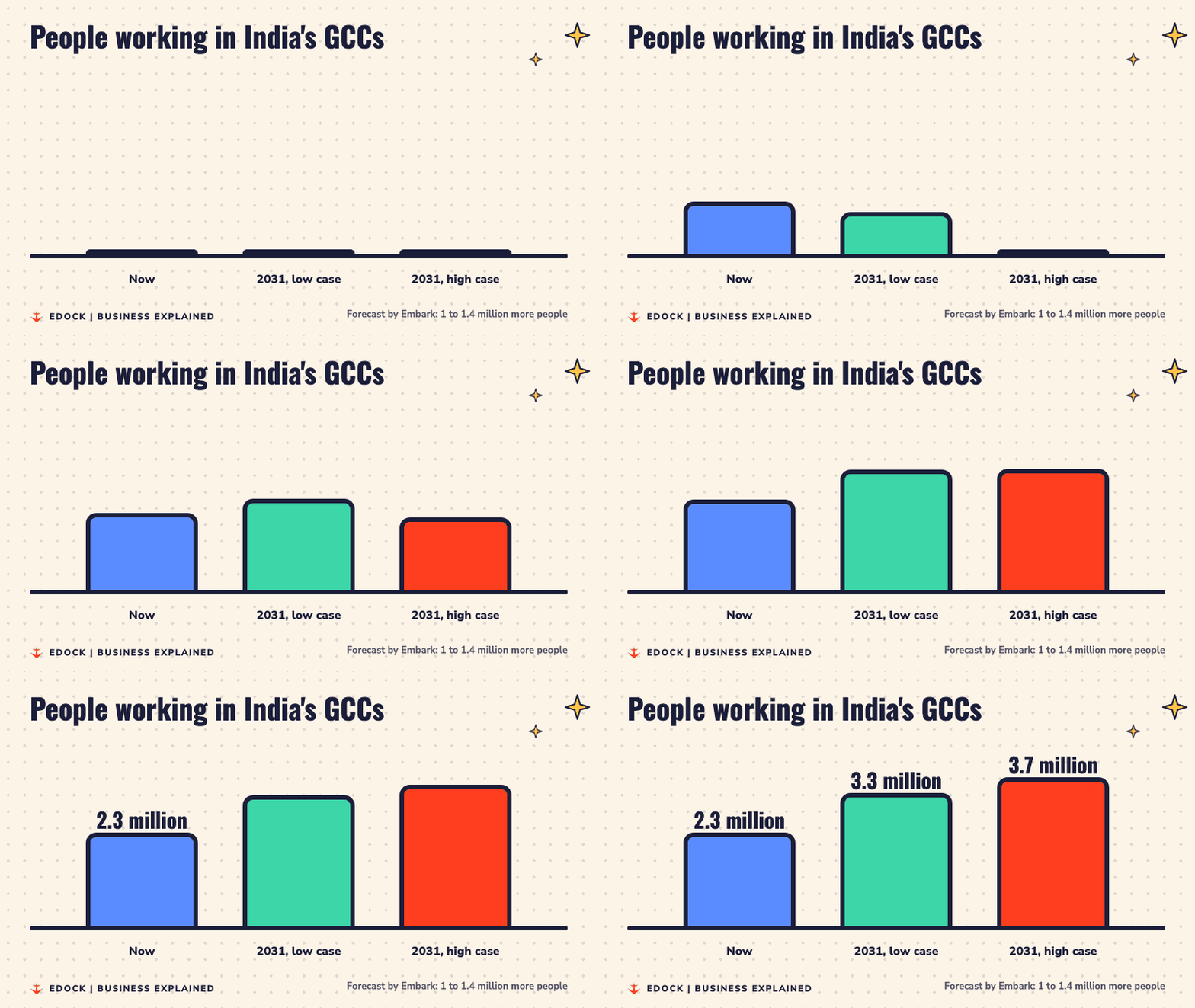
The new report starts from a similar number. It says about 2.3 million people work in India's GCCs now.
Who wrote the new report?
The report comes from Embark, a company set up in 2025 with the backing of the Embassy Group. Its business is helping global companies design, set up and run their India centres. So it works inside the same sector it is studying. That is worth keeping in mind: this is a forecast, which is a careful guess about the future, not a promise.
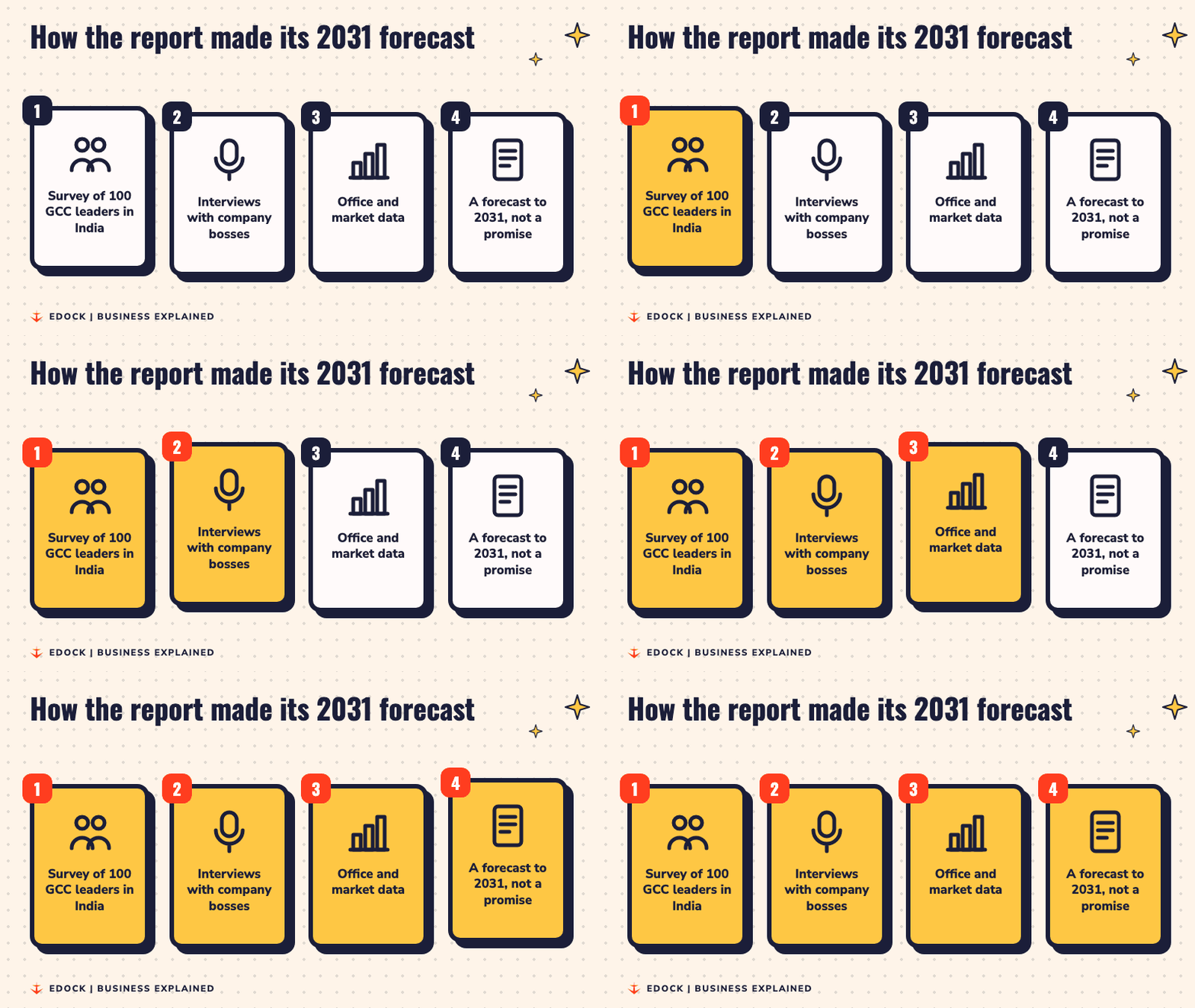
The report is called "India GCCs in the AI Era: Implications for Workforce Growth and Office Demand". According to ETHRWorld, it is based on a survey of 100 GCC leaders in India, interviews with company bosses and market data.
The big number, explained
The report says GCCs in India could have 3.3 million to 3.7 million people by 2031, up from about 2.3 million now. That is 1 million to 1.4 million more.
The word used is "net". Net means the final change after you add and subtract everything. Think of pocket money: if you get Rs 500 and spend Rs 200, your net gain is Rs 300.
Here is the report's maths, as ETHRWorld reports it:
- Added: existing GCCs doing more work and new GCCs opening could bring 1.2 million to 1.5 million roles.
- Added: brand new roles created because of AI could bring about 0.3 million more.
- Taken away: automation (software doing tasks people used to do), not refilling some empty seats, and merging similar roles could cut demand for routine roles by 0.4 million to 0.5 million.
Do the sum: 1.2 plus 0.3 minus 0.5 gives 1.0 million at the low end. 1.5 plus 0.3 minus 0.4 gives 1.4 million at the high end. That is where the range comes from.
The report expects existing GCCs to bring about 80 percent of the new roles. So most growth would come from centres already in India, not just brand new ones.
Which skills will be in demand?
The report says companies will want more people with special skills in AI, data, platform engineering, cybersecurity and solution architecture. It also lists governance (the rules for using tools safely) and system monitoring (watching systems so problems are caught early).
It estimates that India's pool of AI specialists could reach 0.8 million to 0.9 million people by 2031. Knowing one field deeply, like banking or retail, is also expected to matter more.
There is a twist. The report found that 92 percent of the leaders surveyed have moved beyond trying AI in small corners. But the real productivity gains they see are still below 15 percent. Productivity means how much work gets done in the same time. It is like buying a fancy new cricket bat: it only helps if you also change how you practise. The report says data, process changes, training and better ways to measure results are holding things back.
More GCCs could still come
According to the report, about 3,144 large global companies (from a list called the Global 5000) do not yet have a GCC in India. It says this could lead to 590 to 640 new centres by 2031.
Mid-sized companies could make up about 28 percent of these new centres. Some may start very small, with "Nano GCCs" of just 5 to 100 specialists, like opening a small chai counter before building a full cafe.

Which cities, and what about offices?
The report expects big cities to stay on top. About 90 percent of new GCCs could open in Tier 1 cities. Bengaluru and Hyderabad together take 67 percent of GCC office leasing (renting office space) among Tier 1 cities, ETHRWorld reports. Smaller cities could get targeted growth through a hub-and-spoke model, where a main office in a big city is linked to smaller offices elsewhere, like a main bus depot with smaller stops around it.
More people means more desks. The report says GCCs could need 150 million to 170 million extra square feet of office space by 2031. Offices may also look different: shared and team spaces could grow from 27 percent of office space now to 55 percent by 2031.
Banking, financial services and insurance, along with tech, media and telecom, make up about 54 percent of the extra office demand. Retail and consumer goods could be among the fastest growing, at 17 to 21 percent a year.
Embark's CEO and co-founder Aravind Maiya also talks about how India's GCCs have changed in this video from the company's own channel.
What this means for a student or first-jobber
The report does not promise any single person a role. It is one company's estimate. But it points to a clear pattern: routine tasks may shrink, while roles that need special skills in AI, data, security and deep knowledge of one industry may grow. Embark's Aravind Maiya told ETHRWorld that AI is turning GCCs from places that mainly deliver work into strategic centres.
For anyone choosing what to learn next, that is the useful part of the story: watch the skills list, not just the headline number.
