India's exports to New Zealand turn duty free on October 20 as exporters line up first shipments
Version 1 of 1 saved 17 Oct 2026, 9:37 am IST · Chain line 58
As it was first published
India's exports to New Zealand turn duty free on October 20 as exporters line up first shipments
The India New Zealand trade deal starts on Dussehra. Here is what a tariff is, who gains, and why young Indians should care.
Picture a toll booth on a highway that has charged every truck for years. Now picture it being taken down overnight. That is roughly what happens to Indian goods heading to New Zealand on 20 October 2026, the day the India New Zealand Free Trade Agreement comes into force.
On that day, New Zealand's import tax on all Indian goods drops to zero. The Commerce Ministry wants to show this off. As businessline reported on 16 October, it has asked industry bodies to find shipments that are ready to sail around that date, so the first ones can be waved off at a ceremony.
Wait, what is a free trade agreement?
When a product crosses a border, the country receiving it often charges a tax on it. This tax is called a tariff, or import duty. Say a shop in Auckland buys a Rs 1,000 shirt from India and New Zealand charges a 10% duty. The shop pays Rs 100 extra just to bring it in. That makes the shirt costlier for the final buyer.
A free trade agreement, or FTA, is a deal between two countries to cut or remove these taxes on each other's goods. Think of two neighbours agreeing not to charge each other for borrowing sugar. Both sides hope to sell more to each other.
India and New Zealand signed their FTA on 27 April 2026 at Bharat Mandapam in New Delhi. Commerce Minister Piyush Goyal and New Zealand's Trade Minister Todd McClay put their names on it. New Zealand's Parliament passed the law to make it work on 16 September 2026.
What changes on October 20?
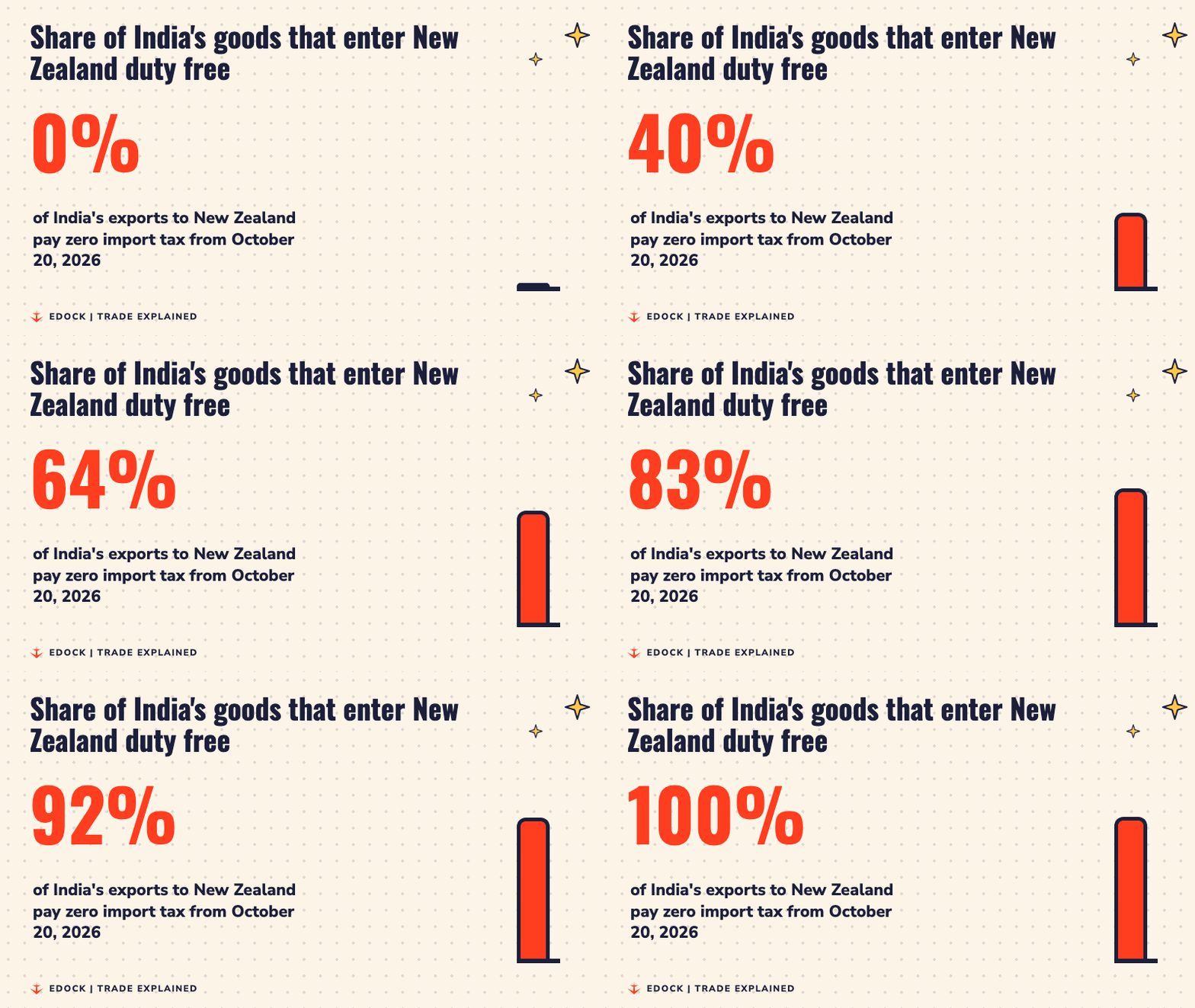
According to the government's own release, every single tariff line, covering 100% of India's exports to New Zealand, becomes duty free from day one. A tariff line is simply one product category in a country's tax list, like "cotton shirts" or "leather shoes".
The date was picked on purpose. Goyal said the government chose Dussehra, Vijay Dashmi, for the start. In his words from the release, the agreement "would provide fresh momentum to the bilateral partnership".
Who actually gains?
Here is a twist. New Zealand's import taxes were already low for most things. Its average applied tariff is about 1.9%. So for many products, nothing much changes.
The real gain is in goods where New Zealand charged more, between 5% and 10%. The ministry hopes to see gains in textiles, carpets, auto parts, leather, footwear, chemicals, engineering goods, ceramics, processed food, plastics, rubber and some electronics.
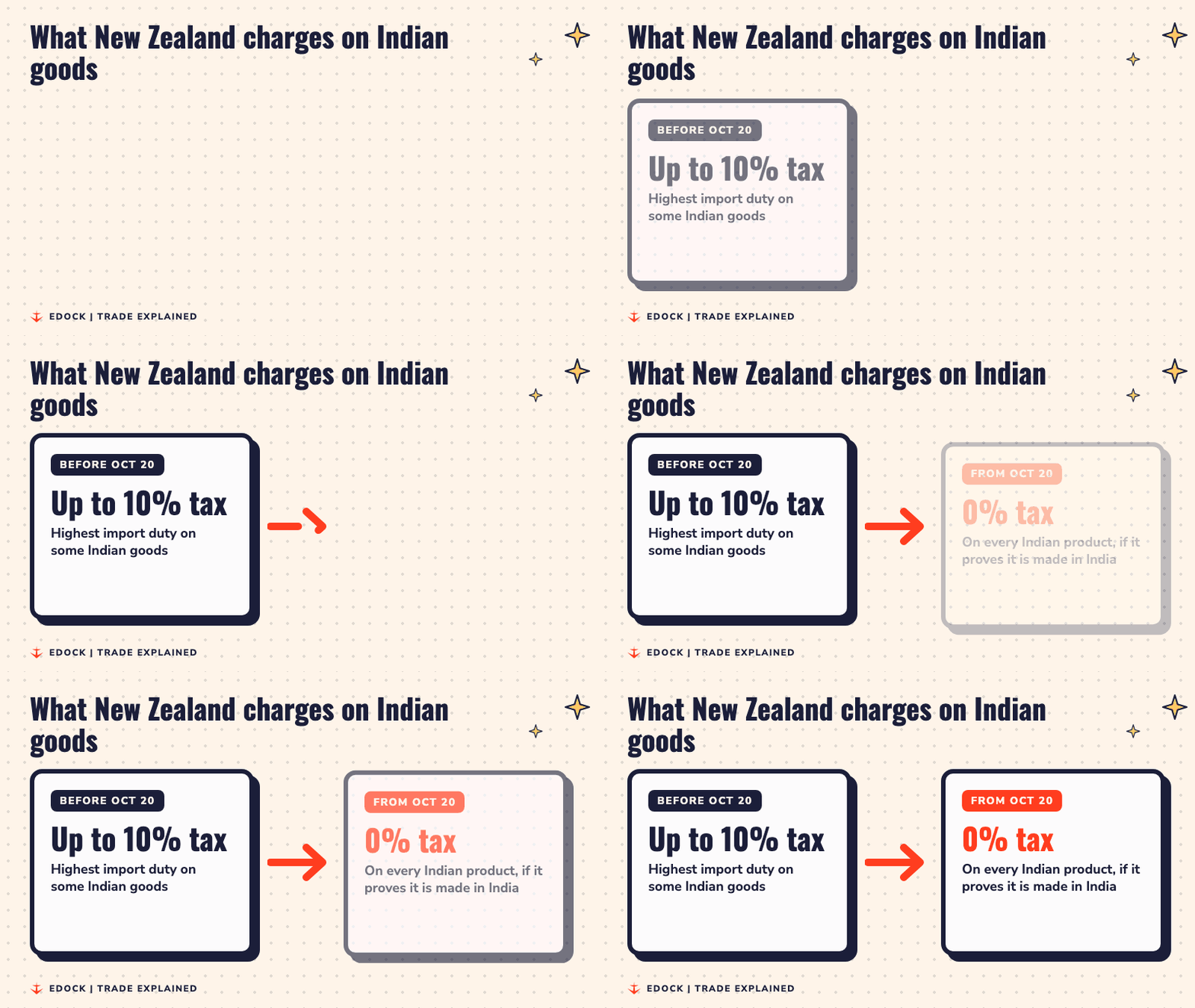
The government says New Zealand's peak tariffs of up to 10% go away for sectors like textiles and apparel, leather and footwear, gems and jewellery, engineering goods and processed foods. Back to the shirt: the Rs 100 extra charge disappears. That can help an Indian maker beat a rival from another country on price.
How big is this trade, really?
Not huge. In FY26, the financial year from April 2025 to March 2026, India sold New Zealand goods worth $566.51 million and bought goods worth $589.10 million. So India bought a little more than it sold, by about $22.6 million. Counting services too, like IT work and tourism, total trade was around $2.29 billion.
Compare that with India's bigger trading partners and New Zealand is a small corner shop next to a big mall. But both governments have a bigger plan. They want to double two-way trade in goods and services to NZ$7 billion, about Rs 35,000 crore, by 2030. New Zealand has also promised to help bring $20 billion of investment into India over 15 years.
An ET Government analysis says the deal is part of India's push to sell to many more countries, so it does not depend too much on a few big markets. Like a cricket team that does not rely on only one batter.
The catch: proving it is made in India
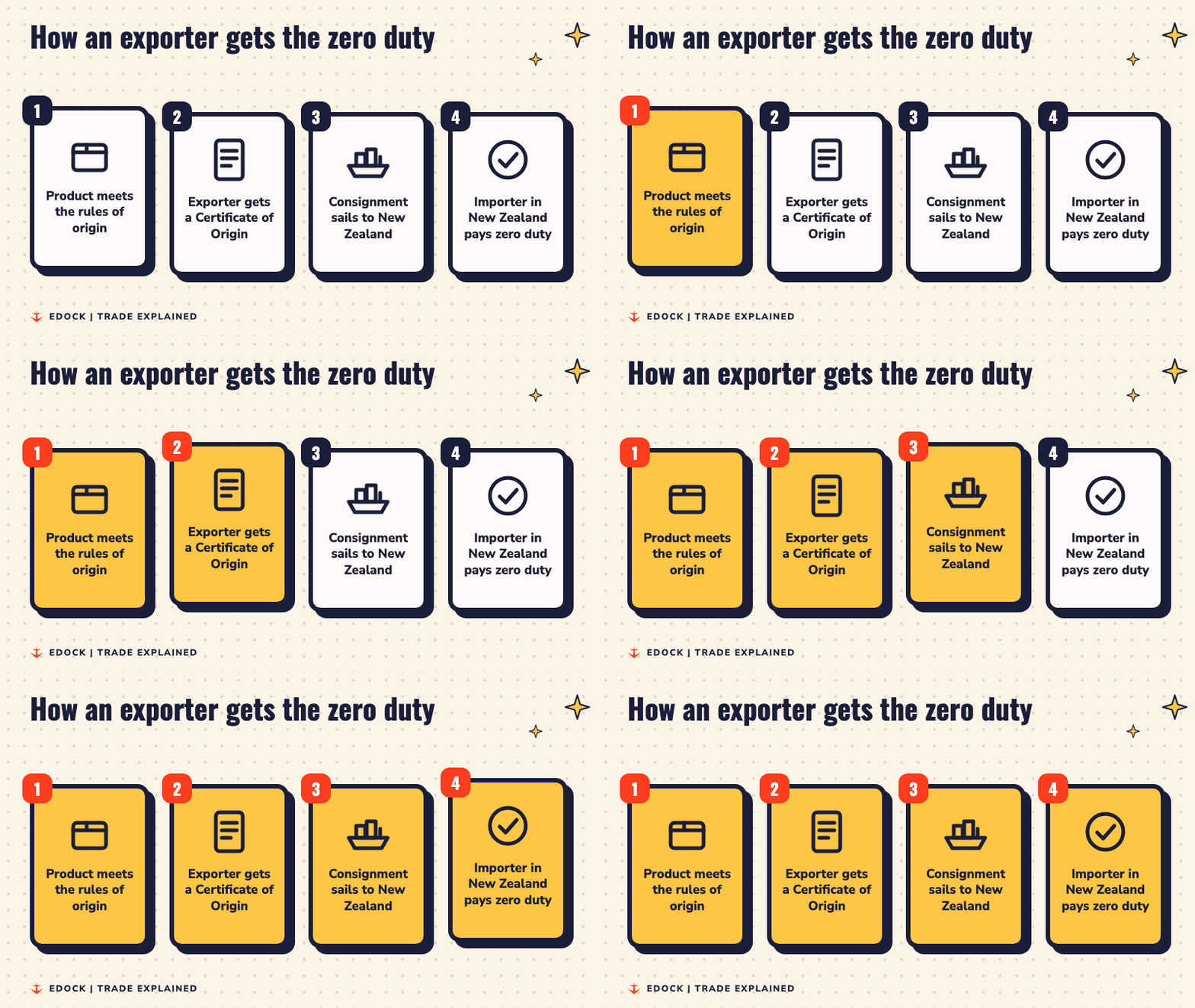
Zero duty is not automatic. Exporters must follow the deal's rules of origin. These are rules that check whether a product was really made in India. The exporter usually shows this with a Certificate of Origin, a kind of birth certificate for the product.
Why so strict? To stop shortcuts. The FAQs on the pact say goods from a third country cannot be routed through New Zealand to get the lower tariff in India. It is like a school canteen discount only for students of that school, checked with an ID card.
What does New Zealand get?
A deal goes both ways. Tariffs on over half of New Zealand's exports to India, like sheepmeat, wool, coal and most timber products, end on day one. Once the deal is fully rolled out, over 80% of its exports will enter India tariff free.
India kept its guard up for farmers. Most dairy and some farm products are left out completely. The ET report says milk, cheese, yoghurt, onions, sugar, edible oils and more get no duty cuts. New Zealand's apples, kiwifruit and Manuka honey get only a limited, controlled entry, with a minimum price and set seasons.
Why should a student care?
This part is not only about ships. The deal sets aside 1,000 Working Holiday visas each year for young Indians. There are also 5,000 visas for skilled Indian workers. Students get no cap on numbers, and post-study work rights of up to three years for STEM graduates and four years for doctoral scholars.
The skilled worker visas are split by field. The ET report lists 1,000 for IT, 1,000 for engineers and 1,200 for healthcare, including 900 for nurses. There are even 250 spots for Indian chefs and 100 for yoga instructors.
What happens next?
The ministry plans the flag-off event at Vanijya Bhawan in New Delhi on 19 October, one day before the deal starts. The first consignments are meant to show the gains right away.
The bigger test comes later. A zero tax only helps if exporters, especially small ones, use it. That means getting the paperwork right and finding buyers far from home. If they do, a small toll booth removed in October could turn into a much busier highway by 2030.
Sources
- Indian exporters readying consignments for India New Zealand FTA launch, businessline
- India New Zealand FTA to enter into force from 20 October 2026, Press Information Bureau
- New Zealand route won't help third country goods claim India FTA benefits, The Economic Times
- India New Zealand FTA takes effect October 20, ET Government
- Signing of the India New Zealand FTA, YouTube
- India NZ FTA to come into force on October 20, CNBC TV18 on YouTube
- Cover photos: Container ship coming into the Port of Auckland, by GPS 56, CC BY 2.0; Rolled fabrics, by Manjil Aryal, CC0; Handgefertigte Schuhe, by AK-Bino, CC0
