India's edible oil imports rise 3.27% as palm oil leads the way
Version 1 of 1 saved 17 Oct 2026, 3:32 am IST · Chain line 52
As it was first published
India's edible oil imports rise 3.27% as palm oil leads the way
India brought in 151.64 lakh tonnes of cooking oil in 11 months, with palm oil up 5.32%. Here is where it comes from and why your kitchen feels it.
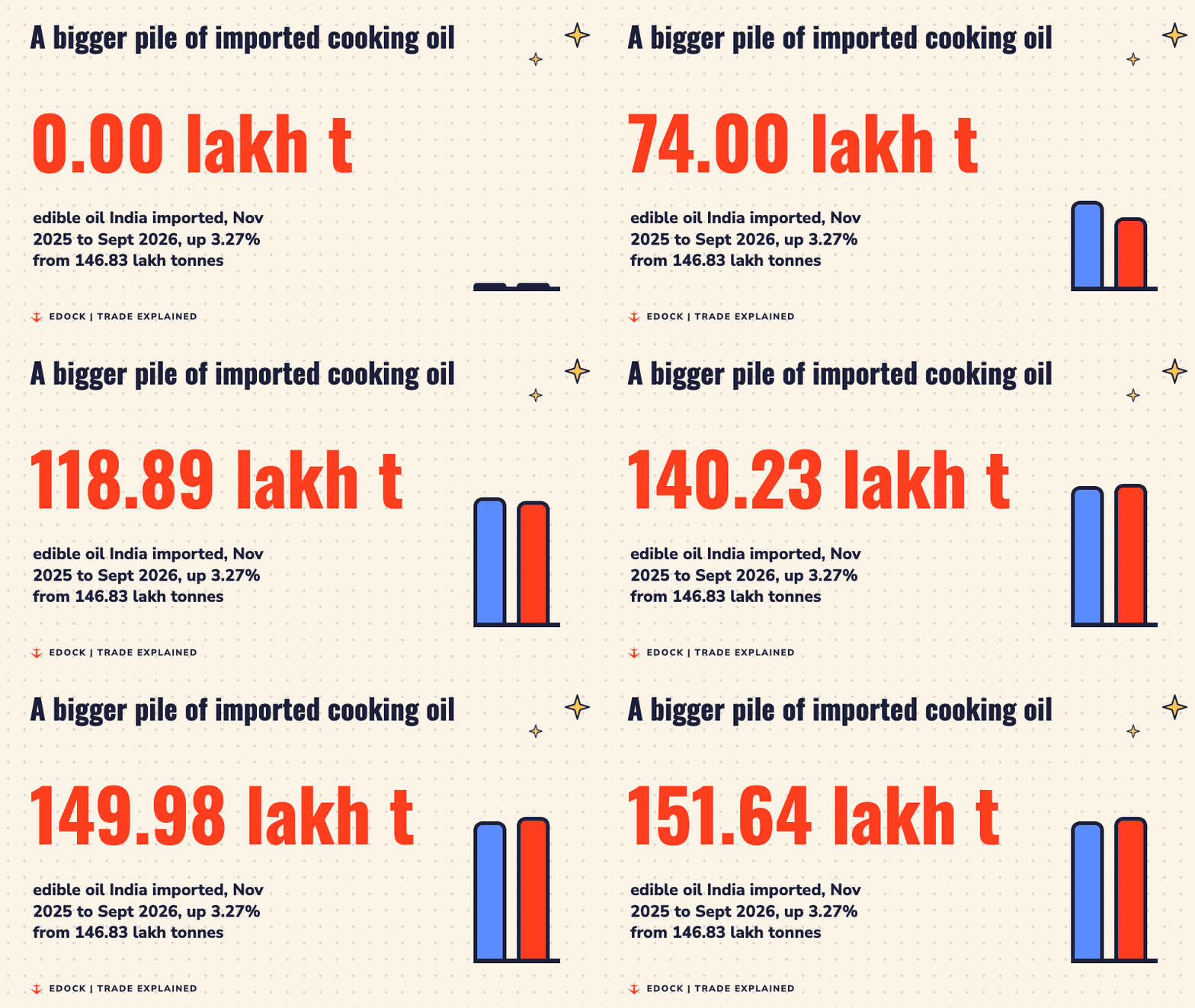
Picture the tin of cooking oil in your kitchen. There is a good chance a big part of what is inside came on a ship from far away. On 15 October 2026, the Solvent Extractors' Association of India (SEA), a group of oil companies that tracks this trade, shared new numbers. India brought in 151.64 lakh tonnes of edible oil from November 2025 to September 2026. That is 3.27% more than the 146.83 lakh tonnes of the same months a year earlier. The biggest push came from palm oil.
First, what is an "oil year"?
Most of us think of a year as January to December. The cooking oil trade uses a different calendar called the oil year, which runs from November to October. So these numbers cover the first 11 months of oil year 2025-26. One month is still left to count.
A quick word on size. One lakh tonnes is 1,00,000 tonnes, and one tonne is 1,000 kilos. So 151.64 lakh tonnes is more than 15 million tonnes of oil. If one tanker lorry carried 10 tonnes, you would need over 15 lakh lorry trips to move it all.
Palm, soy and sunflower: meet the three big oils
Not all cooking oil is the same. India buys three main kinds from other countries.
- Palm oil comes from the orange-red fruit of the oil palm tree. It is the one India buys the most.
- Soybean oil is pressed out of soybean seeds, the same beans that give us soya chunks.
- Sunflower oil comes from the seeds inside the big yellow sunflower.
Soybean, sunflower and rapeseed oil are often grouped together as "soft oils", as Rural Voice reported from the SEA data.
Here is how each one did in the 11 months:
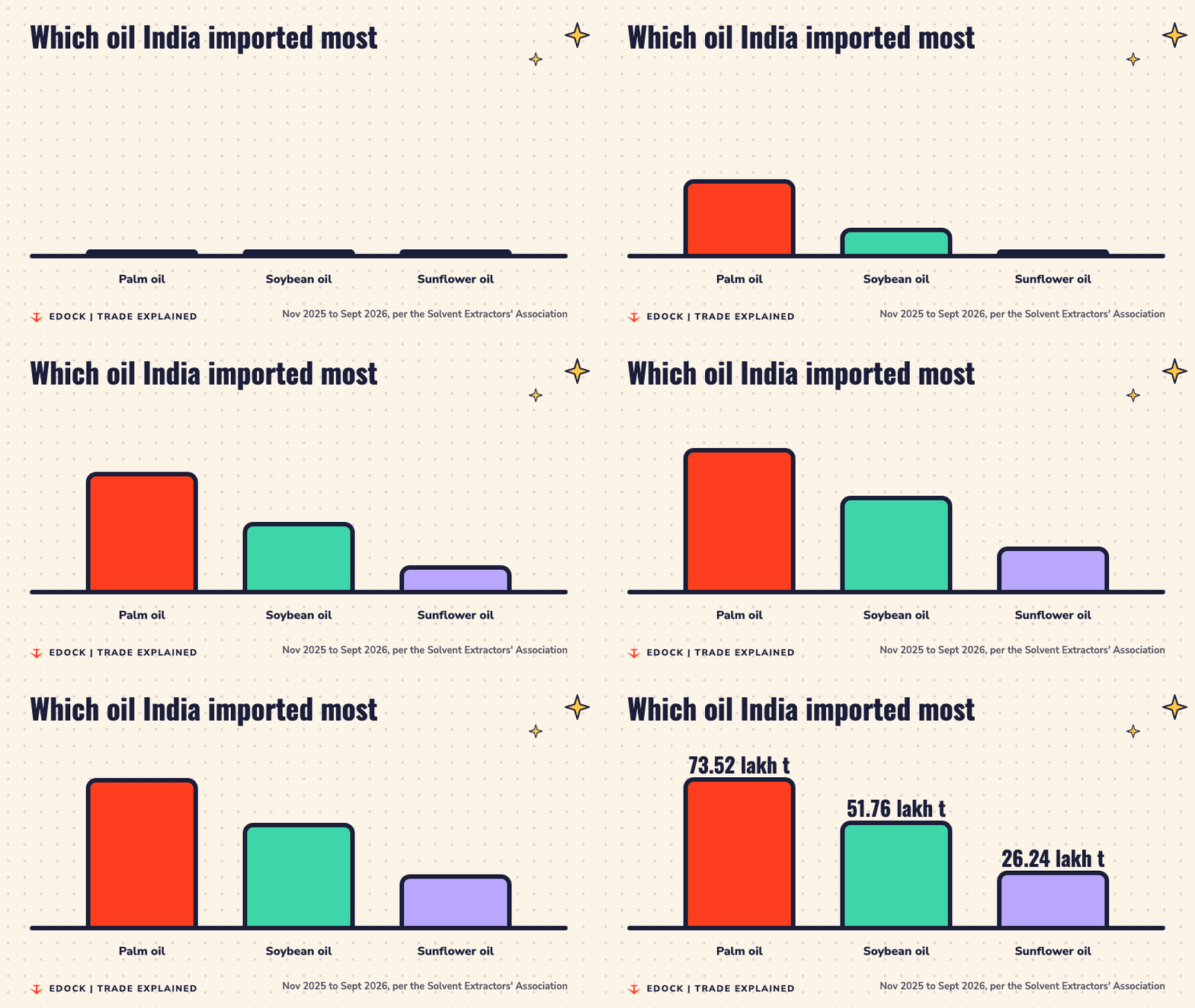
- Palm oil imports rose 5.32%, from 69.80 to 73.52 lakh tonnes.
- Soybean oil rose 3.25%, from 50.13 to 51.76 lakh tonnes.
- Sunflower oil fell 1.90%, from 26.75 to 26.24 lakh tonnes.
Palm oil alone made up about 48% of all edible oil imports, while soft oils together made up 52%. Think of it like a cricket team where one player scores almost half the runs.
Where does India buy its oil from?
Each oil has its own home countries, according to the SEA figures shared by BusinessLine.
- Argentina was the biggest supplier of all, with 34.43 lakh tonnes. Of this, 27.14 lakh tonnes was crude soybean oil and 7.29 lakh tonnes was sunflower oil.
- Malaysia sent 29.76 lakh tonnes of palm oil.
- Indonesia sent 29.05 lakh tonnes of palm oil.
- Russia sent 12.89 lakh tonnes, mostly crude sunflower oil.
Put Malaysia and Indonesia together and they sent 58.81 lakh tonnes of palm oil. So when you hear "palm oil", think of those two neighbours across the sea.
There is one surprise on the list: Nepal. It sent India 6.82 lakh tonnes of refined oils, mostly refined soybean oil. Nepal mainly buys crude soybean oil from abroad, cleans it, and then sells the refined oil to India. Under a South Asian trade deal called SAFTA, these oils enter India with nil import duty. An import duty is a tax a country charges on goods coming in from outside, a bit like an entry ticket at a fair.
Raw oil in, ready-made oil out
Here is a quieter change inside the numbers. Oil can come into India in two forms. Crude oil is raw, like unwashed vegetables from the market. It still has to be cleaned in a factory. Refined oil is already cleaned and ready to pack, like chopped vegetables from a shop.
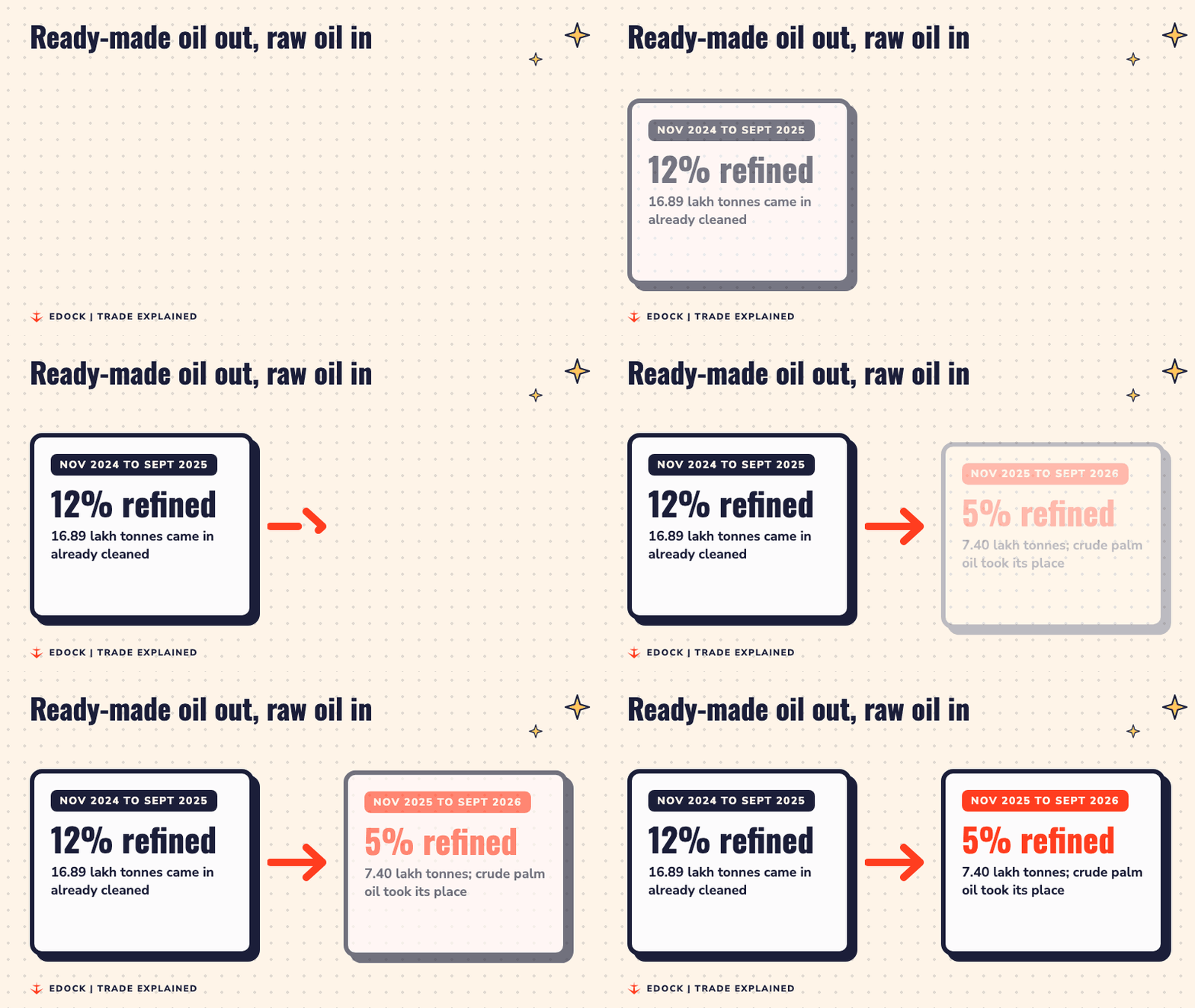
India's imports of refined oils fell sharply to 7,40,441 tonnes from 16,89,228 tonnes, The Economic Times reported. Refined oil's share of all edible oil imports dropped from 12% to 5%. At the same time, crude oil's share climbed from 88% to 95%.
Why? The SEA linked it to almost no imports of refined palmolein from Indonesia and Malaysia. Refined palmolein is a cleaned form of palm oil. Its place was taken by crude palm oil, which Indian factories then clean themselves. That means more of the cleaning work now happens inside India.
A dip in September
The full 11 months went up, but September on its own went down. India imported 15.44 lakh tonnes in September, 7% less than the 16.58 lakh tonnes of September 2025. The main reason was crude sunflower oil, which fell to about 1.05 lakh tonnes from 2.72 lakh tonnes a year earlier.
On 1 October 2026, India held an estimated 20.72 lakh tonnes of edible oil in stock, at ports and in the supply chain, a little more than a month earlier.
Why should your kitchen care?
Because the oil got costlier abroad, and the rupee got weaker at the same time. In September 2026, compared with September 2025, crude palm oil rose 10.4% to $1,285 a tonne. Crude soybean oil rose 11.2% to $1,314. Crude sunflower oil rose 10.8% to $1,432.
Now add the rupee. One US dollar cost Rs 88.32 a year ago and Rs 95.51 now, so the rupee lost about 8.1% of its value. Think of it like pocket money: if your Rs 100 suddenly buys fewer chocolates at a shop abroad, that is a weaker rupee.
A simple sum shows how the two add up. A tonne of crude palm oil cost about Rs 1,02,804 a year ago ($1,164 times Rs 88.32). In September 2026 it cost about Rs 1,22,730 ($1,285 times Rs 95.51). That is roughly 19% more in rupees, before shipping, taxes and factory costs.
India's import bill for edible oils may stay under pressure because of high world prices and the weak rupee, Rural Voice noted. Companies that pack the oil in your kitchen buy at these prices. Since India buys so much of its oil from outside, what happens in Malaysian palm farms or Argentine soybean fields can end up affecting the price of the tin at your local kirana store.
The big picture
India is a giant buyer of cooking oil. It buys more palm oil than anything else, mostly from Malaysia and Indonesia, and it gets soybean and sunflower oil from places like Argentina and Russia. This year it bought more in total, and more of it arrived raw instead of ready-made. With prices higher and the rupee weaker, the October numbers will show how the full oil year ends.
Sources
- India's edible oil imports up 3.27% in Nov-Sept on higher palm oil shipments, BusinessLine
- India's edible oil imports dip 7 pc to 15.44 lakh ton in Sep: SEA, The Economic Times
- India's vegetable oil imports rise 3% in first 11 months of 2025-26, Rural Voice
- Cover photo: Oil Palm Fruit Bunch, by Officialbernard1, CC BY 4.0
- Cover photo: Sunflower field, Moldova, by Guttorm Flatabø, CC BY 2.0
- Cover photo: Close-up of High Oleic Soybean Pods, by United Soybean Board, CC BY 2.0
