India drops the export tax on petrol but makes diesel exports costlier
Version 1 of 1 saved 1 Nov 2026, 7:25 am IST · Chain line 337
As it was first published
India drops the export tax on petrol but makes diesel exports costlier
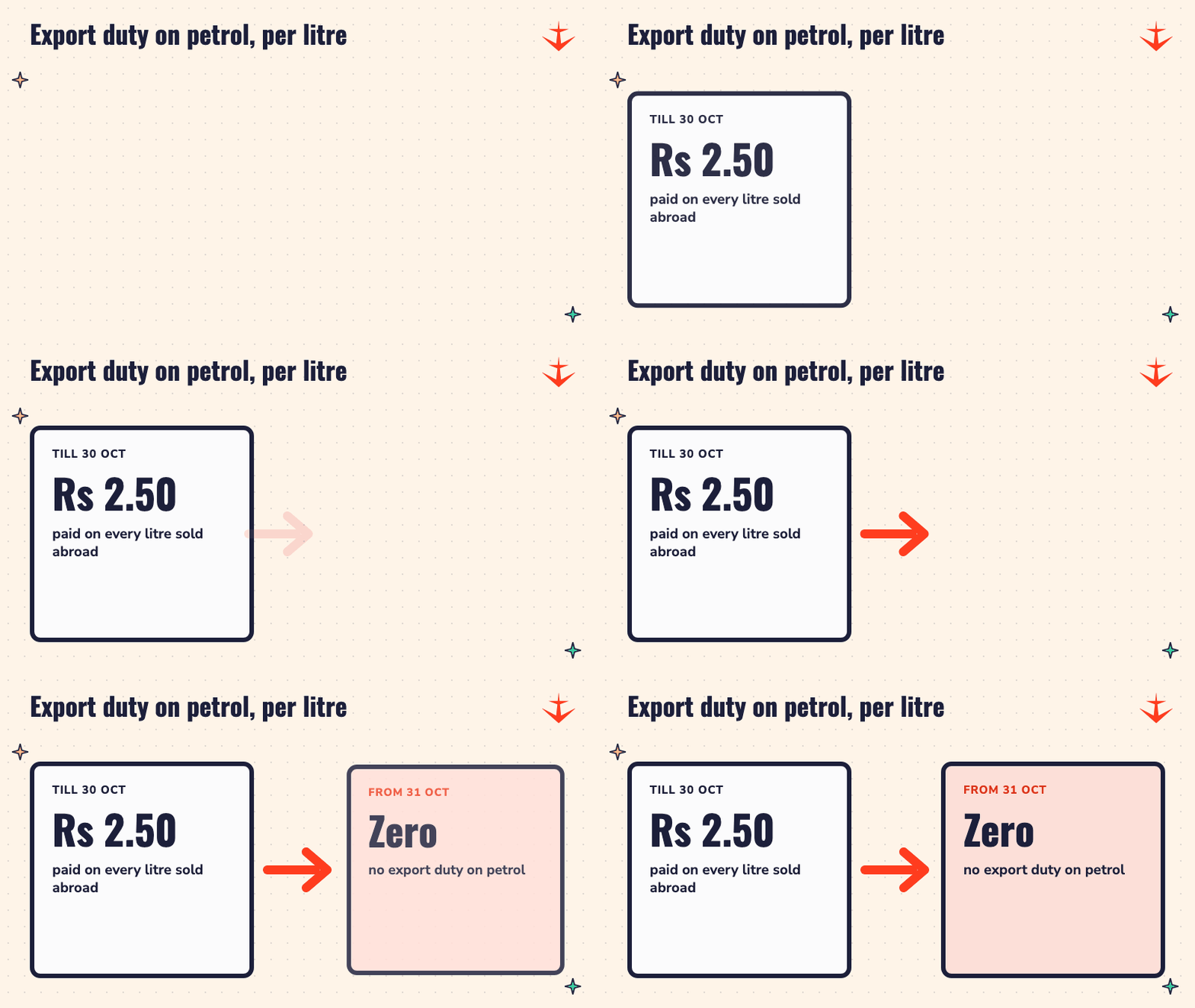
From 31 October, refiners pay nothing extra to ship petrol abroad, but pay Rs 11.50 a litre on diesel and Rs 11 on jet fuel.
Picture two tankers loading fuel at an Indian port, both bound for buyers in other countries. One carries petrol. The other carries diesel. From Saturday, 31 October 2026, the petrol tanker pays no export tax at all. The diesel tanker pays Rs 11.50 for every litre on board. That is the result of new Finance Ministry notifications issued on Saturday.
The change is small on paper, a few rupees here and there. Still, the move tells a bigger story about how India is trying to keep enough fuel at home while a war in West Asia keeps oil prices high.
What changed on 31 October
There are three fuels in this story. Petrol runs scooters and cars. Diesel runs trucks, buses, tractors and generators. ATF, short for aviation turbine fuel, is the jet fuel that planes burn.
Here are the new export rates, as reported by Mint and The Tribune:
- Petrol: zero, down from Rs 2.50 a litre.
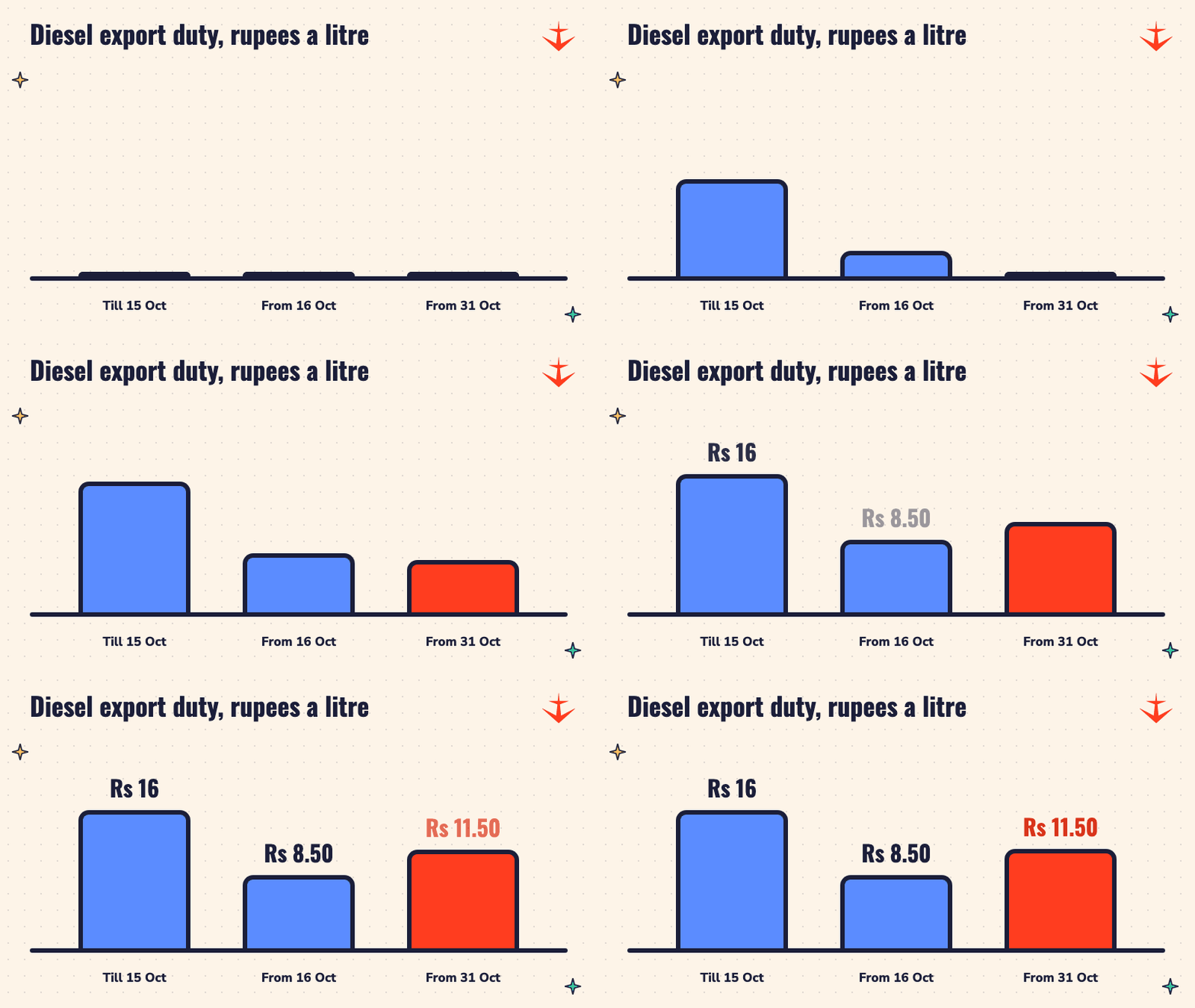
- Diesel: Rs 11.50 a litre, up from eight and a half rupees. That is Rs 3 more on every litre.
- ATF: Rs 11 a litre, up from Rs 10.50. That is 50 paise more.
The new rates apply from 31 October for the next fortnight, which means about two weeks. For diesel, the charge is really two charges added together: a special extra excise duty and a road and infrastructure cess. A cess is a tax collected for one named purpose, here roads and infrastructure.
What is an export duty, in plain words?
An export duty is a fee a company pays to the government when it sells goods to a buyer in another country. Think of it as a gate fee on the way out.
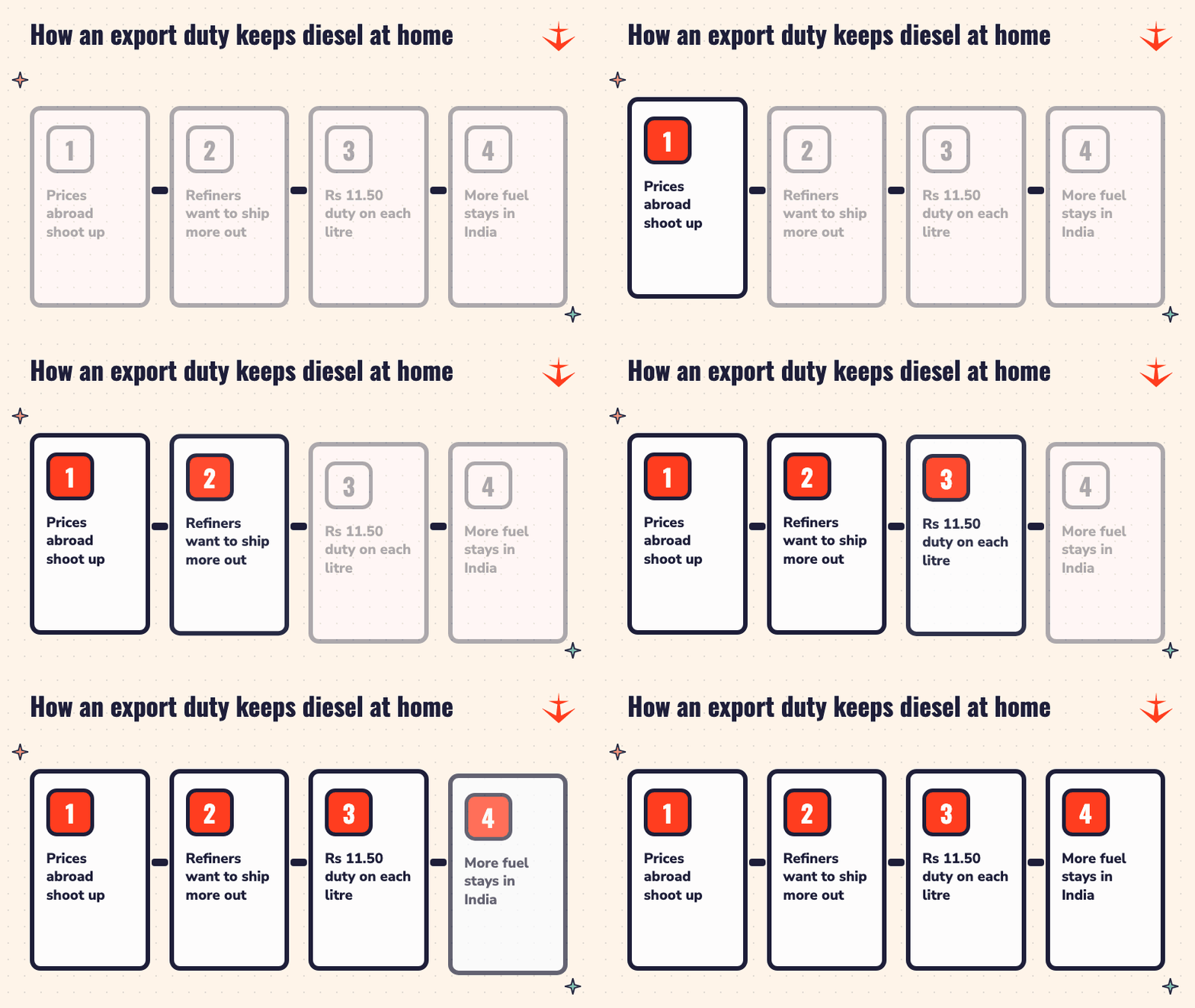
Imagine a samosa stall in your street. One day a wedding party in the next town offers double the usual price for every samosa. The stall owner could send all his samosas there, and his regular customers would go home hungry. Now imagine the local council charges him a fee on every samosa that leaves town. Suddenly, selling to the neighbours looks just as good. More samosas remain in the street.
Fuel works the same way. When fuel prices abroad shoot up, refiners (the companies that turn crude oil into petrol, diesel and jet fuel) can earn more by shipping fuel out. The government's stated aim, reports The Economic Times, was to stop refiners from putting overseas buyers ahead of Indian ones.
People often call this a windfall tax. A windfall is money you did not work for, like finding Rs 500 in an old jacket. The tax was also meant to stop exporters from gaining too much from the gap between world prices and Indian prices, according to Mint.
Why did these taxes start in the first place?
The story goes back to the war in West Asia. Mint reports the conflict began nearly nine months ago, when the United States and Israel launched strikes on Iran. Before the war, around 45% of the crude oil India imports came through the Strait of Hormuz, a narrow sea route out of the Persian Gulf, says The Economic Times. When ships could not move freely there, oil got costlier and harder to find.
So the government put export duties on diesel and ATF on 27 March. Petrol joined the list on 16 May, reports The Tribune. Since then, the rates have been checked and changed every fortnight.
A tax that changes like a batting order
Like a captain who changes the batting order every match, the government resets these rates every two weeks. The Economic Times reports that the rates depend on the average crude oil price over the past 15 days. Business Today adds that the review also looks at world fuel prices and how much refiners could gain from selling overseas.
Look at diesel alone. Until mid October, the duty was Rs 16 a litre. From 16 October, the government cut the duty to eight and a half rupees and raised the petrol duty to Rs 2.50. Now, just two weeks later, diesel is back up to Rs 11.50 and petrol is down to zero.
Why diesel and not petrol?
The notifications do not give a reason for treating the two fuels differently. Business Today calls it a differentiated approach, with higher duties on diesel and ATF and no levy on petrol.
Some numbers help explain why diesel matters so much. Diesel made up 42% of India's fuel exports by volume in April to September, against 23% for petrol, according to The Economic Times. In the same six months, Indians used 5% more diesel, while diesel production fell 0.3%. The Economic Times says strong demand at home left refiners with less fuel to sell overseas.
Will the fuel at your local pump change?
Not because of this. The Finance Ministry said there is no change in the duty rates on petrol and diesel sold for use inside India. These new rates touch only fuel that leaves the country.
The Economic Times notes that the government has kept retail petrol and diesel prices stable to shield buyers from the full shock of the war, while using export duties to steer how much fuel goes overseas. The stated aim of these duties has not changed since March: keep enough fuel available inside India.
What this means for refiners
India's fuel exports come mostly from a few big refiners. Reliance Industries alone sells about 70% of them, with Nayara Energy, the state-run MRPL and others making up the rest, reports The Economic Times.
Here is a simple sum to show the change. On 1,000 litres of diesel sent abroad, the duty is now Rs 11,500, which is Rs 3,000 more than a day earlier. On 1,000 litres of jet fuel, the duty is now Rs 11,000, up Rs 500. On 1,000 litres of petrol, the duty drops from Rs 2,500 to nothing. So petrol shipments abroad just got cheaper for refiners, while diesel shipments got costlier.
What to watch next
The new rates last for one fortnight. Under the fortnightly system, the next review should come in about two weeks, and each review can move the rates up or down in line with world oil prices.
This ET Now video covers an earlier fortnightly change to the same export duties and shows how these reviews are reported:
For now, the message from 31 October is clear in numbers: petrol can leave India free of this duty, but every litre of diesel and jet fuel leaving the country pays more than before.
Sources
- Government ends petrol export duty, raises levies on diesel and ATF, The Economic Times, 31 October 2026
- Govt ends petrol export duty, hikes levies on diesel and ATF, Mint, 31 October 2026
- Govt raises windfall tax on diesel, ATF exports; petrol levy scrapped, The Tribune, 31 October 2026
- Government hikes windfall tax on diesel, ATF exports; cuts petrol export duty to zero, Business Today, 31 October 2026
- Windfall gains tax revised for petrol and diesel exports from 16 October, The Economic Times, October 2026
- India earns nearly 50% more on fuel exports in April to September, The Economic Times
- Windfall Tax Revised: Govt Cuts Diesel and ATF Export Duty, Raises Petrol Tax, ET Now on YouTube
- Cover photo: An oil tanker sails past Cochin Port, Vallarpadam Island, by Rangan Datta Wiki, CC BY-SA 4.0
