Hyundai sold a record number of cars. So why did its profit fall?
Hyundai Motor India earned over Rs 20,000 crore in one quarter for the first time, but costlier steel and copper ate into the profit.

Picture a samosa stall on the busiest day of its life. The queue is long and every tray is sold out. But when the owner counts the money at night, there is less left over than a year ago. Oil and potatoes got costlier, and the extra customers did not cover the extra bill.
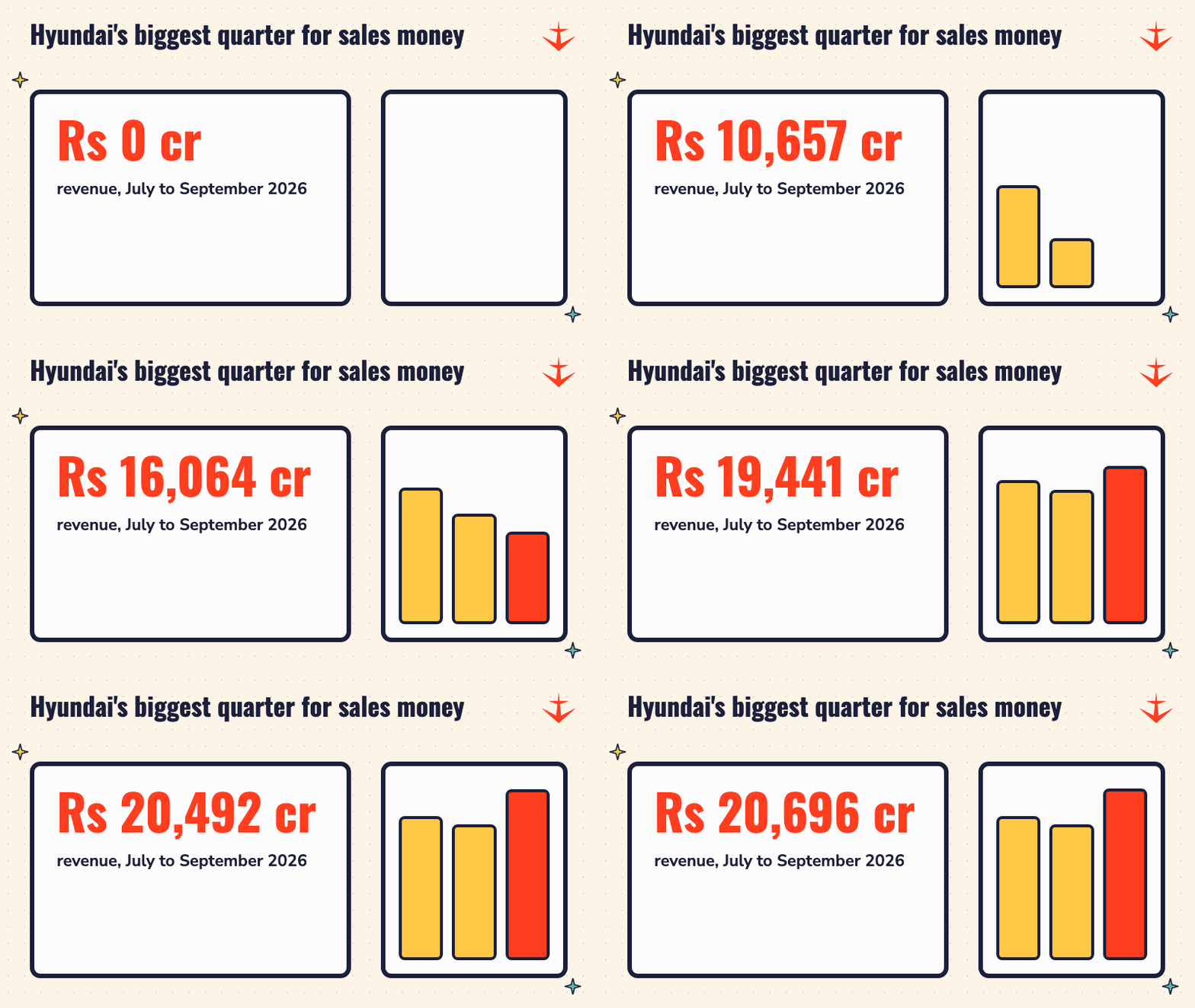
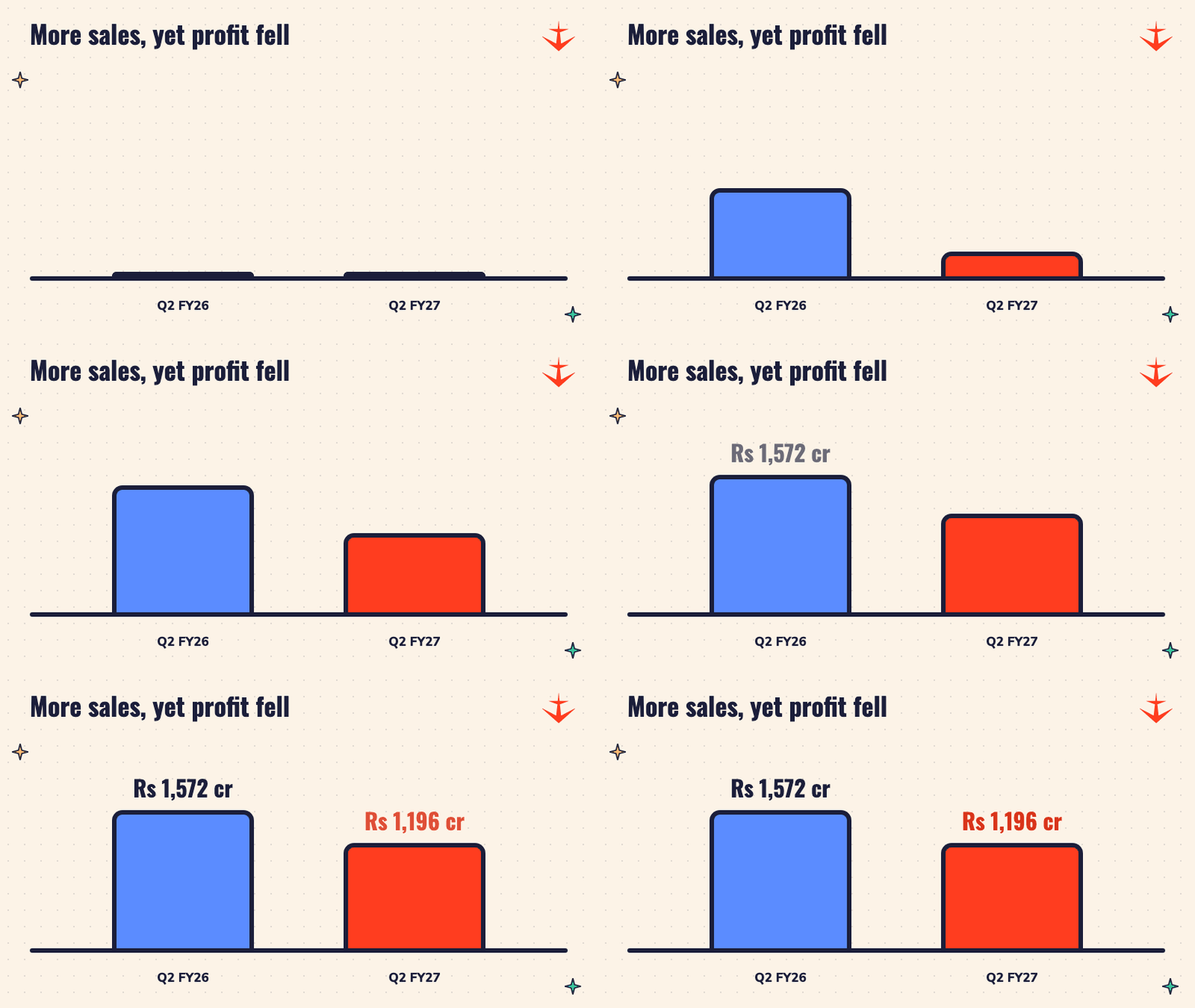
That is roughly what happened to Hyundai Motor India. On Wednesday, 28 October 2026, the carmaker said it sold 2,19,072 vehicles between July and September, its highest number ever in a quarter. Its revenue crossed Rs 20,000 crore in a single quarter for the first time. Yet the company's profit after tax fell about 24%, to Rs 1,196 crore from Rs 1,572 crore a year earlier.
Wait, more sales and less profit?
Two words help here. Revenue is all the money that comes in from selling things. If a stall sells 100 samosas at Rs 20 each, its revenue is Rs 2,000. Profit is what is left after paying for everything: oil, flour, potatoes, gas, rent and the helper's wages.
A quarter is three months. Companies share their numbers every quarter, like a school sending a report card four times a year. July to September is the second quarter of India's money year, which runs from April to March. That is why it is called Q2 FY27.
For Hyundai, revenue from operations rose 18.5% to Rs 20,696 crore, up from Rs 17,460 crore. But expenses climbed 24% to Rs 19,302 crore, led by the cost of materials. Costs grew faster than sales, so profit shrank. These are the company's consolidated numbers, which means they add up Hyundai Motor India and the smaller companies it owns.
Where did the money go?
A car is a big pile of metal. Steel makes the body and doors. Copper runs through the wires that carry power to the lights, the music system and the starter. When these metals get costlier, every car costs more to build.
The Economic Times reported that higher prices of copper and steel pushed up making costs, and that the crisis in the Middle East added to the uncertainty for carmakers. Hyundai's own chief, Tarun Garg, said in the company's release that "elevated commodity costs weighed on the quarter's profitability." Commodities are basic raw goods like metals, oil and grains, bought and sold in huge amounts.
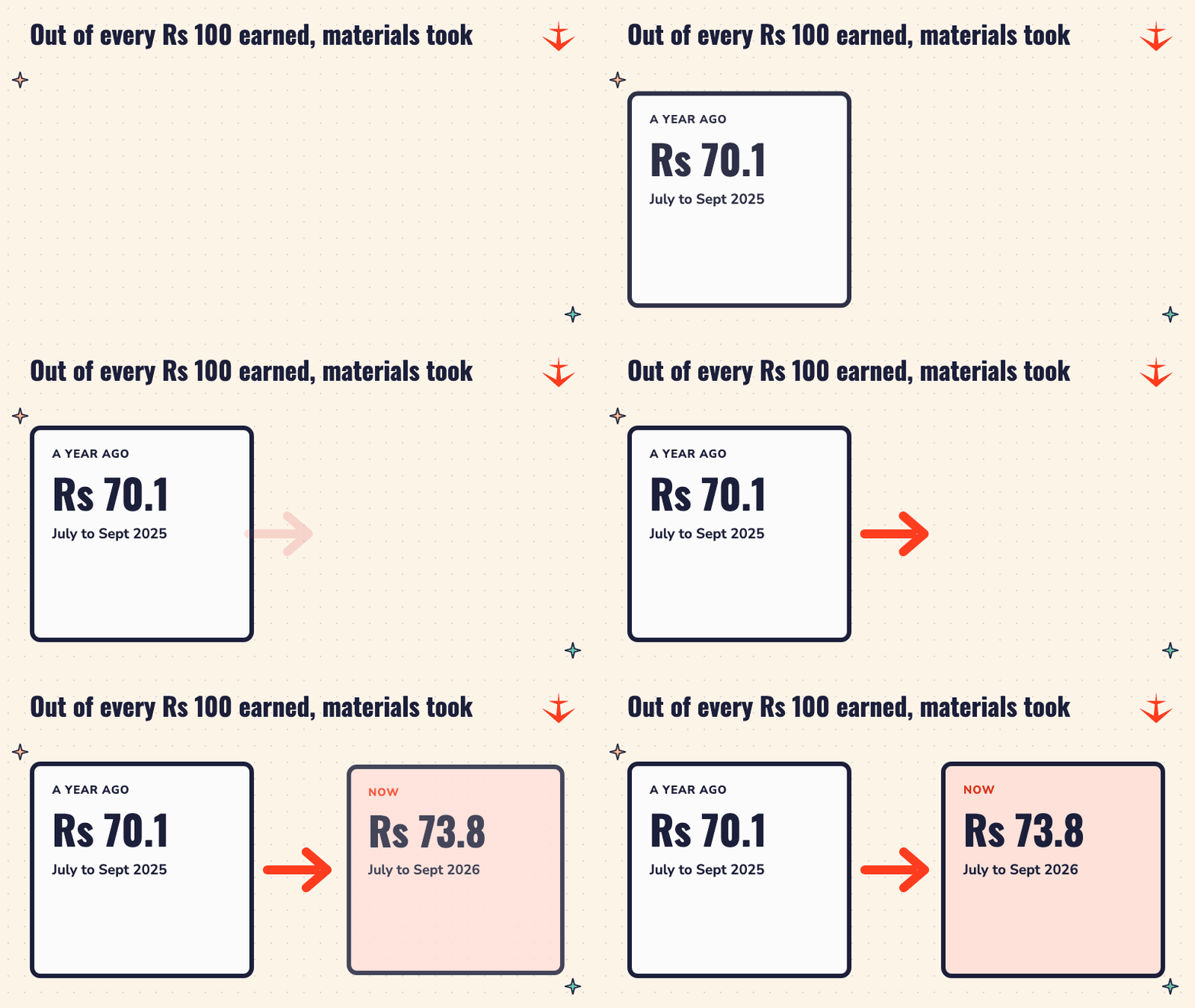
Here is the clearest way to see the squeeze. Raw materials took 73.8% of revenue this quarter, up from 70.1% a year earlier, according to a report on the company's investor presentation. So out of every Rs 100 Hyundai earned, Rs 73.80 now went on materials, compared with Rs 70.10 before. That extra Rs 3.70 on every Rs 100 is money that used to stay with the company.
A simple way to read the profit squeeze
Companies often talk about EBITDA. It is the profit from the main work of the business before paying interest on loans, tax, and the slow wearing out of machines. Think of it as what the samosa stall earns from samosas alone, before the shop loan and the tax.
Hyundai's EBITDA fell 18.7% to Rs 1,974 crore. Its EBITDA margin, which is that profit as a part of revenue, dropped to 9.5% from 13.9%. In plain words, on every Rs 100 of sales, the main business kept Rs 9.50 instead of Rs 13.90. There is one small bright spot: the margin was a little better than in the April to June quarter, when it was 9.3%.
So why were so many people buying?
A big reason is tax. On 22 September 2025, India cut GST on small cars to 18% from 28%. GST is the tax added to the price of things we buy. A lower tax means a lower price tag for buyers, and The Economic Times said this cut kept helping demand this year.
Inside India, Hyundai's sales rose 18.8% to 1,65,772 vehicles. Villages and small towns made up a record 26.6% of its Indian sales, and cars running on CNG made up a record 19.1%, the company said. CNG is compressed natural gas, a fuel that many cars in India run on.
Exports, which means cars sent to other countries, grew only 3.7% to 53,300 units. The company said exports still jumped 38% compared with the April to June quarter, "despite geo-political challenges."
Why not just raise car prices?
When a samosa stall pays more for oil, it has two easy choices. It can raise the price, or it can stop giving the extra chutney for free. Carmakers have similar tools, and the numbers show a bit of both.
Hyundai's average selling price per vehicle rose 2% to about Rs 8,07,000. In the same three months, the discount Hyundai gave on each vehicle in India fell 8.2% to about Rs 23,000. So buyers on average got a slightly smaller discount than a year ago.
The company also raised localisation from 82% to 84%. Localisation means buying more parts made in India instead of bringing them from abroad. Think of a stall buying potatoes from the local mandi instead of a far away city. Kotak Neo's report said this supports a steadier supply chain and helps keep costs in check.
The company said bigger volumes, a healthy mix of models and cost cutting helped its margin improve from the last quarter. Still, profit fell from a year ago.
Where these cars come from
Hyundai Motor India was set up on 6 May 1996, and its first plant was built at Irungattukottai near Chennai in Tamil Nadu. Its newer plant in Pune crossed one lakh vehicles within eight months of starting work, and the company's total exports from India have reached four million units, according to the same report. Every one of these cars needs steel and copper, which is why metal prices matter so much to the whole business.
This video from Hyundai India shows how cars are built at the company's plant in India.
What comes next?
The company said it sees October to March as "a period of accelerated momentum," with new models planned. It also said cost pressures persist.
There is a catch. Last year's tax cut lifted sales a lot, so the next few quarters will be compared with strong numbers. Analysts quoted by Reuters, and cited by The Economic Times, expect this "base effect" to grow. A base effect is like a batter who hit a century last match: even a good 70 today looks like a fall. Maruti Suzuki, India's biggest carmaker, also reported a smaller than expected profit on Tuesday, a sign the cost squeeze is not only Hyundai's problem.
The lesson is simple, and it works for a car company as well as a samosa stall. Selling more is only half the game. What really counts is how much is left after paying for everything that goes into the product.
Sources
- Hyundai Motor India Limited Q2 FY27 Financial Results, Hyundai Motor India
- Hyundai Motor India's Q2 profit falls 24% as commodity costs blunt tax cut boost to demand, The Economic Times
- Hyundai Motor India's Q2 profit falls 24 pc to Rs 1,196 crore, IANS
- Hyundai record Q2 sales of 2.19 lakh vehicles despite a 24% fall in quarterly profit, Kotak Neo
- GST Bachat Utsav: tax cuts on automobiles, All India Radio News
- Hyundai Motor India, Wikipedia
- Hyundai, Manufacturing Plant, India, HyundaiIndia on YouTube
- Cover photo: Hyundai's manufacturing plant near Chennai, by L.vivian.richard at English Wikipedia, public domain

You may republish this story under CC BY 4.0: credit Pranav Sharma and link to this page.