HPCL swaps Rs 50,000 crore of refinery loans for cheaper ones to save Rs 1,000 crore a year
The oil company refinanced the debt on its new Rajasthan refinery. Here is how a cheaper loan, like a cheaper phone EMI, can save crores.
Picture saving Rs 1,000 crore a year without selling a single extra litre of fuel. That works out to about Rs 2.7 crore every single day. On Friday, 23 October 2026, Hindustan Petroleum Corporation (HPCL) said it had swapped about Rs 50,000 crore of loans on its new Rajasthan refinery for cheaper ones, and that this, along with a few other money moves, could cut its yearly interest bill by about that much.
The news came from HPCL's Chairman and Managing Director Vikas Kaushal, who spoke to analysts (people who study companies for investors) on a call about the company's results.
First, what is this refinery?
A refinery is like a giant kitchen. Crude oil, the thick black oil that comes out of the ground, goes in. Petrol, diesel and other useful products come out. The new one sits at Pachpadra in Balotra district, Rajasthan, and is run by a company called HPCL Rajasthan Refinery Limited, or HRRL.
HRRL is a joint venture. Think of two friends who open one samosa stall together and split the ownership. Here, HPCL owns 74% and the Government of Rajasthan owns 26%. The plant can process 9 million tonnes of crude a year and was built at a cost of Rs 79,459 crore.
That cost grew a lot over time. In April 2026, HPCL told the stock exchanges that the petroleum ministry had approved raising the project cost from Rs 43,129 crore to Rs 79,459 crore, with HPCL putting in Rs 19,600 crore of its own money to keep its 74% share. A big chunk of the rest was borrowed, and borrowed money comes with interest.
So what does "refinancing" mean?
Imagine you bought a phone on an EMI that charges a high interest rate. Then a different shop offers you a cheaper EMI. You take the new, cheaper loan, use it to pay off the old one, and from then on you pay less every month. The phone is the same. Only the loan got cheaper. That is refinancing.
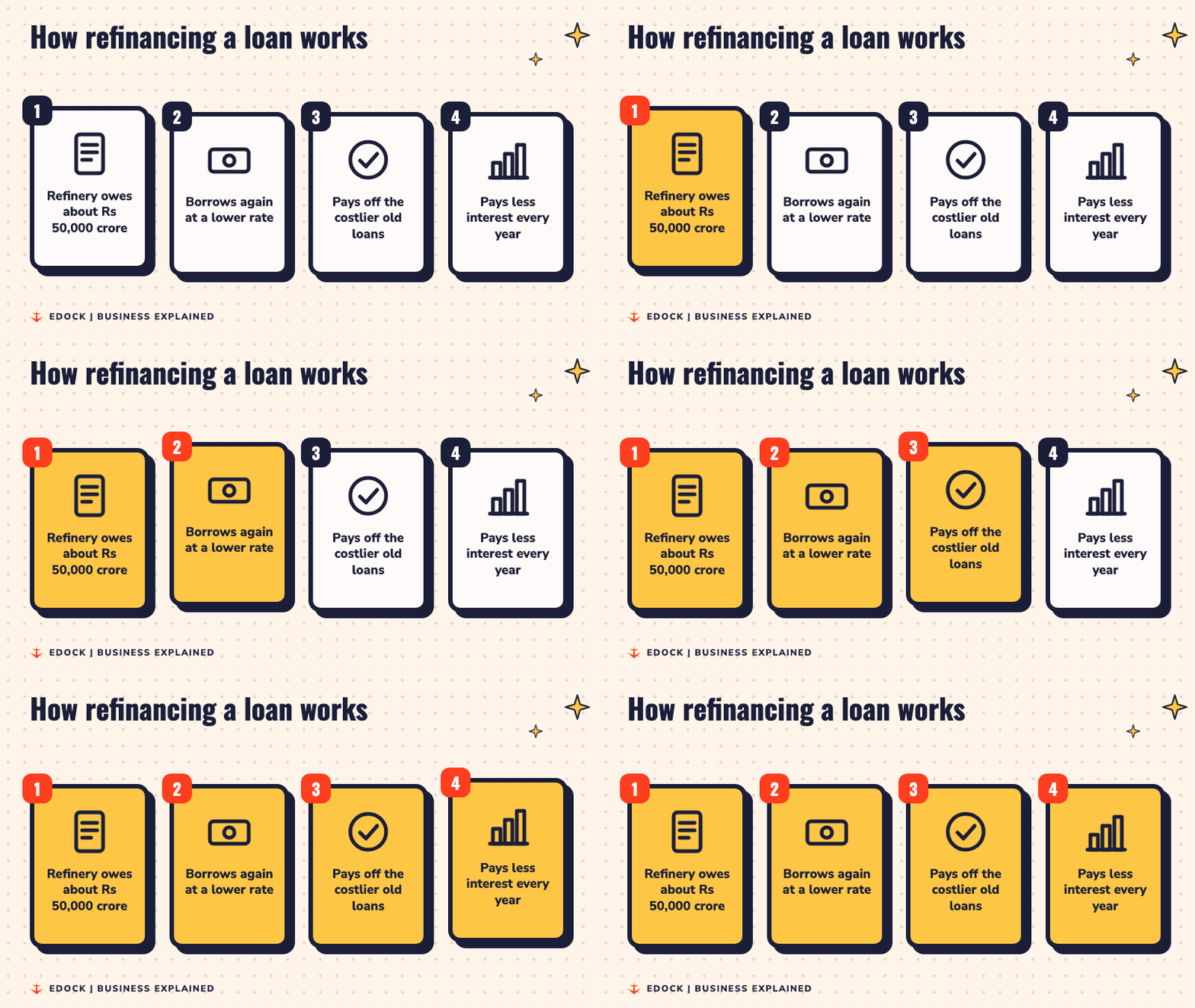
HPCL says the new loans came with a cut of around 105 basis points in borrowing costs. A basis point is one hundredth of one percent, so 105 basis points means about 1.05 percentage points less interest. The new terms took effect on 3 October, and Kaushal said this refinancing alone should save about Rs 470 crore to Rs 550 crore a year.
A quick check of the maths: 1.05% of Rs 50,000 crore is about Rs 525 crore. That number sits right inside the range HPCL gave.
Who lent the new money?
Part of the old project loans were replaced with Rs 8,000 crore of rupee term loans (loans repaid over a fixed number of years) from a group of lenders:
- National Bank for Financing Infrastructure and Development (NaBFID)
- India Infrastructure Finance Company Limited (IIFCL)
- ICICI Bank
- UCO Bank
- Punjab & Sind Bank
On top of that, Bank of Baroda gave a Rs 2,000 crore working capital loan, and ICICI Bank added credit lines worth Rs 400 crore. Working capital is the everyday cash a business needs to keep running, like the money a chai stall keeps aside for milk, sugar and gas before customers pay.
Where does the full Rs 1,000 crore come from?
Cheaper loans are only one part. HPCL is also changing how much of the refinery is paid for with loans and how much with owners' money, called equity. Equity is money the owners put in themselves. Unlike a loan, it does not charge interest every month.
Here is what the sources say happened:
- In the July to September quarter, the Rajasthan government put in Rs 1,500 crore of equity.
- HPCL turned Rs 4,300 crore of special loans (ones that get repaid only after the main lenders) into equity. That step alone is expected to lower interest costs by about Rs 350 crore.
- The state has promised about Rs 1,100 crore a year in interest-free loans, and the first instalment has already arrived.
- More equity is planned over the next one or two quarters.
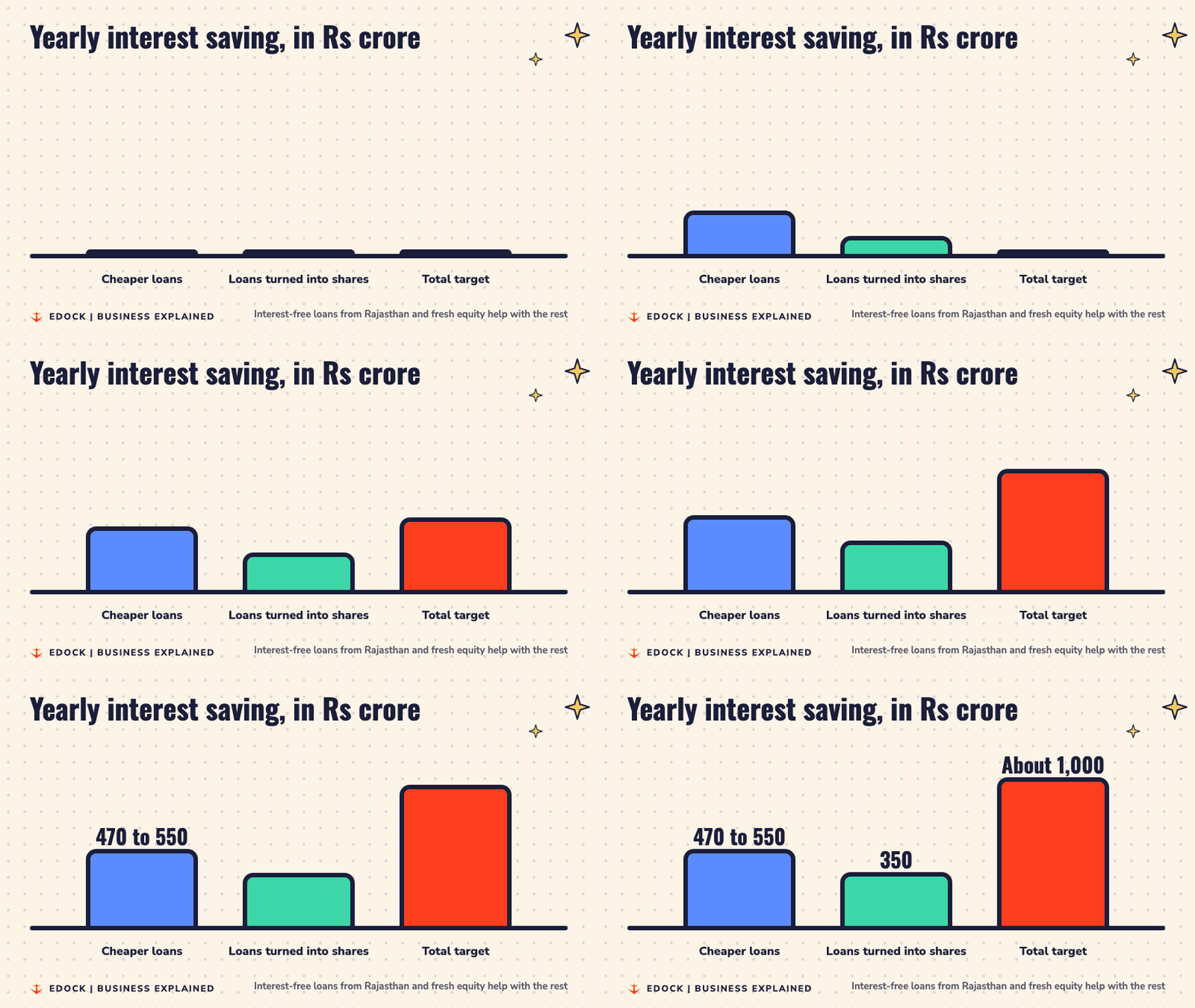
Kaushal said all these steps together could reduce yearly interest costs by about Rs 1,000 crore compared with the previous year. In his words, "We have significantly altered the debt structure of the company."
Why does HPCL care so much right now?
Because the refinery is only just getting going. Its commercial operation date, the day it officially started running as a business, was declared on 22 June. It is now running at about 60% of what it can do. HPCL expects it to reach a speed of 8 million to 9 million tonnes a year around December.
Sales are picking up fast. The refinery shipped about 15,000 tonnes of products on the day before the call. Three months earlier it shipped nothing. October shipments are expected to cross 400,000 tonnes (4 lakh tonnes), bringing in more than Rs 4,000 crore for the month.

There is one more number to know: the gross refining margin. It is roughly what a refinery earns on each barrel of crude it turns into fuel, before its other costs. Think of it as what a juice seller earns per glass after paying for the fruit. The Rajasthan plant earned about 12 US dollars a barrel in the September quarter. HPCL expects that to rise above 20 dollars a barrel in the fourth quarter, as the plant starts using higher-sulphur crude, which it was built to handle.
Kaushal also said the refinery could post a profit before tax for October. He was clear that this was the management's hope, not a formal forecast, because refining margins swing a lot.
What about HPCL as a whole?
The parent company is under some pressure. A day earlier, HPCL reported that its standalone net profit for July to September fell 9% to Rs 3,483 crore, from Rs 3,830 crore a year earlier, as crude oil prices jumped and tax expenses rose. When profits are squeezed like that, cutting Rs 1,000 crore of interest is a way to keep more of what the business earns.
The big lesson in small words
Profit is not only about selling more. It is also about paying less for the money borrowed. HPCL did not build anything new on 23 October. It simply found cheaper loans, turned some debt into ownership, and got help from its partner state. The same idea works at home: a cheaper EMI on the same phone leaves more pocket money at the end of every month.
Sources
- Business Standard (PTI): HPCL refinances Rs 50,000 crore Rajasthan refinery debt
- The Economic Times: HPCL refinances Rs 50,000 crore Rajasthan refinery debt
- Daily Excelsior: HPCL refinances Rs 50,000 crore Rajasthan refinery debt
- HPCL filing to the stock exchanges on the HRRL project cost, 17 April 2026
- Business Standard (Reuters): HPCL Q2 profit falls 9% to Rs 3,483 crore
- Ministry of Petroleum and Natural Gas: Inside HRRL (YouTube)
- Cover photo: HP petrol bunk, Shivamogga, Karnataka (2026), by Gpkp, CC BY-SA 4.0

You may republish this story under CC BY 4.0: credit Manpreet Kaur and link to this page.