How a Jaipur exporter can use India's free trade deals to ship goods duty free
Version 1 of 1 saved 18 Oct 2026, 11:16 am IST · Chain line 90
As it was first published
How a Jaipur exporter can use India's free trade deals to ship goods duty free
The Commerce Ministry held an FTA outreach in Jaipur on 17 October. Here is how rules of origin and a certificate of origin turn a trade deal into a lower border tax.
Picture a small workshop in Jaipur that cuts coloured gemstones. A buyer in another country likes the stones. But at the buyer's border, a tax is added on top of the price. Now the stones cost more than stones from a rival country. A free trade agreement can make that border tax shrink, or vanish. That is why, on Saturday, 17 October 2026, the Commerce Ministry held a "Leveraging FTAs" outreach programme in Jaipur, to help exporters understand and use the benefits of these deals.
A day earlier, on 16 October, Sanjay Budhia, Chairman of the CII National Committee on Exports, said Indian businesses, especially small ones, should make use of FTAs and the Export Promotion Mission to sell more abroad. So what is an FTA, and how does a real exporter actually use one?
First, what is a free trade agreement?
When goods cross a border, the buying country often charges an import duty. A duty is a tax on goods coming in. Think of it like an entry fee at a fair. If the fee is 10%, a Rs 1,000 box of goods pays Rs 100 just to get in.
A free trade agreement, or FTA, is a deal between two countries (or a group of countries) to cut these entry fees for each other's goods. Some fees drop to zero. Others go down slowly over a few years.
Which deals does India already have?
India has finalised eight free trade pacts in the last five years. Deals with Mauritius, the UAE, Oman, Australia, the EFTA group (Switzerland, Norway, Iceland and Liechtenstein) and the UK are already in force. The deal with New Zealand starts on 20 October, and a deal with the 27-nation European Union is set to be signed in December.
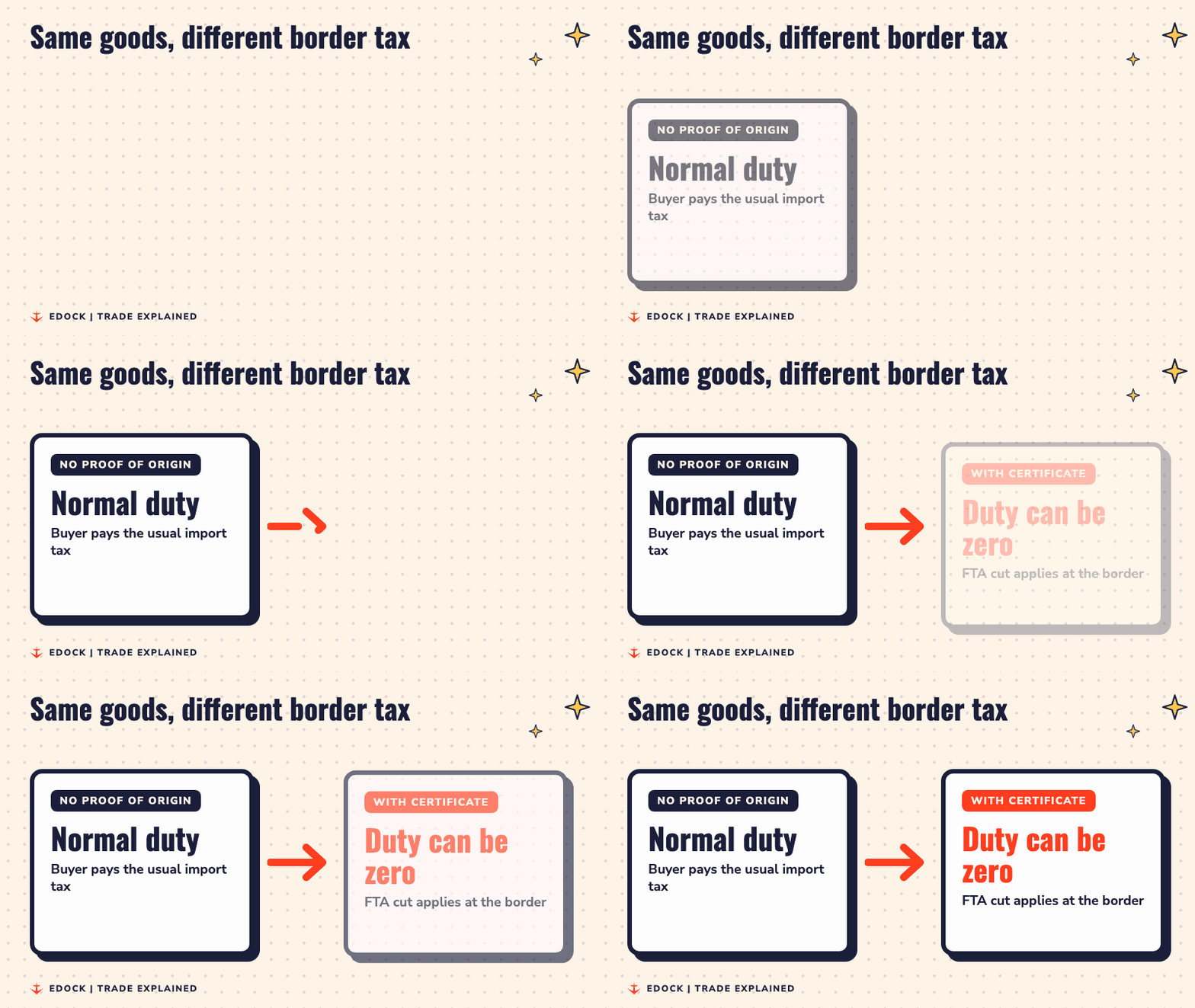
The New Zealand deal shows how it works in practice. From 20 October, import duties on all Indian goods going to New Zealand are set to drop to zero. New Zealand's average duty is already low, at about 1.9%, but on some products it goes up to 5 to 10%. Those are the products where Indian sellers gain the most.
The catch: proving your goods are really Indian
Here is the part many people miss. An FTA cut is not given to every box that leaves an Indian port. It is given only to goods that "originate" in India, meaning they were really made here.
So every deal has rules of origin. The World Trade Organization describes these as the criteria used to decide the national source of a product.
The rules for the New Zealand deal, notified by India's customs body, give a good example. A product can qualify in a few ways, according to a guide to the new rules:
- Wholly obtained: made fully from things grown, mined or produced in India.
- Change in tariff classification: imported parts must be turned into a clearly different product. Every product has a code number at customs, and the code must change after the work is done in India.
- Qualifying value content: a minimum share of the product's value must come from India or the partner country.
- Specified process: the product must go through a set manufacturing step.
Just as important is what does not count. Simple packing, putting on labels, sorting, simple assembly, mixing or polishing do not make a product Indian on their own. It is a bit like a samosa stall. Buying ready samosas from another shop and putting them on your own plate does not make them your samosas. Making the dough, filling and frying them does.
The certificate of origin: the paper that unlocks zero duty
To get the duty-free benefit in New Zealand, exporters must make sure their products meet the rules of origin and obtain the prescribed Certificate of Origin, or use another allowed method.
A certificate of origin is like a birth certificate for a shipment. Under the New Zealand rules, it must be issued by an authorised authority, with a signature and an official seal. It lists the exporter, the importer, the product code, a description of the goods and the invoice details. Instead of a certificate, an eligible declarant can fill in an origin declaration. Records that prove origin, such as bills for raw material and production notes, must be kept for at least five years.
How a Jaipur exporter would use it, step by step
Rajasthan's key export sectors include textiles, handicrafts, gems and jewellery, engineering goods and stone. At the Jaipur programme, a presentation by the city's Joint Director General of Foreign Trade, Md. Moin Afaque, pointed to chances in lab-grown diamond jewellery, coloured gemstones, Kundan-Meenakari jewellery and recycled gold jewellery. It said India ranks eighth among the world's gems and jewellery exporters, with a 2.9% share of a $1 trillion global market.
Here is a simple, made-up example of the steps. A Jaipur workshop makes a carved wooden elephant from Indian wood, and a shop abroad wants to buy it.
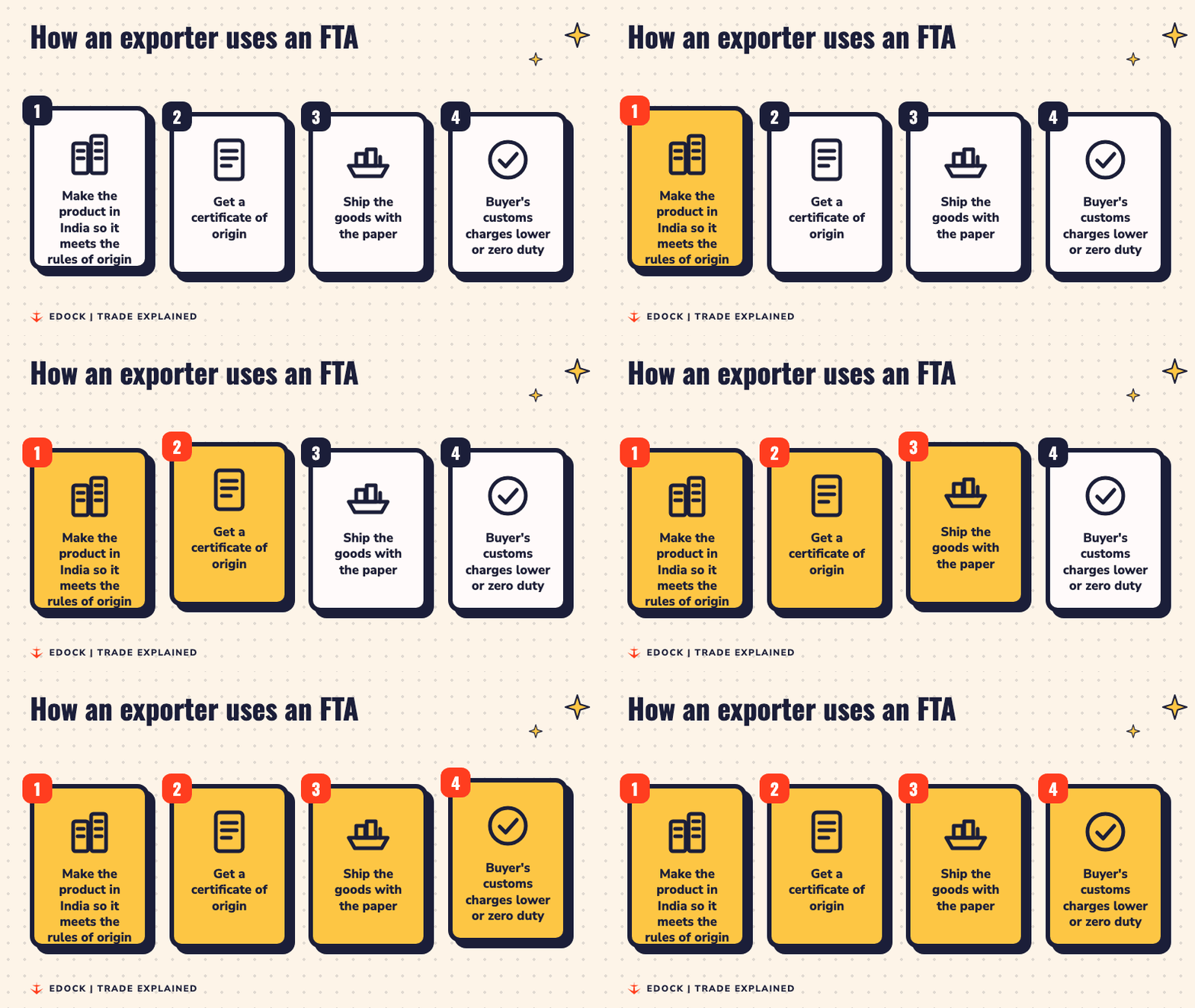
- Check the deal. The exporter finds the product's customs code and checks the duty in the buyer's country, with and without the FTA.
- Check the rule. The exporter reads the rule of origin for that code. In this made-up case, wood grown and carved in India is the easy kind. Goods made from imported parts need more care.
- Get the paper. The exporter applies for a certificate of origin, or makes an origin declaration where the deal allows it.
- Ship and claim. The paper travels with the goods. The buyer shows it at their customs and pays the lower duty.
Now the money. Say the elephant sells for Rs 10,000 and the normal duty in a partner country is 5%. Without the deal, the buyer pays Rs 500 extra at the border. With the deal and a valid certificate, that Rs 500 could be zero. On a container of a thousand pieces, it is Rs 5 lakh that the buyer saves, which makes Indian goods easier to pick over a rival's.
The stakes are real. India's handicraft exports in 2025-26 were $3.75 billion, according to the Export Promotion Council for Handicrafts.
So why don't all exporters use FTAs?
This is the surprising part. According to the think tank GTRI, only 20 to 30% of eligible Indian exports actually use FTA benefits. For goods shipped into India from partner countries, the figure is 60 to 70%. GTRI blamed high compliance costs (the time and money spent on paperwork and checks) and the fact that duties in many partner countries are already low, so the saving is not worth the effort for some small firms.
That gap is exactly what events like the one in Jaipur try to close. The sessions there covered export-ready products, tariff preferences, rules of origin, quality and certification, and ways to meet overseas buyers.
The bigger picture
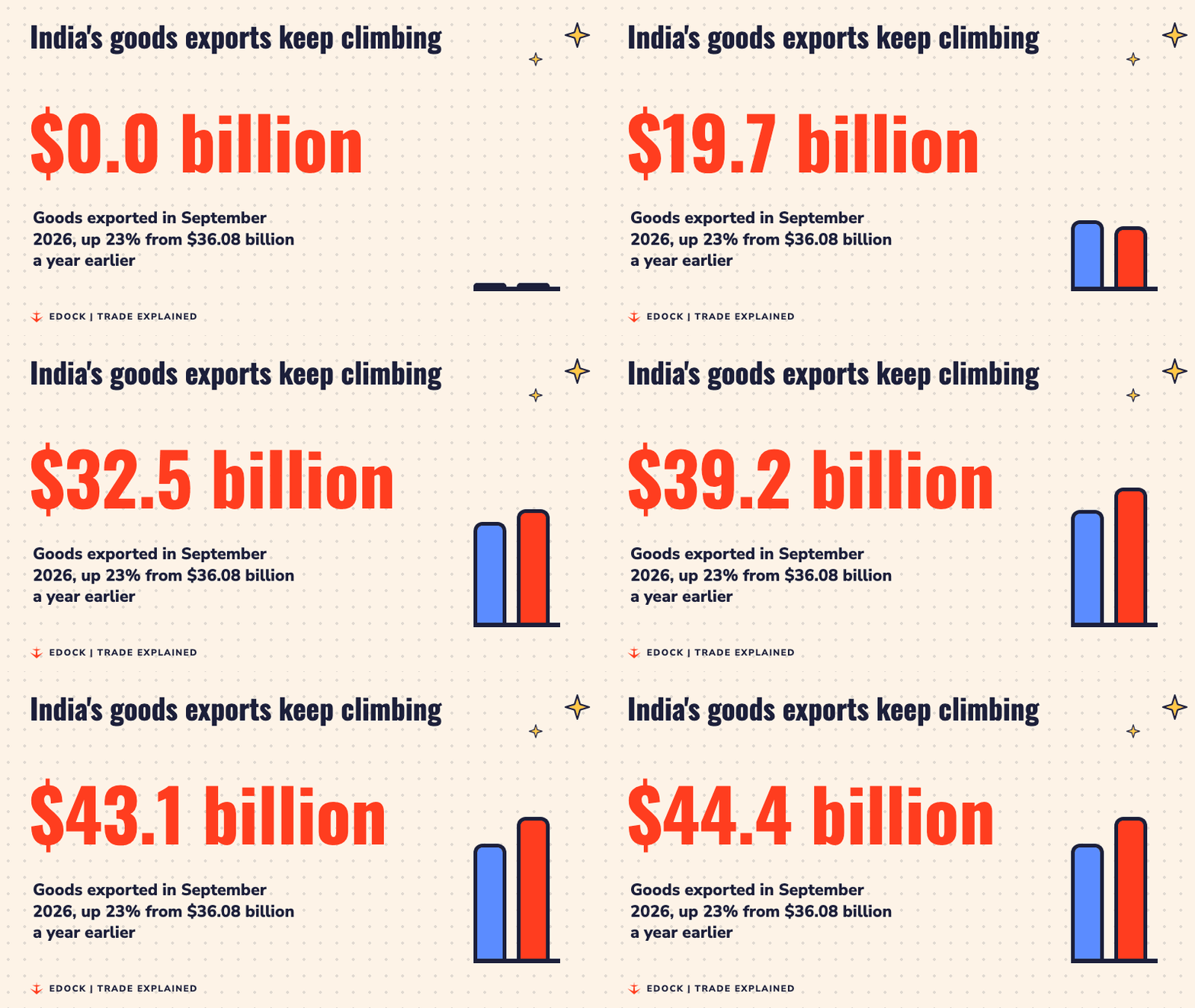
Exports are already rising. India's goods exports grew 23% to $44.4 billion in September 2026, up from $36.08 billion in September 2025. From April to September, goods exports rose 18.51% to $259.89 billion.
An FTA is a bit like a free pass to a cricket stadium. The pass is printed and ready. But it only helps if you pick it up, show it at the gate and walk in. For India's exporters, the certificate of origin is how they show that pass at the gate.
Sources
- The Economic Times: Commerce Ministry organises Leveraging FTAs outreach in Jaipur
- The Economic Times: India needs to leverage FTAs, says CII's Budhia
- BusinessLine: Indian exporters readying consignments for India and New Zealand FTA launch
- India Briefing: India and New Zealand FTA rules of origin
- World Trade Organization: Rules of origin, technical information
- KNN India: India's FTA utilisation at 20 to 30%, says GTRI
- The Economic Times: Rs 3,600 crore business enquiries at handicraft fair
- Cover photos: Jaipur-Edelsteinschleiferei-01-2018-gje, by Gerd Eichmann, CC BY 4.0; International Container Transshipment Terminal, Kochi, by BgbwikiV4, CC BY 4.0

