HCLTech opens two chip centres in Bengaluru and Hubli for Japan's Rapidus
Indian engineers will help plan the chips for Rapidus's 2 nm factory in Hokkaido. Here is what that work is, in simple words.

Picture this. A young engineer in Hubli, Karnataka, sits at a desk and draws the plan for a computer chip. A few weeks later, a factory thousands of kilometres away in snowy northern Japan uses that plan to make one of the smallest and most advanced chips in the world.
That is now real work in India. On Monday, 26 October 2026, Indian IT company HCLTech and Japanese chipmaker Rapidus announced a partnership and opened two development centres in Bengaluru and Hubli. Both centres will work only on Rapidus's chip engineering needs.
First, what is a chip?
A semiconductor chip is the tiny brain inside almost every gadget: your phone, your laptop, a car, even a washing machine. It is a small piece of silicon with billions of tiny switches on it. The switches turn on and off very fast, and that is how a gadget "thinks".
Making a chip has two big parts, and they are very different.
- Chip design is like a tailor's pattern. Someone has to decide exactly where every line and every cut goes.
- Chip making is like the factory that sews the clothes. It takes the pattern and turns it into real things, in huge numbers.
Rapidus is building the factory. HCLTech's new centres will help with the pattern side, so the factory has good plans to work with.
Who is Rapidus?
Rapidus is a young company. It was set up in August 2022 with the support of eight big Japanese companies, including Toyota, Sony, SoftBank and NEC. Its goal is to make chips using a "2 nanometre" process.
A nanometre is one billionth of a metre. The 2 nm process is a name for one of the newest and most advanced ways of making chips. Smaller parts mean more switches fit on one chip, a bit like fitting more shops into the same street by making each shop narrower.
Rapidus picked a site near New Chitose Airport in Hokkaido, Japan's northern island, for its factory. Test production on its pilot line began on 1 April 2025, and it showed its first 2 nm test chips in July 2025. It hopes to start mass production in late 2027.
What will the Indian engineers actually do?
The centres will offer five kinds of work. The names sound scary, but each one is simple underneath:
- Mask design. A mask is like a rangoli stencil. Light shines through it to print the chip's pattern onto silicon, layer by layer.
- Layout design. This is the floor plan of the chip: where each tiny part sits and how the wires connect, like planning rooms and corridors in a house.
- Process design kit development. A design kit is the factory's rulebook. It tells chip designers what the factory can and cannot make, like a bakery telling you the biggest cake its oven can fit.
- Design technology co-optimisation. Here the design team and the factory team adjust things together, like a tailor and a sewing unit tweaking a pattern so it is easier to stitch.
- Design infrastructure. The computer tools and setup that designers need every day.
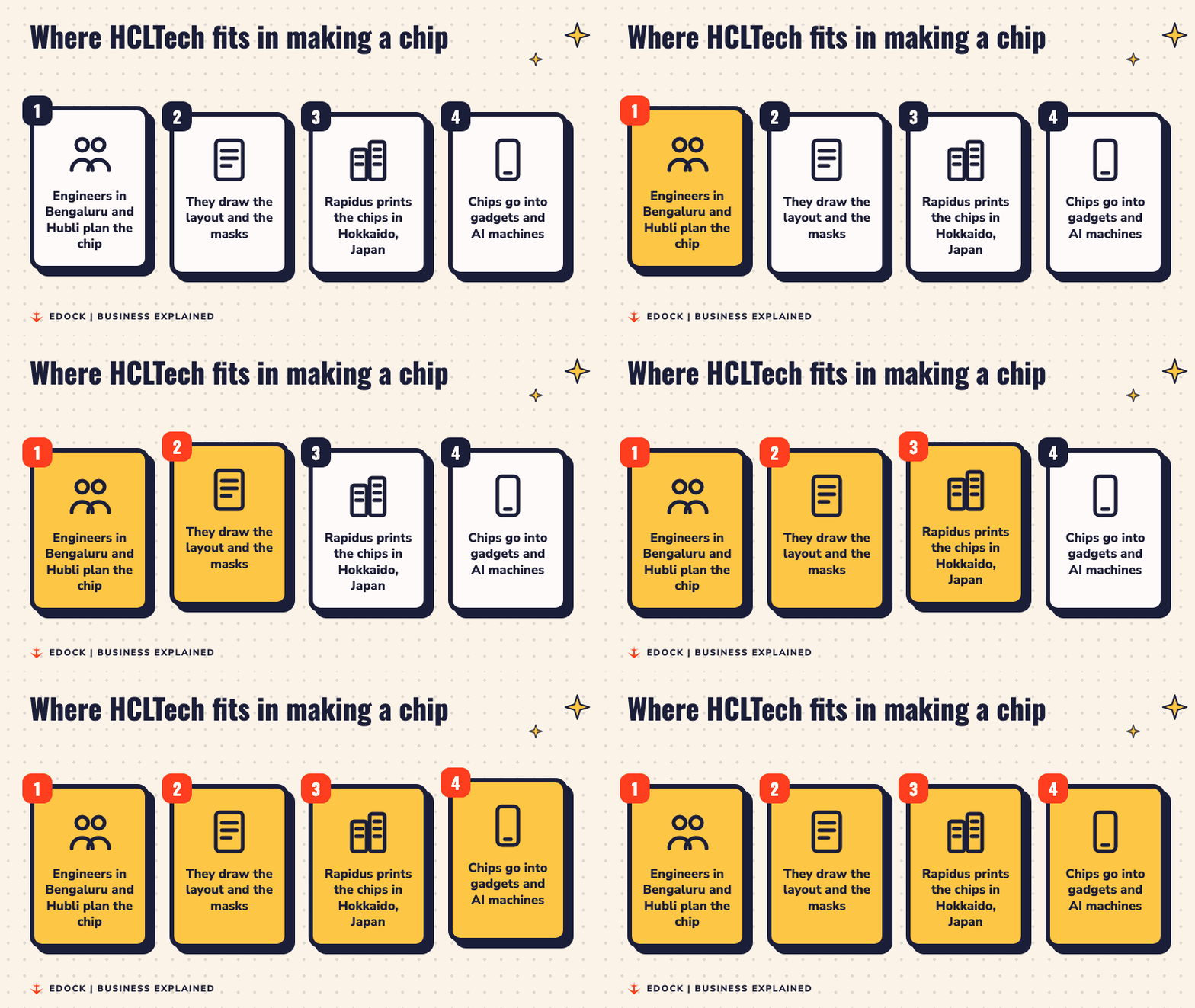
There is a second part too. HCLTech will help Rapidus build a pipeline of Indian engineering talent to meet the Japanese company's staff needs in Japan. In simple words, Indian engineers trained on this work could later be a source of people for Rapidus.
What the two bosses said
Rapidus CEO Atsuyoshi Koike said the tie-up will give his company access to India's growing pool of chip engineering talent. HCLTech CEO C Vijayakumar said, as quoted by BusinessLine, that "advanced semiconductors will define the technologies of the next decade."
Two things were not shared. The companies have not disclosed how much money the deal is worth or how many engineers will work at the two centres.
Why would a Japanese factory need Indian engineers?
A chip factory alone is not enough. Before a single chip is made, many design and checking tasks have to be done. As BW Businessworld points out, talk about chips often focuses on factories, but design and engineering work is just as needed to build advanced chips.
Think of a new cricket stadium. Building the ground is one job. But someone also has to plan the seats, the lights and the pitch, and check that everything fits. Rapidus is building the ground. HCLTech is helping with the planning.
HCLTech is hiring again
The news comes just after HCLTech grew its team. In the July to September 2026 quarter, it added 6,450 people on a net basis, its biggest quarterly addition in 16 quarters. Its headcount rose from 2,23,889 at the end of June to a record 2,30,339 on 30 September.
Quick check of the sum: 2,30,339 minus 2,23,889 is 6,450. It matches.

"Net basis" means people who joined minus people who left. If a class gains 10 new students and 4 leave, the net gain is 6.
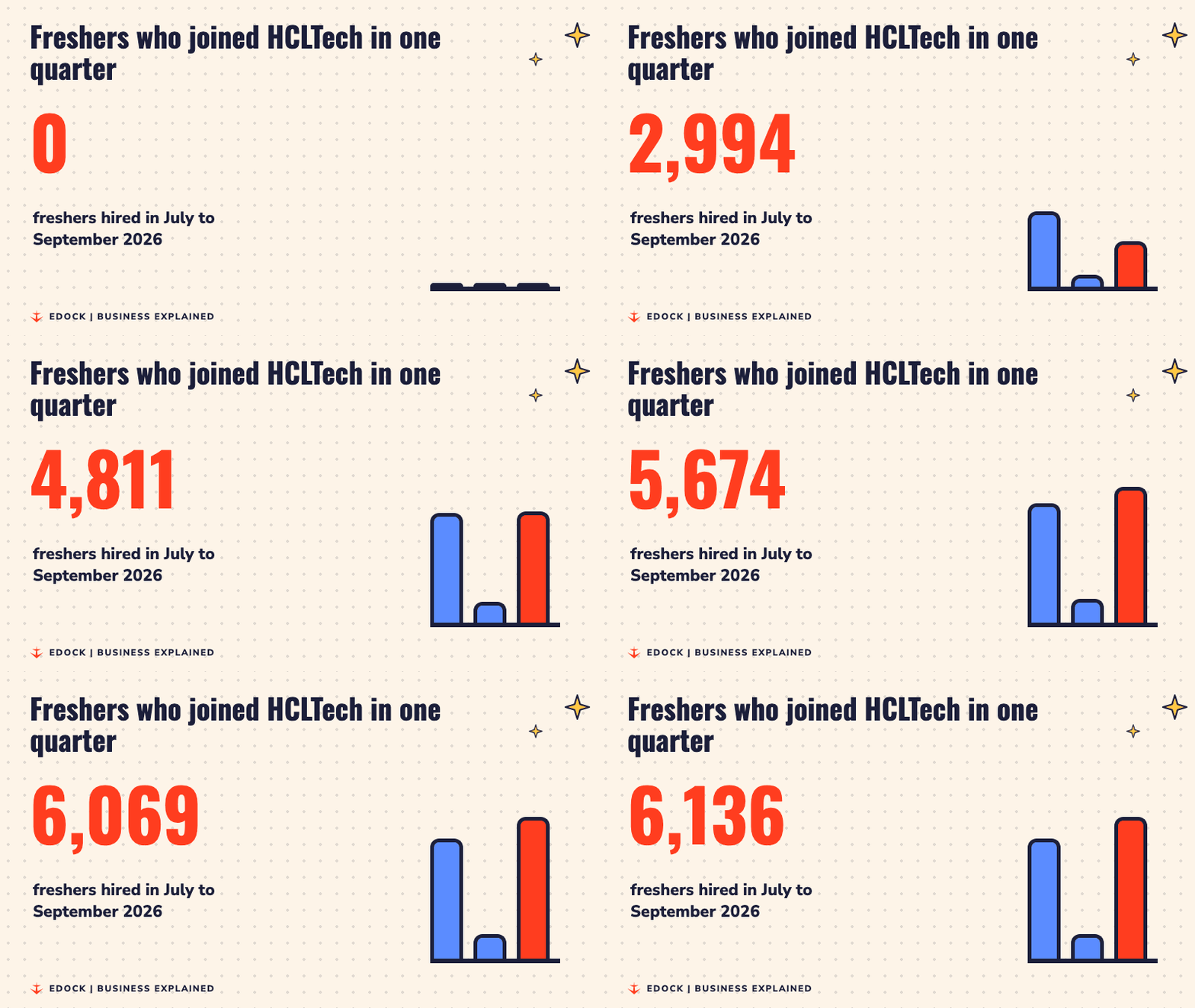
Most of the new joiners were fresh graduates. HCLTech hired 6,136 freshers in the quarter, compared with 1,056 in the previous quarter and 5,196 in the same quarter a year earlier. Its chief people officer said the company works with IITs and NITs to find engineering talent.
The Rapidus centres are a separate project, and the companies have not said how many of these new hires will work on it.
What this means for engineering students
This deal links Indian engineers directly to one of the newest chip factories being built in the world.
For a student in electronics, electrical or computer engineering, words like "mask design", "layout" and "process design kit" are worth learning now. They are the everyday language of chip work. Bengaluru is already a big tech city. Hubli getting one of the two centres shows that this kind of work is not only for metro cities.
The partnership also reflects growing tech ties between India and Japan.
The short version
- HCLTech and Rapidus opened two centres in Bengaluru and Hubli on 26 October 2026.
- The centres will do chip design support work: masks, layouts, design kits and more.
- Rapidus is building a 2 nm chip factory in Hokkaido and hopes to mass-produce from late 2027.
- The deal value and number of engineers were not shared.
Sources
- BusinessLine: HCLTech, Japan's Rapidus announce partnership
- Business Standard: HCL opens 2 development centres for Rapidus
- BW Businessworld: HCLTech, Rapidus set up centres in India
- Outlook Business: HCLTech opens two development centres
- ET Manufacturing: HCLTech partners with Japan's Rapidus
- Press release copy: Rapidus and HCLTech announce partnership
- BW People: HCLTech adds 6,450 employees in Q2
- BW People: HCLTech headcount crosses 2.3 lakh
- Wikipedia: Rapidus
- Wikipedia: 2 nm process
- Cover photo: HCL Technologies office in Sholinganallur, Chennai, by Raghukraman, CC0

You may republish this story under CC BY 4.0: credit Arshdeep Singh and link to this page.