Govt will pay the full certificate bill for micro and small exporters, says Goyal
Version 1 of 1 saved 23 Oct 2026, 8:58 pm IST · Chain line 179
As it was first published
Govt will pay the full certificate bill for micro and small exporters, says Goyal
Foreign buyers want costly test papers before they trust a product. Here is what the Export Promotion Mission now offers and who can claim it.
Picture a small workshop in Tiruppur or Moradabad. It makes good T-shirts or brass lamps. A shop in Germany wants to buy them. But first the German buyer asks for a stack of papers that prove the product is safe and clean. Each paper costs money, and for a tiny business that bill can hurt.
Now the government says it will pick up that bill. Commerce and Industry Minister Piyush Goyal said, speaking in Berlin on 22 October 2026, that the government will take care of the entire cost of "expensive" certification for micro and small exporters. The report was published on 23 October. The help comes under a scheme called the Export Promotion Mission, or EPM.
First, what is an export certificate?
Think of it like a school certificate. A new school will not just take your word that you passed Class 10. It wants to see the marksheet. In the same way, a foreign buyer does not just trust a factory it has never visited. It asks for proof from a testing lab or an inspector.
These papers can cover many things. Fortune India explains that exporters often spend heavily on product testing, inspection, international certificates, factory audits (a check of how the factory works) and systems that track where every part came from. Big companies can pay for all this easily. For small ones, it can eat up a big part of the money they make.
What exactly did Goyal say?
According to BusinessLine, the minister said the government is willing to support everybody who wants to export anywhere in the world. For micro and small businesses, he said, it is willing to take care of the entire cost of certification, if a certificate or process is very expensive.
He asked old and new exporters, in every product and sector, to go to the Directorate General of Foreign Trade (DGFT) for this support. The DGFT is the government office that looks after the rules for selling to and buying from other countries.
He also said the cost of meeting two European Union (EU) rules would be covered for micro and small businesses. Bigger businesses would get support on a graded basis, which means a smaller share as the business gets bigger.
What is the Export Promotion Mission?
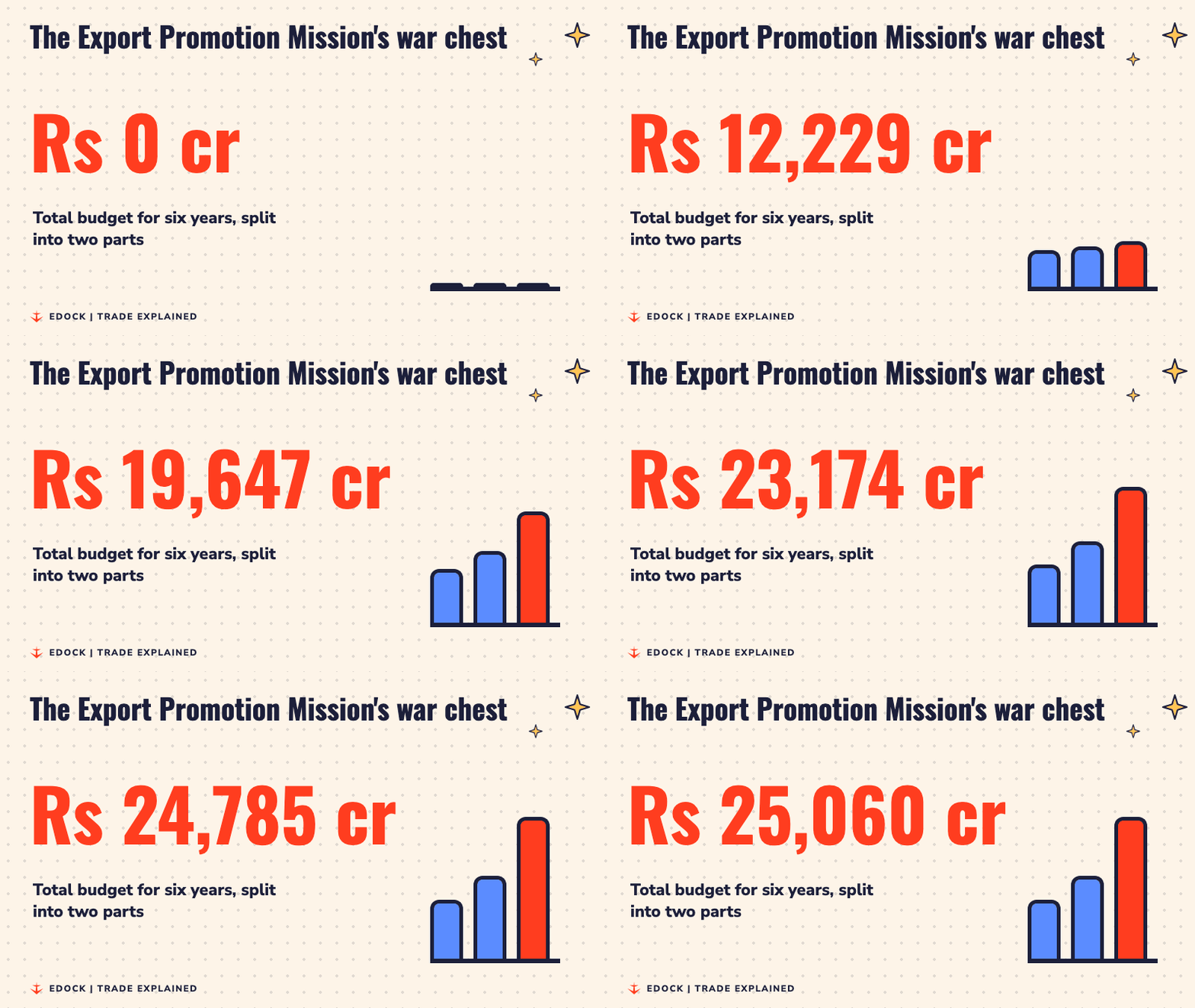
The EPM is a big government plan to help Indian businesses sell abroad. It was approved in November 2025 with a budget of Rs 25,060 crore for six financial years. It has two parts:
- Niryat Protsahan (Rs 10,401 crore): money help, like cheaper loans for exporters.
- Niryat Disha (Rs 14,659 crore): support for the rest of the export journey, like certificates, warehouses abroad and transport.
Add the two parts and you get Rs 25,060 crore. To picture that, imagine a cricket kit bag that holds money for six seasons, with one pocket for loans and a bigger pocket for everything else.
Meet TRACE, the part that pays for certificates
Inside Niryat Disha sits a smaller scheme with a long name: Trade Regulations, Accreditation and Compliance Enablement, or TRACE. Its job is to pay back part of what exporters spend on tests, inspections and certificates.
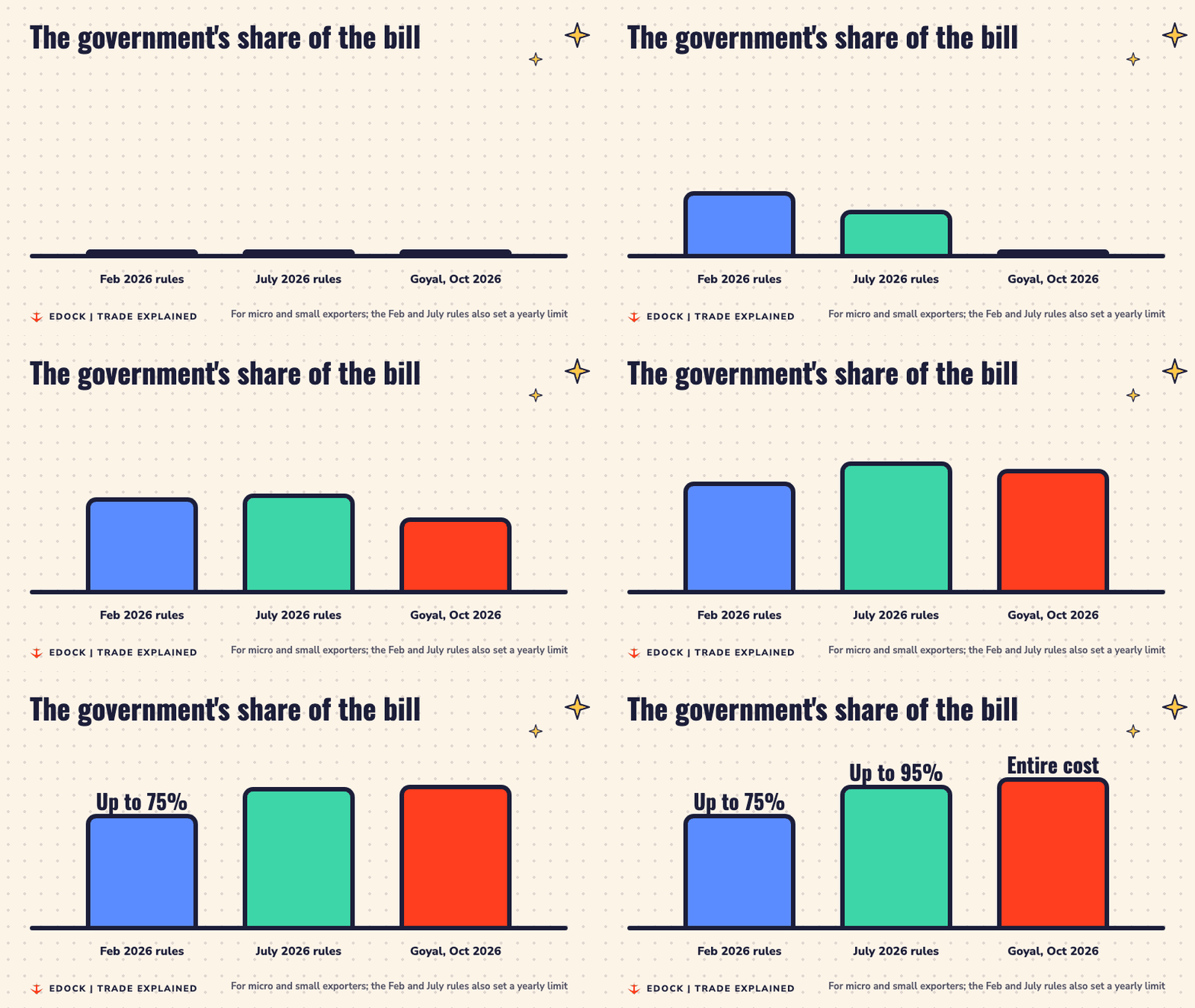
When the government launched TRACE in February 2026, it paid back 60% of eligible costs for certificates on a "Positive List" and 75% for those on a "Priority Positive List". The yearly limit was Rs 25 lakh for each exporter.
Then, on 1 July 2026, the DGFT issued new TRACE rules. Under these, MSMEs can get back up to 95% of certification costs, medium-sized firms up to 80%, and the limit rose to Rs 50 lakh for each exporter. Goyal's new promise goes one step further for micro and small firms: the entire cost.
Here is a simple example with made-up numbers. Say a certificate costs Rs 4 lakh. Paying back 75% means Rs 3 lakh comes back. Paying back 95% means Rs 3.8 lakh comes back. Paying the entire cost means all Rs 4 lakh comes back.
Who can claim it, and how?
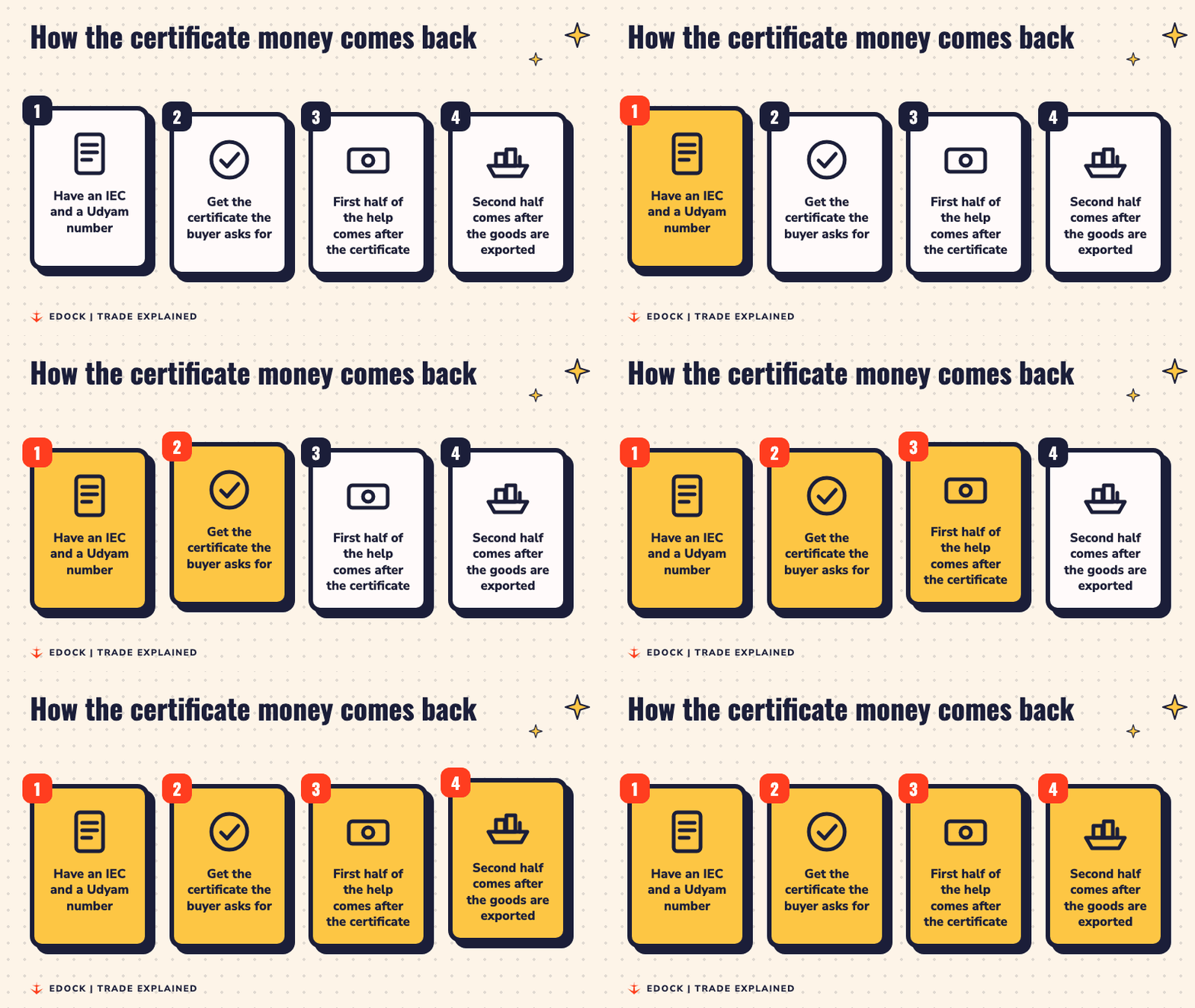
To use TRACE, an exporter needs two numbers, says BusinessLine: a valid Importer Exporter Code (IEC), which is the ID a business uses to trade with other countries, and a valid MSME Udyam Registration Number, which is the government's sign-up number for small businesses. MSME stands for micro, small and medium enterprises. A micro enterprise can be as small as a one-room workshop.
Under the July rules explained by Fortune India, the money comes back in two halves:
- The exporter gets the certificate and claims the first half. It must show the bill, proof of payment, and proof that the foreign market needed that certificate.
- After the goods covered by the certificate are exported, and the payment from the buyer has come in, the exporter claims the second half.
The money goes straight into the bank account linked to the IEC. There is a deadline too: the claim must come within two years of first telling the DGFT about it, or it lapses. It is a bit like a cashback offer that needs you to show the bill before a date.
Why Europe is a big reason
Small exporters have been worried about two EU rules, Moneycontrol reports:
- CBAM (Carbon Border Adjustment Mechanism): a charge on the carbon behind some imported goods, like cement, iron and steel, aluminium and fertilisers. Think of it as a pollution entry fee at Europe's door.
- EUDR (EU Deforestation Regulation): it wants proof that goods like coffee, cocoa, rubber, soy, palm oil, cattle and wood did not come from land where forests were recently cut. It starts on 30 December for big and medium firms and on 30 June 2027 for most micro and small firms.
Both rules need data, checks and certificates. Small firms with no big office staff find that hard and costly.
Europe matters a lot to Indian sellers. India's exports to EU countries were $72.4 billion in 2025-26, down 4.57% from the year before. The EU took about 17% of all goods India sold abroad that year. Goyal also said he hopes the India-EU trade deal will be signed by the end of this year.
What this could mean for young people
Many first-time exporters are small: a family pickle brand, a handloom group, a small leather unit. A lower certificate bill could make it easier for them to try a new country or a new product. Goyal said the aim is to encourage more people to go for new products and new markets, and to bring in new exporters.
A few things are still worth watching. The minister's words describe what the government is willing to do. The exact rules on which certificates count, and how much each firm gets, are set by the DGFT. Anyone who wants to use the scheme should check the latest DGFT notices before spending money on a certificate.
Sources
- BusinessLine: Govt to bear expensive certification costs for micro, small exporters under EPM
- Moneycontrol: Govt to bear MSMEs' certification costs for EU's CBAM, deforestation rules
- Fortune India: New TRACE rules explained
- PIB: Piyush Goyal launches Export Promotion Mission interventions
- Mint on YouTube: Piyush Goyal promises government support for all exporters
- Cover photo: Piyush Goyal at the Startup20 Summit in Gurugram, 2023, by Shariquejamalworld, CC BY-SA 4.0
