Foreign investors pull Rs 48,056 crore out of Indian shares in October
Foreign funds have now taken Rs 3.08 lakh crore out of Indian shares in 2026, almost double all of 2025. Here is what that means, in simple words.

Picture a crowd of rich visitors who come to your local market every year and buy a lot. Now picture them packing up and leaving with their bags of cash. That is roughly what happened in India's share market this month. On Sunday, 25 October 2026, depository data showed that foreign investors had pulled out Rs 48,056 crore from Indian shares in October so far.
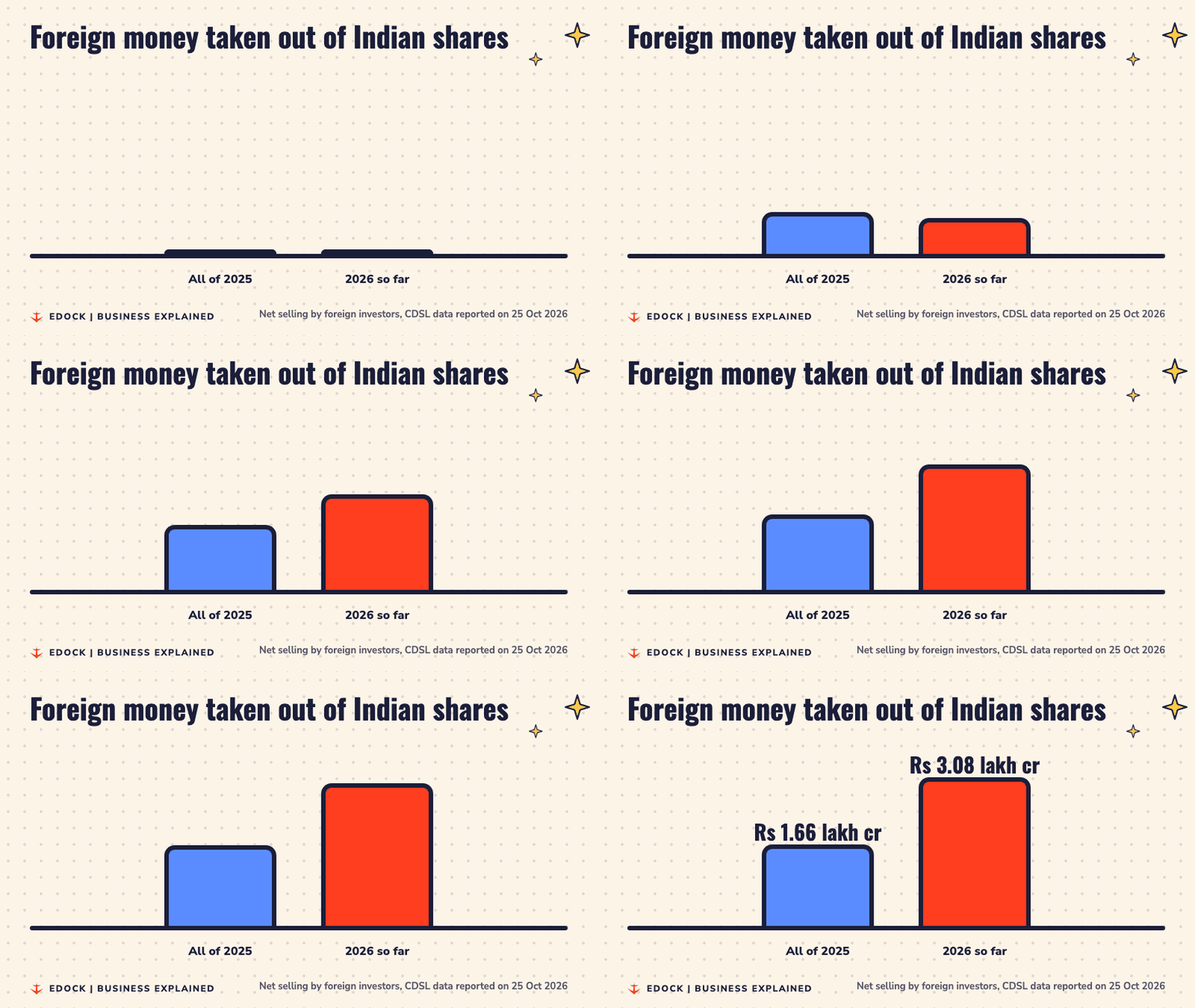
That came right after a Rs 35,861 crore pull-out in September. And across the whole of 2026, the total has reached Rs 3.08 lakh crore, far more than the Rs 1.66 lakh crore that left in all of 2025.
Big numbers. So who are these investors, why are they leaving, and why should a student or a first-jobber care? Let us break it down.
First, who is an FPI?
FPI stands for Foreign Portfolio Investor. Think of a big fund in the US, Europe or Singapore that collects money from many people and buys shares of Indian companies like Reliance, Infosys or HDFC Bank. A share is a tiny piece of a company. Buy one share and you own a small slice of it, like owning one slice of a big pizza.
The word "portfolio" just means a basket of investments. These investors do not build factories here. They buy and sell shares, often quickly, the way a shopper fills a cart and can empty it again tomorrow.
When news reports say FPIs "pulled out" money, they mean net selling. Net means what is left after you subtract one side from the other. If you sell 10 samosas and buy back 3, your net sale is 7.
How the Rs 48,056 crore adds up
According to News On AIR, foreign investors sold Rs 53,337 crore of shares on the stock exchanges in October so far. At the same time, they put Rs 5,281 crore into new share sales, called the primary market (this is where a company sells fresh shares, for example in an IPO, its first public share sale). Take Rs 5,281 crore away from Rs 53,337 crore and you get the Rs 48,056 crore net outflow.

The data comes from Central Depository Services Ltd (CDSL), as reported by The Times of India. A depository is like a digital locker that keeps a record of who owns which shares, so it can see money moving in and out.
From buyers to sellers in a few weeks
The mood changed fast. Foreign investors were actually buying in the middle of the year. They put in Rs 20,200 crore in July and Rs 29,631 crore in August. Then September and October flipped the story.

As Financial Express pointed out, October's selling is already about 34% bigger than September's full month, and October is not over yet.
Why are they leaving?
Experts quoted in the reports named a few reasons. None of these is a single big villain. It is more like several small pebbles in a shoe.
- Costly crude oil. Dheeraj Gaur of Choice Wealth said crude oil prices had surged to around $114 per barrel amid Middle East tensions. Costlier oil raises running costs for many Indian companies.
- Weak company earnings. Gaur also pointed to weak corporate earnings, inflation worries and uncertainty over how much spare cash is moving around in India's markets. Earnings are simply the profit a company makes.
- Future profits under pressure. Anand K Rathi, co-founder of MIRA Money, said second-quarter results were fairly strong, but higher oil and logistics costs could weigh on profit growth in coming quarters.
- The US looks attractive. Rathi added that high US interest rates have kept American assets attractive. When money earns good interest in the US, many investors are happy to keep it there.
Why it touches the rupee and the Sensex
The Sensex and Nifty are scoreboards for the share market. Each tracks a group of big companies, like a team score built from the runs of its best players. When many people sell shares at once, prices tend to slip and the scoreboard can fall.
The rupee link is simple too. A foreign fund that sells Indian shares gets rupees. To take the money home, it swaps those rupees for dollars. More people wanting dollars is like more people wanting the last samosa at the stall: the dollar's price goes up and the rupee can weaken. When foreign money comes back in, the opposite can happen.
A small breather last week
There was some relief. In the week that ended on 23 October, foreign investors turned net buyers on two trading days.
V K Vijayakumar of Geojit Investments linked this to a fall in US bond yields. A bond is a loan you give to a government or company, and the yield is the interest it pays you. The US 10-year yield eased from 5.36% to around 5%. He also pointed to the rupee strengthening to 94.94 against the US dollar and to large company shares looking more reasonably priced.
Financial Express added a fair note of caution: two days of buying do not prove that the trend has turned.
Who is catching the falling money?
Indian investors are. Rathi said steady money from domestic institutional investors (Indian mutual funds, insurers and similar big players) and from SIPs has helped cushion the selling. An SIP, or systematic investment plan, is when people put a fixed amount into a mutual fund every month, like a monthly piggy bank top-up from a salary.
Vedant Gupte, co-founder and CEO of the investment platform Trackk, said the outflows look less alarming because foreign ownership of Indian shares was already at multi-year lows and Indian investors now hold a bigger share of the market. He added that continued foreign buying in IPOs suggests some of the selling could be a rotation out of existing holdings rather than a loss of confidence in India. Rotation is like a cricket captain changing bowlers: the team stays, but the players on the field change.
What experts are watching next
Pabitro Mukherjee of Bajaj Broking said market watchers will track the US Federal Reserve's policy meeting, the Bank of Japan's interest rate decision and US GDP data in the coming week, along with Brent crude prices, world conflicts and the results season. GDP is the total value of everything a country produces in a year, a kind of national report card.
Why this matters to you
Even if you have never bought a share, foreign money flows reach your life. A weaker rupee can make imported phones, laptops and foreign trips costlier. Oil prices feed into bus fares and delivery charges. And if you start a monthly SIP from your first salary, you become part of the Indian money that is now balancing out foreign selling.
This post explains the news. It is not advice to buy or sell anything.
Sources
- The Times of India: Foreign investors withdraw Rs 48,056 crore in October as market selling continues
- Financial Express: FPIs withdraw Rs 48,056 crore from equities in Oct; 2026 outflows hit Rs 3.08 lakh crore
- Free Press Journal: FPIs pull out Rs 48,056 crore from Indian equities in October
- News On AIR: FPIs withdraw Rs 48,056 crore from Indian equities in October so far
- Cover photo: National Stock Exchange building at BKC, Mumbai, by 312user, CC BY-SA 4.0

You may republish this story under CC BY 4.0: credit Manpreet Kaur and link to this page.