Elon Musk says SpaceX borrowed $40 billion for AI chips. Here is why it matters
Musk says lenders trust SpaceX because of Starlink and rocket income, while smaller AI cloud firms are finding it hard to borrow.

Picture borrowing so much money that it could buy 40 billion dollars of computer chips. Not in rupees. In dollars. That is the size of the loan Elon Musk says his rocket company SpaceX has just locked in. Musk said it in posts on X, the social media app he owns, and Bloomberg Television reported it on 26 October 2026.
The money is meant for one thing: special chips called GPUs that power artificial intelligence. Here is what happened, what the big words mean, and why the rest of the AI world is nervous.
What did Musk actually say?
Musk was replying to a post by investor Chamath Palihapitiya about AI computing power, Mint reported. In his reply, Musk wrote:
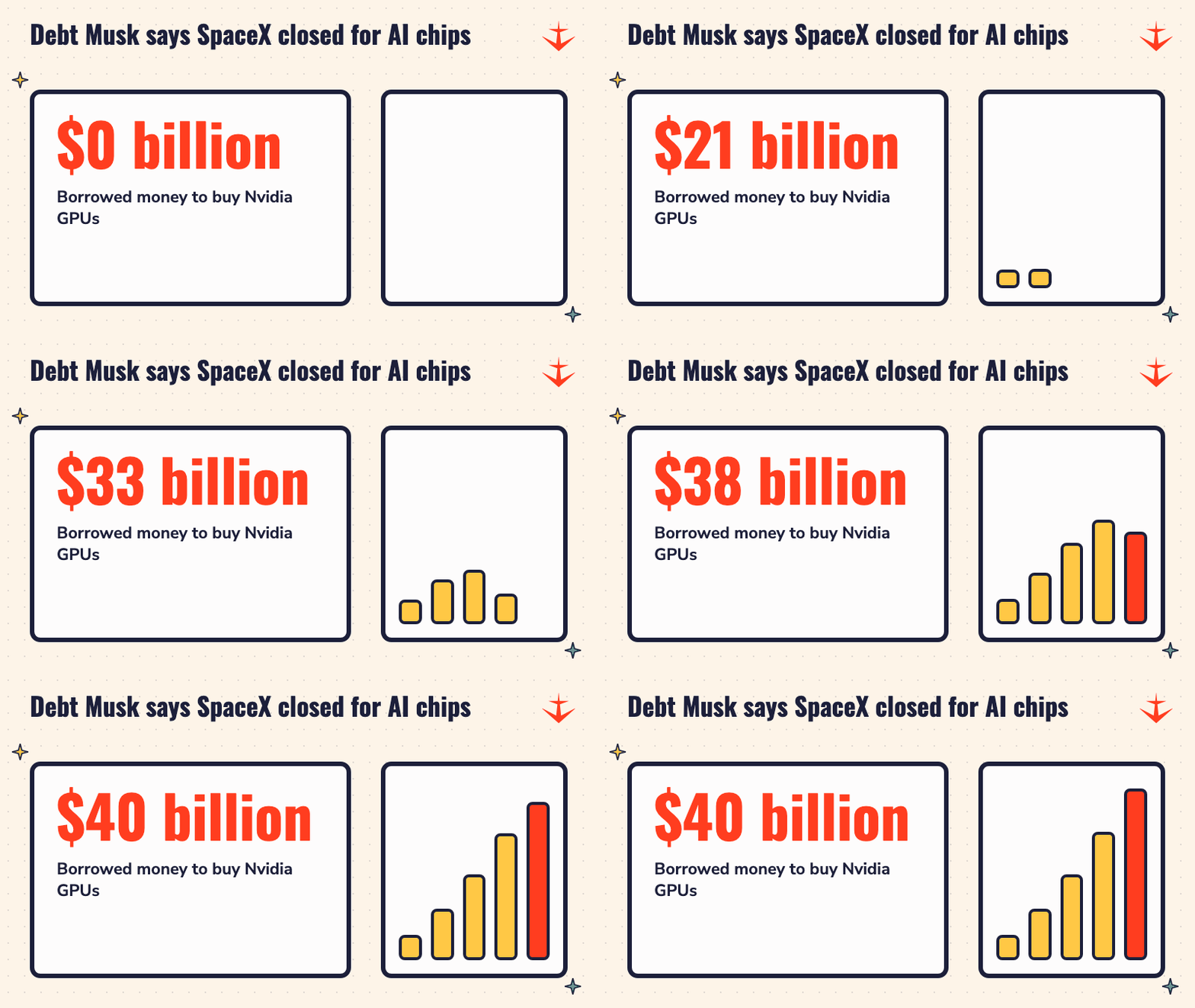
"SpaceX closed $40B of debt for GPUs, but we're investment grade and have Starlink & launch revenue."
He also said that, in the past few weeks, lenders have almost stopped giving money to companies that earn nothing apart from AI data centres. He later said SpaceX will not buy any of these smaller firms, calling the idea "pointless", according to Mint.
Wait, is the deal fully done?
Here is the careful part. The $40 billion "closed" is what Musk said. Bloomberg, quoted by Mint, reported that the people involved were still talking about the final pricing as of Sunday. Pricing means the interest rate SpaceX will pay, which is the cost of borrowing.
Think of it like booking a wedding hall. You have shaken hands and the date is fixed, but the final bill is still being worked out. Bloomberg Television also covered this gap between Musk's post and the pricing talks in the video below.
The big words, made simple
Debt. Debt is borrowed money that must be paid back, usually with extra money on top called interest. If a friend lends you Rs 100 for a samosa party and you return Rs 110 next month, the Rs 10 is the interest.
Investment grade. Rating agencies give companies a kind of report card for paying back loans. "Investment grade" means a good score: lenders think the company is very likely to repay. It is like the friend in your group who always returns borrowed money on time. Everyone happily lends to that friend.
GPU. A GPU, or graphics processing unit, is a chip that can do many small calculations at the same time. That makes it the engine behind AI chatbots. The GPUs in this deal come from Nvidia, the best known maker of AI chips.
Neocloud. A neocloud is a newer company that fills big buildings with GPUs and rents that computing power to tech companies, the way a cyber cafe rents out computers by the hour. Mint says these firms have faced heavy questions over the past two weeks about how much they have borrowed and whether demand will last.
Why can SpaceX borrow when others cannot?
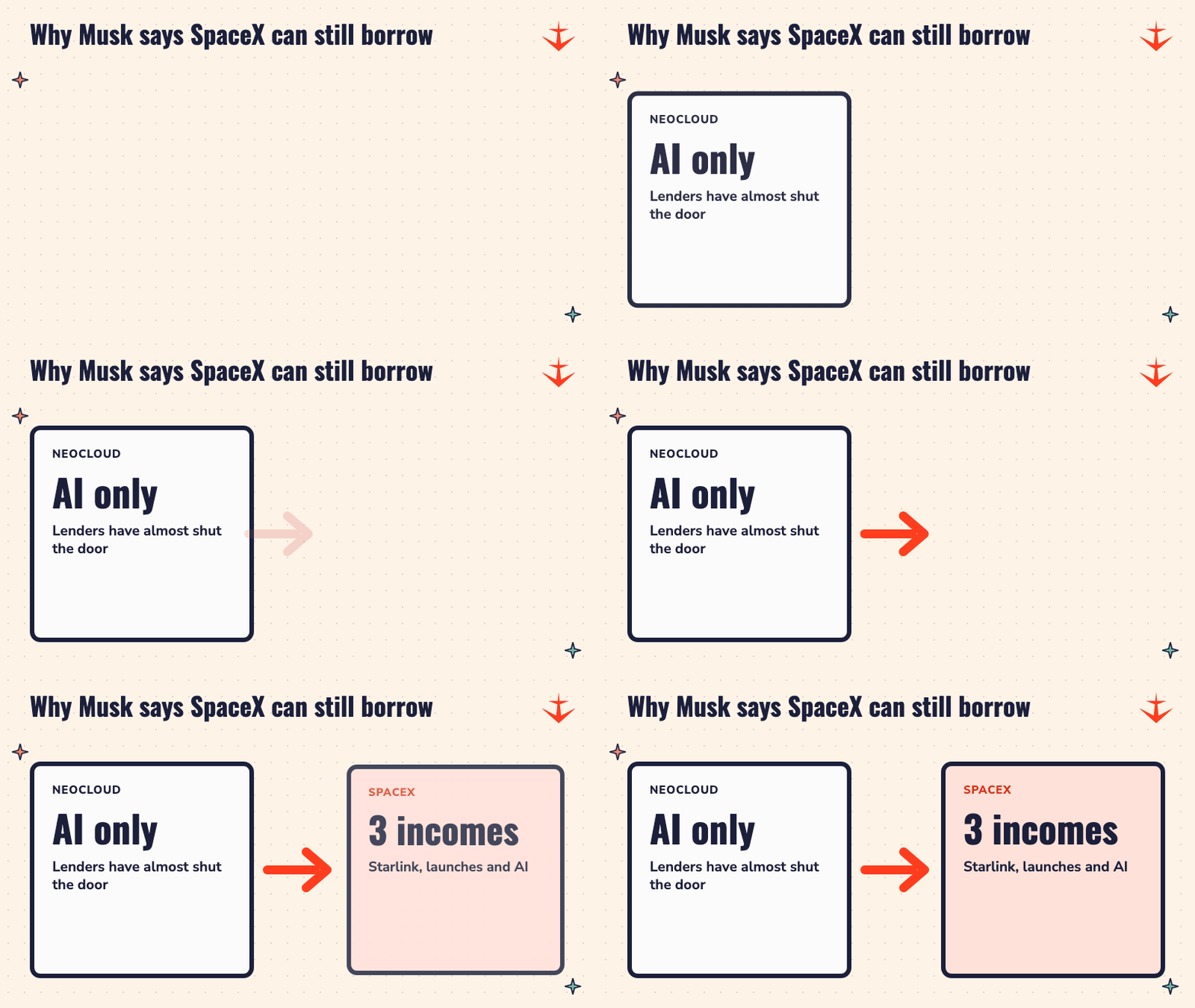
Musk's answer is simple: SpaceX has other ways to earn. Wikipedia lists three parts of the company. Space, which flies Falcon 9 rockets and the Dragon spacecraft. Connectivity, which runs Starlink, the satellite internet service. And AI, which makes the Grok chatbot and runs large data centres. SpaceX earned US$18.7 billion in revenue in 2025, says Wikipedia.
Compare a samosa stall that also sells chai and cold drinks with a stall that sells only one new snack. If the new snack stops selling, the first stall still has chai money. Lenders feel safer with the first one.
Musk did not hold back on what he thinks comes next for the others. He wrote that "the 200+ neoclouds are going to see guppy-level death and consolidation", Mint reported. Consolidation means many small firms shutting down or merging into a few big ones. That is his view, not a fact yet.
Who is lending, and how?
According to Bloomberg, as reported by Mint:
- Bankers led by Goldman Sachs had been discussing the structure with investors led by Apollo Global Management.
- Atlas SP, which is backed by Apollo, was set to manage the entity that holds the deal.
- Another large bond manager had also thought about investing.
- The debt was expected to be sold as private placements, which means it is sold to a small group of big investors, not to the public.
The deal is "off balance sheet". A balance sheet is a company's list of what it owns and what it owes. Off balance sheet means the loan sits in a separate entity, so it does not show up directly as SpaceX's own debt. It is like a friend's name on the bike loan even though you ride the bike every day.
There is history here. A similar attempt last year by Musk's AI startup xAI went wrong. SpaceX finally had to record about $13 billion of that debt on its own books, Mint said.
How the plan looked in early October
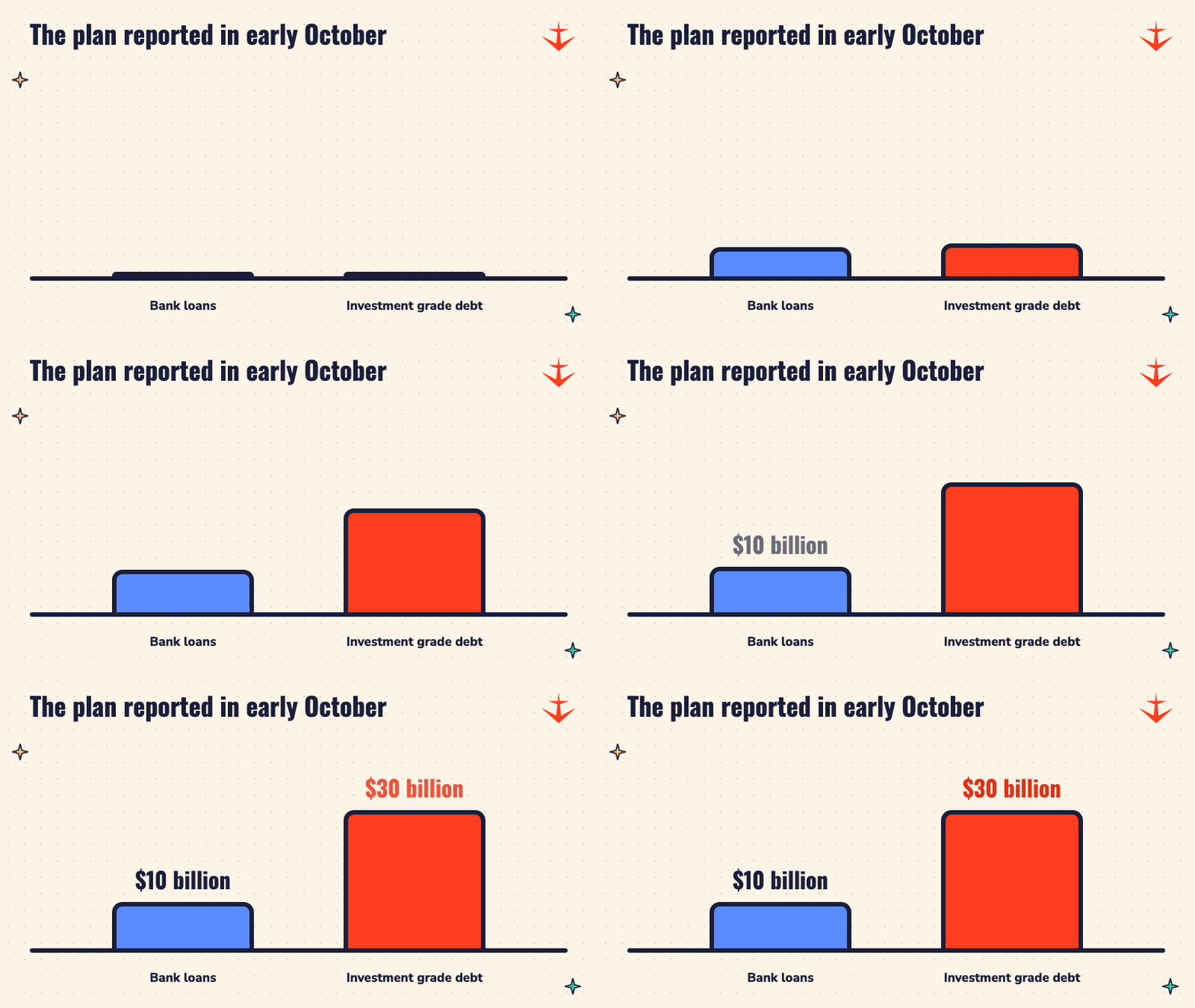
This did not come out of nowhere. On 6 October, the Financial Times reported that SpaceX wanted to raise $40 billion for Nvidia chips, investingLive summarised. The plan then was about $10 billion in bank loans and $30 billion in investment grade debt, with Apollo expected to lead. At that time, the deal was expected to close in 2027.
The same report said SpaceX went public in June in a record share sale of around $86 billion, and that it rents out computing power from its Colossus data centres to other AI developers, mainly Anthropic and Google. Morgan Stanley estimates AI infrastructure will need $1.5 trillion of outside money by 2028, the report added.
What did SpaceX's money chief say?
The debt comes after strong results for July to September, when SpaceX's AI unit made a profit for the first time, Mint reported. On the results call, Chief Financial Officer Bret Johnsen said the company was talking to lenders about more borrowing. He said, "We have a lot of conviction that we are going to be able to do this in a very measured fashion and continue to keep ourselves in that IG status along the way." IG is short for investment grade.
Is there an India link?
Starlink, one of the incomes Musk is leaning on, has not started in India yet. It is still waiting for final security clearance, Khaleej Times reported on 11 October. Musk said then that Starlink would need affordable prices in India, because "if Starlink is too expensive in India, no one will buy it".
For a young reader, the bigger lesson is simple. In the AI race, the winner is not only the one with the smartest chatbot. It is also the one that lenders trust enough to hand over billions. Curious how Starlink itself works? This video explains it.
Sources
- Mint: Elon Musk says SpaceX closed $40 billion debt deal for AI chips
- Bloomberg Television: Musk says $40 billion debt deal for AI chips has closed
- investingLive: SpaceX seeks $40 billion in debt led by Apollo, FT says
- Wikipedia: SpaceX
- Khaleej Times: Musk vows affordable Starlink in India
- Branch Education: How does Starlink satellite internet work?
- Cover photo: Elon Musk at the AI Safety Summit, Bletchley Park, 2023, by UK Government, CC BY 2.0

You may republish this story under CC BY 4.0: credit Arshdeep Singh and link to this page.