E2E Networks swings to a Rs 73 crore profit by renting out AI computers
Version 1 of 1 saved 16 Oct 2026, 7:07 pm IST · Chain line 38
As it was first published
E2E Networks swings to a Rs 73 crore profit by renting out AI computers
The Indian GPU cloud company's sales grew about five times in a year. Here is what a GPU is, and why renting one is now big money.
Picture a shop that lost money a year ago. Now, over the last three months, it earned about ₹79 lakh of profit a day, on average. That shop is E2E Networks, an Indian company that rents out powerful computers for AI. On 16 October 2026, it reported a net profit of ₹72.7 crore for July to September 2026, against a loss of ₹13.5 crore in the same three months a year earlier.
Its sales grew too. Revenue jumped 411% to ₹223.8 crore, from ₹43.8 crore a year ago, according to Inc42. That is more than five times bigger in one year. (₹72.7 crore spread over the 92 days of the quarter gives the ₹79 lakh a day figure.)
So what does E2E actually sell, and why is it suddenly making so much money? Let us break it down.
First, what is a GPU?
Every computer has a brain called a CPU. Think of a CPU as one very clever teacher who solves maths questions one after another, very fast.
A GPU (graphics processing unit) works differently. Think of it as a whole classroom of students, each doing one small sum at the same time. GPUs were first made to draw video game pictures, where millions of tiny dots on the screen must be coloured at once.
AI needs the same trick. To teach an AI model, a computer has to do billions of small sums again and again. A classroom of students beats one teacher at that job. That is why GPUs have become the most wanted machines in tech.
E2E offers some of the most powerful ones made by NVIDIA, including the B200, H200 and H100. Companies use them for training, fine tuning and running AI models.
Why rent a computer instead of buying one?
Top AI GPUs are very costly, and you need hundreds or thousands of them working together. Most startups cannot buy that many. Even big firms may need them only for a few weeks.
So they rent. It is like renting a cricket kit for a weekend tournament instead of buying a full kit you will barely use. This is called cloud computing: you use someone else's computers over the internet and pay only for what you use. E2E runs these machines from data centres in Noida and Chennai, and customers log in from anywhere.

How did a loss turn into a big profit?
The secret is that most costs did not grow as fast as sales. Revenue grew about five times. But total expenses rose 93.4%, from ₹70.6 crore to ₹136.6 crore, so they did not even double.
Think of a samosa stall. The stall, the stove and the helper cost about the same whether you sell 50 samosas or 500. Once more customers show up, most of the extra money is profit. E2E is in a similar spot: once its GPUs are bought and switched on, every extra hour someone rents them adds a lot to the bottom line.
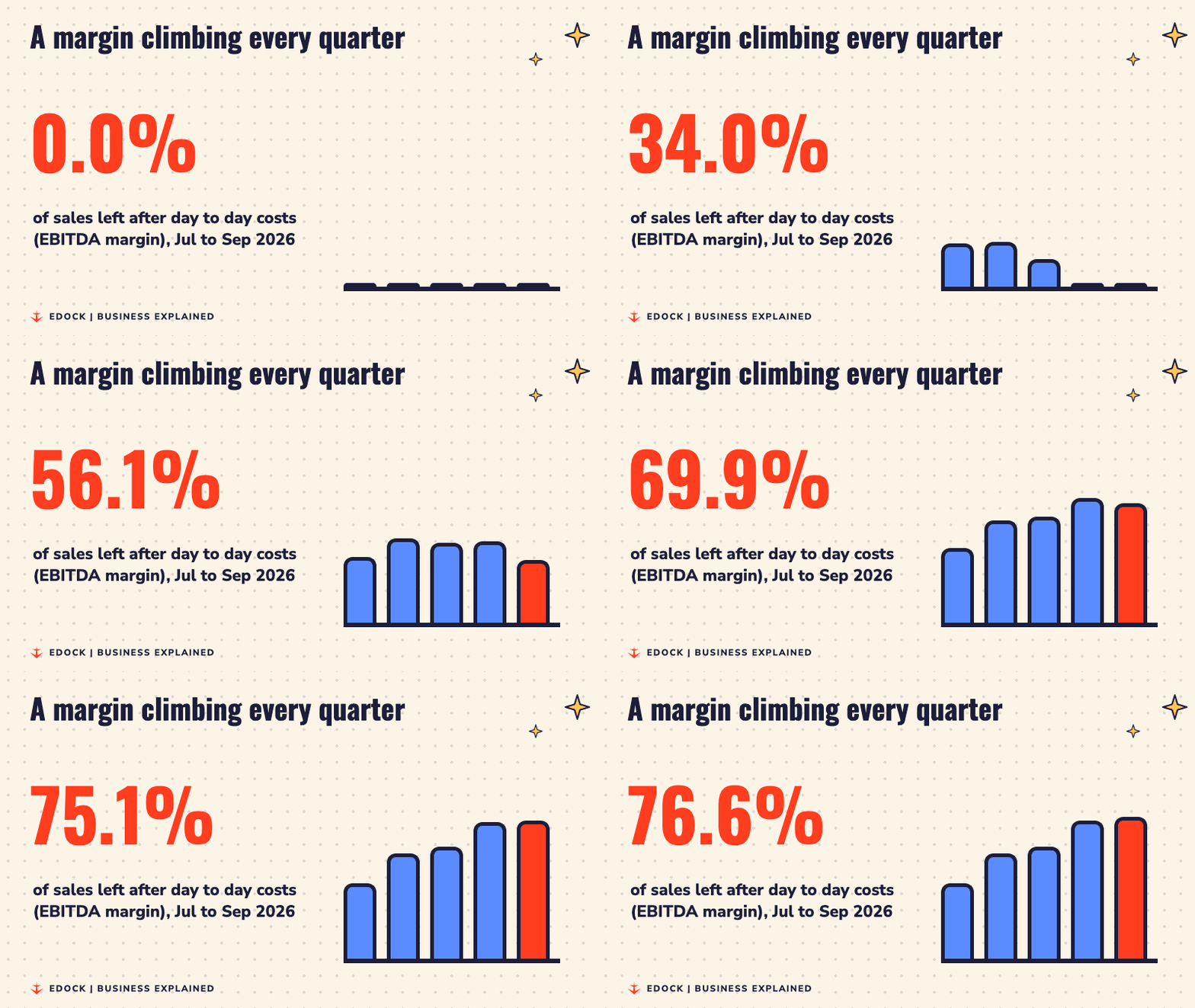
Here is one business word that shows this. EBITDA is the money left after day to day costs, before paying interest, tax and the cost of machines wearing out. E2E's investor slides put its EBITDA margin at 76.6% for the quarter. In simple words, out of every ₹100 of sales, about ₹76.60 was left after running costs.
More GPUs, more customers
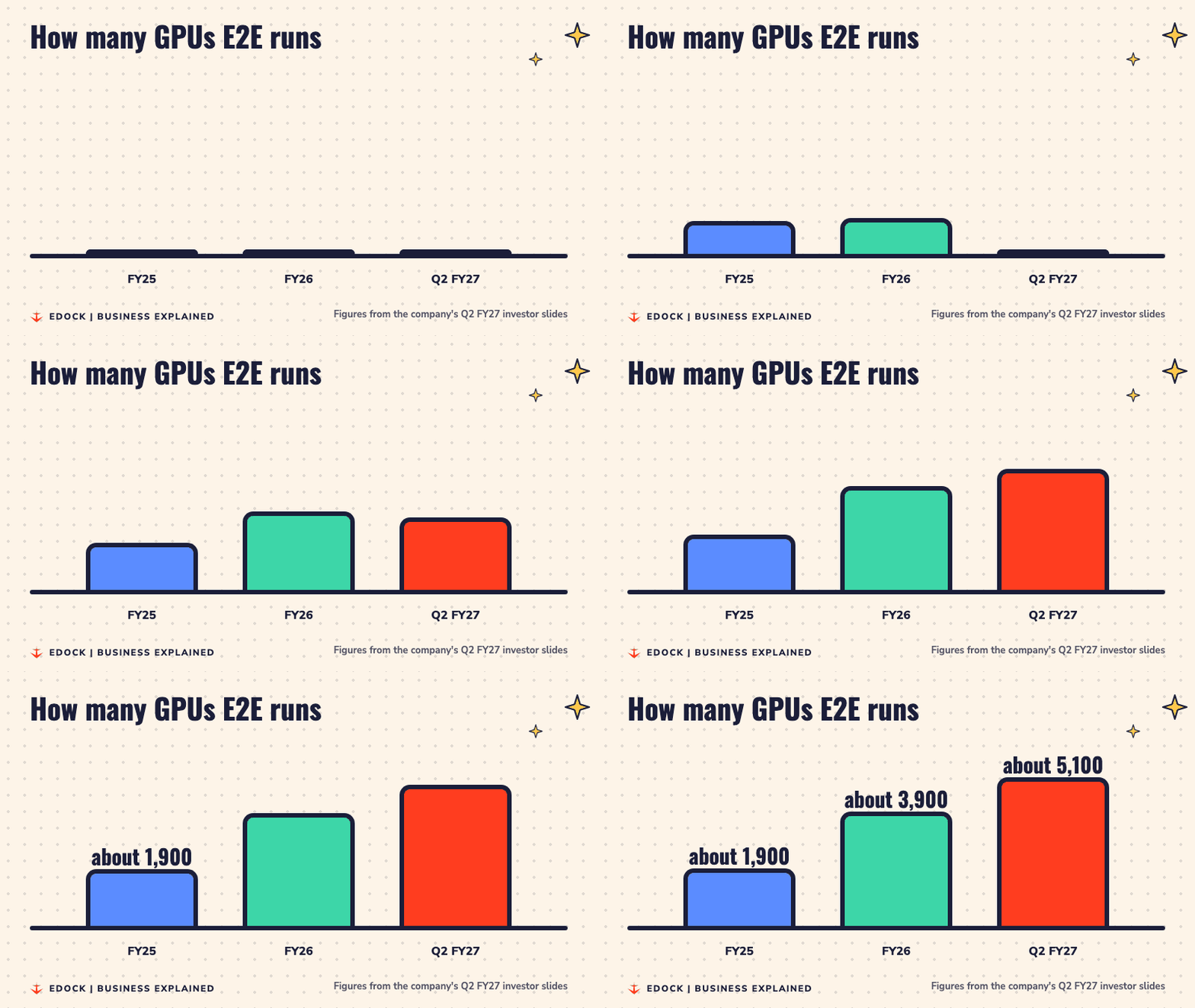
E2E has been buying machines fast. Its slides show about 1,900 GPUs in FY25, 3,900 in FY26 and about 5,100 now. (FY means financial year. In India, FY26 ran from April 2025 to March 2026.)
The big new arrival was a cluster of 1,024 NVIDIA B200 GPUs. A cluster is a group of GPUs joined together so they work like one giant machine. In its July results, the company said the B200 cluster went live and started earning within its first quarter.
The ₹1,000 crore deal
On 31 August 2026, E2E told the stock exchanges it had signed a binding term sheet worth about ₹1,000 crore with an Indian "sovereign AI" company. A sovereign AI company builds AI inside the country, for the country. The customer's name was not shared. The deal runs until June 2029.
Before this, the NVIDIA Blackwell machines that E2E switched on at the end of May 2026 were rented on a pay as you go basis, like a metered auto ride where you pay only for the distance you travel. The new deal turns that into a long booking, more like a monthly pass.
E2E's Chief Financial Officer, Nitin Jain, said in the company's statement that the deal "provides greater revenue visibility over a multi-year horizon". Revenue visibility simply means being able to see future income in advance, the way a tuition teacher with a full year of fees paid knows next month's earnings.
Monthly income is rising too
Many cloud companies track monthly recurring revenue, or MRR. It is the income that comes in again and again every month, like the money a milkman collects from the same homes every month. E2E's MRR reached ₹751 million (₹75.1 crore) in September 2026, up from ₹718 million in June 2026. Four years earlier, in September 2022, it was just ₹56 million.
Is it all good news?
Not quite. Big machines bring big bills. GPUs lose value as newer, faster models arrive, just like last year's phone. Accountants spread that loss over time and call it depreciation. For this quarter, E2E's depreciation was ₹740 million, or ₹74 crore.
The company is also borrowing more. Its total borrowings rose to ₹4,504 million in September 2026, from ₹1,032 million in March 2026, the same slides show. Borrowed money has to be paid back with interest, whether the GPUs stay busy or not.
And NVIDIA keeps launching new chips. E2E's slides say another 1,024 or more B200 GPUs are being set up for the coming quarters, and that it is planning for newer NVIDIA designs called B300 and Vera Rubin, with no timelines given. Staying on the latest machines means spending again and again.
Why should a student care?
Every time you chat with an AI app, some GPU somewhere does the work. E2E's numbers show an Indian company can also earn well by renting this power to Indian startups and AI builders.
Its Managing Director, Tarun Dua, linked the August deal to how "India's requirements for AI compute continue to scale", in the same exchange filing. If that demand keeps growing, renting GPUs could become one of the quiet money makers behind India's AI boom.
Sources
- Inc42: E2E Networks swings to ₹73 Cr profit in Q2, revenue jumps 411% YoY
- Investing.com: E2E Networks Q2 FY27 slides, revenue surges 411% on GPU expansion
- NSE filing: E2E Networks signs binding term sheet worth about Rs 1,000 crore with sovereign AI company (31 August 2026)
- NSE filing: E2E Networks reports Q1 FY27 results (21 July 2026)
- YouTube: E2E Networks Earnings Call for Q2FY27 (Trendlyne); Becoming the AI power grid for the world, E2E (Blume Ventures podcast)
- Cover photos: Datacenter Server Racks, by Carl Lender, CC BY 2.0; Rear of rack at NERSC data center, closeup, by Derrick Coetzee, CC0

